From Superheroes to Personal Mythology: How a Friday Afternoon Sent My Therapist Brain Down a…
Or; Holy Brain Twister, Batman!
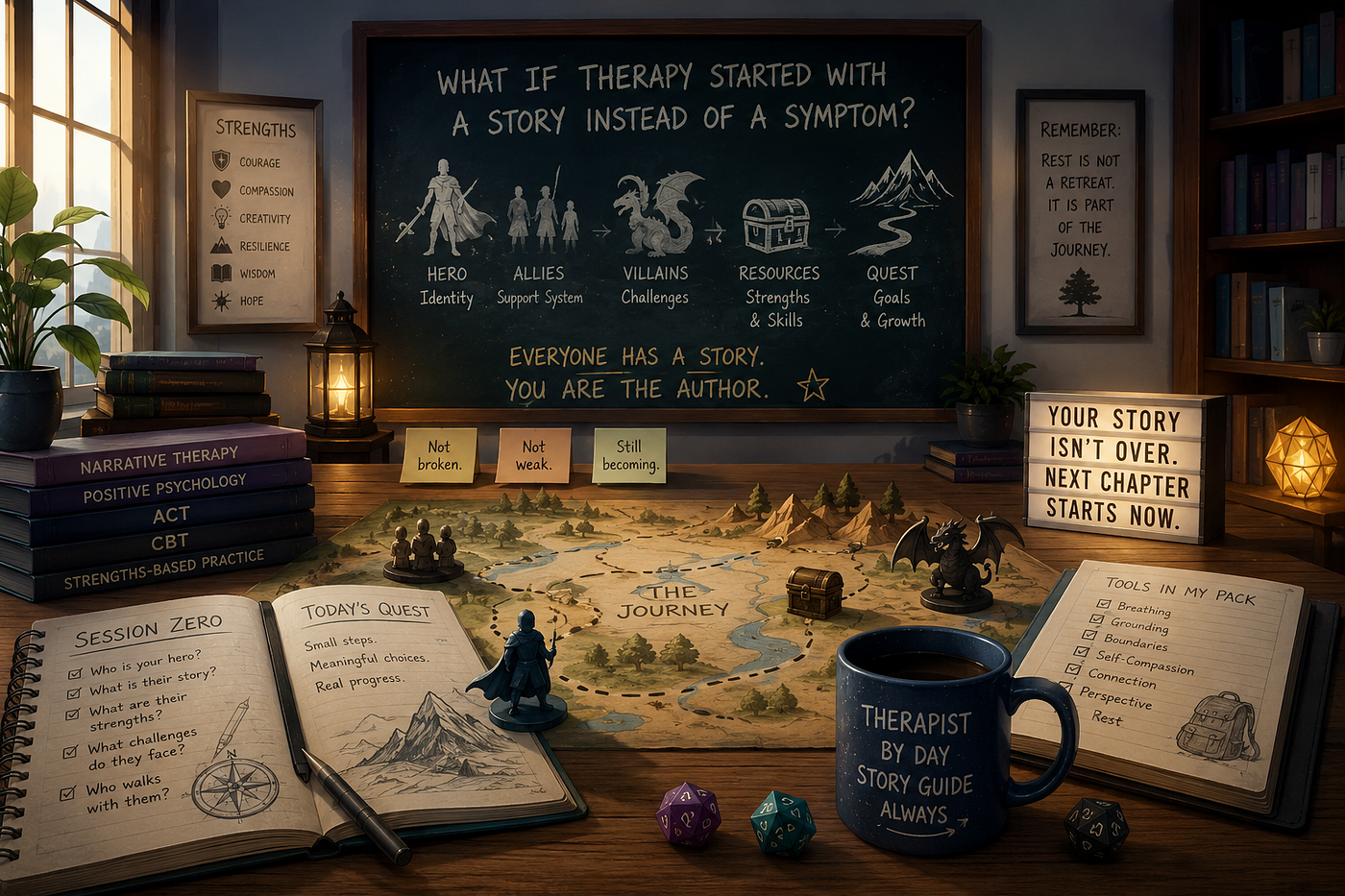
Image by Tifany and ChatGPT AI
From Superheroes to Personal Mythology: How a Friday Afternoon Sent My Therapist Brain Down a Wonderfully Nerdy Rabbit Hole
Or; Holy Brain Twister, Batman!
There are days when my ADHD therapist brain behaves itself.
This was not one of those days.
It started innocently enough. (Famous last words.)
I had been reading about psychologist Dr. Janina Scarlet’s Superhero Therapy because, let’s be honest, the title alone practically demands that a geeky therapist clicks on it. The concept is fascinating: helping people understand trauma, anxiety, depression, and resilience through the stories of superheroes.
Immediately, I thought, “Well… that’s just cool.”
As both a therapist and a lifelong nerd, it made perfect sense to me.
Stories have always been how many of us make sense of the world.
Batman isn’t interesting because he punches bad guys.
He’s interesting because he keeps showing up despite grief and trauma.
Spider-Man isn’t relatable because he can crawl on walls.
He’s relatable because he constantly wonders if he’s doing enough.
The X-Men have never really been about mutant powers.
They’re about identity.
Belonging.
Difference.
Community.
That part clicked almost immediately.
Then my brain did what it usually does.
It asked one tiny little question that completely derailed the afternoon.
What if the therapeutic value isn’t actually superheroes?
Uh oh.
Once my brain says “what if,” I know I’m probably not getting anything productive done for the next several hours.
Because if superheroes work…
…why?
What exactly is doing the therapeutic heavy lifting?
Is it Batman?
Or is it something much older?
The more I thought about it, the more I realized humans have been doing this forever.
Long before comic books, we had myths.
Long before Marvel, we had legends.
Long before Superman, we had stories about reluctant heroes, wise mentors, tricksters, healers, explorers, guardians, and ordinary people who somehow found themselves doing extraordinary things.
Maybe superheroes aren’t something entirely new.
Maybe they’re just our generation’s mythology.
That idea lodged itself firmly in my brain.
And once it was there…
Well…
There was no stopping it.
My AI brainstorming partner and I started tossing ideas back and forth, and what began as “Tell me more about Superhero Therapy” somehow evolved into several hours of asking increasingly nerdy questions.
What if therapy started with a character sheet instead of a symptom checklist?
What if strengths became powers?
What if coping skills became equipment?
What if your support system became your adventuring party?
What if depression wasn’t your identity but the recurring villain who keeps showing up at the worst possible moments?
And then…
One idea after another started falling into place.
Not because they were revolutionary.
But because they seemed to fit together.
For example…
One of the things that has always bothered me about mental health language is how often it sounds like we’re supposed to “defeat” depression or “beat” anxiety.
But that’s not how many people actually experience those conditions.
Anyone who’s lived with chronic depression, PTSD, OCD, anxiety, addiction, or grief knows that the villains don’t always disappear.
Sometimes they retreat.
Sometimes they level up.
Sometimes they sneak back in wearing a fake mustache and hoping you won’t recognize them.
(Depression is surprisingly bad at disguises.)
The hero isn’t a failure because the villain returned.
That’s what villains do.
Batman didn’t retire because the Joker escaped again.
The Enterprise doesn’t get decommissioned every time the Klingons show up.
Recovery isn’t about making sure the villain never returns.
It’s about becoming a wiser, stronger, more resourceful protagonist every time they do.
Then we wandered into something I honestly wasn’t expecting.
Resource management.
Every RPG I’ve ever played has limited resources.
Health.
Mana.
Stamina.
Spell slots.
Potions.
Money.
Food.
Repair kits.
Nobody thinks they’re a terrible wizard because they ran out of mana.
They think,
“I need to rest before the next dungeon.”
Wait a second…
Why don’t we talk about mental health that way?
Depression costs energy.
Anxiety costs energy.
Masking costs energy.
Trauma costs energy.
Being a caregiver costs energy.
Fighting discrimination costs energy.
Simply existing in an unsupportive world sometimes costs an astonishing amount of energy.
Maybe self-care isn’t really self-care.
Maybe it’s resource management.
Maybe rest isn’t something you earn after productivity.
Maybe it’s part of what allows the journey to continue.
Even Superman has to rest occasionally.
The Enterprise has to dock for repairs.
You can’t fire phasers if the warp core is offline.
That one felt important.
Then something even bigger happened.
We stopped talking about superheroes almost entirely.
Instead, we started talking about identity.
Not diagnosis.
Not pathology.
Identity.
What if therapy began by asking:
“Tell me about your hero.”
Not because I want clients pretending to be superheroes.
Because sometimes it’s easier to talk about ourselves when we’re talking about someone who represents us.
A character.
An avatar.
A traveler.
A captain.
A healer.
A detective.
A guardian.
Someone inspired by us but just far enough away that we can safely examine the difficult parts.
Instead of asking,
“What’s wrong with you?”
Maybe we could ask,
“What’s your current quest?”
Instead of asking,
“What are your symptoms?”
Maybe we ask,
“What villains keep showing up?”
Instead of asking,
“What coping skills have you learned?”
Maybe we ask,
“What new equipment have you added to your inventory?”
Those questions aren’t replacing evidence-based therapy.
They’re simply changing the language through which that therapy happens.
The more we explored it, the more I realized this wasn’t really about geek culture.
Geek culture was just the doorway.
The bigger idea was that people naturally understand themselves through stories.
Some people find those stories in comic books.
Others find them in Star Trek.
Some in Tolkien.
Some in Dungeons & Dragons.
Some in religion.
Some in family stories.
Some create entirely original worlds.
Different mythology.
Same human process.
By the end of the afternoon, what had started as curiosity about Superhero Therapy had somehow become pages of notes for something I’m tentatively calling the Mythic Identity Framework — an attempt to organize evidence-based therapy around personal mythology, symbolic storytelling, strengths, character development, and identity.
Is it a finished model?
Not even close.
It’s an idea.
A question.
Maybe the beginning of something.
Maybe just one of those wonderfully weird thought experiments that therapists and nerds occasionally stumble into.
Either way, I’m glad I followed the rabbit hole.
Because somewhere between Batman and CBT…
between Star Trek and Narrative Therapy…
between role-playing games and Positive Psychology…
I was reminded of something I probably should have known all along.
People rarely experience their lives as a list of symptoms.
They experience them as stories.
And maybe…
Just maybe…
Helping someone discover that they are still the author of that story is one of the most powerful things therapy can offer.
Now, if you’ll excuse me, I have approximately fourteen pages of notes, three new assessment ideas, a possible workbook outline, and what I’m pretty sure is the beginning of a conference presentation.
This is why I can’t have nice, quiet hobbies.
About My Writing Process
People occasionally ask how I put these pieces together, so here’s the honest answer.
I write the first drafts. Sometimes they’re polished. Sometimes they’re an absolute disaster held together by caffeine, ADHD, and whatever emotion decided to punch me in the face that week.
Once I have something on the page, I use ChatGPT as a collaborative editing partner. It helps me do research, organize ideas, tighten pacing, smooth transitions, catch repetition, and occasionally tells me when I’ve wandered so far off on a tangent that even I can’t remember where I was going.
Every story, opinion, memory, and conclusion is still my own. If something makes you laugh, makes you think, or makes you wonder whether I’m actually three opossums in a trench coat… that’s all me.
AI just helps me polish the words so they better reflect what was already in my head.
메타데이터
- post_id
- d0bf9ba62ece
- slug
- from-superheroes-to-personal-mythology-how-a-friday-afternoon-sent-my-therapist-brain-down-a-d0bf9ba62ece
- url
- https://medium.com/@tifanyanne/from-superheroes-to-personal-mythology-how-a-friday-afternoon-sent-my-therapist-brain-down-a-d0bf9ba62ece
- canonical_url
- https://medium.com/@tifanyanne/from-superheroes-to-personal-mythology-how-a-friday-afternoon-sent-my-therapist-brain-down-a-d0bf9ba62ece
- author_url
- https://medium.com/@tifanyanne
- status
- ok
- fetched_at
- 2026-08-10 18:01:24