Dynamic SQL in Oracle PL/SQL: Why It Exists and When You Should Use It
Static SQL is predictable. Dynamic SQL is adaptable. A skilled Oracle developer knows when to use each.
Dynamic SQL in Oracle PL/SQL: Why It Exists and When You Should Use It
Static SQL is predictable. Dynamic SQL is adaptable. A skilled Oracle developer knows when to use each.
Introduction
Oracle PL/SQL is one of the most powerful procedural programming languages for database development. It enables developers to write efficient business logic using SQL statements integrated with procedural constructs such as loops, conditions, cursors, and exception handling.
In most applications, developers use Static SQL, where the SQL statement is completely known during compilation. Static SQL offers excellent performance, compile-time validation, and easier maintenance.
However, enterprise applications are rarely static.
Modern systems often allow users to choose tables, filters, columns, sorting options, or even entire reports dynamically. In these situations, the SQL statement cannot be determined until the application is running.
To solve this problem, Oracle introduced Dynamic SQL.
Dynamic SQL allows SQL statements to be constructed and executed at runtime, making applications more flexible and reusable.
The Problem with Static SQL
Consider an HR Management System.
A user wants to search employees based on optional filters such as:
- Department
- Job Title
- Salary Range
- Hire Date
- Location
With Static SQL, developers often end up writing multiple queries to support different combinations of filters.
For example:
SELECT * FROM EMP WHERE DEPTNO= 10;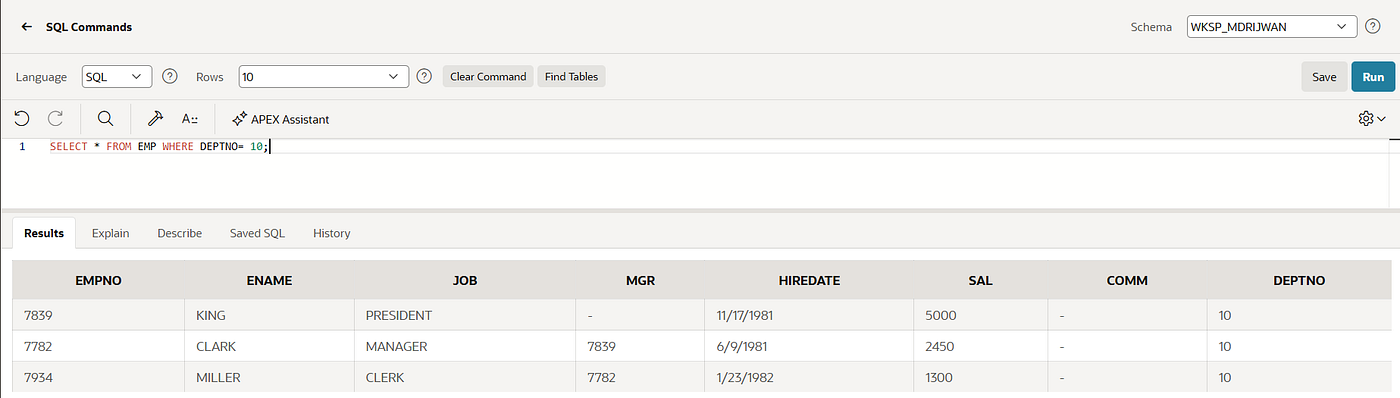
Another query:
SELECT * FROM EMP WHERE DEPTNO= 10 AND salary > 2450;
Another query:
SELECT * FROM EMP WHERE JOB = 'SALSMAN';
As business requirements grow, the number of SQL statements increases rapidly, making the application difficult to maintain.
How Dynamic SQL Solves This Problem
Instead of creating many SQL statements, Dynamic SQL allows us to build the required SQL statement programmatically.
Imagine that a user selects:
- Department = 10
- Minimum Salary = 50000
The application builds the following SQL dynamically:
SELECT * FROM EMP WHERE DEPTNO = 10 AND SAL>= 5000;If tomorrow the user selects different filters, Oracle generates a different SQL statement without changing the PL/SQL program.
This flexibility is the primary purpose of Dynamic SQL.
What is Dynamic SQL?
Dynamic SQL is a programming technique in Oracle PL/SQL where SQL statements are created as character strings and executed during runtime.
Unlike Static SQL, the database does not know the exact SQL statement until the program executes.
In simple words:
Static SQL = SQL written before execution.
Dynamic SQL = SQL generated during execution.
Static SQL vs Dynamic SQL


Unlike Static SQL, the SQL statement is first constructed as a string and then executed.
Native Dynamic SQL
Oracle provides Native Dynamic SQL (NDS) through the
EXECUTE IMMEDIATEstatement.
Basic syntax:
EXECUTE IMMEDIATE dynamic_sql_string;
Example:
DECLARE
v_sql VARCHAR2(200);
BEGIN

v_sql := 'DELETE FROM EMP WHERE EMPNO = 105';

EXECUTE IMMEDIATE v_sql;
END;
Here, the SQL statement is stored in a variable and executed only at runtime.
When Should You Use Dynamic SQL?
Dynamic SQL is commonly used when:
- Table names change dynamically.
- Column names are selected at runtime.
- Optional search filters are required.
- DDL statements (CREATE, ALTER, DROP) need to be executed.
- Generic reporting modules are developed.
- Metadata-driven applications are built.
- Oracle APEX applications generate dynamic reports.
Advantages of Dynamic SQL
- Highly flexible
- Reduces duplicate code
- Supports runtime SQL generation
- Executes DDL statements
- Useful for generic procedures
- Ideal for metadata-driven applications
Limitations
Dynamic SQL should not replace Static SQL.
Some limitations include:
- More difficult to debug
- Runtime parsing overhead
- Increased maintenance complexity
- Potential SQL Injection risks if user input is not validated
Whenever Static SQL can solve the requirement, it should generally be preferred.
Real-World Business Example
Imagine an Oracle APEX application where users can generate reports by selecting:
- Department
- Job Role
- Salary Range
- Joining Date
Instead of creating separate reports for every possible combination, the application dynamically builds the SQL query based on the selected filters.
This is one of the most common and practical uses of Dynamic SQL in enterprise Oracle applications.
Best Practices
- Prefer Static SQL whenever possible.
- Use Dynamic SQL only when runtime flexibility is required.
- Always validate user input.
- Use bind variables to improve performance and reduce SQL Injection risks.
- Handle runtime errors using PL/SQL Exception Handling.
Conclusion
Dynamic SQL is an essential feature of Oracle PL/SQL that enables developers to create flexible and configurable database applications. While Static SQL remains the preferred choice for fixed business logic, Dynamic SQL becomes indispensable whenever SQL statements must be generated at runtime.
A good Oracle developer understands not only how to write Dynamic SQL, but also when it should — and should not — be used.
In the next part of this series, we will explore EXECUTE IMMEDIATE in detail, including dynamic INSERT, UPDATE, DELETE, SELECT, bind variables, and practical enterprise examples.
메타데이터
- post_id
- d0bfc674b771
- slug
- dynamic-sql-in-oracle-pl-sql-why-it-exists-and-when-you-should-use-it-d0bfc674b771
- url
- https://medium.com/@mdrijwan1267/dynamic-sql-in-oracle-pl-sql-why-it-exists-and-when-you-should-use-it-d0bfc674b771
- canonical_url
- https://medium.com/@mdrijwan1267/dynamic-sql-in-oracle-pl-sql-why-it-exists-and-when-you-should-use-it-d0bfc674b771
- author_url
- https://medium.com/@mdrijwan1267
- status
- ok
- fetched_at
- 2026-06-28 10:39:35
