The Balinese King Who Invented Spiritually Responsible Capitalism
A King, a Queen, and a Very Suspicious Witchcraft Allegation
The Balinese King Who Invented Spiritually Responsible Capitalism
A King, a Queen, and a Very Suspicious Witchcraft Allegation
In ancient India, king Udayana was a legendary figure. He was a king of the city of Kaushambi in the north-central India as well as a patron of Shakyamuni Buddha. The Buddhist scripture Samyutta Nikaya records Udayana’s convertion to Buddhism after his visit to the monk Pindola Bharadvaja. Two fourth century plays by the ancient Indian poet Bhasa, the Svapnavasavadattam and Pratijnayaugandharayana, depict Udayana as a romantic hero and putting his legend as the central theme of the plays. A Chinese translation of Ekottaragama Sutra, completed by monk Dharamanandi in 385 AD, tells us about the sadness of king Udayana. He was left behind by the Buddha who had temporarily traveled to heaven. As a dedication to his beloved teacher, king Udayana commissioned a five foot statue made in likeness of the Buddha. Later, a fifth century AD collection of Buddhist tales called 冥祥記 (Mingxiang ji, “Signs from the Unseen Realm”) by scholar-official Wang Yan recounts a story of Emperor Ming of the Eastern Han Dynasty who dreamed about a divine man. This divine man was gold-coloured, standing over twenty feet in height with a halo around his head. When the emperor later described this dream to his courtiers, one of his courtiers recognized this “divine man” as a deity in India. The emperor then sent an embassy to India who returned with the painted image of the Buddha commissioned by king Udayana which that had been completed during the Buddha’s and King Udayana’s lifetime.
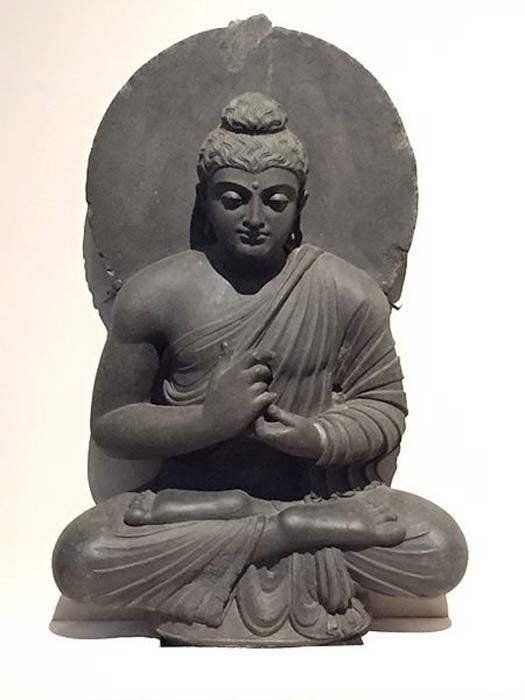
Sculpture of Buddha preaching (c second century), Indian Museum, Kolkata. (Jacklee/ CC BY-SA 4.0)
Hundreds of years later, in the small island of Bali in the 10th century, lived another king Udayana. Belonging to the Warmadewa dynasty, the earliest dynasty in Bali, king Udayana’s rule saw the advance of material welfare of his people through consistent market mechanisms and trade relations, as well as rich variety of life and livelihood of the agricultural sector which led to abundant harvest. From Udayana’s rule, some clear pictures of the existence of accounting practices emerged leading to the use of coins printed in gold and silver plates for the local currency. To this day, Udayana’s name is associated with Bali’s past greatness. But unlike the semi legendary Udayana, the story of the king of Bali was less fantastical and arguably more relatable.
King Udayana and the Development of Balinese Land-Owning and Agricultural Systems

Gunung Kawi. Ancient carved in the stone temple with royal Udayana tombs. Bali, Indonesia (*Adobe Stock)*
King Udayana ‘s reign is regarded as the Golden Age of Bali. He united Bali with the nearby island of Nusa Tenggara and extended his influence to East Java through his marriage to the Javanese princess Mahendradatta as well as through his first-born son Airlangga who, in his youth, was educated at the court of Watugaluh, Medang, East Java, under the patronage of his maternal uncle King Dharmawangsa. Dharmawangsa was later murdered along with his entire family and many of his subjects in the calamity called Pralaya Medang (”Death of Medang”), which took place in the Dharmawangsa Palace during Airlangga’s wedding ceremony.
Udayana’s rule also gave rise to cultural and religious diversity. The two major religions of the time, Hinduism and Buddhism, had wide varieties of sects or cults. In his daily travels, the king himself was accompanied by two groups of Hindu and Buddhist priests. Cultural diversity is shown in inscriptions written with by using the Devanagari scripts, Kawi and Sanskrit scripts as well as ancient Balinese and Old Javanese scripts. In the running of government, Udayana was notably democratic despite the Balinese system of government at the time which was a monarchy. He made decisions based on consensus, he came to the fields to check the harvests himself and provided opportunities for citizens to come directly to him with any complaints. The bureaucratic structure of the kingdom during the reign of King Udayana started from the village-level officials who reported to the central officials. The central officials reported to the king himself who made decisions based on his consultations with his retainers and priestly advisers.

Deified statue of King Airlangga depicted as Vishnu mounting Garuda, found in 11th century AD Belahan Temple, East Java, Indonesia. (Gunawan Kartapranata / CC BY-SA 3.0)
The status of the land owned by the villagers at the time is a communal land. This means that the ownership of the land and the houses belonged to the village, while the results of agricultural harvests and transactions was considered as the right of individuals. The communal land ownership was recorded as assets of the village which was “lent” to the residents and their descendants. If the resident have no descendants, the land was taken back by the village and given to people in need.
During Udayana’s rule, innovations in agriculture appeared in forms such as a taxation system for agricultural commodities and the Subak, the traditional Balinese irrigation system still used to this day. The development of agriculture at the time is indicated by the terms of use of agricultural lands summed up in an 993 AD inscription which says …huma, parlak, padang, mmal, mulyan ma 4… pswangan gusali ing tapa haji… (“… to wet fields, dry fields, meadows, moor, subject to levy property taxes 4 masaka … reported by the treasurer tax collector …”). Several inscriptions also mention the terms undahagi (a title for an expert on aqueducts), dawuhan (an air dam to irrigate the fields), tambuku (a tool used to split water in a field), span (the unit volume of irrigation) and makahaser (the overseer of the irrigation systems at the time). Like everyone else, the makahaser also had to pay taxes to the king. This is mentioned in the Trunyan AI inscription in 911 AD …kabakatan ya makahaser, kunang yanada hitamanahda mahadiri pswangan gusali di thanin sanghyang di turunan… (“… for the post of head of the subak, subject to levy taxes that will be offered in derivatives …”)

The Belanjong pillar inscription in Sanur dates to 914 AD, and testifies to the contacts between Bali and the Indian subcontinent. (PHGCOM /CC BY-SA 3.0)
A time-share system called mlaga was set up for field owners and employees or tenants. However, although the Tengkulak inscription in 1023 AD established that the distribution of the results of the mlaga system termed ptlun (“divided by three”), it does not explain which party gets one third and two thirds of the share.
King Udayana and the Philosophy Behind the Ancient Balinese Coinage
The use of currency in public trades before the era of King Udayana were mainly conducted through the exchange of goods such as an onion in exchange for a fish, or three bananas traded with a tin of rice. An exchange would occur when both the buyer and the seller agreed on the amount of goods exchanged. Some traders although some also used other mediums of payments such as beads, teeth of hunted animals, rocks and shells. The mediums of exchange are expected to be easy to carry and made of durable materials. They also need to be of a certain weight based on mutual agreement and have a sign or stamp of the authority at that time stating that the object is used as a legitimate medium of exchange.

Balinese altar at Rice terraces of Gunung Batukaru. This Subak landscape is a UNESCO World Heritage Site since 2012. (Arabsalam / CC BY-SA 3.0)
As apparent from his close relationship to his priestly courtiers, king Udayana used religious values to the basis of the social and economic transactions. He devised two patterns on either sides of gold coins depicting the balance between outward and inward or material and spiritual concepts. Four sandalwood trees were printed on silver currency to depict the four cardinal directions which according to ancient Balinese belief were controlled by the gods and goddesses to protect their people. Sandalwood trees were considered sacred in ancient Bali and were often used in sacred ceremonies and building materials. The reasoning behind putting these religious symbols on the coins was so that the Balinese people relate making money with religious sanctity. Thus the currency was not only intended as a means of exchange and monetary policies, but also a symbol of purity and nobility — although money and “purity” seem to be opposite concepts in the modern world, they were closely linked in ancient Bali.

Ancient Chinese coins or reproductions of unknown origin. (Public Domain)
Overall, the symbols in the currency were roughly interpreted as “righteous or noble transaction”. If one always remembers and be guided that all things belongs to the divine and will return to the deities in any transaction, the transaction will be done with the divine mercy and in accordance with the guided path of goodness, honesty, sincerity and simplicity of life which lead to the ultimate road to emotional and physical well-being. The idea is that if everyone from businessmen and government officials to merchants and farmers use this concept, then there will be no such thing as crime, corruption and other misconducts. In the ancient Balinese belief, money represents abundance, and abundance is not merely an external factor in life. The lack of inner abundance in matters of trades would lead to an imbalance in the the harmony between the outer and inner well-being. Therefore, trades should always be accompanied by a reflection on the harmony and balance between one’s physical well-being (the material world) and one’s inner happiness (the spiritual world) reflected in the coins devised by Udayana. These coins were then used as a tool of the trade exchange and, due to the presence of the symbolic ornaments or texts on both sides of them, they were considered more valuable as they were considered religious artifacts which contained the name of the king. However, this proved to be impractical. As gold and silver currency were considered high value, they were never used in small-value transactions and usually only held by the kingdom instead of the average people.

Masks of deities at a Balinese market (kravka / Adobe Stock)
Markets were placed in strategic areas such as areas with dense populations, crossroads and the harbors. Apart from meeting the needs of the people, the markets also functioned as places to cultivate trade relations between regions and islands. The money used in these trade transactions in the kepeng, a currency brought by the Chinese to conduct trades in Bali. Kepeng was used when there was need for money in small denominations. It also had the added advantage of being easy to carry as a kepeng coin typically has a hole in the middle which can typically be used to bind in significant amounts of paper money or notes.
King Udayana’s running of the government was inseparable from the strong influence of his wife, queen Mahendradatta. In inscriptions relating to Udayana, the name of the queen always precedes the name of the king. This was different to writing inscriptions issued by the kings who ruled before and after Udayana in which the name of the queen were left out completely.
The Marriage of the Balinese King Udayana and the Javanese Princess Mahendradatta
To add to his prestige and influence, King Udayana of Bali married the Javanese princess Mahendradatta of the Isyana Dynasty from East Java. Mahendradatta was the daughter of king Sri Makutawangsawarddhana and the sister of King Dharmawangsa of the Medang Kingdom, a Hindu-Buddhist kingdom that flourished in Java between the 8th and 11th centuries. The marriage of Udayana and Mahendradatta was very likely meant as political union to seal Bali as part of Medang’s realm. The union produced three sons: Airlangga who later became the king of the Kingdom of Kahuripan, which was built from the territory of Medang after its destruction by king Wurawari of Lwaram; Marakata, who later become king of Bali after the death of their father; and Anak Wungsu who ascended to the Balinese throne after the death of his brother Marakata.

Map of Medang Kingdom (also popularly known as “Mataram Kingdom”), ancient Hindu-Buddhist kingdom in Central Java and East Java circa eighth-11th century. The map encompassed two periods: Central Java Period and East Java Period. ( Gunawan Kartapranata /CC BY-SA 3.0)
Although the complete history of Udayana and his familial relationship is difficult to ascertain as there are little written historical records of Indonesia prior to its independence in 1945, we can get a little glimpse from the folktales surrounding the Balinese traditional arts. An example of this is the Balinese Barong dance, which is a part of the ritual drama which focuses on the ongoing battle between Barong (the force of good) and Rangda (the force of evil). Barong is depicted as a lion or dragon-like animal with an ornate feathery tail while Rangda is portrayed as a vicious old woman with unruly long white air and big, sharp teeth. While Barong protects villages, Rangda inflicts villages with plague, malicious magic and miseries.
The colors black, white and red which are associated with Rangda are also associated with Durga. Rangda seems to have been inspired by at least two famous worshippers of Durga. The first worshipper is the legendary widow Calon Arang from the 12th century. Often portrayed as a fierce witch with a frightening face, Calon Arang often damaged farmers’ crops and bringing about diseases to the land. The other, earlier worshipper of Durga, is queen Mahendradatta herself who is also known for her devotion to the cult of Durga in Bali. Therefore, through his marriage, Udayana also contributed greatly to the Balinese arts.

Borobudur, the largest single Buddhist structure in the world, one of the monuments constructed by the Sailendran of the Medang Kingdom. (CC0)
Due to her powerful position, Mahendradatta’s association with Rangda is more complicated than that of Calon Arang. As the the princess of the ruling Medang Kingdom who married into the Balinese Warmadewa family, who were Medang’s vassal, thus sealing Bali as part of the East Javanese Medang realm, she might have been seen as ruling Bali through her husband as queen Regnant. Even if Mahendradatta was not the queen regnant, her position would have been powerful enough for the Balinese court to carefully revere, or even fear, her which would have still earned her many enemies. Therefore, Mahendradatta’s unfavorable image in Balinese folklore may be the result of the influence of the Balinese court politics to discredit the ruling foreign queen. It may have also reflected her marital difficulties with king Udayana. Her husband and sons, the most powerful men in the kingdom, could have stopped this unfavorable comparison of her to the figure of Rangda if they felt the need to do so as this comparison would cast them in an unfavorable light through their association with her. As there are no surviving records which described the familial relationship and dynamic of Udayana’s family and there is no surviving records about Mahendradatta’s husband and sons being viewed unfavorably or inconvenienced in any way by this association, we can perhaps assume that Mahendradatta’s relationship with her husband and sons was a distant one.

Dance of Calon Arang with Rangda (1959)( *Tropenmuseum, part of the National Museum of World Cultures/ CC BY-SA 3.0)*
The folklore regarding Mahendradatta which linked her to Rangda says that Mahendradatta was condemned, divorced and exiled by Udayana for allegedly practicing witchcraft and black magic. The humiliated Mahendradatta then sought revenge upon her husband’s court and the whole kingdom. She summoned all the evil spirits and took her revenge by killing off half the kingdom with plague before being defeated by a holy man. Mahendradatta’s image in Balinese folklore is probably the result of the influence of the Balinese court politics to discredit the ruling foreign Javanese queen. It may have also reflected her marital difficulties with Udayana. After her death in 1011 CE, statues of Mahendradatta was erected depicting her as Durga Mahisashuramardini (“Durga the slayer of Bull-demon”). Mahendradatta was entombed in the temple within Pura Bukit Dharma Kutri in Buruan village, Blahbatu, Gianyar Regency, Bali.
REFERENCES:
- Benge, A., (2016)Transformation of the Udayana Buddha: From Mortal to God https://www.academia.edu/31157962/Transformation_of_the_Udayana_Buddha_From_Mortal_to_God
- Budiasih, I. G. A. N., Sukoharsono, E. G., (2012)Accounting Practices and The Use of Money in The Reign of King Udayana in Bali: An Ethnoarcheological Approach, The Indonesian Journal of Accounting Research, vol 15 no. 3
- Budiasih, I. G. A. N., (2012) Construction of Agriculture Accounting Practices in the Reign of King Udayana Bali: Ethnoarchaeological Approach, https://repositori.unud.ac.id/protected/storage/upload/repositori/ID3_1690115199402200116091303902pemakalah-internasional.pdf
- Chinese Buddhist Encyclopedia, (2014) http://chinabuddhismencyclopedia.com/en/index.php/Udayana
- Fisher, M., (2017) https://www.ancient-origins.net/history/shocking-demon-brings-plague-and-devours-babies-ancient-goddess-evil-widow-rangda-balinese-021710/page/0/1
- Lutfillah,N. Q., Sukoharsono, E. G., (2013) Historiografi Akuntantsi Indonesia masa Mataram Kuno (abad VII-XI Masehi), Jurnal Akuntansi Multiparadigma, Volume 4, Nomor 1, pp: 75–84
- Rhi, J., (2005) Images, Relics, and Jewels: The Assimilation of Images in the Buddhist Relic Cult of Gandhāra: Or Vice Versa, Artibus Asiae, Vol. 65, №2, pp. 169–211
메타데이터
- post_id
- d0c50bd03e73
- slug
- the-balinese-king-who-invented-spiritually-responsible-capitalism-d0c50bd03e73
- url
- https://medium.com/@mariannerosamundfisher/the-balinese-king-who-invented-spiritually-responsible-capitalism-d0c50bd03e73
- canonical_url
- https://medium.com/@mariannerosamundfisher/the-balinese-king-who-invented-spiritually-responsible-capitalism-d0c50bd03e73
- author_url
- https://medium.com/@mariannerosamundfisher
- status
- ok
- fetched_at
- 2026-08-17 01:30:46




,_Indian_Museum,_Kolkata,_India_-_20150807-01.jpg)


#/media/File:Batukaru1.JPG)


