Martin Luther King Jr.’s Prophecy On Flawed Liberalism
What It Means for Hartford’s Caribbean Community. In 1959, Martin Luther King Jr. spoke at the University of Hartford and warned...
Martin Luther King Jr.’s Prophecy On Flawed Liberalism
What it means for Hartford’s Caribbean community.
In 1959, Martin Luther King Jr. spoke at the University of Hartford and warned that the state of Connecticut had never fully immersed itself. He described a liberalism that was “so objectively analytical that it never gets subjectively committed… Neither hot nor cold, but lukewarm.” Sixty years later, a global COVID-19 pandemic arrived, confirming every word.
*Connecticut Fault Lines* is the documentary I spent years building, a film about how we got here. It begins with a question King himself posed: “In order to understand the future, it is often necessary to get a clear picture of the past.” I came to believe that question was not rhetorical, but an assignment.
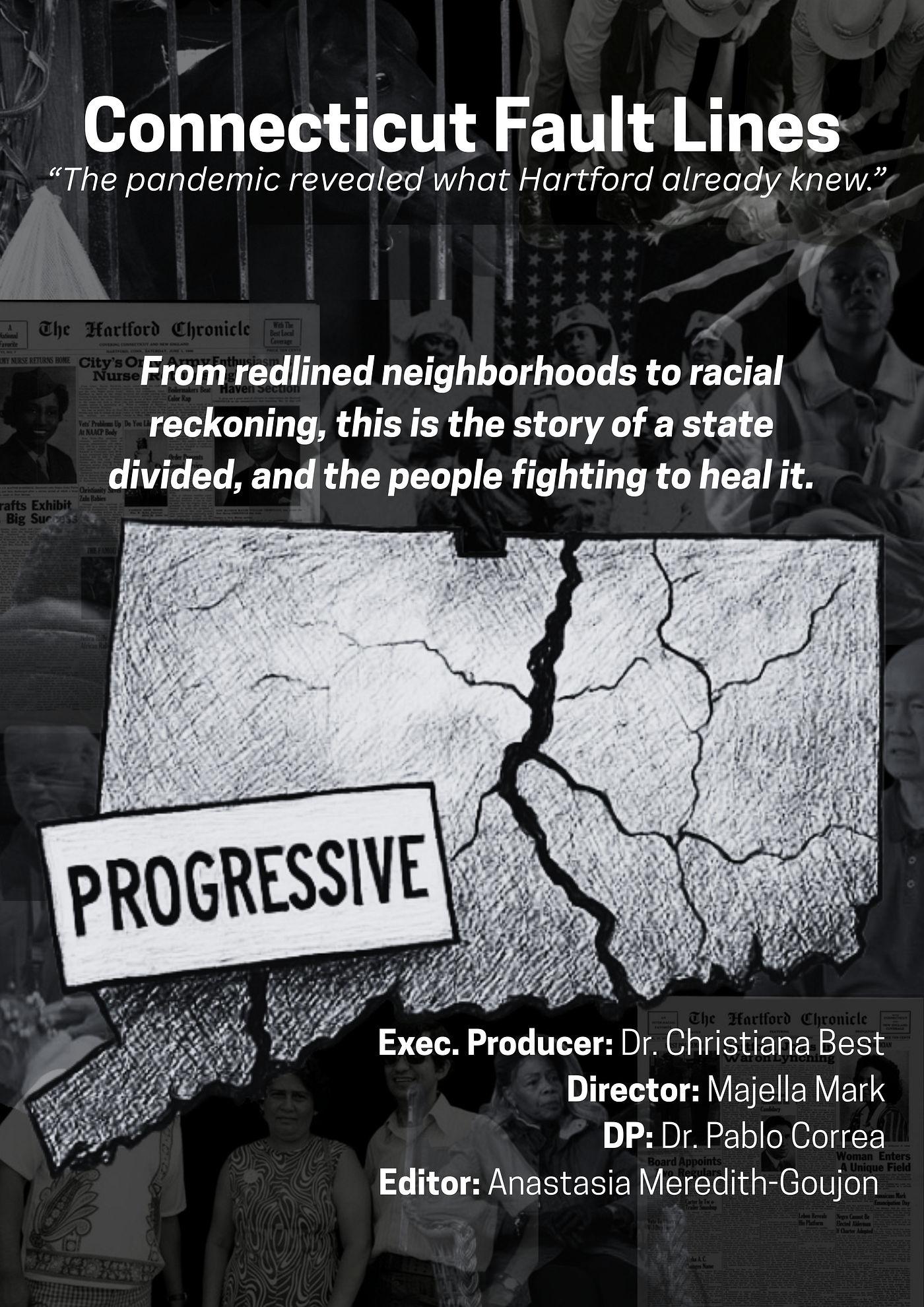
Film Poster for Connecticut Fault Lines
Connecticut presents itself as a progressive state, one that wears its liberalism like a badge of honor. From a distance, the image holds a state that champions diversity, equality, and justice. Zoom in, however, and the picture fractures. Connecticut is more purple than Democrat blue. The divide between the haves and the have-nots runs deep and deliberate, and nowhere is that more concentrated than in Hartford’s North End.
Hartford has long been a mecca for migration, a city that opened its doors to refugees, asylum seekers, and families building new lives. Caribbean DNA is woven into its streets. Jamaicans, Puerto Ricans, Grenadians, Bajans, Trinidadians, and Haitians came with creative enthusiasm, work ethic, and cultures that enriched the institutions they entered.
Many in this country have never heard of the British West Indies Temporary Alien Labor Program (BWI Program), the government-sanctioned labor import scheme that brought workers from across the Caribbean and Latin America into fields and factories from the 1940s through the 1960s. King himself picked tobacco as a young Morehouse man, working alongside Caribbean brothers, learning firsthand how unwelcoming America could be. The redlining, the poor housing on Clay Hill, the racial harassment on Main Street, this was not only a Southern struggle, and it was not only the struggle of American Descendants of Slaves (ADOS). Caribbean people were sold the same dream and handed the same betrayal.
My mentor, Craig Rothman, is an Irish-heritage filmmaker born and raised in Hartford’s North End. His parents attended Weaver High School. His family was among the last white families to leave the neighborhood during white flight in the 1950s. Decades later, Craig found himself working alongside me, a Black woman named Majella, also born and raised in that same North End, to immigrant parents from Grenada. I attended Barbour and Rawson Elementary, grew up at the Artist Collective on Clark Street, and went on to make a film about that very ground we both came from.
What connects us is geography. What separates us is the experience of living in our skin. That is what history is, the story of a moment told from the perspective of whoever spoke loudest. The Caribbean community of Hartford, particularly in the North End, has been relegated to a footnote when it deserves a chapter.
History is not a narrow collection of events with a handful of named characters while the rest of us stand in the background as props. It is a layered cluster of perspectives that together form the full picture of our existence. Like text on a page, our story is recorded through our physical reality.
One woman in the film told me, “I was born in trauma.” She did not mean it as a metaphor. She meant Milford Street. She meant a brother was murdered. She meant a life shaped by events that never become headlines unless a community is loud enough to force them into headlines.
The pandemic became a petri dish. We watched people die from COVID-19 and from police violence simultaneously, with George Floyd’s death arriving at a moment when the entire country was locked inside, stripped of distraction, with nowhere to look away. For many, it was a reckoning. For people like me, it was a confirmation of what we already knew.
Executive Producer, Dr. Christiana Best, whose oral history work has been a cornerstone of this project, said it plainly in the film, “We all know of COVID-19 as the virus. But we as Black people have always known there was a virus there.” Racism is a virus. Mistrust is its symptom. Neglect is its consequence.
The pandemic did not create Hartford’s disparities; it made them impossible to politely ignore. In an affluent town like Granby, a student’s biggest pandemic challenge might have been boredom. In Hartford, it was access to the internet, to quiet, to food, to safety, to stability. Crises do not invent prejudice. They activate the prejudice already built into the system.
Frontline healthcare workers described the early assumptions circulating about Hartford’s communities, that Black residents were resistant to testing. The truth was more damning; people lacked information, trust, and culturally competent care. Community leaders responded by going where people already gathered, barbershops, churches, and schools. They built communication networks. They showed up. Trust, in these communities, was not a perk. It was a survival strategy.
King never accepted the argument that structural change must wait for a transformation in individual hearts. “The law cannot make a man love me,” he said, “but it can control his determination to lynch me.” Hartford’s Caribbean community, second- and third-generation Americans, many with roots in this city that predate the gentrification now remaking its neighborhoods, has lived in this tension for generations. Their labor, their organizing, their cultural contributions, and their art have been rendered as footnotes in the story of the Nutmeg State. Not through outright hostility, but through omission. Through the liberal tendency to celebrate diversity in the abstract while failing to document, fund, or preserve it.
What King called for, a “true, genuine ethical liberalism” where individuals stand on principle and recognize that right is right and wrong is wrong, remains, in Connecticut, an unfinished project. But the film is not an obituary. It is a record of people who refuse to be invisible.
We filmed a community garden that had become an intergenerational classroom, children learning to tend land that feeds people. We filmed Patricia Kelly and the Ebony Horsewomen, an organization that has been building confidence, character, and safety through horses for decades, the kind of program that surprises people who have never looked closely enough at Hartford to know what it contains.
What stays with me most is not disappointment, but the insistence on living. I kept returning to the edit of a prayer I heard: "I want to be Black in peace." To run in peace. To shop in peace. To sit in a car in peace. To pray in peace. This is not a radical demand. It is a basic human request. The fact that it still needs to be spoken aloud, in 2026, in this state, in this country, tells you exactly where we are.
Making Connecticut Fault Lines sharpened my understanding of Hartford. Not as a city I have to explain or defend, but as a city with profound intelligence about survival, adaptation, what it costs, and what it means to love a place enough to stay and fight for it.
After the COVID-19 pandemic, the only honest conclusion is that we learned very little from the past. The inequalities it exposed did not disappear when the masks came off. They are still here, in housing policy, in school funding, in public health infrastructure, in who gets believed and who gets blamed.
King’s prophecy was not cynical. It was a challenge. He was telling us, in 1959, in this very state, that lukewarm is no longer enough. That there was a right side to stand on, and that standing required a firm choice.
The future is not something that happens to us. It is something we make by telling the truth about the past, by naming what is happening in the present, and by choosing the future, with commitment rather than comfort, to build a world where peace is not a privilege.
[embed]Trailer for Connecticut Fault Lines
Majella Mark is a filmmaker, oral historian, and writer from Hartford, CT. Connecticut Fault Lines is currently being screened in Connecticut and will soon be shown at film festivals.
메타데이터
- post_id
- d0df1a3eeba7
- slug
- martin-luther-king-jr-s-prophecy-on-flawed-liberalism-d0df1a3eeba7
- url
- https://humanparts.medium.com/martin-luther-king-jr-s-prophecy-on-flawed-liberalism-d0df1a3eeba7
- canonical_url
- https://humanparts.medium.com/martin-luther-king-jr-s-prophecy-on-flawed-liberalism-d0df1a3eeba7
- author_url
- https://medium.com/@majellamark
- status
- ok
- fetched_at
- 2026-06-11 06:59:45