What are Half Wave and Full Wave Rectifiers?
Introduction
What are Half Wave and Full Wave Rectifiers?
Introduction
In the realm of electronics, rectifiers play a crucial role in converting alternating current (AC) into direct current (DC). Rectifiers are widely used in power supplies, battery charging circuits, and electronic devices to ensure a smooth DC output. The two primary types of rectifiers are half wave rectifiers and full-wave rectifiers. In this article, we will explore the working principle, circuit diagrams, advantages, disadvantages, and applications of both types of rectifiers in great detail.
What is a Rectifier?

A rectifier is an electrical device that converts AC voltage into DC voltage. Since AC voltage alternates between positive and negative cycles, rectifiers are used to eliminate the negative component to produce a unidirectional current. The two main types of rectifiers are:
- Half Wave Rectifier
- Full Wave Rectifier
Each type has its own advantages and limitations based on efficiency, output, and component requirements.
Half Wave Rectifier
Definition
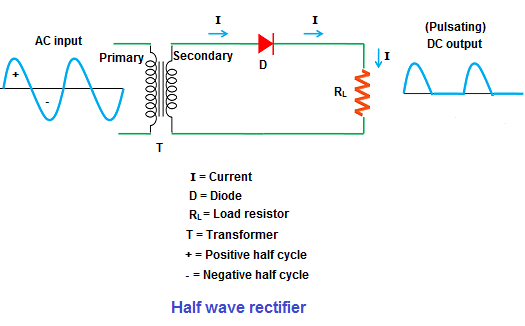
A half wave rectifier allows only one half-cycle (either positive or negative) of the AC voltage to pass through, blocking the other half. As a result, it produces a pulsating DC output with a high ripple factor.
Circuit Diagram
The basic components required for a half wave rectifier include:
- Transformer (optional) — Used for stepping up or stepping down the AC voltage.
- Diode — A semiconductor device that allows current to flow in one direction only.
- Load Resistor (RL) — A resistor used to consume the DC output.
Working Principle:
- During the positive half-cycle of AC input, the diode becomes forward-biased, allowing current to flow through the load.
- During the negative half-cycle, the diode is reverse-biased, blocking the current flow.
- As a result, only positive half-cycles appear at the output, making the rectification inefficient compared to full wave rectifiers.
Waveform
The output voltage waveform consists of positive pulses, with gaps corresponding to the blocked negative half-cycles.
Advantages of Half Wave Rectifier
- Simple circuit design with fewer components.
- Cost-effective and easy to construct.
- Used in low-power applications where efficiency is not critical.
Disadvantages of Half Wave Rectifier
- Low efficiency (~40.6%) as half of the input power is wasted.
- High ripple factor, requiring additional filtering for smoother DC output.
- Lower output voltage and poor voltage regulation.
Applications of Half Wave Rectifier
- Battery charging circuits for low-power applications.
- Signal demodulation in communication systems.
- Simple power supply circuits for electronic devices.
Full Wave Rectifier
Definition
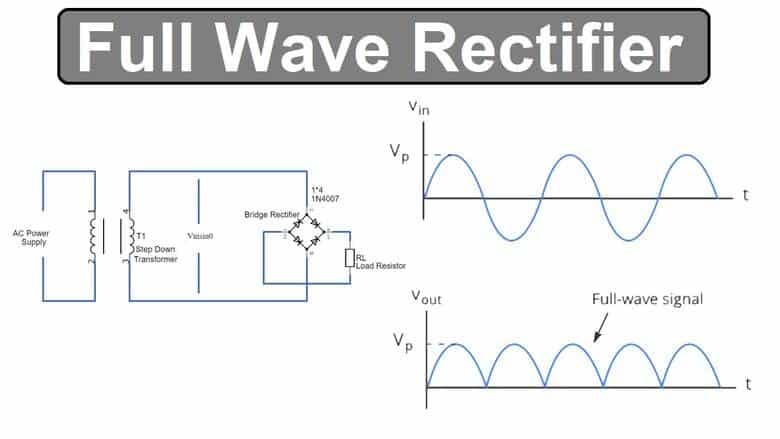
A **full wave rectifier converts the entire AC cycle into DC voltage**, significantly improving efficiency and performance compared to a half wave rectifier.
Types of Full Wave Rectifiers
- Center-Tap Full Wave Rectifier
- Bridge Rectifier
Circuit Diagram and Working Principle
1. Center-Tap Full Wave Rectifier
- Uses a center-tapped transformer and two diodes.
- The transformer splits the AC input into two equal halves.
- Each diode conducts during alternate half-cycles, ensuring that both positive and negative halves contribute to the output.
2. Bridge Rectifier
- Uses four diodes in a bridge configuration.
- Does not require a center-tapped transformer.
- Conducts in both half-cycles, improving efficiency.
Waveform
The output waveform consists of continuous pulses without any gaps, making it smoother than a half wave rectifier.
Advantages of Full Wave Rectifier
- Higher efficiency (~81.2%) compared to half wave rectifiers.
- Lower ripple factor, resulting in better DC output.
- Higher output voltage and better voltage regulation.
- More reliable and widely used in power supply applications.
Disadvantages of Full Wave Rectifier
- Requires more components (two or four diodes and a transformer).
- More expensive and complex compared to half wave rectifiers.
Applications of Full Wave Rectifier
- DC power supplies for electronic devices.
- Voltage doubling circuits for high-voltage applications.
- Audio amplifiers and signal processing.
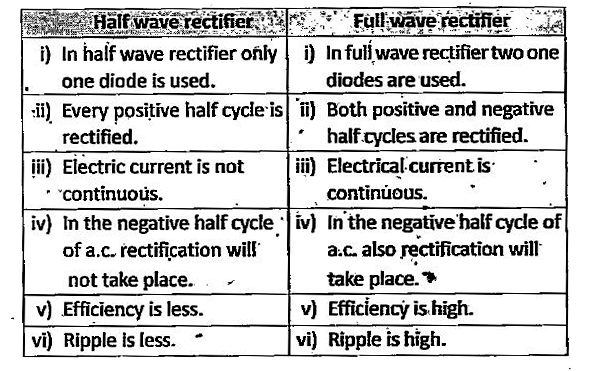
Comparison Table: Half Wave vs Full Wave Rectifier
Conclusion
Both half wave and full wave rectifiers play a vital role in converting AC into DC. While the half wave rectifier is simple and cost-effective, its efficiency is low. On the other hand, the full wave rectifier provides a smoother and more efficient DC output, making it ideal for high-power applications such as Emco Brake systems. The choice between the two depends on the application requirements, efficiency, and cost considerations.
메타데이터
- post_id
- d0eaee8cb9fd
- slug
- what-are-half-wave-and-full-wave-rectifiers-d0eaee8cb9fd
- url
- https://medium.com/@buzzlift/what-are-half-wave-and-full-wave-rectifiers-d0eaee8cb9fd
- canonical_url
- https://medium.com/@buzzlift/what-are-half-wave-and-full-wave-rectifiers-d0eaee8cb9fd
- author_url
- https://medium.com/@buzzlift
- status
- ok
- fetched_at
- 2026-06-27 10:07:59