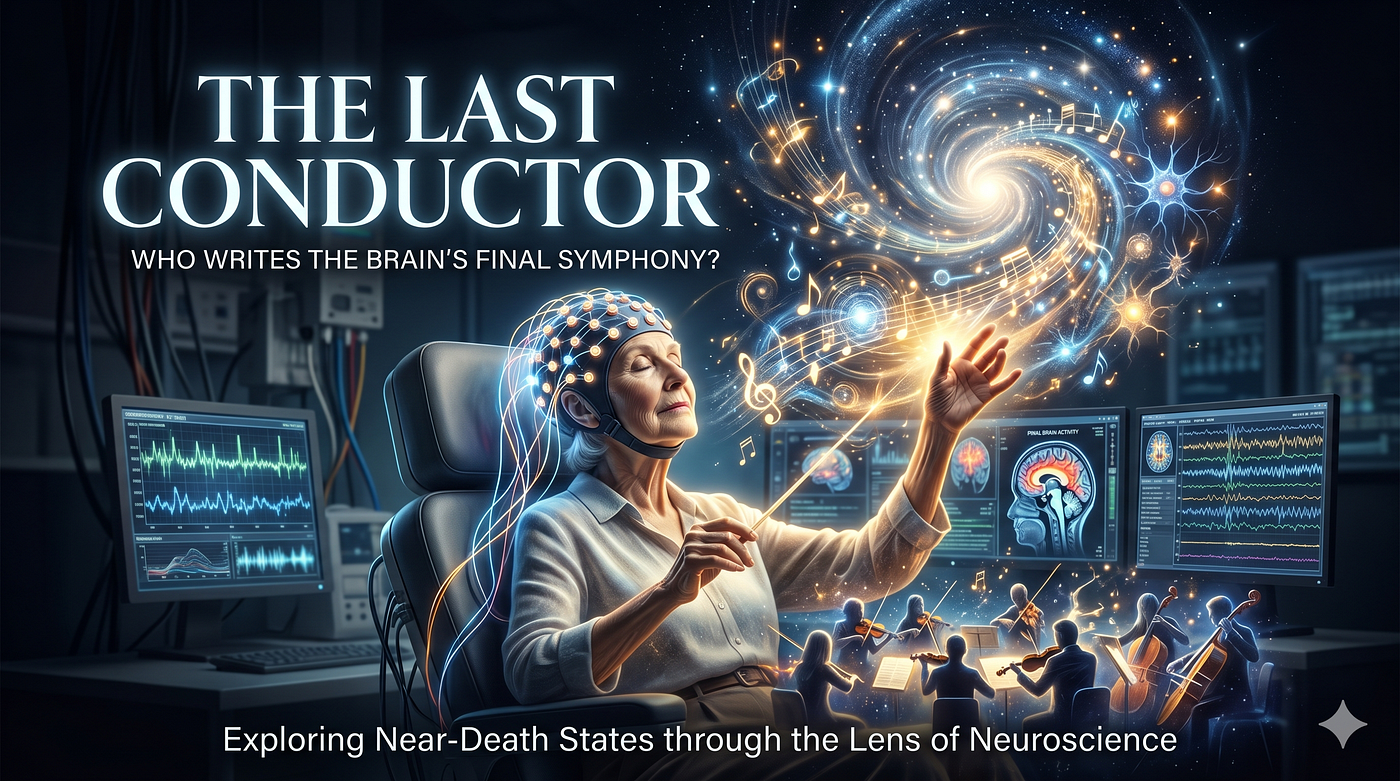
The Last Conductor: Who Writes the Brain’s Final Symphony?
M. Yeghiyan Part 2 of the series: “Life and Death, Sleep and Awakening”
The Last Conductor: Who Writes the Brain’s Final Symphony?
M. Yeghiyan Part 2 of the series: “Life and Death, Sleep and Awakening”
Preamble
In our previous discussion, we explored the brain as an orchestra, with the Default Mode Network (DMN) acting as the conductor — gathering scattered memories into a final symphony before silence. We asked a question: if this is a symphony, who or what writes its score?
The answer we arrived at was elegant, yet left room for mystery: perhaps life itself.
Today, armed with new findings and bold hypotheses, we take a step further. We examine the mechanics of the final phenomenon — the choreography of neurons, molecules, and electrical rhythms that science is only beginning to decipher.
And perhaps we may approach the central question: Is death a passage into nothingness — or the brain’s final, extraordinarily complex act of creation?
The Final Surge
In 2022, a team led by Ajmal Zemmar recorded something that captured the scientific community’s attention. EEG monitoring of an 87-year-old patient revealed not silence, but a surge of gamma oscillations — rhythms associated with integrated conscious processing — occurring around the time of cardiac arrest.
More recently, research from the University of Liège reported that approximately one-third of participants undergoing induced hypoxia (syncope) described experiences phenomenologically similar to near-death experiences. During these episodes, EEG signals displayed increased complexity in regions associated with self-referential processing.
Taken together, these observations suggest something profound:
The brain does not simply fade into inactivity. It may enter a state of heightened dynamical integration.
A Machine That Dreams Reality: Predictive Coding
Why would such a state emerge?
Predictive coding offers a powerful framework. The brain can be understood as a hierarchical prediction-generating system that continuously constructs models of the world and updates them through sensory input. External reality functions as a calibration signal.
At the moment of cardiac arrest, this calibration collapses. Sensory input vanishes.
Prediction error can no longer be minimized through model updating. The hierarchical structure of inference destabilizes.
Only one strategy remains: generation.
In the absence of external constraints, the brain may shift into a free-running generative mode — reconstructing reality from stored models, emotionally salient memories, and deeply learned patterns.
The DMN — once coordinating the self within the world — may now orchestrate an internally generated reality for a final observer.
The Chemistry of Transition
Such a symphony requires instruments.
Melatonin and N,N-dimethyltryptamine (DMT) share structural similarities as tryptamines and are both associated with deep regulatory processes. Melatonin governs circadian transitions and promotes sleep by modulating wake-stabilizing systems such as orexin — a neuropeptide crucial for maintaining arousal.
Under extreme metabolic stress, endogenous tryptamines, including DMT, may participate in modulating perception, although their precise functional role remains hypothetical.
Dean et al. (2019) confirmed the presence of DMT in mammalian brain tissue, while Borjigin and colleagues demonstrated complex surges in neural coherence and connectivity during cardiac arrest.
Additionally, studies from Imperial College London (2018) reported striking phenomenological similarities between DMT-induced states and near-death experiences.
Whether DMT acts as an active mediator or represents an epiphenomenon remains unresolved. Yet its presence suggests a potential molecular layer within the transition process.
The Witness: DMN and the Last Self
Where does this final act unfold?
The Default Mode Network can be understood as the neural infrastructure of autobiographical coherence — the system that maintains a model of the self across time.
It becomes active when we remember, imagine, and reflect.
In deep sleep, DMN activity diminishes. Yet during hypoxic transitions, increased signal complexity has been observed in self-related cortical regions.
This suggests not passive collapse — but active integration.
In the original Greek sense of agon — a struggle — the system may be attempting to preserve coherence, integrating lived experience into a final unified state.
An inverse perspective emerges from Cotard syndrome: individuals who believe themselves to be dead often exhibit markedly reduced DMN activity.
To experience oneself as alive, the network must resonate.
At the threshold of death, it may resonate most intensely.

Figure 1. Comparison of neural connectivity during normal wakefulness and the terminal state. While baseline activity is anchored by external sensory inputs (Bottom-Up), the final surge is characterized by intense internal hypersynchrony within the Default Mode Network (Top-Down Generative Mode).
Epilogue: A Choreography We Are Only Beginning to Hear
So what do we see when we look behind the curtain?
Not chaos. But choreography:
Circadian rhythms mark time — day and night, life and death. Orexin and melatonin regulate the thresholds of wakefulness and sleep. Predictive coding, deprived of sensory input, shifts toward internal generation. The Default Mode Network becomes the stage for this final construction. Gamma rhythms bind distributed memories into a coherent whole. Endogenous neurochemistry may modulate the subjective tone of this process.
We do not know what the conductor feels in the final moment before the orchestra falls silent. But we are beginning to understand how the score might be written.
And perhaps the most important insight is this:
Death may not be a system error, nor merely a shutdown. It may represent the brain’s final integrative act — the culmination of a life spent predicting, modeling, and making sense of the world.
When the world disappears, the brain may reconstruct it from within — from what mattered most.
The miracle of entering the light is a magnificent symphony of life — loud, clear, and oriented toward the future. Yet the final symphony, played before the transition into another realm, is no less profound.
It is dramatic, because it is farewell. But it is also beautiful — because within this final burst of neural activity, within this last dance of molecules and memories, resides the universe’s love for the human being.
A love that allows us to leave — granting us, in the final moment, the greatest work of art: our own life, seen in its entirety.
The ending remains open.
What happens when the final note fades? Will anyone hear it?
The answer lies beyond neuroscience.
Yet the very fact that we can ask this question — grounded in neurophysiology and molecular biology — makes us not merely observers, but co-authors of this timeless narrative.
References
-
Vicente, R. et al. (2022). Enhanced Interplay of Neuronal Coherence and Coupling in the Dying Human Brain. Frontiers in Aging Neuroscience.
-
Borjigin, J. et al. (2013). Surge of neurophysiological coherence and connectivity in the dying brain. PNAS.
-
Dean, J. G. et al. (2019). Biosynthesis and Extracellular Concentrations of DMT in Mammalian Brain. Scientific Reports.
-
Strassman, R. (2001). DMT: The Spirit Molecule.
-
Zemmar, A. et al. (2022). First-ever recording of the dying human brain shows waves similar to memory flashbacks.
메타데이터
- post_id
- d0fac2bf9e3b
- slug
- the-last-conductor-who-writes-the-brains-final-symphony-d0fac2bf9e3b
- url
- https://medium.com/@marukeyeghiyan/the-last-conductor-who-writes-the-brains-final-symphony-d0fac2bf9e3b
- canonical_url
- https://medium.com/@marukeyeghiyan/the-last-conductor-who-writes-the-brains-final-symphony-d0fac2bf9e3b
- author_url
- https://medium.com/@marukeyeghiyan
- status
- ok
- fetched_at
- 2026-06-09 15:37:30