What the Funk? Artists Who Went Back to the Well [Pt 6]
No originals, no safety net: the artists who recorded entire albums they didn’t write, and justified every note
What the Funk? Artists Who Went Back to the Well [Pt 6]
No originals, no safety net: the artists who recorded entire albums they didn’t write, and justified every note
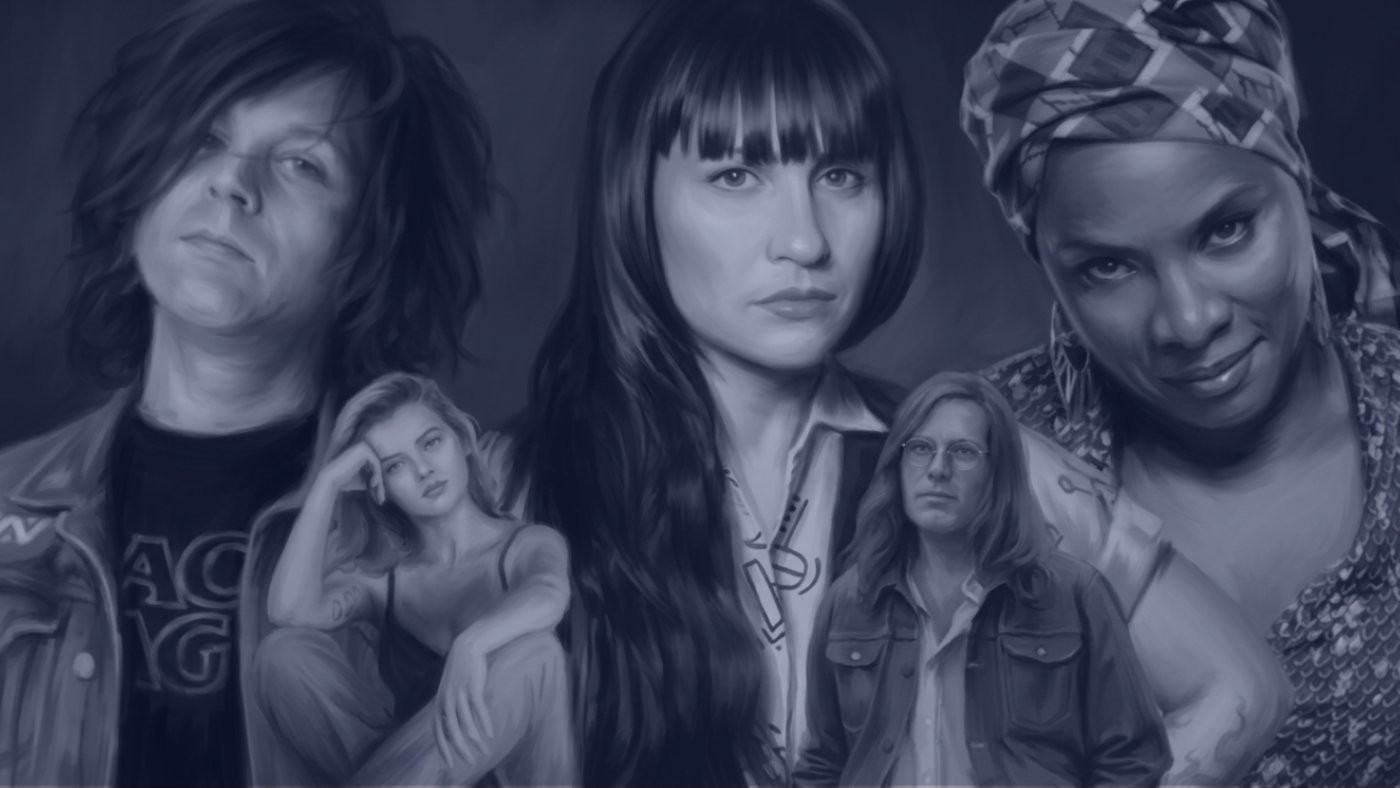
Ryan Adams, Rosie Carney, Frankie Rose, Fruit Bats, Anjelique Kidjo. Image: AI generated in Canva by author
This is where the series takes its most audacious turn.
The previous five instalments concerned artists returning to their own material — their own songs, their own albums, their own unfinished arguments with work they’d already released. The impulse was familiar even when the results were surprising: a creator circling back, reassessing, finding something left to say.
Part 6 removes that safety net entirely. These are artists who took on albums they didn’t write, didn’t record first, and had no obvious claim to — and recorded them in full anyway. Not tribute acts. Not karaoke at scale. Artists who looked at someone else’s landmark record and decided they had a perspective on it worth committing to tape.
It is, by any measure, the most exposed position in this series. There is nowhere to hide when the comparison is that direct. The albums that follow earned their place here by not flinching.
1. 1989 — Ryan Adams [2015]
The concept arrived pre-loaded with irony that Adams refused to use. A 40-year-old Americana veteran covering the biggest pop album in the world track by track could have been a knowing wink, a stunt, a joke at someone’s expense. Instead he played it entirely straight, processing Taylor Swift’s synth-pop through the emotional register of a man in the middle of a collapsing marriage, finding in her romantic exuberance something that sounded, to his ears, like his own melancholy. The results split critics along predictable lines. Admirers heard the songs’ underlying architecture revealed; detractors heard Adams simply absorbing everything into his default mode of weariness. Both readings hold. *Out of the Woods stretched to six minutes of aching regret earns its transformation; Shake It Off* rendered as a brooding dirge mostly doesn’t. The deeper problem is that Swift’s melodies were engineered for a specific kind of impact, percussive and precise, and Adams’ arrangements occasionally flatten what they intend to honour. That Swift herself heard her own songs differently after living with his versions suggests the exercise wasn’t entirely without consequence — which may be the most honest measure of whether a cover album justifies itself.
[embed]
Nebraska — Ryan Adams [2022]
Nebraska was already a cover version of sorts — Springsteen recording demos so stark and unmediated that releasing them felt less like a creative decision than a confession. That accidental quality, the sense of a man alone in a room with a four-track and no plan to be overheard, is precisely what makes it both definitive and, paradoxically, open to reinterpretation. Adams approaches the material not as a curator but as a musician with his own ideas about what these songs might contain. The results are uneven and deliberate in roughly equal measure. *Johnny 99 finds a rockabilly energy the original never sought; State Trooper gets rebuilt around distortion and feedback that push it somewhere close to the Jesus and Mary Chain; [Reason to Believe](https://open.spotify.com/track/22QmX3RPF54ctUzndoNKDl?si=7f7a3c5416dc4e87)* loses its acoustic spine entirely, replaced by solitary piano. Where Adams follows Springsteen closely, the exercise feels redundant. Where he doesn’t, it earns its existence. That the album was released for free suggests Adams understood the terms of the gamble: this was homage and argument simultaneously, and charging for it would have tipped the balance toward vanity.
[embed]
Blood On The Tracks — Ryan Adams [2022]
Covering your favourite album by your favourite songwriter is either the most personal thing an artist can do or the most reckless, and Adams, releasing Blood on the Tracks as a free download on Christmas Eve at the end of a year in which he’d already issued five other albums, seemed disinclined to treat the distinction as meaningful. The liberties are considerable: verses cut, tempos altered, instrumental codas added that push the runtime 20 minutes beyond Dylan’s original. It’s hard to understand why Adams went here though. He sounds tired, the songs are listless and feel like he’s still working out how to attack them. All in all, this reeks of a home recording that should have stayed in the vault.
[embed]
Morning Glory — Ryan Adams [2023]
By the third instalment of his unofficial covers trilogy, Adams had developed an identifiable methodology: strip everything back, drench in reverb, locate the melancholy underneath the bravado, and release it for free before anyone can object. Applied to Nebraska it yielded genuine insight; applied to Blood on the Tracks it produced something personal. Applied to Morning Glory, the approach begins to reveal its limits. Oasis built its second album on density and urgency, on songs that demanded to be heard at volume by large numbers of people simultaneously, and Adams’ acoustic deconstruction drains that quality without replacing it with anything comparably vital. The inclusion of B-sides and a reshuffled tracklist suggests ambition, but the execution too often settles into singer-songwriter sludge. His Wonderwall simply replicates the 2004 version that made his reputation. The songs survive, as good songs tend to. Like Blood on the Tracks, this album struggles to find an argument for its own existence.
[embed]
2. Anjelique Kidjo — Remain In Light [2018]
The most searching question a cover album can ask is not whether it can replicate the original, but whether it has any business existing alongside it. Kidjo answers that question before the first track ends. Where Talking Heads approached Afrobeat as inspired outsiders, assembling polyrhythms they’d absorbed intellectually, Kidjo arrives from inside the tradition, returning music shaped by African influence to African hands with an authority the original never claimed. The effect is less reversal than completion. Songs that Byrne delivered with a cerebral detachment find in Kidjo’s voice something visceral and grounded; *Listening Wind, queasy and dissociated in the original, becomes under her stewardship something closer to testimony. Tony Allen’s presence behind the kit on several tracks removes any residual approximation from the rhythms, replacing studied recreation with the real thing. The moments of loss are minor: [Crosseyed and Painless](https://open.spotify.com/track/4Mv2cCZWORGFV6rbiRCWZX?si=a5b1b73a664f4fbc) trades nervous energy for danceability, not an unfair exchange but a different one. What Kidjo builds overall is not a tribute so much as a reckoning — a record that hears what Remain in Light* was reaching for and decides, quietly, to show how it might actually get there.
[embed]
3. Rosie Carney — The Bends [2020]
The Bends was always two albums in uneasy coexistence: the one that bristled with Jonny Greenwood’s squalling guitar and Thom Yorke’s barely contained fury, and the one underneath, anxious and tender and frightened of its own shadow. Carney, recording alone during lockdown on GarageBand before her co-producer added strings and woodwind remotely, had no interest in the first album. She went straight for the second. The result is celestial and occasionally revelatory, stripping the record’s prickly outer skin to find the existential dread beneath, which turns out to translate naturally into folk minimalism. *Bullet Proof… I Wish I Was barely needs rearranging; [Sulk](https://open.spotify.com/track/4cfg8WolVMlPbpYJWp6iCI?si=1b4c2749ecf34354), given layered vocals and a vocoder, becomes something genuinely strange and new. The losses are real: listeners drawn to the album’s restless anger will find little purchase here. But Carney’s achievement is less a cover than a reframe — proof that The Bends* contained multitudes its original arrangements never fully let breathe.
[embed]
4. Fruit Bats — Siamese Dream [2021]
Siamese Dream was Billy Corgan’s monument to maximalism, built on guitar tones so distinctive they became their own argument against covering the album at all. Eric D. Johnson, recording alone during lockdown under his Fruit Bats alias, had the good sense not to argue back. Instead he approached the material as if reconstructing it from memory, following wherever his imagination led rather than competing with the source. The results trade Corgan’s crushing weight for something hazy and intimate, dream-pop where there was once alt-rock, campfire warmth where there was cathedral noise. The risk with this approach is that stripped-back versions reveal songwriting rather than improve on it, and Siamese Dream’s bones are strong enough to bear the scrutiny. *Quiet refashioned as a collage experiment and [Geek U.S.A.* ](https://open.spotify.com/track/7tq5jJxG6Rz2RZll5lA0qV?si=0f5d6460a72047fb)rendered almost a cappella suggest genuine creative curiosity rather than mere affection. Johnson’s version won’t displace the original in anyone’s memory. It doesn’t need to. It occupies a completely different frequency — a fond, inventive parallel version of an album that, it turns out, was always hiding a quieter self inside all that noise.
[embed]
5. Frankie Rose — Seventeen Seconds [2017]
Seventeen Seconds was always The Cure at their most austere, Robert Smith stripping back the post-punk clutter to find something colder and more skeletal underneath. Rose, arriving from Brooklyn’s indie scene with a songwriting instinct tuned to similar frequencies, doesn’t so much reinterpret the album as inhabit it, keeping faith with the original’s palette while pressing her own voice into the spaces the source material left deliberately empty. The results are more homage than reinvention, which carries its own risks. Where the album finds its footing, particularly on M and the widescreen atmospherics of *A Forest, Rose’s ear for drama and her feel for the period’s gothic textures make the exercise worthwhile. Elsewhere the pace becomes a liability, with several mid-album tracks settling into a pleasant but undifferentiated walking tempo. The novel idea of covering an album this specific rather than an artist this beloved gives Seventeen Seconds* a niche appeal it largely deserves.
[embed]
Related reading
Artists Who Went Back to the Well [Pt 1]
Artists Who Went Back to the Well [Pt 2]
Artists Who Went Back to the Well [Pt 3]
Artists Who Went Back to the Well [Pt 4]
Artists Who Went Back to the Well [Pt 5]
메타데이터
- post_id
- d1038d56d5ba
- slug
- what-the-funk-artists-who-went-back-to-the-well-pt-6-d1038d56d5ba
- url
- https://medium.com/big-list-energy/what-the-funk-artists-who-went-back-to-the-well-pt-6-d1038d56d5ba
- canonical_url
- https://medium.com/big-list-energy/what-the-funk-artists-who-went-back-to-the-well-pt-6-d1038d56d5ba
- author_url
- https://medium.com/@sacott66
- status
- ok
- fetched_at
- 2026-07-08 18:29:56