The Google Ads Format Question Nobody Asks Before Spending — and Why the Answer Changes Everything
By Sandip Sahani — Founder, Sanrovax
The Google Ads Format Question Nobody Asks Before Spending — and Why the Answer Changes Everything
By Sandip Sahani — Founder, Sanrovax
There is a question I ask every business that comes to me saying Google Ads did not work for them.
Not “what was your budget?” Not “what keywords did you target?” Not “what was your CTR?”
The question is: which type of Google Ad were you actually running?
The answer, a significant portion of the time, reveals the entire problem. Not targeting. Not budget. Not creative. Format. The business ran the wrong type of Google Ad for what they were actually trying to accomplish — and then drew the conclusion that Google Ads as a platform failed them.
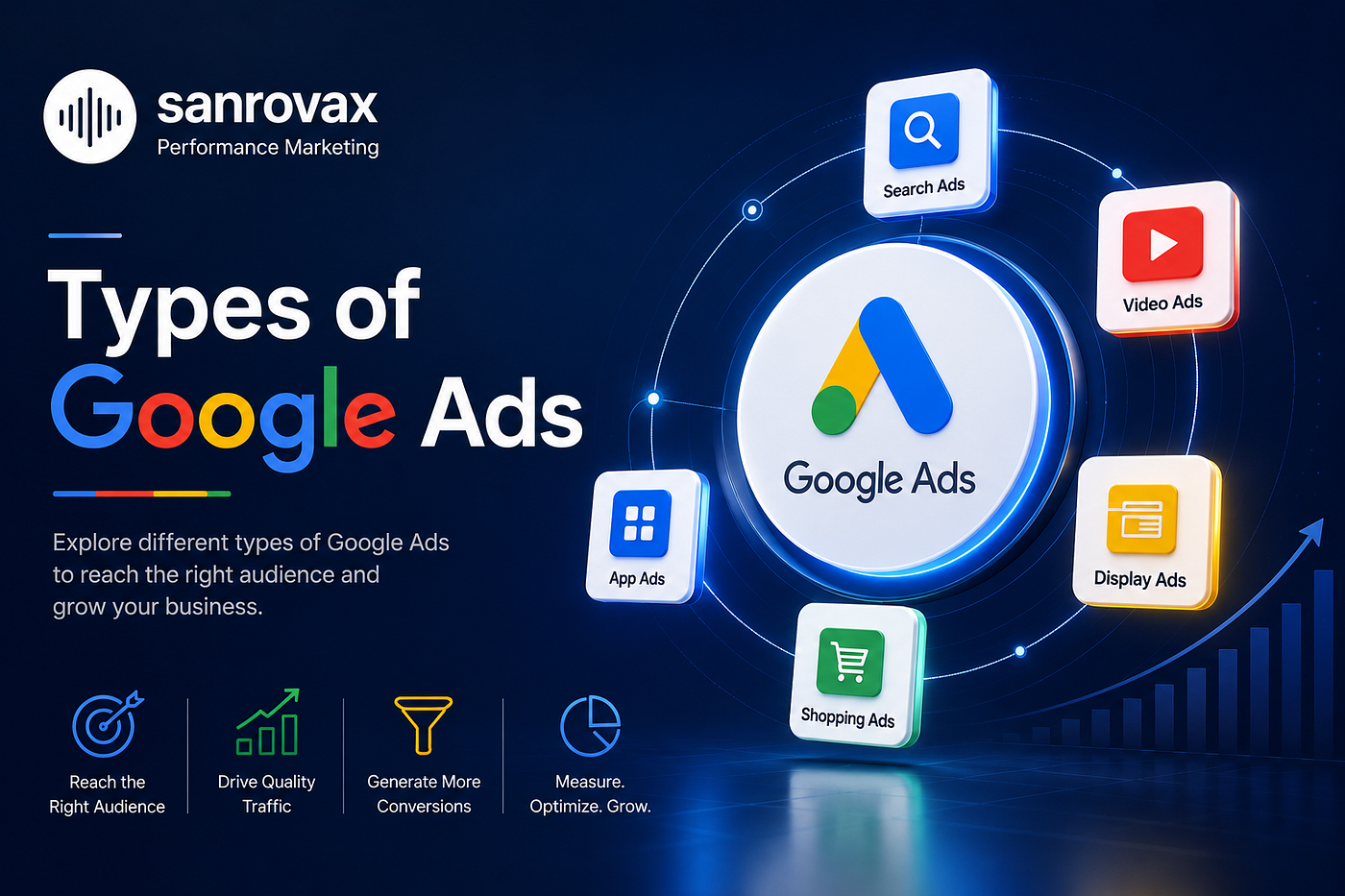
This is a fair mistake to make. There are nine distinct types of Google Ads. Most guides treat them as a checklist to memorize rather than a decision framework to reason through. And Google’s own interface, particularly for new advertisers, nudges toward Smart Campaigns and Performance Max — formats that hide their mechanics behind AI automation, making it difficult to diagnose what went wrong when results do not materialize.
I want to walk through all nine — not as a list, but as a decision problem. Because the type question is not about what each format is. It is about which stage of the customer journey your campaign is trying to reach.
The Distinction That Changes Everything
Before any conversation about format, there is one variable that should be established first: is your target customer actively searching for what you sell, or do they not yet know they need it?
This is not a subtle distinction. It is the load-bearing structure of the entire format decision.
Search Ads — and Shopping Ads, their e-commerce equivalent — work when demand already exists. When a meaningful number of people in your target geography are typing queries into Google that relate to your product or service, Search captures that demand at its most valuable moment. The user is already interested, already looking, and already comparing options. Your ad appearing at that moment is genuinely helpful to them, not an interruption.
Display Ads, Demand Gen, and Video Ads work when demand needs to be created or discovered. When the right audience for your product does not yet know your brand, or does not yet know they need what you sell, or is not yet in an active-search frame of mind — these formats reach them in browsing and discovery contexts. The expectation is recognition and consideration, not immediate conversion.
This is the diagnosis most businesses skip. They choose a format based on what sounds right, or what their competitor seems to be running, or what Google’s interface defaults toward — without establishing whether their customer is in search mode or discovery mode at the point where the campaign should reach them.
Running Search Ads when your product has no existing search volume is paying CPC rates to win auctions that barely exist. Running Display Ads to cold audiences and expecting conversion rates comparable to Search is misunderstanding what the format is built for. Both mistakes are common. Both are entirely avoidable with a single diagnostic question answered first.
What I Have Actually Seen Fail — and Why
Let me be specific about the failure patterns, because they are more instructive than a clean explanation of what each format is supposed to do.
The most expensive mistake I encounter regularly is Performance Max on a new account. Google actively promotes Performance Max to new advertisers, and the pitch is compelling: one campaign, every Google surface, AI does the optimization. What the pitch omits is the data requirement. Performance Max learns from conversion signals. With fewer than 50 conversions per month, the AI has insufficient data to optimize meaningfully — it is effectively guessing, and you are paying for those guesses. New accounts with zero conversion history, running Performance Max, consistently produce results that look like the platform does not work. The platform works. The format requirement was not met.
The second mistake is Display Ads treated as a conversion channel for cold audiences. Display Ads at ₹10–45 CPM can reach a large audience cost-efficiently. They are genuinely useful for retargeting — showing your brand to users who visited your website and left, creating the reminder that sometimes tips a consideration-stage user into a purchase decision. But cold Display traffic — users who have never heard of your brand, reached while they are reading a news article or playing a mobile game — converts at rates that make cost-per-acquisition numbers look alarming. This is not a problem to fix with better targeting or better creative. It is the format doing exactly what it is built to do, which is awareness-level reach, not conversion-level performance.
The third is the Shopping Ads gap among Indian D2C brands. Shopping Ads deliver 76% more clicks than text ads for the same product queries. For any business selling physical products online, this is not a marginal improvement — it restructures the economics of Google advertising for the product. Yet a significant number of Indian D2C brands run only Search text ads, either because Merchant Center setup felt complex or because nobody told them Shopping was the right starting point. The setup cost is a one-time friction. The performance difference is persistent.
The Format That Is Most Underused Among Indian Businesses
I want to call out Demand Gen specifically, because I think it represents the largest gap between what Indian businesses are actually running and what would serve them well.
Demand Gen campaigns — visual, social-style ads running across YouTube’s home feed and Shorts, Gmail, and Google Discover — reach 3 billion monthly active users across surfaces most Indian businesses have not considered as advertising real estate. The format is intentionally similar to Meta Ads in its visual approach and discovery context. It is designed to reach users who are not searching but who are browsing content that signals potential category interest.
Most Indian D2C brands I encounter have tried Meta Ads and Google Search. Very few have tried Demand Gen — which means they are missing a format that sits natively on YouTube’s home feed (where India’s 500 million YouTube users spend significant daily time) and in Google Discover (the personalized content feed that is the default home screen on hundreds of millions of Android devices in India).
The comparison I use: if Meta Ads are building awareness for people scrolling Instagram, Demand Gen is building awareness for people scrolling YouTube’s home screen and their morning Google Discover feed. Both contexts are browsing. Both are discovery-stage. The difference is which platform’s ecosystem you are spending in.
The Format That Gets Oversold — and the Honest Version
Performance Max deserves a more specific treatment than “it needs 50 conversions” — because the nuance matters for how you think about it.
PMax works well as a scaling tool. When an account has conversion history, a clean Pixel setup, a strong creative asset library, and a goal of increasing volume at a target ROAS — PMax’s AI, optimizing simultaneously across Search, Shopping, Display, YouTube, Gmail, and Discover, can identify performance opportunities that a human manager running separate campaigns for each channel would not find as efficiently.
What PMax does not work well for is learning. The automation removes visibility into where budget is being spent and which placements are converting. A new advertiser running PMax cannot extract the keyword-level data that Search campaigns provide, the audience-level data that Display campaigns provide, or the placement-level data that Video campaigns provide. PMax produces consolidated results without the diagnostic signal that tells you what is working — which means you cannot improve the things that are not.
My practical recommendation: build the foundation with Search (for demand capture) and Display (for retargeting) for the first 60–90 days, reach 50+ conversions per month, and then introduce PMax as a scaling layer on top of those proven foundations — not as the starting point.
The 2026 Development Worth Watching
Google’s AI Mode Ads — placements within AI-generated search overviews — are now live in early markets and expanding. These placements appear above traditional Search results, inside the AI-generated answer itself. Early data suggests higher CPCs than traditional Search but potentially stronger engagement, given that the user is reading an AI-generated response about a topic when the ad appears.
For Indian businesses in categories where appearing alongside AI recommendations carries meaningful weight — healthcare, financial services, SaaS, professional services — this format is worth monitoring. The mechanics are still evolving, but the direction is clear: search advertising is expanding from the list of blue links into the AI-generated answer layer above it. The businesses that understand this early have more time to build presence in that layer before it becomes as competitive as traditional Search.
The Format Decision, Simplified
After all of this, the practical framework is not complicated.
If customers search for what you sell — start with Search. Add Shopping if you have products and Merchant Center can be set up. Build retargeting Display campaigns once your Pixel has collected website visitor data.
If customers don’t yet know they need you — start with Demand Gen or Video. Build awareness first, then layer Search once your brand is recognized enough to generate search volume.
If you have a mobile app — App Campaigns, India CPI economics make this viable at lower budgets than most markets.
If you are scaling with proven conversion data — add Performance Max as a channel multiplier, not a starting point.
The goal is matching the format to the stage of the customer journey — not picking the format that sounds most sophisticated, or that Google’s interface makes easiest to set up, or that a competitor appears to be running. The customer journey is the map. The format is the vehicle. Using the wrong vehicle on the right map still gets you lost.
Complete guide with India-specific pricing for all 9 formats, industry-wise recommendation table, budget tier guide, and 10-question FAQ: sanrovax.com/types-of-google-ads
Book a call: sanrovax.com
Sandip Sahani is the Founder of Sanrovax, a performance marketing agency based in West Bengal, India, working with Indian and Australian businesses on Meta Ads, Google Ads, YouTube, JioHotstar, and full-funnel growth systems.
Follow me on Medium for more on Indian digital advertising and performance marketing.
메타데이터
- post_id
- d10fee36d2b3
- slug
- the-google-ads-format-question-nobody-asks-before-spending-and-why-the-answer-changes-everything-d10fee36d2b3
- url
- https://medium.com/@sanrovax/the-google-ads-format-question-nobody-asks-before-spending-and-why-the-answer-changes-everything-d10fee36d2b3
- canonical_url
- https://medium.com/@sanrovax/the-google-ads-format-question-nobody-asks-before-spending-and-why-the-answer-changes-everything-d10fee36d2b3
- author_url
- https://medium.com/@sanrovax
- status
- ok
- fetched_at
- 2026-06-27 23:56:40