Listen to the Mockingbird
A different kind of melody
Listen to the Mockingbird
A different kind of melody
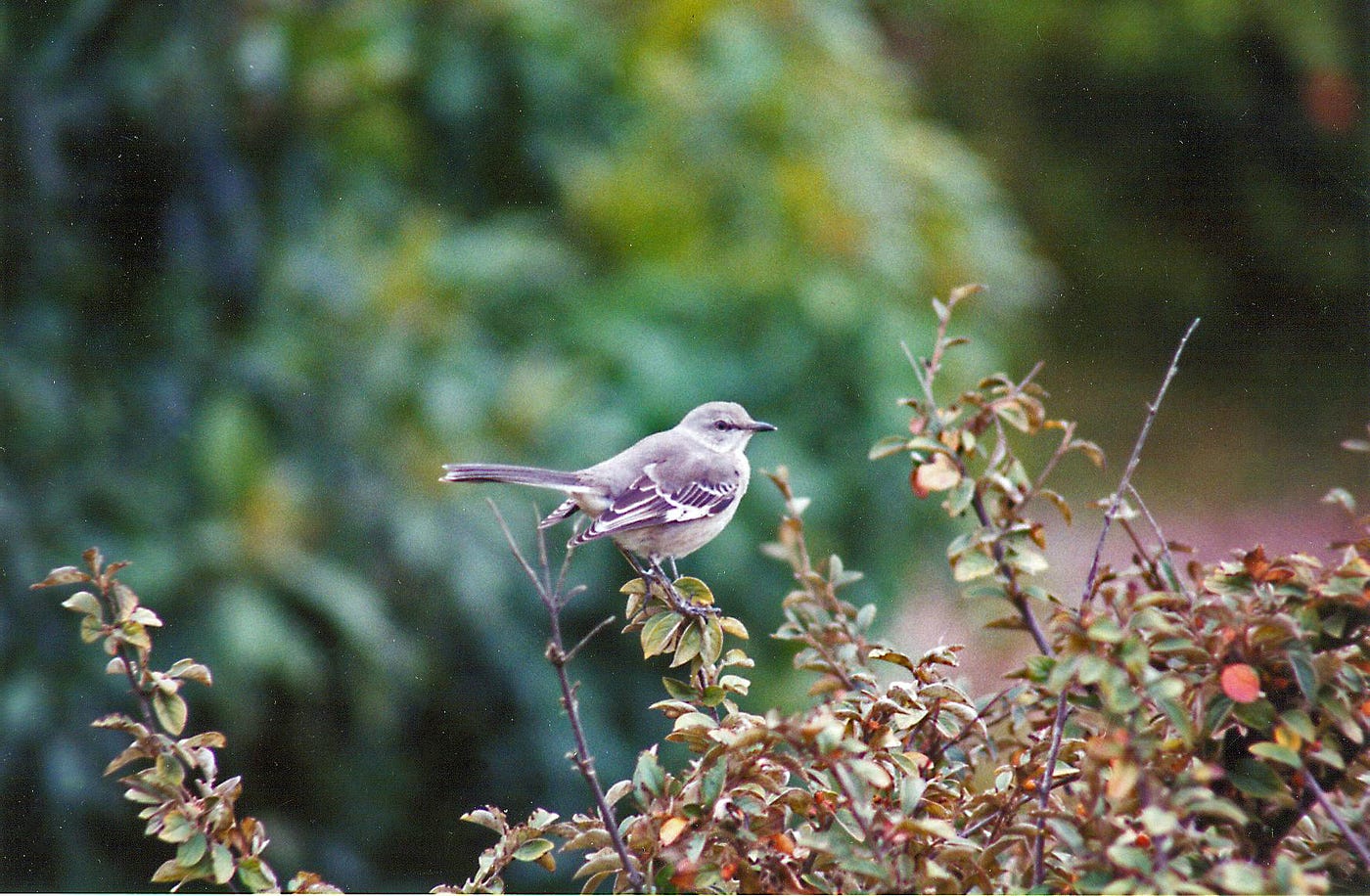
Northern Mockingbird in the garden — Photo by Ruth Ann Angus
As birds go, most are beautiful, gracing us with their chirruping songs. There are a few, however, that are downright annoying, among them the rooster with his crowing, the crow and the jay with their raucous songs, the gull with his squawking, the wild turkey’s gobble-gobble, but especially the mockingbird.
I like birds, I really do. They are one of the reasons I settled in Morro Bay, California, years ago. It is a treat to see the scampering steps of a family of California quail as they charge out from the bushes on the countryside trails. And it is refreshing to watch the graceful gliding of the flights of egrets and herons, their necks in a loop, their long legs trailing behind them. What fun to watch the sanderlings racing the incoming waves at the beach as they peck in the sand for tiny crustaceans. Yard birds perch on the fences and search the lawn and the garden for a morsel. In early mornings, we listen to their wake-up serenade.
Silence is golden, but none more so than when it is continually shattered by sounds that should not be heard in the dead of night. This is the problem with the mockingbird. It is just as miserable to be kept awake with the song of this bird as it is to listen to the incessant barking of a dog. Why is it I am hearing it at midnight? Doesn’t this bird ever sleep?
Mockingbirds are year-round birds in my area, but I don’t usually see or hear them until springtime. Every year, one bird shows up and takes residence in the Japanese Maple tree across the street. I doubt that this is the same bird every year since I have lived here for 40 years, but a little research told me that they live about eight to ten years, sometimes as much as 15 years. So, I think it is safe to say that for a while, the same bird has been singing, endlessly, in or near that tree for a long time.
Our most recent tenant likes to fly from the tree to the power line, and I am greeted by him every time I open the door. The thing is, it often sounds like ten or more birds singing all at once. Mockingbirds are great mimics.
Some years, there has been evidence of a nest in the tree, and then two mockingbirds are seen perched on the wire, singing away. They are monogamous, at least for the nesting season, although there are incidences where pairs have stayed together for life. I wonder if that is the case with our recent situation. Weeks ago, I watched as two of them flew about, swirling and plunging at each other. Looked like a mating dance to me. But since then, only one bird has been serenading from the wire. This is most likely a male looking for a mate, since he sings all night long. This gets more intense during the full moon.
One thing is for sure: they are definitely territorial and do not allow any other species to violate their space. It doesn’t matter if it is another mockingbird, a crow, or a finch; if it comes within a few feet of the tree, the mockingbird is there, and then all hell breaks loose. The mockingbird flies around and around the invading bird with its legs extended, flapping its wings — all the time screaming at its enemy. It doesn’t take long for the invader to leave.
When things calm down, Mr. Mockingbird flies down to my side lawn, switches his head left and right to see if the coast is clear, and proceeds to peck away at the grass, while hopping and running along the length of the yard. They have a diverse diet, and this one appears to find all kinds of delicious morsels for his meal.
During the 19th century, mockingbirds were kept as pets in cages. Collectors took birds out of nests or trapped adult birds and sold them in major eastern cities. If the bird was an extraordinary singer with a large repertoire, they brought in substantial money.
Up to 200 songs can be in a male’s selections, and they add songs throughout their life. Female birds sing too, but not as much or as often as the males, and rarely in the summer, while males seem to have two distinct collections of songs, one in the spring, from February to August, and one in the fall, from September to November.
It is June now, and so the serenades day and night will go on. Maybe Mr. Mockingbird will finally find a partner and start a family. Maybe, then, he will shut up for a while as Mrs. Mockingbird chides him for keeping the babies awake. I will buy earplugs in the meantime, waiting for the end of the concert season in November.
메타데이터
- post_id
- d113fd8c045b
- slug
- listen-to-the-mockingbird-d113fd8c045b
- url
- https://medium.com/gardening-birding-and-outdoor-adventure/listen-to-the-mockingbird-d113fd8c045b
- canonical_url
- https://medium.com/gardening-birding-and-outdoor-adventure/listen-to-the-mockingbird-d113fd8c045b
- author_url
- https://medium.com/@yeswecanpeacebuilders1
- status
- ok
- fetched_at
- 2026-06-09 15:37:30