50th Edition. The Floor is Theirs: Testimonies in Defense of Vieira
Between the Silence of the Law and the Voice of Literature: The Struggle for Memory and Authenticity
50th Edition. The Floor is Theirs: Testimonies in Defense of Vieira
Between the Silence of the Law and the Voice of Literature: The Struggle for Memory and Authenticity
Would you prefer to read the 50th Edition of “Twin Minds: Alba & Anton” in PORTUGUESE? CLICK HERE: 50ª Edição. A Palavra é Deles: Testemunhos em Defesa de Vieira
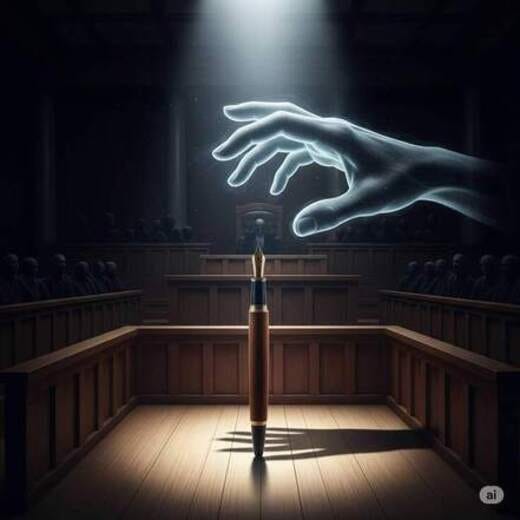
Figure 01. Illustration created via Google Gemini AI: Judging Authorship — a pen stands trial, with the spectral hand of an absent author as its only witness.
✍️ Dear readers,
This edition dares to challenge the boundaries of judicial verdicts, unveiling the grey areas of literary creation, where authorship, authenticity, and legacy intertwine far beyond legal formalities.
Beyond Plagiarism: A Debate on Ethics and Memory
This edition focuses on the testimonies of witnesses called by Vergílio Vieira — friends, jurists, and academics — who defended his work as a legitimate homage, invoking intertextuality and creative freedom.
Henrique Barreto Nunes, Armandina Maia, José Manuel Mendes, Luso Soares, Ernesto José Rodrigues, José Luís Pires Laranjeira, and Jorge Henrique Bastos brought to court arguments that, though often misunderstood by legal scrutiny, revealed the true complexity of speaking on behalf of those who can no longer defend themselves.
This case transcends the courtroom, exposing the abyss between the language of law and that of literature — a theme we will explore in depth following our review of the testimonies.
The Invisible Conflict in the Court Records
While the court judged “acts,” this edition asks: Who protects the voices of the dead? Vieira’s defense, grounded in “borrowed voices,” clashed with the family’s demand for authenticity — a collision between literary ethics and legal norms, between memory and interpretation. Vieira’s own admission of having altered Alba’s texts reveals the very core of this conflict: to what extent does literary recreation honor the original voice?
As Twin Minds: Alba & Anton continues, we invite you to reflect: Can a court, by reducing literature to “evidence,” ever capture the true breath of a work? The testimonies shared here, woven between eloquent silences and passionate defenses, are crucial for answering that very question.
Enjoy your reading!
The editor — always impartial (or nearly so) — promises that this time, no voices were borrowed… only a few ellipses and perhaps the odd dramatic exclamation.
The Editor of “Twin Minds: Alba & Anton”


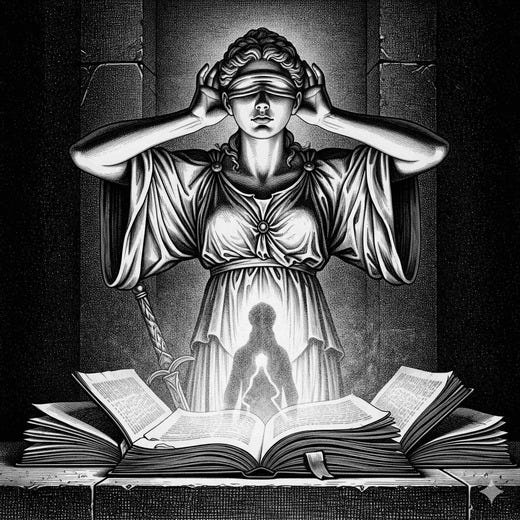
Figure 02. Illustration created via Google Gemini AI: Before the scales of Justice, can the letter of the law judge the spirit of the word? A courtroom in search of truth, at the epicenter of an ethical earthquake that questions the very limits of authorship.
I. Context of the Controversy and Transition to Trial
A brief recap of the legal proceedings brought by Vergílio Vieira against the family of Sebastião Alba, initiated by public allegations following the publication of the short story The Man Who Lost His Shadow (“O Homem que Perdeu a Sombra”) [1] included in the book The Library of Alexandria.
This edition’s framework: the focus is on the testimonies of witnesses summoned by Vergílio Vieira, who intervened in support of his claim, invoking creative freedom and the concept of intertextuality, contrasting with Vieira’s own testimony, addressed in the 48th Edition.
The dispute in question went far beyond a mere accusation of plagiarism, venturing into the deeper and more intangible realm of legitimacy — to speak on behalf of those who cannot defend themselves, to safeguard memory and legacy.

Figure 03. Illustration created via Google Gemini AI: Where the Law seeks facts, Literature defends the soul of a work. In the courtroom, manuscripts become the corpus delicti and memory the silent witness of a contested legacy.
II. Voices in Defense of Vieira: The Witnesses’ Testimonies
Vieira’s lengthy defense, which filled a third of more than two hundred pages of court transcripts, gained depth and substance through the testimonies of close figures, whose voices amplified and refined the arguments of the plaintiff.
1. The Reticent Guardian (Henrique Barreto Nunes)
Henrique Nunes, an acquaintance of the defendant Carlota Gonçalves and a friend of Vergílio Vieira, testified in court as someone with longstanding ties to the literary circles of Braga. He recalled meeting Sebastião Alba “regularly on the street where he lived.”
He considered the chapter “The Man Who Lost His Shadow” a “homage” to the poet, but the formality of the courtroom quickly dissolved that sentiment.
Questioned by the Prosecutor about passages transcribed without quotation marks or credit — including verbatim excerpts from Alba[2] — Henrique Nunes remained silent.
Faced with Nunes’s persistent silence during questioning by the plaintiff’s lawyer, the Judge intervened:
“Judge: Do you recall saying you would tell the truth?”
“Henrique Nunes: I believe I have the right not to answer.”
“Judge: Yes, yes, you have that right. I just wanted to remind you.”
“Henrique Nunes: (…)”
“Judge: All right, it’s your right…” Yet the witness continued to refuse to answer, leaving Vieira’s defense without responses to the most pointed criticisms.
After all, who needs answers when one can invoke the right to remain silent?
Nunes eventually admitted to having seen a “small literary sample” of Alba’s writings after his death — papers that were even publicly displayed at the library.
At times, the courtroom seemed less a place of justice and more a stage for literary monologues: all that was missing was the baton and the red curtain.
Regarding the relationship between the two writers, he described it as “a great friendship,” based on trust, suggesting that Alba had entrusted his manuscripts to Vieira “because of the friendship that united them.”
However, he acknowledged that he had never compared the estate’s texts with those Vieira published, nor did he know whether those manuscripts were in the public domain before publication.
Under the Judge’s insistence, his silence about the copied texts from Alba became the critical point of this testimony. Vieira’s defense thus missed the chance to refute the gravest accusations.
2. The Voice of Zeal (Armandina Maia)
Armandina Maia, a longtime friend of Vieira, described the devastating impact the accusations had on him:
“He was left deeply shaken… it became almost obsessive…”
For Maia, a writer’s name is part of their very existence, and the damage suffered went beyond mere reputation:
“… as far as I could tell, [Vieira] became the target of a heated campaign in the newspapers… If he had had another profession, this probably wouldn’t have happened. He was hurt in his heart, so to speak.”
Although she did not personally know Alba, she maintained that Vieira acted out of genuine zeal:
“If I had someone protecting my work the way Vergílio protected Alba’s, I would rest easy.”
She admitted that the family was troubled by the lack of attribution for some of Alba’s phrases in the text but attributed the conflict to communication failures, not to malice.
In a revealing moment, she put Alba’s legacy into perspective:
“To us, he is an important figure in literature, but that’s just for us. That doesn’t mean he’s important to the average Portuguese. Sebastião Alba is not quite Fernando Pessoa. I don’t know if he ever will be. I doubt it.”
3. The Frontier of the Law (Luso Soares)
Luso Soares, a jurist of distinguished reputation and former lawyer for the Portuguese Society of Authors (Sociedade Portuguesa de Autores) (1980–1990), took the stand with an authority evident in the impassive tone of his responses.
Having personal acquaintance with Sónia Gonçalves — the poet’s daughter and heir — and sharing with her a “great and sincere affection” for her father, Soares brought to the court a technical analysis, enriched by a profound ethical perspective on the case.
A law graduate with a solid historical-legal background, he classified the use of Alba’s unpublished texts as “abusive” — not simply due to any literary echoes, but because it omitted citation or quotation marks, a gesture he deemed “fraudulent.” For Soares, even in the field of intertextuality, a clear requirement prevails:
“When using a text verbatim, it is imperative that the original authorship be made visible — without this, there is no dialogue, but rather a theft of creative act.”
He was incisive in suggesting that the book’s preface might have been a calculated strategy to “pass off” plagiarism under the guise of a literary bridge. This “clever” subterfuge, he said, alluded to the risk that Vieira’s entire work would be perceived as a homage, thereby concealing, however, the lack of rigor and proper attribution of credits.
Before the panel of judges, he also emphasized that Portuguese law respects the moral rights of the author:
“This is not merely a matter of editorial ethics, but of the author’s legal dignity; appropriation without legal attribution violates the very core of Portuguese copyright law.”
Soares also touched on the institutional harm — he sent, he said, a warning to libraries, academies, and publishers: in such cases, silence amounts to complicity in the erosion of literary memory.
In sum, he offered the court not only a critical reading of Vieira’s “uncredited writing,” but also a warning about the concrete risks that legal historians see when a poet’s legacy becomes the object of dispute — where editorial ambiguity threatens the legitimacy of literary creation.
He did not merely criticize the lack of attribution in Vieira’s text; he issued a pressing warning about the danger of turning literary heritage into a minefield of uncertainty. When rigor in editing and memory is neglected, all of literature risks losing its authenticity.
4. The Generous Critic (José Manuel Mendes)
José Manuel Mendes, a university professor and board member of the Portuguese Writers’ Association (Associação Portuguesa de Escritores (APE)), presented himself as an unassailable authority in court. He described himself as a “longtime friend” of Vieira and stated that he too received the so-called “chance papers,” keeping them only for himself, with no intention of sharing or publishing them.
For Mendes, The Man Who Lost His Shadow constituted an “exemplary portrait of Alba”: “praiseworthy and legally legitimate.” Nevertheless, he was unequivocal in affirming that, from a legal point of view, to “constitute plagiarism, understood as a crime… merely as an inadvertent or improper incursion into another’s texts, everything is lacking: Illegality is lacking, appropriation of the entire or partial text is lacking, (…) of a work produced with original character.”
“It is, in my view, to completely ignore what intertextuality is and how intertextual mechanisms function in this century’s literature and, particularly, in world literature.”
He referred to António Cabrita’s[3] preface as a deliberate instrument to highlight the technique of “borrowed voices”; he also interpreted Vieira’s act of not destroying the manuscripts as a symbol of “extreme generosity and honesty,” not of malicious appropriation.
Mendes shared recollections of phrases and fragments he memorized because Alba repeated them “obsessively,” emphasizing that a text could, in fact, be “a complete collage, without a single word from the author, and still constitute an original work.” The back cover, he noted, warns readers about the technique used — “monologues with borrowed voices” — an editorial precaution neglected by the critics.
Regarding the manuscripts, before making any definitive claims, he prudently introduced a caveat:
“After Fernando Pessoa’s trunk, one must be cautious with such assertions.”
Nevertheless, he maintained his firm conviction that there were no texts prepared by Alba for publication, despite being fully aware of the public statements made by his friend Vieira, in the first months after the poet’s death in October 2000, in which Vieira created great expectations by proclaiming himself the heir to a “treasure of words” (40th Edition), and announcing that he would soon publish “a masterpiece, a new Book of Disquiet,” based on the “box the size of a life” he kept (49th Edition).
To plagiarize or not to plagiarize, that is the question — but for some, the real drama was knowing who would keep the “box the size of a life.”

Figure 04. Illustration created via Google Gemini AI: The “box the size of a life”: a treasure chest for some, Pandora’s box for others. From within, Alba’s words take flight, suspended between the friendship that once kept them safe and the suspicion that now haunts them.
With this intervention, Mendes not only defended his friend with erudition, but also sternly rebuked the defendants, accusing them of a lack of communication and of interpreting Vieira’s silence as betrayal.
5. The Heir of Transtextuality (Ernesto José Rodrigues)
Ernesto José Rodrigues, university professor and longtime friend of Vergílio Vieira, argued in court that the plaintiff was not a mere editor of Alba, but a true “literary heir,” to whom the poet entrusted his manuscripts as a symbolic passing of legacy.
Rodrigues maintained that The Man Who Lost His Shadow does not allow an outside reader to identify Alba’s excerpts: it is an homage constructed from borrowed voices, not an imitation. For him, the accusation of plagiarism was “senseless,” born of misinformation, stating:
“Children know little of their parents, especially when they are writers.”
He criticized the edition “**Albas” (Quasi Edition, 2003), organized, introduced, and annotated by Maria de Santa Cruz, considering it “a disservice to the poet**” for using “fictitious titles” and omitting the original addressees of the texts.
In contrast, he praised António Cabrita’s preface as transparent, since it signaled from the outset the use of “borrowed voices,” and interpreted Vieira’s refusal to destroy the manuscripts as a demonstration of intellectual honesty.
Rodrigues expanded the definition of intertextuality with technical terms such as paratextuality, hypertextuality, and paraintertextuality — that is, the whole **transtextuality** that links text to text through prefaces, titles, echoes, and conscious adaptations. For him, literature is more than simple quotation: it is “a crossing of fragments, a living fabric in which scraps are woven together.” [4],[5]
Rodrigues rejected Francisco Noa’s thesis of “literary perfidy” as sensationalist, arguing that it reduces the emotional and creative complexity of literature. He maintained that intertextuality is a living fabric, “a crossing of fragments, a tangle of scraps,”[6] and that it is from this reinterpreted absorption that literary art emerges.
For his testimony, Rodrigues brought a draft entitled Desagravo ((Vindication of) a Vergílio Alberto Vieira, which he proposed Alba’s relatives sign and publish, but which they refused:
*“*Judge** — In essence, it was a public apology from the defendants regarding…”
“Ernesto Rodrigues — Yes. I believe it is a form of redress in which, on one hand, one acknowledges that civic nobility of someone who hands over manuscripts that were theirs… on the other, one admits that, for whatever reason at the time… they had a flawed reading of the text itself… From that moment on, they belonged to Vergílio Alberto Vieira.”
He admitted, however, that if he were Vieira, he would not have handed over the manuscripts and that it would have been more consistent for the family to have asked him to edit Albas, rather than proceeding without prior discussion.
With this intervention, Rodrigues offered not only legal and literary analysis: he questioned the interpretation of Vieira’s silence as betrayal and the defendants’ excessive rigor as an unjust accusation. His testimony was an ethical appeal for dialogue between creation and memory, arguing that to preserve a work requires clarity, respect, and knowledge — not hasty accusations.
6. Reflections in the Mirror of the Absurd (José Luís Pires Laranjeira)
José Laranjeira, a university professor and friend of Vergílio Vieira for three decades, appeared in court with the confidence of one who sees himself as the guardian of literary truth. Yet, throughout his testimony, he revealed at times an overbearing and rambling tone, provoking tension between victorious rhetoric and factual accuracy.
In an unusual moment of personal candor, Laranjeira did not hide the difficult relationship he had with Sebastião Alba, whom he described, at times, as “unbearable.” He confessed he had stopped inviting Alba to his house because he couldn’t stand his temperament, thus underlining that their friendship was marked by a tension between literary admiration and personal displeasure. [7]
Right from the outset, he described The Man Who Lost His Shadow as a work of homage, declaring that “plagiarism was something completely inconceivable, even ridiculous,” reinforcing his stance with a punchline:
“Anyone who doesn’t understand the work should talk to someone who does.”
The statement was assertive, but subsequent questioning by the lawyers exposed a contrast with the declarant’s self-assurance.
During the examination, Laranjeira argued that the absence of quotation marks and the lack of recognition of authorship is literarily acceptable, citing Camões and Borges as precedents.
However, under persistent questioning by the defendants’ lawyer to identify the page where Alba’s authorship was acknowledged — supposedly “p. 117, in the text ‘The difficult… Ah’” — he eventually admitted to having confused the story mentioned with another — “A difícil cianose dos náufragos” (The Difficult Cyanosis of the Castaways):
“In fact, I made a slip… I got confused here… you’re absolutely right. That reference is to another text.”
Despite this correction, he maintained his critical stance towards Alba’s family, labeling the Albas edition as “an outright forgery,” accusing it of providing “a disservice to national literature” by assigning titles randomly and omitting critical filters. He argued that Vieira had greater legitimacy to edit Alba’s manuscripts and lamented that he had not been consulted.
At times, his oratory evidenced delusions of editorial virtue: he praised Vieira as someone with the “stomach” to maintain the friendship and the “devotion” to safeguard the poet’s papers, while others distanced themselves. He repeatedly lauded him as “honest beyond reproach” and of “irreproachable ethics.”
The climax of the examination was the tension with the plaintiff’s own lawyer, as he claimed:
“Justice is not set in motion, and the machine is not started, precisely because people are unaware.”
Laranjeira tried to convey the idea that it was the defendants who triggered the legal proceedings, a point that forced the plaintiff’s own lawyer to remind him:
“Lawyer for Vergílio Vieira: In this case, it was not the defendants who set the wheels of justice in motion. We are here because Dr. Vergílio Alberto Vieira filed a complaint against the defendants.”
José Laranjeira: Because he was slandered.
Lawyer for Vergílio Vieira: Right. But in this case, it was not the defendants who set the wheels of justice in motion.
José Laranjeira: Yes, I know.
That moment exposed the gap between his self-confident discourse and the documentary reality.
In sum, Laranjeira proved to be a confident witness, but one with factual lapses and excessive self-assertion — a reminder that confident rhetoric is not enough when it lacks grounding in the facts. His attitude was typical of someone who prefers the echo of their own words to the rigor of the text.
7. The Chronicler of Ruin (Jorge Henrique Bastos)
Journalist Jorge Henrique Bastos, who worked with Vieira at the newspaper Expresso and knew him both personally and professionally for decades, offered the court a moving and rigorous testimony.
With a cold lucidity, he recounted how an avalanche of news, letters, and rumors in the newsrooms triggered an “earthquake” in Vieira’s life, leaving him “devastated” and on the verge of such a deep depression that he withdrew from editorial work and stopped publishing for months or even years.
Bastos never personally met Alba but stated that he was well informed about his poetic legacy. He referred to the story “The Man Who Lost His Shadow” as purely a tribute, composed from “borrowed voices,” a legitimate technique frequently used in canonical literatures, as in the case of Borges or Camões. He described any suggestion of plagiarism as “completely inconceivable” or “ridiculous,” in rhetoric that mixed indignation with comforting irony.
On the Albas edition, he was unsparing: he called it “incorrectly published,” a collage of texts without critical filtering, almost an improvised assemblage, lacking “serious screening” or proper curation — a way of reconfiguring Alba’s legacy without considering the implications.
Bastos made it clear that, in his view, Vieira would be the most suitable person to organize any proper edition of the estate, regretting that the family decided to act “with institutional urgency,” without dialoguing with those in the literary milieu who had access to Alba’s papers.
A subtle yet relevant point: Bastos mentioned being aware, through the press, of rumors that “Mia Couto was preparing an edition” based on texts in Vieira’s possession, but he found it odd that such a project never materialized.
Throughout his testimony, he was emphatic about the impact Vieira suffered on his reputation: this was not merely a textual dispute, but a crisis of public integrity, where many knew that the writer kept Alba’s papers out of friendship, not usurpation, and that this external misreading was what left him emotionally devastated.
“Vieira’s life was left behind during that chaos,” and that editorial silence should not be confused with bad faith, but with the very heart of authorship put into question.
Taken together, this portrait emerges: Bastos fulfills the role of the cold yet compassionate chronicler, witnessing the collapse of a literary life due to misunderstandings and editorial haste — a warning that, in the literary arena, honor and truth may coexist, but can fall apart for lack of dialogue.
Ultimately, the dispute was almost like a literary condominium meeting: everyone is right, and no one leaves satisfied.

Figure 05. Illustration created via Google Gemini AI: The weight of silence: a writer in dramatic pose, deciding between publishing, keeping, or simply writing a letter to Fernando Pessoa (but signing with a pseudonym, just in case).
III. Beyond the Judicial Verdict
The controversy recounted here goes far beyond the reach of the court’s formal decision. What was judged in the records is not limited to a mere distinction between authorship and plagiarism, but opens the way to deeper questions of authenticity, literary legacy, and legitimacy to speak on behalf of those who can no longer defend themselves.
On the horizon of this dispute stands, as a counterpoint, the vision of Sebastião Alba, for whom “inauthenticity” and the “appropriation of a silence” became open wounds, even inscribed in the note he wrote to Vieira in 1989 (38th Edition), downplayed by the Judge — as we will see in the next edition.
The echoes of this conflict, made of silences, confessions, and resentments, run through the entire narrative and affect not only the protagonists, but also those in the shadows who continue to debate, in the end, to whom literary memory belongs.
Perhaps the greatest unease that emerges from this process is precisely what escapes the letter of the law: those shadowy zones where ethics, emotion, and a sense of justice coexist and clash — a terrain judicial language can hardly reach. If the court judged acts, literature judged voices, intentions, and inheritances — and it is here that the case’s complexity lies.
An essential doubt hovers over this entire plot: who protects the memory and the voice of the absent author? Between the precision of formal justice and the ambiguity of literary creation, it is in this space of uncertainty and reflection that the true fate of artistic legacies is decided. There is always something that escapes any verdict — and it is in that unnamable that the unease of all involved remains alive.
[1] «O Homem que Perdeu a Sombra», em A Biblioteca de Alexandria, por Vergílio Alberto Vieira (Editorial Caminho, 2001).
[2] e.g. “Only angels — I’m thinking of Mozart — can endure mediocrity without killing themselves” (p. 46); for other examples, see the 45th Edition.
[3] António Cabrita, «A Gazeta de Madagáscar (Primeiro Capítulo)», em A Biblioteca de Alexandria, por Vergílio Alberto Vieira (Editorial Caminho, 2001), 16–17.
[4] Genette defines transtextuality as the umbrella term for relationships between texts, including intertextuality (quotations), paratextuality (prefaces, titles), metatextuality, and hypertextuality (parody, translation).
[5] The preface, editorial notes, and discursive pretexts are important paratexts in this debate.
[6] The idea that every text is composed of “interwoven fragments” in a network of voices refers to Bakhtin’s theories, further developed by Kristeva.
[7] Years earlier, Sebastião Alba himself had already made reference to Laranjeira in a letter published in Todo o Alba: “There’s a guy named Laranjeira who talks about our ‘universalism.’ I thought of the ‘cosmopolitanism’ of Stefan Zweig…” (Todo o Alba, p. 528)
메타데이터
- post_id
- d13c390d3ddb
- slug
- 50th-edition-the-floor-is-theirs-testimonies-in-defense-of-vieira-d13c390d3ddb
- url
- https://medium.com/the-geopolitical-economist/50th-edition-the-floor-is-theirs-testimonies-in-defense-of-vieira-d13c390d3ddb
- canonical_url
- https://medium.com/the-geopolitical-economist/50th-edition-the-floor-is-theirs-testimonies-in-defense-of-vieira-d13c390d3ddb
- author_url
- https://medium.com/@aasfrancisco
- status
- ok
- fetched_at
- 2026-08-20 10:38:12