Detection Engineering in Google Security Operations: YARA-L Rules, Chronicle SIEM & Cloud Threat…
Learn how to build high-signal, low-noise detection rules using YARA-L in Chronicle, reduce false positives, and design scalable…
Detection Engineering in Google Security Operations: YARA-L Rules, Chronicle SIEM & Cloud Threat Detection (Part-3)
Learn how to build high-signal, low-noise detection rules using YARA-L in Chronicle, reduce false positives, and design scalable cloud-native threat detection on Google Cloud Security Operations.
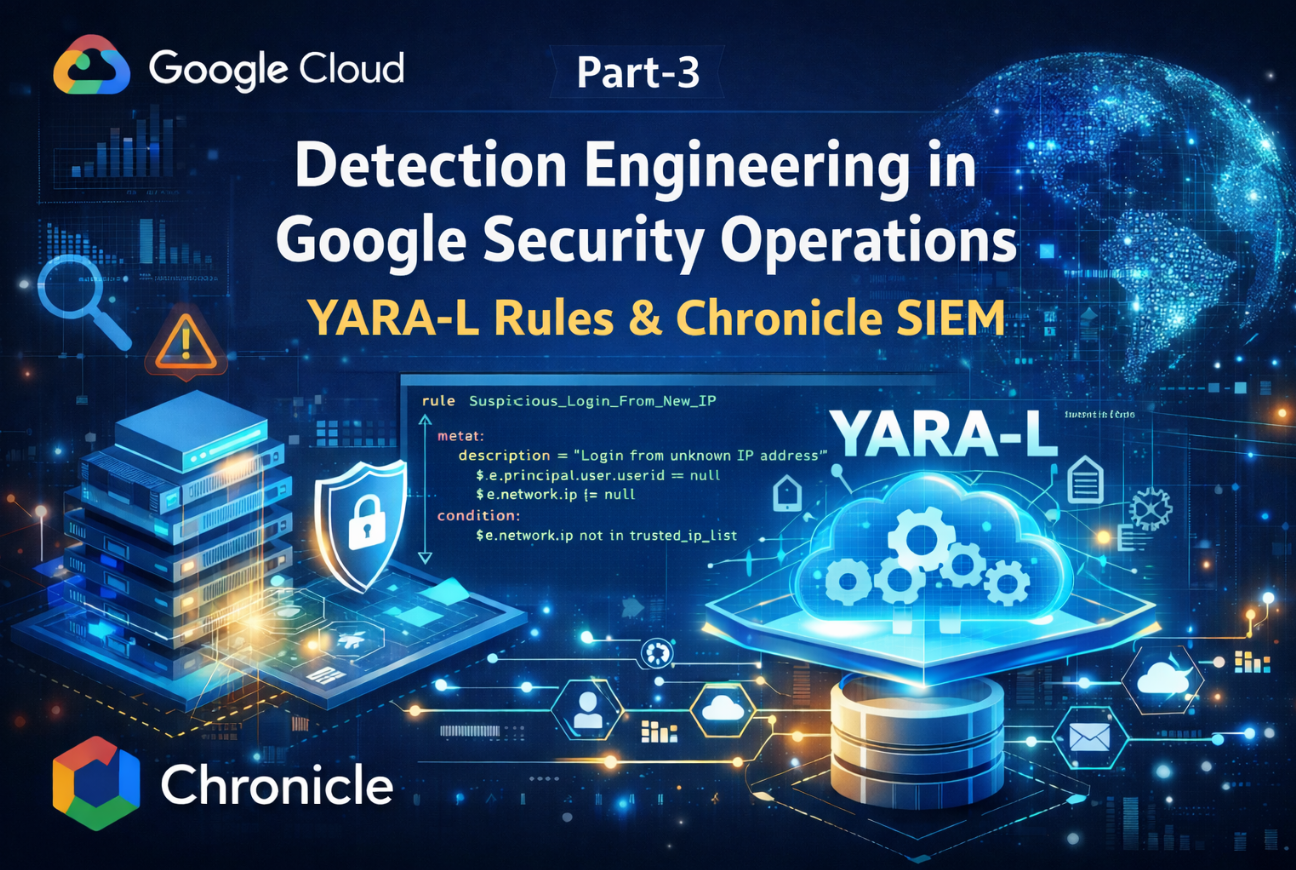
Modern security operations have moved beyond simply collecting logs. Today, the real challenge lies in detecting meaningful threats with precision while minimizing noise.
In cloud-native environments, attackers rarely behave in obvious ways. They exploit identities, misuse APIs, and operate within legitimate workflows. This makes detection engineering one of the most critical capabilities for any modern Security Operations Center (SOC).
This is Part-3 of the Security Operations Knowledge Series, where we focus on how to design effective detections using YARA-L in Google Security Operations (Chronicle).
How This Builds on Part-1 and Part-2
In Part-1, we explored how security operations have evolved in cloud environments and why identity-first security is essential: https://medium.com/google-cloud/modern-cloud-security-operations-on-google-cloud-what-every-engineer-must-know-84bcc10cc47f
In Part-2, we went deep into Chronicle architecture and the Unified Data Model (UDM), which standardizes telemetry across systems: https://medium.com/google-cloud/google-security-operations-deep-dive-chronicle-architecture-and-the-unified-data-model-udm-e556ff9911e3
Now in Part-3, we build on that foundation:
• Logs (Part-2) → become normalized telemetry (UDM) • Telemetry → becomes actionable detections (Part-3)
Why Detection Engineering is Critical
Security tools generate massive volumes of alerts, but only a small percentage are truly actionable.
Without strong detection engineering:
• SOC teams face alert fatigue • Important threats are missed • Investigation time increases
Detection engineering helps you:
• Convert raw telemetry into meaningful signals • Identify attacker behavior patterns • Build scalable, reusable detection logic
What is YARA-L in Google Security Operations?
YARA-L is a rule-based detection language used in Chronicle to detect suspicious activity across normalized data.
Unlike traditional SIEM rules tied to vendor-specific logs, YARA-L operates on UDM fields, which means:
• Detection rules work across multiple data sources • Logic is reusable and scalable • Engineering effort is reduced
Authoritative reference: https://cloud.google.com/chronicle/docs/event-processing/udm-overview
Anatomy of a YARA-L Rule
A YARA-L rule is built using:
• Metadata (description, context) • Event conditions (what to detect) • Logical conditions (how to trigger detection)
Conceptual Example
rule Suspicious_Login_From_New_IP {
  meta:
    description = "Login from unknown IP address"

  events:
    $e.principal.user.userid != null
    $e.network.ip != null

  condition:
    $e.network.ip not in trusted_ip_list
}
This rule highlights a simple but powerful idea: Detect login activity from an unfamiliar source.
Core Detection Patterns in Google Cloud
Effective detection engineering starts with understanding attack patterns.
Identity-Based Detection (Most Critical)
Cloud environments are identity-driven.
Key signals:
• Login from unusual location • Impossible travel scenarios • Multiple failed login attempts • Access from suspicious IP ranges
Privilege Escalation and IAM Abuse
Attackers often escalate privileges after gaining initial access.
Detection signals:
• IAM role changes • Service account key creation • Policy modifications • Self-assignment of high privileges
API Misuse and Anomalous Behavior
Cloud workloads are API-driven.
Look for:
• Unusual API call patterns • Rare or sensitive API usage • Sudden spike in administrative actions
Network and Data Exfiltration Patterns
Even in cloud environments, network signals matter.
Examples:
• Large outbound data transfers • Communication with suspicious endpoints • Unusual port usage
Real-World Detection Use Case
Use Case: Privilege Escalation Detection
Objective: Detect when a user assigns a high-privilege role to themselves.
Detection Logic:
• Identify IAM policy change events • Match actor and target identity • Check for privileged roles
Conceptual Rule
rule Self_Assigned_Privilege_Escalation {
  meta:
    description = "User assigning privileged role to self"

  events:
    $e.metadata.event_type = "IAM_POLICY_CHANGE"
    $e.principal.user.userid = $e.target.user.userid
    $e.target.role in ["roles/owner", "roles/editor"]

  condition:
    $e
}
Reducing False Positives — The Key to Success
The biggest challenge in detection engineering is not writing rules — it’s writing useful rules.
High false positives result in:
• Alert fatigue • Ignored alerts • Reduced SOC efficiency
Practical Techniques
• Apply contextual filters (trusted users, IPs, service accounts) • Use behavioral baselines instead of static rules • Combine multiple signals for stronger detection • Apply thresholds (e.g., repeated failures) • Use time-based correlation
Detection Engineering Best Practices
Start with Threat Modeling
Understand:
• What attack are you detecting? • What logs contain the signal?
Leverage UDM Consistency
UDM enables:
• Cross-platform detection • Simplified rule design • Faster investigation
Keep Rules Modular
• Avoid overly complex logic • Build reusable components
Continuously Tune
• Monitor alert quality • Adjust thresholds • Remove noisy rules
Validate with Real Data
• Test with historical logs • Simulate attack scenarios • Verify detection accuracy
Bridging Theory with Practice
Detection engineering is a hands-on skill. Reading concepts is not enough — you need to practice building and tuning detections.
Many professionals preparing for security certifications or real-world SOC roles look for practical scenario-based learning resources. Some community-driven initiatives also provide access to curated practice environments and realistic question sets.
For example, platforms like: https://certshield.co.in/
have been used by learners to explore scenario-based questions aligned with certification domains. While not a substitute for hands-on lab environments, such resources can help reinforce concepts like detection patterns, IAM abuse scenarios, and threat analysis thinking.
The key is to combine:
• Conceptual understanding • Practical experimentation • Continuous learning
Role in Google Security Operations Engineer Certification
Detection engineering is a core competency in the Google Cloud Professional Security Operations Engineer certification.
The certification evaluates your ability to:
• Build detection rules • Analyze telemetry • Investigate security events • Respond to threats effectively
For insights into real preparation strategies, refer to: https://medium.com/google-cloud/how-i-earned-the-google-cloud-professional-security-operations-engineer-certification-insights-141103a90a5a
Final Thoughts
Detection engineering transforms raw telemetry into actionable intelligence.
With Chronicle and YARA-L, Google Security Operations enables you to:
• Build scalable detections • Reduce alert noise • Detect sophisticated threats
For any security engineer working in cloud environments, mastering detection engineering is not optional — it is essential.
In Part-4, we will move beyond detection and explore Threat Hunting and Incident Response using Chronicle, with practical techniques you can directly apply in real-world environments.
메타데이터
- post_id
- d163f48331d0
- slug
- detection-engineering-in-google-security-operations-yara-l-rules-chronicle-siem-cloud-threat-d163f48331d0
- url
- https://medium.com/google-cloud/detection-engineering-in-google-security-operations-yara-l-rules-chronicle-siem-cloud-threat-d163f48331d0
- canonical_url
- https://medium.com/google-cloud/detection-engineering-in-google-security-operations-yara-l-rules-chronicle-siem-cloud-threat-d163f48331d0
- author_url
- https://medium.com/@gcp.akp
- status
- ok
- fetched_at
- 2026-06-13 16:00:06