Qwen3 Release: Multilingual AI Built on 36 Trillion Tokens
Qwen3, the new open-source LLM series with hybrid thinking modes, multilingual support, and MoE efficiency for coding, reasoning, an
Qwen3 Release: Multilingual AI Built on 36 Trillion Tokens
The most interesting thing about Qwen3 isn’t just that it’s another powerful language model — it’s that it’s a deliberate bet on open-weight AI as the future.
Most leading AI labs treat their best models like guarded secrets, accessible only through restrictive APIs. But Qwen3 is doing the opposite: releasing not just one model, but an entire family of them, from a lightweight 0.6B version all the way up to a massive 235B MoE (Mixture of Experts) model — all under the permissive Apache 2.0 license. This means anyone can use, modify, or build commercial products on top of them without legal friction.
This is significant because, historically, open-source alternatives in tech have lagged behind proprietary ones. But in AI, open-weight models are closing the gap at an unexpected pace. Qwen3 suggests that gap might shrink even faster than anticipated.
Why Open-Weight Models Change Everything
When a model’s weights are released openly, it doesn’t just give people a tool — it gives them a foundation. Researchers can dissect its inner workings, developers can fine-tune it for niche applications, and startups can build without being throttled by API costs or usage limits.
The most transformative open-source projects in history didn’t just replicate existing software — they enabled entirely new possibilities. Linux didn’t just mimic Unix; it became the backbone of the modern internet. Similarly, open-weight AI models could unlock innovation that proprietary systems can’t, simply because they’re not constrained by corporate control.
The real test of Qwen3 won’t be its benchmark scores — it’ll be what people build with it that wasn’t possible before.
Hybrid Thinking: A Smarter Way to Allocate Compute
One of Qwen3’s most interesting features is its hybrid thinking mode. Most language models today operate in a single mode: either they think deeply (slow but accurate) or respond quickly (fast but sometimes shallow). Qwen3 lets users choose between the two.
This isn’t just a usability improvement — it’s a smarter way to manage computational resources. If you’re asking, “What’s the capital of France?”, you don’t need the model to deliberate for seconds. But if you’re solving a complex math proof, you want it to reason step-by-step. Giving users control over this trade-off is a subtle but important efficiency win.
How Qwen3 Was Trained: Data at Scale
Qwen3 was trained on 36 trillion tokens — double the dataset size of its predecessor, Qwen2.5. But the more interesting aspect is how that data was collected.
Instead of just scraping the web, the team used their own models to refine and expand the dataset:
- Qwen2.5-VL extracted text from PDFs and other unstructured documents.
- Qwen2.5-Math generated synthetic math problems and textbooks.
- Qwen2.5-Coder improved the quality of code snippets.
This suggests a shift in how future AI models will be trained: less reliance on raw internet text, more reliance on AI-curated, high-quality synthetic data.
The Efficiency of Mixture-of-Experts (MoE)
MoE models are becoming a standard trick for scaling AI efficiently. Instead of activating all parameters for every query, they dynamically route computations through specialized sub-networks.
Qwen3’s largest MoE model has 235 billion parameters, but only 22 billion are active at any given time. This makes it far more cost-effective to run than a dense model of the same size. If AI progress is to continue without hitting a compute wall, techniques like MoE will be essential.
What Comes Next?
The most exciting aspect of Qwen3 isn’t what it can do today — it’s what developers and researchers will do with it tomorrow.
When Meta released LLaMA, they likely didn’t anticipate the explosion of fine-tuned variants, local inference tools (like llama.cpp), and startups built on top of it. Qwen3 could trigger a similar wave of innovation, especially given its hybrid reasoning and multilingual capabilities.
The real measure of Qwen3’s success won’t be its performance on benchmarks — it’ll be the unexpected applications that emerge once it’s in the hands of thousands of builders.

The Bigger Trend: Open vs. Closed AI
Qwen3 is part of a broader shift. While some companies lock down their models behind paywalls and usage restrictions, others (like Mistral, Meta, and now Qwen) are betting that open-weight models will ultimately drive more innovation.
If history is any guide, the more flexible, adaptable approach usually wins in the long run. The question isn’t whether open-weight models will catch up to closed ones — it’s how much faster they’ll evolve once they do.
Qwen3 is another step in that direction. And if the past few years are any indication, the most interesting developments in AI won’t come from a single lab — they’ll come from the collective tinkering of the open-source community.
Further Reading::
What is Detection as Code? How to implement Detection-as-Code
Stable Diffusion Deepfakes: Creation and Detection
🚨Oracle Cloud Data Breach: 6M Records Compromised
*🚀DeepSeek R1 Explained: Chain of Thought, Reinforcement Learning, and Model Distillation*
⚙️LangChain vs. LangGraph: A Comparative Analysis
🤖What is Manus AI?: The First General AI Agent Unveiled
🔗What is Model Context Protocol? (MCP) Architecture Overview
The Difference Between AI Assistants and AI Agents (And Why It Matters)
🤖DeepSeek R1 API Interaction with Python
Frequently Asked Questions
1. What is Qwen3 and what are its key offerings?
Qwen3 is the latest generation of large language models developed within the Qwen family. It is being released with a range of models, including two openly available Mixture-of-Experts (MoE) models: Qwen3–235B-A22B (a large model with 235 billion total parameters and 22 billion activated parameters) and Qwen3–30B-A3B (a smaller MoE model with 30 billion total parameters and 3 billion activated parameters). Additionally, six dense models are also open-weighted: Qwen3–32B, Qwen3–14B, Qwen3–8B, Qwen3–4B, Qwen3–1.7B, and Qwen3–0.6B. These models are released under the Apache 2.0 license, aiming to promote research and development in the field of large foundation models.
2. How does Qwen3 compare to previous Qwen models and competitors?
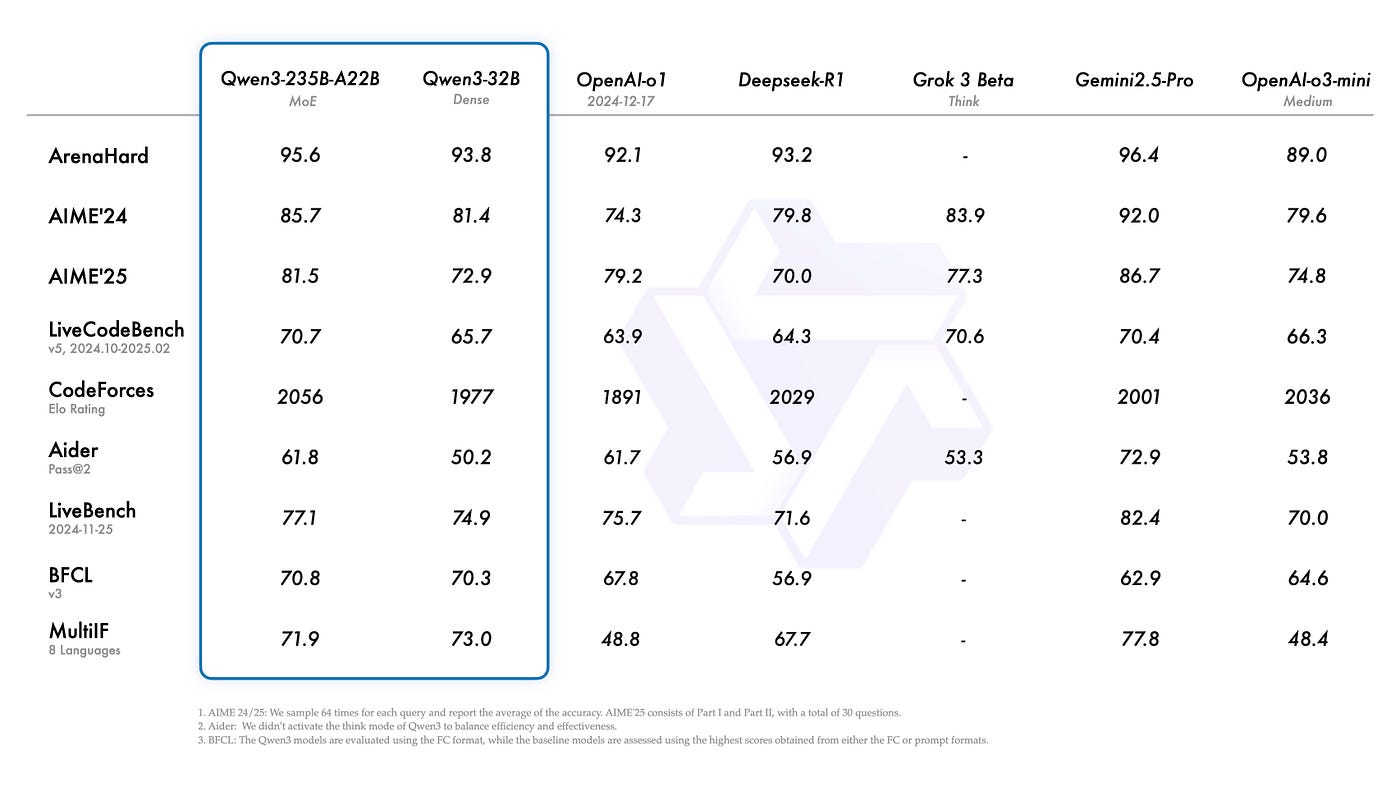
Qwen3 demonstrates significant performance improvements compared to previous Qwen models like Qwen2.5. The dense models in the Qwen3 family, such as Qwen3–1.7B/4B/8B/14B/32B-Base, are stated to perform as well as their larger Qwen2.5 counterparts (Qwen2.5–3B/7B/14B/32B/72B-Base) and even outperform them in specific areas like STEM, coding, and reasoning. The MoE models, like Qwen3-MoE base models, achieve similar performance to Qwen2.5 dense base models while using significantly fewer active parameters (only 10%), leading to substantial cost savings. When compared to other top-tier models such as DeepSeek-R1, o1, o3-mini, Grok-3, and Gemini-2.5-Pro, the flagship model Qwen3–235B-A22B achieves competitive results across various benchmarks including coding, math, and general capabilities.
3. What are the “Hybrid Thinking Modes” in Qwen3?
Qwen3 models introduce a unique feature called “Hybrid Thinking Modes,” which allows for flexible problem-solving. There are two primary modes:
- Thinking Mode: In this mode, the model takes a step-by-step approach to reasoning before providing a final answer. This is particularly useful for complex problems requiring in-depth analysis.
- Non-Thinking Mode: This mode delivers quick, near-instantaneous responses, making it suitable for simpler questions where speed is prioritised.
This flexibility enables users to control the computational reasoning budget allocated to the model, optimising the balance between cost efficiency and inference quality based on the task’s difficulty. A soft switch mechanism with /think and /no_think prompts allows users to dynamically control the mode during conversations.
4. How has the pre-training process for Qwen3 evolved?
The pre-training dataset for Qwen3 has been substantially expanded to approximately 36 trillion tokens, nearly double the 18 trillion tokens used for Qwen2.5. This dataset covers 119 languages and dialects and includes data collected from both the web and PDF-like documents. Qwen2.5-VL was used for text extraction from documents, and Qwen2.5 was employed to enhance data quality. Synthetic data for math and code, including textbooks, question-answer pairs, and code snippets, was generated using Qwen2.5-Math and Qwen2.5-Coder.
The pre-training process is a three-stage pipeline:
- Stage 1 (S1): Initial pre-training on over 30 trillion tokens with a 4K context length, focusing on basic language skills and general knowledge.
- Stage 2 (S2): Pre-training on an additional 5 trillion tokens with an increased proportion of knowledge-intensive data (STEM, coding, reasoning).
- Stage 3: Using high-quality long-context data to extend the context length to 32K tokens, improving the model’s ability to handle longer inputs.
5. What is the significance of the multilingual support in Qwen3?
Qwen3 models support a broad range of 119 languages and dialects. This extensive multilingual capability is a key feature that significantly expands the potential applications of the models on a global scale. It allows users worldwide to utilise Qwen3 in their native languages, opening up new possibilities for international development and research.
6. How have the agentic capabilities of Qwen3 been improved?
The Qwen3 models have been specifically optimised for coding and agentic capabilities. Support for MCP has also been strengthened. The integration of these improvements enhances the model’s ability to interact with its environment and perform complex tasks. To facilitate the use of these agentic abilities, Qwen-Agent is recommended, which internally handles tool-calling templates and parsers, simplifying coding complexity. Users can define available tools using MCP configuration files, integrated tools within Qwen-Agent, or by integrating their own tools.
7. Where can users access and deploy Qwen3 models?
The Qwen3 models are available on popular platforms like Hugging Face, ModelScope, and Kaggle, including both the post-trained and pre-trained versions (e.g., Qwen3–30B-A3B and Qwen3–30B-A3B-Base). For deployment, frameworks like SGLang and vLLM are recommended. For local usage, tools such as Ollama, LMStudio, MLX, llama.cpp, and KTransformers are highly suggested. Users can also try out Qwen3 via the Qwen Chat Web (chat.qwen.ai) and mobile application.
8. How was the hybrid thinking model developed through post-training?
The hybrid model, capable of both step-by-step reasoning and rapid responses, was developed through a four-stage post-training pipeline:
- (1) Long Chain-of-Thought (CoT) Cold Start: Initial fine-tuning using diverse long CoT data across various domains (math, coding, reasoning, STEM) to build fundamental reasoning skills.
- (2) Reasoning-Based Reinforcement Learning (RL): Scaling up computational resources for RL with rule-based rewards to enhance the model’s exploration and exploitation capabilities.
- (3) Thinking Mode Fusion: Integrating non-thinking capabilities by fine-tuning the model on a combination of long CoT data and commonly used instruction-tuning data generated by the enhanced thinking model from the second stage.
- (4) General RL: Applying RL across over 20 general-domain tasks to further strengthen the model’s general capabilities and correct undesired behaviours, including instruction following, format following, and agent capabilities.
메타데이터
- post_id
- d16bfe8bad83
- slug
- qwen3-release-multilingual-ai-built-on-36-trillion-tokens-d16bfe8bad83
- url
- https://medium.com/@tahirbalarabe2/qwen3-release-multilingual-ai-built-on-36-trillion-tokens-d16bfe8bad83
- canonical_url
- https://medium.com/@tahirbalarabe2/qwen3-release-multilingual-ai-built-on-36-trillion-tokens-d16bfe8bad83
- author_url
- https://medium.com/@tahirbalarabe2
- status
- ok
- fetched_at
- 2026-07-10 16:56:18