The Golden Age of the Russian Nobility
A Day in the Life of a Typical Nobleman
The Golden Age of the Russian Nobility
A Day in the Life of a Typical Nobleman
Part I
Late 18th — Early 19th Century
Let us now imagine what the life of a typical nobleman of that time might have looked like. Where did he live, and who were his ancestors? Where did he serve, and how did he spend his leisure time? Where did his income come from, and how did he envision his future life?
Family and Lineage
Our hero is a young and promising 26-year-old hereditary nobleman, Konstantin Danilovich Sadowski. His grandfather came from simple free people and served under Peter the Great. For his merits during the Great Northern War against Sweden, he was elevated to hereditary nobility. The Emperor granted him several villages and an estate, securing a comfortable life both for him and his descendants.
The hero’s grandfather kept his distance from court intrigues and palace coups, which allowed him to preserve both his reputation and the family fortune. His son — Konstantin’s father — followed the same principle: service to the Fatherland came first. In those days, honor and dignity of the uniform were valued far above wealth.
However, Konstantin’s father passed away shortly before the events of our story. Thus, the young man became the head of the family — the eldest and only son. His mother lives permanently in a country estate, while our hero builds his military career in the capital, Saint Petersburg.
Place of Residence and Service
Konstantin Sadowski lives not far from the barracks of the Preobrazhensky Regiment on the Liteyny side of Saint Petersburg, close to Liteyny Prospekt. The house was purchased by his father — conveniently near his place of service, yet situated in a rather prestigious district.
The residence is a two-story building in the Palladian style (Neoclassicism). The main entrance features columns with a portico and wrought-iron gates. In front of the house lies a ceremonial drive. On the ground floor are the formal reception rooms, which were arranged by his mother when she still lived permanently in the capital. The second floor contains the private chambers. Behind the house there is a formal French-style garden with perfectly straight paths and neatly trimmed shrubs and flowerbeds.
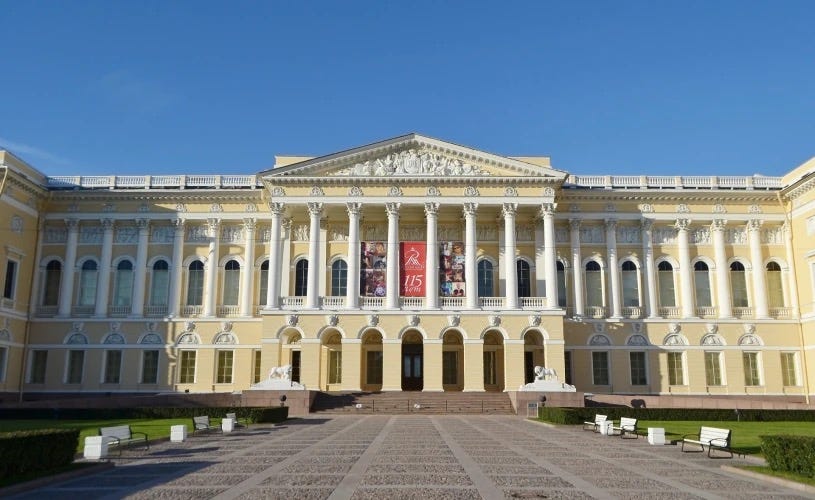


Neoclassical style palaces in St.Petersburn — the architectural style of Konstantin’s house
On the estate grounds there are also several outbuildings and a small stable. After the death of his father and his mother’s departure to the country estate, the household is no longer heavily staffed. The young bachelor manages with a modest retinue (for the time): a cook with an assistant, a footman, a valet, maids, a gardener, and a coachman. The staff could be expanded, but there is no real need for it at present.
Naturally, Konstantin Danilovich does not merely live in the capital — he is an officer of the Preobrazhensky Life Guards Regiment. He was enrolled in the regiment as a soldier in childhood. His father trained him at home as well, so by the time he joined active service, the young officer already knew how to stand guard and perform bayonet drills.
His rank is that of staff captain. At present, however, Konstantin Danilovich temporarily commands an entire company — around 150 men. He frequently visits the barracks to inspect the soldiers and their equipment, conduct drills, review reports, and assign guard duties.

“F. Ya. Alekseev, Potemkin Street. 1800. Closing of the perspective — on the right, the barracks of the Preobrazhensky Regiment.
His annual salary amounts to approximately 900–1000 rubles. To put this into perspective, a serf with a plot of land cost around 50–100 rubles at the time. Thus, his salary was stable, though far from extravagant. The family’s main income came from villages worked by serfs and estate lands, which generated up to 4,000 rubles annually.
About the Interior of the House
While our hero is soundly asleep after a modest revel the night before, we have a moment to quickly walk through his city residence and take a look at its interiors.
We enter the house through a ceremonial porch with tall columns painted white and adorned with Roman porticos. We open the massive oak doors with wrought-iron grilles and step into a spacious, bright, oval-shaped ceremonial hall (the main foyer) on the first floor. The floor is laid with parquet, where different types of wood intertwine in elegant, simple patterns. In the very center of the room, instead of parquet, there is a circular inlay of granite and marble. At its heart stands a large flower vase.
The walls, decorated with refined white stucco moldings and painted in a light peach tone, are adorned with family portraits, while a large crystal chandelier hangs from the ceiling. Several doors lead in different directions — to the right, straight ahead, and to the left. All of them are elegant white carved gateways into the world of the reception rooms.


Interiors of a noble house of the early 19th century — it is in exactly this kind of setting that Konstantin Danilovich lives.
On the right side lies the women’s wing of the reception rooms. A sequence of enfilade rooms unfolds, with silk-covered walls, paintings, and stucco decorations on both walls and ceilings. Each room has its own function: first a drawing room, then a sitting room, and a tea salon. At the end stands the ceremonial boudoir — where the matriarch of the family received her closest guests.
To the left of the main hall is the men’s wing of the reception rooms. It also consists of several rooms: a reception room, a library, a sitting room, and a formal study at the end.
The greatest pride of the house, however, lies behind the door opposite the main entrance — there, behind double doors, is a ceremonial marble staircase rising two stories high, flanked by vases and pilasters. This staircase was a gift from Prince Dolgorukov to Konstantin’s father in recognition of his distinguished service at the court of Empress Elizabeth.
To the right of the staircase is a spacious dining room with floor-to-ceiling windows. It could accommodate up to fifty guests. The room stretches almost the full length of the building and would be rather ordinary if not for its painted ceiling. A master artist depicted Greek gods of leisure and pleasure floating among the clouds.

Pavlovtsev Mansion — one the grand halls of the house
To the left of the staircase is the ballroom. It is decorated more lavishly — and perhaps even more extravagantly — than the rest of the house, a legacy of the Baroque era of Catherine the Great. The abundance of gilded stucco, paintings, and chandeliers almost dazzles those who enter.
However, the ballroom has not been used for quite some time. After the death of his father, his mother lost interest in social entertainments and now prefers to live in the country estate, visiting the capital only occasionally, when obliged to attend invitations from old acquaintances. As for Konstantin himself, he does not yet host balls… for that, one needs a hostess of the house, and our hero is still unmarried.
Someone is coming… quietly!
Daily Routine
Early morning on Saint Petersburg’s Liteyny Prospekt. The time is around 8 a.m. The streets are already filled with carts and carriages — merchants and shopkeepers preparing to open their businesses. In the distance, the creaking masts of trading ships arriving at the city can be heard.
In our hero’s house, the upper floors are still quiet, except for two maidservants carefully removing heavy velvet curtains from the windows, letting bright spring sunlight flood the ceremonial rooms on the first floor. Opening the windows of the drawing room, one of the maids lets fresh air flow into the enfilade of modest yet carefully and tastefully furnished rooms.
In the basement, however, life has long been in full swing. The cook is issuing instructions to her two apprentices — breakfast for the master is being prepared. On the wood-burning stove, coffee is nearly ready. In the kitchen, thin slices of ham and bread are being cut, while a jar of strawberry preserve — last year’s jam — is taken from the cellar.
The master’s valet carefully pours coffee into a porcelain cup and hurries upstairs to the second floor. It is time to wake the young master. In Konstantin Danilovich’s bedroom, he draws the curtains aside, waking the hero. Placing the fresh coffee on the bedside table, the valet invites him to breakfast, which at this very moment is being set in the dining room on the first floor. There, a letter from the commander of the Preobrazhensky Life Guards Regiment awaits him — he is to appear at the morning inspection and briefing at 9 a.m.
Konstantin puts on a dressing gown and, coffee cup in hand, approaches his writing desk by the window. The table is covered with papers, reports, petitions, letters from his mother, and invitations to balls. He reluctantly scans them in search of the necessary documents while sipping his morning coffee.
After about ten minutes, our hero descends to the dining room via the grand staircase, where breakfast is already waiting. On the table, set in the latest French style, are neatly arranged cold meat appetizers, several slices of bread, and jam. In a cup, tea with lemon has already been poured, and beside the main plate lies a note from the valet, which he reads during his meal.
Meanwhile, Konstantin’s uniform is being cleaned by his valet, while the coachman harnesses the horses to the carriage that will take him to the morning inspection at the guards regiment. The officer’s uniform is being prepared in a room adjacent to the bachelor’s bedroom. It could be called a boudoir or a study; however, the status of our hero as an unmarried man was immediately reflected in the interiors — there were no flowers, no cozy furniture arrangements, no paintings or figurines. All of that had been taken by his mother to the country estate.
Preparing the uniform was not an easy task for the valet, but fortunately everything had been prepared the night before, and now it only needed a light inspection and brushing. The boots were already polished to a shine, and the officer’s sabre gleamed in the morning spring sunlight, scattering small rainbow reflections across the room.
After finishing his tea with buns and jam, Konstantin hurries upstairs. He has little time left to change, wash, and depart for the barracks. The valet is already ready. Our hero dresses, adjusts a few of his orders, checks his sword, and almost light-footed runs back down the stone grand staircase, throws open the heavy oak doors… and there, waiting for him, is a carriage harnessed with a pair of horses.
This carriage is a so-called britzka — widely used by landowners and young officers of the time. It required less maintenance than a formal carriage and was considered less ceremonial, although it could still be painted in family colors and bear the family coat of arms. The britzka had no fixed roof — it was open-top. Such was Konstantin’s carriage: a green britzka with the family coat of arms of the Sadowski lineage.

Britzka
The Preobrazhensky Regiment Barracks
The Guards — and especially the Preobrazhensky Regiment — were the elite of the Imperial Russian Army. They were composed of nobles, often enrolled in service almost from birth. Service there was not only prestigious for one’s future career, but practically essential if an officer wished to meet the right people, as it brought together the children of princes and counts — the old and powerful aristocracy, diplomats, ministers, and courtiers. The very fact that our hero serves there already makes him part of the elite of the Russian Empire. One did not simply enter such a regiment — Konstantin was enrolled there thanks to his father.
In the late 18th and early 19th centuries, the Preobrazhensky Regiment barracks formed a vast complex of neoclassical buildings, including armories, soldiers’ and officers’ quarters, parade grounds, administrative offices, residences for senior military command, stables, and more.
By morning, the place was already loud and crowded. Drummers march in tight formation across the parade ground, beating out the rhythm of the drill step. In the armories, soldiers are already busy cleaning their weapons — flintlock muskets and sabres must always be in perfect condition. Orderlies (secretaries and assistants) run from building to building with various assignments, while on the parade ground — a large stone-paved square used for maneuvers and formations — entire companies are already assembled. Loud commands from staff captains and company commanders echo across the space as they inspect the troops.
From time to time, britzkas arrive at the barracks, but no one pays them any attention — it is a familiar sight; officers are simply arriving for duty. Konstantin Danilovich is no exception: his carriage pulls up to the entrance of the barracks, where a sergeant-major is already waiting with a report on the state of the company. As Konstantin steps out of the carriage, the report is delivered immediately:
— Two in the infirmary, Your Excellency! Ill! And three punished for a drunken brawl last night at the tavern.
Konstantin calmly listens to the report and signs the document. This is followed by an inspection inside the soldiers’ quarters — everything must be in accordance with regulations. Beds are perfectly made, uniforms clean and tidy, weapons at the ready. Several soldiers are immediately reprimanded and sentenced to the guardhouse — punishment duty within the barracks — for dirty buttons and unwhitened belts.

Officer’s uniform of the Life Guards of the Preobrazhensky Regiment Russian Empire, 1800–1801
The company then marches out onto the parade ground, where our hero commands formations and spends several hours drilling the soldiers in parade maneuvers and weapons exercises. The men must master complex movements with heavy muskets — skills that today would require exceptional professionals, but at the time were standard military training.
One of the younger soldiers is visibly nervous. Seeing the approaching staff captain, he suddenly raises his rifle so sharply that he nearly drops it. Konstantin merely smirks and walks on. Half a year earlier, this young man had been the son of a rural deacon and was seeing the capital for the first time.
The weather is beautiful — soft but already warm spring sunlight pours over the parade ground, and sweat runs down Konstantin’s face in thin streams. The uniform is not designed for hours of drills and command under the open sun. A woolen coat, several layers of undergarments, heavy officer’s boots, a formal hat — all of it makes movement uncomfortable. Yet this uniform is perfect for displaying oneself before ladies in high society.
The same sergeant-major runs up to Konstantin:
— Your Excellency, the battalion commander is waiting for you!
There is nothing to do… the inspection is over, and the officer turns on his heel and marches with precise, measured steps toward the officers’ quarters for a meeting with the battalion commander. The conversation will most likely not be a pleasant one — one is not summoned without reason.
The office is on the ground floor — a modest but bright room with a writing desk and several chairs. A portrait of the Emperor hangs on the wall, as it must. Desks and cabinets are piled with papers, reports, and dispatches. There, Konstantin is questioned about a recent duel — two of his fellow officers were involved in one a few days earlier, an encounter that ended tragically.
Duels, although matters of honor, were illegal at the time. The state could not afford to waste its best servants on foolish affairs — especially since young officers usually dueled or fought sabres over trivial matters or drunken quarrels. It might be over the attention of a noble lady or a simple argument. Yet honor of the uniform outweighed even life itself.
Konstantin Danilovich knew nothing of the duel and did not participate in it. He was unaware of its cause and therefore could offer no useful information to his commander. After about thirty minutes, the conversation ends, and he is dismissed with wishes for a good day.
— Convey to your acquaintances, Staff Captain, that the sovereign keeps officers for service, not so that they may shoot each other on the Vyborg Side, — says the commander.
Before leaving, our hero manages to inquire about a possible new appointment at court, but no clear answer is given.
Afterwards, until about one o’clock in the afternoon, Konstantin Danilovich is occupied with the usual dull duties: listening to reports and dispatches, reviewing paperwork, further uniform inspections, and conversations with soldiers and clerks. Impatient, he glances repeatedly at the clock tower of the barracks — any moment now it will be lunchtime, and he must leave. A few days earlier, he had been invited to lunch at the new home of an old friend.
Lunch at a Fellow Officer’s House
Konstantin Danilovich climbs into his britzka and rides through the bustling streets of the capital along the Moika Embankment. Not far from the Summer Garden stands the elegant and comparatively spacious new mansion of Konstantin’s friend — Count Obukhovsky. As is customary, the house is painted yellow and built in a fashionable neoclassical style: tall columns with porticos, stucco decorations with Greek and Roman motifs, and high floor-to-ceiling windows — “a true palace,” Konstantin thought.
Service in the Guards had done its work — our hero had met the future count, then still an heir to the title, during his military service. In their youth, he and Obukhovsky had roamed the taverns of the capital until dawn, narrowly managing to avoid losing their fortunes at whist.
The arriving guest is met at the gate by a footman, and at the main doors stands the count himself with his young wife, Anna Petrovna. The friends embrace as if they had not seen each other for years. Konstantin greets Anna Petrovna in a more formal manner — with a slight bow and a kiss on the hand. Although the gesture is rather familiar, it is not unusual, as they are close friends.
The hosts lead their esteemed guest through the newly furnished halls of the house. They pass drawing rooms, tea salons, and parlors with fireplaces, a gallery of paintings, and finally enter the formal dining room. It is a long hall with high ceilings, as usual, painted by hand with classical antique motifs. Along the edges of the room, marble statues stand in alcoves on tall pedestals. Paintings in gilded frames hang on the walls, while a crystal chandelier floats like a cloud above the ceiling.
The long dining table, covered with a tablecloth, is only partially set — there are only three guests, so there is no need for full ceremonial service. Nevertheless, the table is adorned with the finest German and Russian porcelain, silverware, and a tall silver centerpiece filled with fruit and flowers. The guests take their seats, and as etiquette dictates, the hostess is the first to sit, followed by the men.
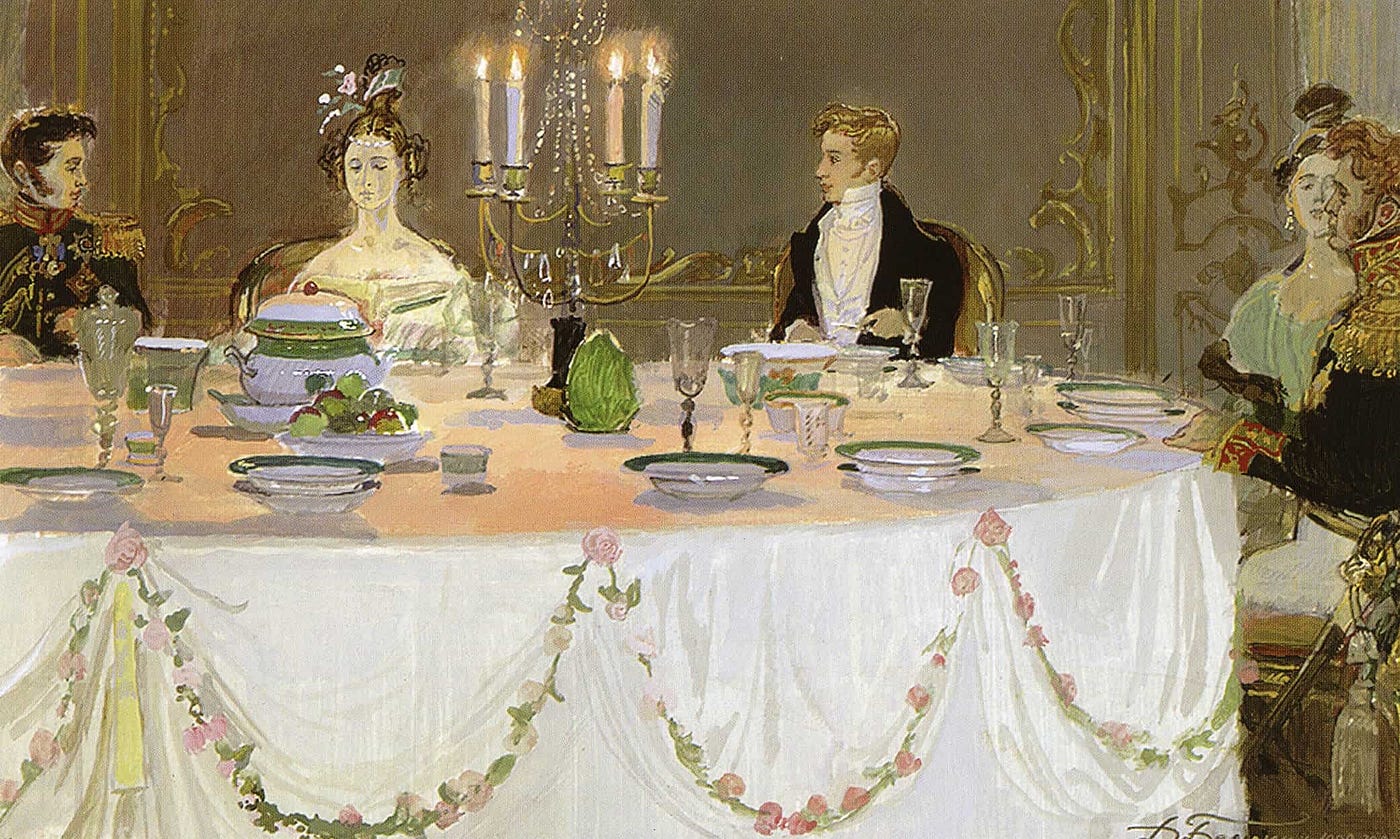
D. Belyukin. Illustration for A. S. Pushkin’s poem Eugene Onegin — approximate table setting for a formal supper
It is worth noting, for the sake of our story, how this house came to be…
Anna Petrovna, the wife of the count, was born into a noble family, though not a particularly distinguished one. Her lineage also once emerged from the service nobility. However, her fortune was considerable — several thousand serfs, entire villages with developed agriculture, and even production estates. Having no male heirs, her father married her to a nobleman close to the court, albeit somewhat financially strained. Such unions were not uncommon at the time — a combination of capital and access to the upper circles of the Empire.
The count and countess made an excellent match, despite the absence of passionate love as it is understood today. Their family life, however, proved successful — they found in each other close and gentle companionship, and the rest was simply the steady labor of marriage.
Lunch at the count’s house consisted of the finest dishes of the time — French cuisine, as was fashionable. As appetizers, cold dishes of sturgeon and ham were served. The first course was turtle soup. The main course consisted of game roast, followed by dessert — French cheeses and candied fruits. Not excessive, but quite sufficient. The meal was accompanied by Rhine wines. Vodka, at the time, was not consumed during daytime in polite society.
During lunch, they discussed court affairs and changes in the palace and the army. Much was said about the theatre. It was not customary to discuss politics or finances.
After lunch, the gentlemen moved to the library to play whist. The stakes were modest — after all, they were close friends. The hostess, meanwhile, preferred to take a walk in the garden. The game did not last long, about an hour.
The wall clock in the library strikes three in the afternoon. Though the timing is somewhat irregular, there is still much to be done, and it is time to return home. At four o’clock, Konstantin has an appointment with an architect. After shaking hands and embracing, Konstantin Danilovich bids farewell to the hosts, promising to meet again at the next reception. A britzka is already waiting at the entrance, and our hero once again speeds through the capital’s avenues toward his home.
The remainder of the day, including the ball and the salon scenes, will be continued in Part Two.
메타데이터
- post_id
- d18078d55a4e
- slug
- the-golden-age-of-the-russian-nobility-d18078d55a4e
- url
- https://medium.com/@v.gomann/the-golden-age-of-the-russian-nobility-d18078d55a4e
- canonical_url
- https://medium.com/@v.gomann/the-golden-age-of-the-russian-nobility-d18078d55a4e
- author_url
- https://medium.com/@v.gomann
- status
- ok
- fetched_at
- 2026-06-26 21:52:29