Why Arcade Ball Games Like Ballz Are Still Dominating Mobile Charts in 2026 (And How to Launch One…
Scroll through the top charts on the App Store or Google Play in 2026 and you’ll notice something interesting: alongside the flashy…
Why Arcade Ball Games Like Ballz Are Still Dominating Mobile Charts in 2026 (And How to Launch One Fast)
Scroll through the top charts on the App Store or Google Play in 2026 and you’ll notice something interesting: alongside the flashy hybrid-casual titles and narrative puzzle games, simple arcade ball games are still sitting comfortably in the top grossing and top free lists. No huge 3D worlds. No complex meta-progression systems. Just a ball, a paddle, some bricks, and a satisfying loop that players can’t put down.
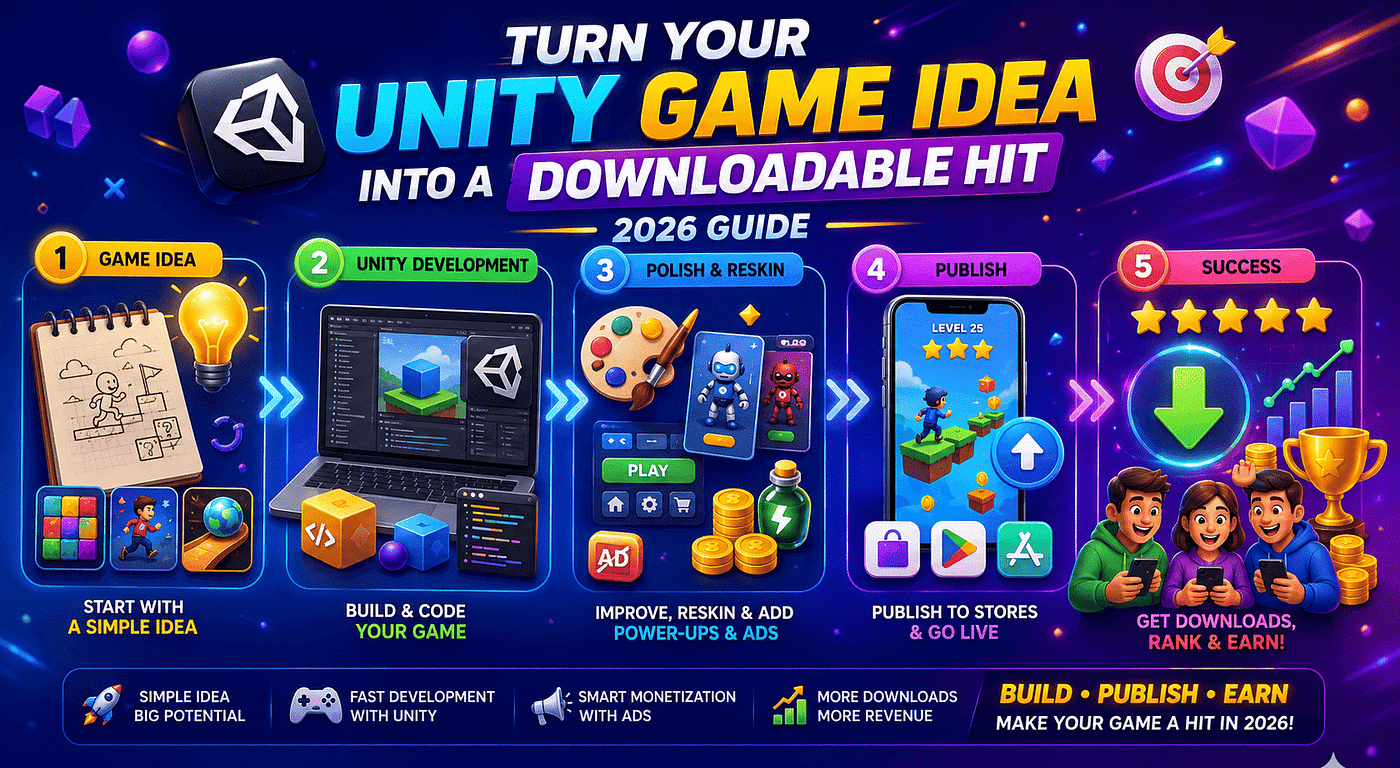
If you’ve been following the hyper-casual space, this shouldn’t surprise you. A few months back I wrote about a similar phenomenon in why crowd runner combat games are dominating mobile charts in 2026 — and how to build one fast, and the underlying reason both genres succeed is the same: simplicity scales. Games that are instantly understandable, endlessly replayable, and cheap to build tend to outperform ambitious, complex titles when it comes to actual revenue-per-development-hour — which is the metric that matters most for indie developers and small studios.
In this article, I want to break down exactly why arcade ball games are having a moment again in 2026, what makes them so viable for solo developers and small teams, and how you can go from idea to a published iOS or Android game in a fraction of the time it would take to build something from scratch.
The Enduring Appeal of Arcade Ball Games
Arcade ball games — think Breakout, Peggle-style physics, and modern viral hits in the “Ballz” and “Brick Breaker” family — share a few core traits that make them extremely resilient as a genre:
1. Zero Learning Curve
Players understand the mechanic within two seconds of opening the app. Aim, shoot, watch the ball bounce and clear blocks. There’s no tutorial fatigue, no onboarding funnel to optimize, and no risk of losing players before they even reach the “fun” part of the game. In an attention economy where the average session before uninstall is measured in seconds, this matters enormously.
2. Physics-Based Randomness Keeps It Fresh
Unlike static puzzle games where every level plays out identically, ball physics introduce a small amount of unpredictability into every shot. That unpredictability is what keeps players coming back — it’s the same psychological hook that makes games like pinball endlessly replayable decades after their invention.
3. Extremely Low Development Overhead
This is the part that matters most if you’re a developer rather than just a player. Arcade ball mechanics don’t require expensive 3D art, complex animation rigs, or heavy narrative writing. A polished ball game can be built with simple 2D or low-poly 3D assets, basic physics interactions, and a level generator — all of which are well within reach of a solo developer or a two-person team.
4. Proven Monetization Patterns
Because the genre has been validated across thousands of releases, the monetization playbook is well understood: rewarded video ads between levels, interstitials at natural break points, and light IAP for power-ups or level skips. There’s very little guesswork involved compared to more experimental genres.
Why Building From Scratch Isn’t Always the Smart Move
Here’s the uncomfortable truth a lot of new Unity developers don’t want to hear: building a fully original arcade ball game from a blank Unity project — physics tuning, level design tools, ad integration, UI polish, App Store assets — routinely takes 200–400+ hours even for an experienced solo developer. That’s weeks or months of unpaid development time before you see a single dollar of revenue, with no guarantee the final product will perform well in the market.
This is exactly why so many successful indie publishers in 2026 have shifted toward starting from proven, pre-built templates instead of reinventing the wheel every time. A well-built template already has the physics tuned, the level system built, the UI polished, and — critically — a track record of what works in this specific genre.
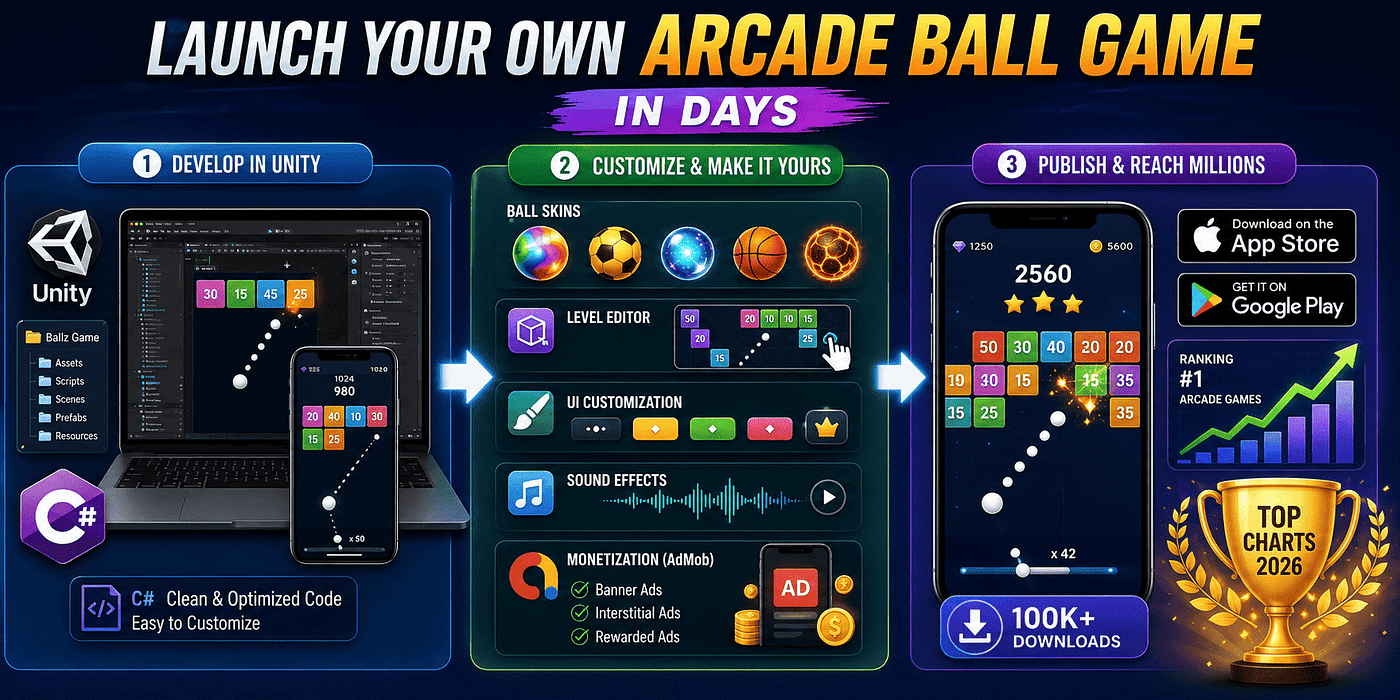
If you want a concrete example of what a production-ready arcade ball template looks like, the Ballz Unity Game Template is a great reference point. It includes the core bounce-and-break mechanic, a scalable level system, and a clean codebase structured for reskinning — meaning a developer can swap art, tune difficulty, and have a genuinely differentiated release ready in a matter of days rather than months.
From Template to App Store: What the Launch Process Actually Looks Like
Getting a great template is only step one. The bigger question most developers ask next is: “Okay, but how do I actually get this onto the App Store?” That process — Xcode configuration, code signing, App Tracking Transparency, App Store Connect setup, and review submission — trips up more first-time developers than the actual game development does.
I put together a full walkthrough of that exact process, covering everything from Unity Player Settings and IL2CPP configuration to Xcode archiving, TestFlight, and App Store review, in How to Launch a Unity Game on iOS in 2026 — Complete Step-by-Step Guide. If you’re planning to take an arcade ball template (or any Unity project) live on iOS, that guide walks through every setting and gotcha you’ll run into along the way, including the App Tracking Transparency requirement that trips up a lot of ad-monetized games during review.
Between a solid template and a clear build pipeline, the gap between “I have an idea” and “my game is live on the App Store” shrinks from months to weeks.
What Makes an Arcade Ball Game Stand Out in a Crowded Genre
Simplicity is the genre’s biggest strength, but it also means competition is fierce — thousands of ball and brick-breaker clones exist. If you’re building or reskinning one in 2026, a few things separate the titles that actually chart from the ones that disappear into the noise:
Distinct Visual Identity
Even within a simple mechanic, art direction matters enormously. Neon aesthetics, pastel “satisfying” color palettes, or a themed skin (holiday events, seasonal reskins, collaboration themes) can dramatically improve store conversion rates, even when the underlying gameplay is nearly identical to a competitor.
Smart Difficulty Curves
The best-performing ball games use dynamic difficulty adjustment — subtly easing difficulty for players who are about to churn, and ramping it up for players who are clearly engaged. This is a small technical addition that has an outsized impact on Day 1 and Day 7 retention.
Satisfying Feedback Loops
Screen shake, particle effects, satisfying “pop” sound design, and combo multipliers all contribute to what the industry calls “juice.” Arcade ball games live or die by how good each individual shot feels, so investing extra polish time here pays off disproportionately compared to adding new content.
Fast, Clean Ad Integration
Because monetization is ad-heavy in this genre, a clumsy or intrusive ad implementation can tank retention fast. Rewarded ads that genuinely add value (extra balls, level skips, power-ups) tend to outperform forced interstitials that interrupt the core loop too aggressively.
A Realistic Roadmap: Idea to Launch in Under 30 Days
For developers who want a concrete plan, here’s a realistic timeline using a template-based approach rather than building from scratch:
Week 1 — Setup and Reskin Acquire a proven template like the Ballz Unity Game Template, review the codebase, and begin reskinning: new art assets, color palette, sound design, and any thematic changes to differentiate from the base product.
Week 2 — Tuning and Feature Additions Adjust difficulty curves, add a light meta layer if desired (daily rewards, simple progression, cosmetic unlocks), and integrate your ad SDK and mediation platform.
Week 3 — iOS Build and Testing Configure Unity’s iOS Player Settings, generate your Xcode project, handle signing and App Tracking Transparency, and run a full TestFlight cycle with real testers on physical devices.
Week 4 — Store Listing and Submission Finalize App Store Connect metadata, screenshots, and keywords, submit for review, and prepare a soft-launch marketing plan for release day.
This timeline is aggressive but genuinely achievable when you start from a functional, tested codebase instead of a blank Unity project — which is the entire value proposition of working from a template in the first place.
Common Mistakes Developers Make With This Genre
Even with a strong foundation, there are a few recurring mistakes worth avoiding:
- Under-polishing the “juice.” Developers often rush past sound design and visual feedback to get to “content,” when in this genre, feel matters more than content volume.
- Over-monetizing too early. Bombarding new players with ads before they’ve experienced a few satisfying rounds increases Day 1 churn significantly.
- Ignoring App Store optimization. A great game with a generic title, poor keywords, and mediocre screenshots will underperform a mediocre game with excellent ASO.
- Skipping real-device testing. Physics-based games are especially sensitive to frame rate inconsistencies, which are often invisible in the Unity Editor but obvious on lower-end devices.
- Launching without a soft-launch phase. Testing retention and monetization metrics in a smaller market before a global launch prevents wasted ad spend on a version of the game that isn’t ready.
Final Thoughts
Arcade ball games prove a point that applies across the entire hyper-casual and casual mobile space: you don’t need groundbreaking innovation to build a successful mobile game — you need a tight, satisfying core loop, smart execution, and a fast path from idea to App Store. The genre’s staying power in 2026 comes down to exactly the same fundamentals that made Breakout addictive decades ago, now paired with modern physics, mediation-driven ad monetization, and data-informed live-ops.
Whether you’re starting from a template like Ballz Unity Game Template or building your own take on the mechanic, the fastest path to market in 2026 is the same one outlined in How to Launch a Unity Game on iOS in 2026 — Complete Step-by-Step Guide: configure your project correctly, test rigorously on real devices, and treat your App Store listing with the same care you give the game itself.
If simple genres like this interest you, it’s also worth reading how a related trend played out in the action space over in why crowd runner combat games are dominating mobile charts in 2026 — the underlying lessons about simplicity, fast execution, and proven mechanics apply just as much to arcade ball games as they do to crowd runners.
Frequently Asked Questions
Why are arcade ball games still popular in 2026 despite being a decades-old genre? Because the core mechanic — aiming, physics-based unpredictability, and instant satisfaction — has no learning curve and remains inherently replayable. Modern polish (juicy feedback, dynamic difficulty, themed reskins) keeps the genre feeling fresh without changing the fundamentals that make it work.
Is it better to build an arcade ball game from scratch or start from a template? For most solo developers and small teams, starting from a proven template is significantly more time- and cost-efficient. It removes hundreds of hours of physics tuning, level system building, and bug fixing, letting you focus your time on differentiation — art, theme, and polish — rather than reinventing core systems.
How long does it take to launch a reskinned arcade ball game on iOS? With a solid template and a clear plan, it’s realistic to go from acquiring the codebase to submitting your App Store build in around 3–4 weeks, including reskinning, ad integration, testing, and store listing preparation.
What monetization model works best for arcade ball games? A hybrid of rewarded video ads (for power-ups, extra balls, or level retries), interstitials at natural break points, and optional light IAP for cosmetic or convenience purchases is the most common and proven approach for this genre.
Do I need coding experience to launch a template-based Unity game? Basic familiarity with Unity and C# is helpful for tuning gameplay, integrating ad SDKs, and troubleshooting build issues, but a well-structured template significantly lowers the technical bar compared to building a game from a blank project.
What’s the biggest mistake developers make when launching arcade ball games? Under-investing in “juice” — the sound design, particle effects, and feedback that make each shot feel satisfying — while over-investing in adding more content. In this genre, feel matters more than volume.
Can I use the same iOS launch process for other Unity game genres, not just arcade ball games? Yes. The Unity-to-iOS build pipeline — Player Settings configuration, Xcode signing, App Tracking Transparency, TestFlight, and App Store Connect submission — is the same regardless of genre, which is why it’s worth understanding the process once and reusing it across every title you launch.
메타데이터
- post_id
- d181328fdd41
- slug
- why-arcade-ball-games-like-ballz-are-still-dominating-mobile-charts-in-2026-and-how-to-launch-one-d181328fdd41
- url
- https://medium.com/@unitysourcecode2026/why-arcade-ball-games-like-ballz-are-still-dominating-mobile-charts-in-2026-and-how-to-launch-one-d181328fdd41
- canonical_url
- https://medium.com/@unitysourcecode2026/why-arcade-ball-games-like-ballz-are-still-dominating-mobile-charts-in-2026-and-how-to-launch-one-d181328fdd41
- author_url
- https://medium.com/@unitysourcecode2026
- status
- ok
- fetched_at
- 2026-07-09 20:10:33