The Celebration of Difference in the Postmodern Age
How postmodern thought transforms diversity, identity, universality, and collective consciousness in the digital age.
The other side of religiously nuanced celebrations does not only demonstrate exclusivity, but it also shows an excessive enthusiasm toward pluralism — toward difference, cross-boundary encounters, and an attitude that appreciates diversity from various perspectives. This pluralist attitude tries to value plurality itself from many viewpoints. Postmodernism strongly emphasizes this pluralism even more radically than before. In many ways, postmodernism represents the climax of appreciating diversity and plurality, not only socially and culturally but also philosophically.
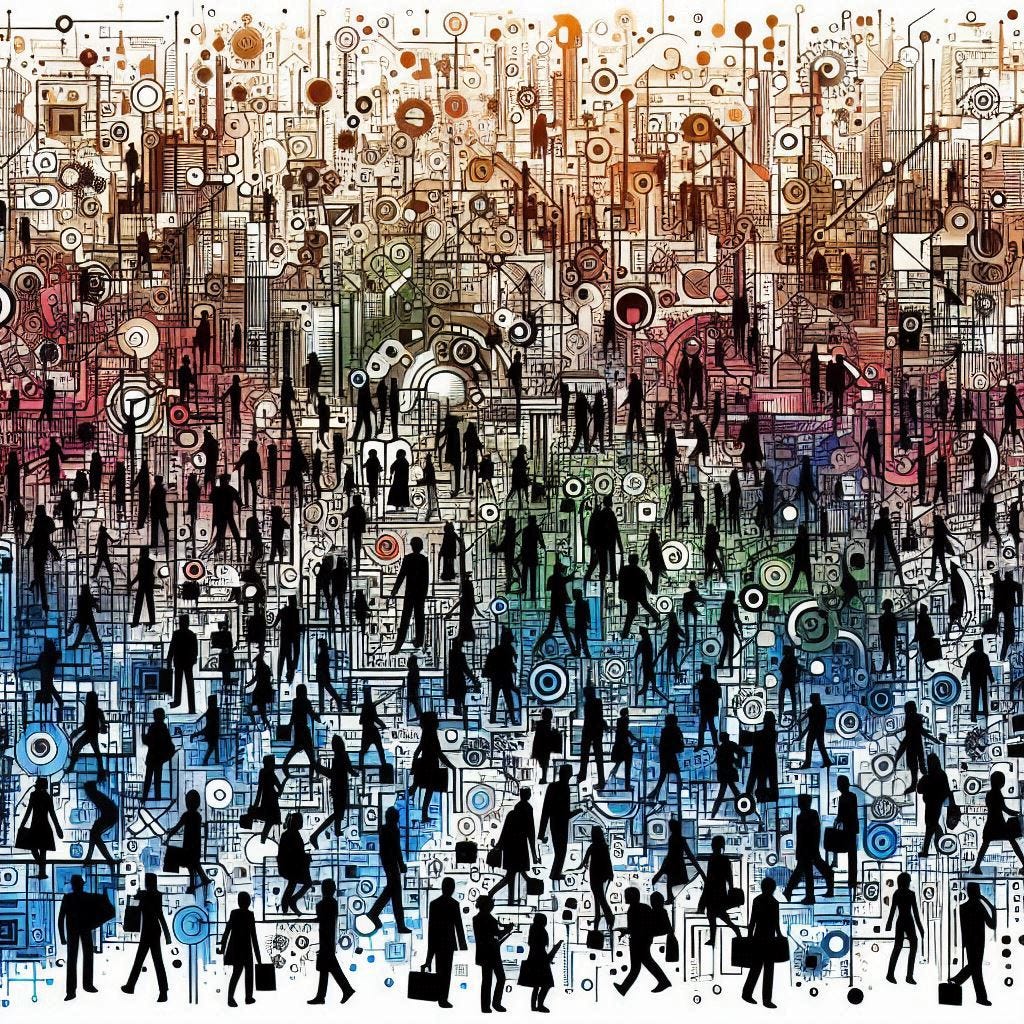
Illustration from pluralisticpractice.com
The larger point is the desire to appreciate differences, even to a radical level: the assumption that life itself is fundamentally difference and a continuous process of differentiation. Some contemporary ontological and scientific perspectives argue that existence itself is based on difference and self-differentiation. Life develops through processes of splitting, diversification, and becoming different. Even at the cellular level, life begins with division: cells divide and differentiate. An embryo develops because cells continuously differentiate into ears, hearts, eyes, and so on.
This process of differentiation also happens within individual human beings. Physically, mentally, and socially, we are always changing and becoming different from our earlier selves. As we grow, think, interact, and encounter more people, we continuously transform ourselves. In this view, life resembles an embryo constantly differentiating itself.
Some even imagine this ontologically: perhaps all existence originally emerged from one divine source, which then “split” into countless forms — humans, animals, plants, stones, and endless varieties within them. Human beings themselves become increasingly differentiated in ethnicity, personality, gender, culture, and identity. Thus, the essence of life is differentiation.
Because of this, people who cannot appreciate difference are seen as failing to appreciate life itself. Difference is not an accident; it is the very nature of existence. Even non-organic things display this tendency. For example, when soil is shaken in water and left to settle, it separates into different layers. Everything differentiates itself naturally.
Postmodern thought therefore encourages reflection on the fundamental meaning of difference. Thinkers from the early twentieth century onward — such as Alfred North Whitehead and later scientific-philosophical figures like Humberto Maturana — explored these ideas extensively. Many scientists and philosophers attempted to articulate existence as a process of continual differentiation.
At the same time, however, postmodernism also generates suspicion toward all forms of universalism. Universal truths are often viewed as disguised imperialism, hidden domination, or subtle hegemony. Many universal values historically emerged from Western philosophical traditions, so they can appear imposed upon others. Human rights, for example, are sometimes criticized because their universal formulations emerged from specific historical and cultural conditions.
Yet this suspicion can itself become excessive. Life is paradoxical: difference always contains similarities as well. Human beings differ in many ways, but they also share universal dimensions. Universal principles are possible precisely because there are shared human experiences beneath differences.
The issue is often not the values themselves, but the process through which those values become universal. Many people accept universal human rights because they emerged through collective international discussion, negotiation, and correction rather than from a single authority imposing them.
There is also a moral and spiritual dimension here. At the highest levels of moral and religious consciousness, universal unity often reappears. Mystics, humanitarians, and spiritually mature individuals frequently rediscover the unity underlying difference. Figures like Nelson Mandela embody this universal human perspective.
Children at very early stages of life often experience a kind of innocent universality, seeing others simply as fellow human beings. Later, during adolescence and identity formation, people become highly sensitive to differences and boundaries. But at deeper stages of maturity, universality often emerges again. In moments of disaster, suffering, or collective tragedy, humans spontaneously rediscover unity. During earthquakes, tsunamis, or humanitarian crises, people no longer see victims as strangers. Media coverage of suffering creates shared emotional experiences across nations and cultures.
Modern communication technologies intensify this collective consciousness. The internet, social media, and global communication networks allow people across the world to participate emotionally and intellectually in shared events. Open-source culture, collaborative projects like Wikipedia, and digital sharing cultures demonstrate how knowledge increasingly becomes “from everyone, for everyone.”
This development expands the “sense of belonging.” Historically, identity centered on tribe, ethnicity, or nation. But globalization gradually widens this sense of belonging toward regional and even global humanity. Structures like Association of Southeast Asian Nations or the European Union illustrate this broadening consciousness.
At the same time, pluralism always exists in tension with unity. Life is simultaneously one and many. Reality consists of diversity, yet also interconnectedness. In today’s networked world, relationships are increasingly viewed not hierarchically but relationally — as webs and intersections. Because everything is connected to everything else, reality becomes polycentric rather than centered around a single authority.
In this framework, no single center permanently dominates. Any point in the network can become central depending on circumstances. A peripheral group, a marginalized region, or even a terrorist attack can suddenly become the focal point of global attention. After the September 11 attacks, for example, terrorism became a global political center of concern. Similarly, economic attention can shift rapidly toward countries like China because of changing global dynamics.
Reality therefore becomes polycentric, fluid, and difficult to predict. In a deeply networked world, centers constantly shift depending on events, interests, and perspectives. This makes rigid predictions increasingly unreliable because outcomes emerge from countless interconnected forces rather than from one stable center of control.
메타데이터
- post_id
- d19549eddc4e
- slug
- the-celebration-of-difference-in-the-postmodern-age-d19549eddc4e
- url
- https://medium.com/@shrimpmindparadox/the-celebration-of-difference-in-the-postmodern-age-d19549eddc4e
- canonical_url
- https://medium.com/@shrimpmindparadox/the-celebration-of-difference-in-the-postmodern-age-d19549eddc4e
- author_url
- https://medium.com/@shrimpmindparadox
- status
- ok
- fetched_at
- 2026-06-09 15:37:30