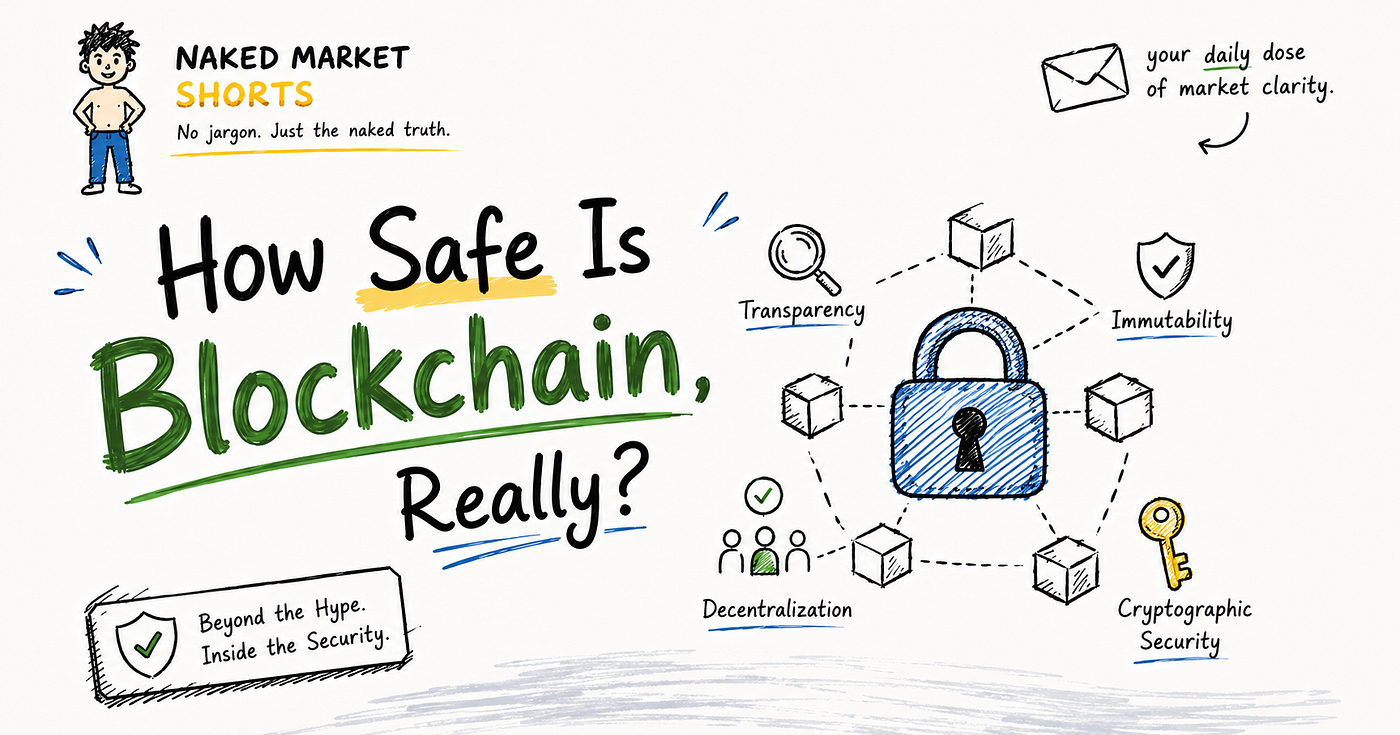
How Safe Is Blockchain, Really?
Its the most unbreakable vault humanity has ever built and it will let you lose everything to a single typo, and never once say sorry…
How Safe Is Blockchain, Really?
Its the most unbreakable vault humanity has ever built and it will let you lose everything to a single typo, and never once say sorry. “Safe” turns out to be three different questions wearing one word.
Naked Market breaks down macro finance, blockchain infrastructure, AI systems, and automated trading to help you understand the future of global finance before the mainstream catches up.
Here are two true stories. They cant both be right — and yet they are.
Story one. Bitcoins core cryptography has been live since 2009. For sixteen years it has guarded trillions of dollars while sitting in the open as the single most tempting target on the internet, and in all that time no one has ever broken it. Not once. By that measure its the safest money humanity has ever built.
Story two. In a landfill in Wales, buried under hundreds of thousands of tonnes of rubbish, sits a small hard drive. On it is the only key to a wallet holding 8,000 bitcoin — today worth around three-quarters of a billion dollars. A man named James Howells threw it out by mistake in 2013. The coins are still there, fully visible to anyone on the public ledger, sitting at an address you can look up right now. He will never touch them again. A court has confirmed it. There is no one to call.

So is blockchain safe? Both stories are completely true, which means the question, as asked, is broken. The word “safe” is hiding a swap, and until you see it youll keep getting answers that feel contradictory. So lets pull it apart. No code. No jargon you cant follow.
“Safe” is three questions wearing one word
When somebody asks “is blockchain safe?” they usually mean something vague like “will my money be okay?” But buried inside that one word are three completely different questions, with three completely different answers:

One: is the chain itself sound? Can the actual technology be broken? Two: if something goes wrong, can it be undone? Is there a safety net? And three: will it still be safe tomorrow, as computers and the world around it change? Mix these together and you get fog. Answer them one at a time and the whole thing snaps into focus.
Question 1: Is the chain sound? (Yes — almost boringly so.)
This is the part the hype actually gets right, so we can be quick — weve walked these floors before.
The cryptography that locks ownership and chains history together has never been broken on a major network. The signatures, the fingerprints, the whole machine we built it up from scratch in an earlier issue, and the track record speaks for itself. Overpowering the network instead — the dreaded “51% attack” is possible in theory, but on a serious chain it would cost more than youd ever steal, which is exactly why, as we saw in the piece on how strangers agree, the truth on a blockchain is simply the version too expensive for anyone to overturn.

And the thefts you read about every month? Almost none of them are the chain breaking. When we mapped where crypto money actually gets stolen, the pattern was overwhelming: the money bleeds out of the floors built on top — the bridges, the apps, and above all the people — while the vault in the basement sits untouched. The cryptography is the strongest part of the entire system.
So if the chain is this sound, why did Howells lose everything? Why does anyone? Because soundness was never the whole of safety. It was only ever the first question.
Question 2: If it breaks, can it be undone? (No. And this is the part nobody warns you about.)
Here is the swap at the heart of the whole thing.
A bank feels safe because a human being is in charge of it. If a thief drains your account, the bank can claw the money back. If you forget your password, they reset it. If a payment goes to the wrong place, they reverse it. Someone, somewhere, has the power to fix your mistake. That is what “safe” has meant your whole life.
But notice the catch hiding inside that comfort. The same human who can reverse a thiefs transaction can freeze yours. The same authority that can restore your access can deny it. The same institution that can undo a payment can also inflate the currency, censor a transfer, or seize an account on instruction. The safety net and the leash are the same hand.

A blockchains entire purpose is to cut that hand off. No central authority, by design. And here is the trade almost nobody spells out: when you remove the one who can freeze you, you also remove the one who can save you. There are no chargebacks. No password reset. No fraud department. No undo button anywhere in the system.

Which is the whole, brutal lesson of that hard drive in Wales. The chain did not fail Howells — it did precisely what it was built to do. His coins sit there, perfectly secure, signed over to a key that no longer exists in any reachable form. Nobody — no government, no company, no developer — has the power to hand them back, because the power to hand them back is exactly the power blockchain was designed to abolish. He is not a freak case, either. Analysts estimate that something like a fifth of all bitcoin in existence is already lost this way — forgotten passwords, dead owners, discarded drives. Gone, in plain sight, forever.
And that same irreversibility cuts both ways. The reason a thief who tricks you keeps the money — the $1.5 billion Bybit theft, every drained wallet — is the very same reason a payment you fat-finger to the wrong address is unrecoverable. Finality doesnt care whether the hand on the key was yours or a thiefs. The feature that makes the ledger impossible to secretly rewrite is the identical feature that makes an honest mistake impossible to take back.
“Be your own bank” has a quiet second half: youre also your own vault, your own security guard, your own insurance with no one to call at 2am.
And since you are now the one in charge, you are also the target. Remember the number from the heist map: in 2025, roughly three-quarters of all stolen crypto came not from broken code but from tricked humans — phishing, fake apps, social engineering. The vault is bulletproof. The person standing at the door, holding the only key, is the soft spot. That isnt a flaw in blockchain. Its the cost of being the only one in charge.

So the honest answer to question two is a flat no. Nothing can be undone. But sit with this properly, because its not simply a weakness — its a trade. You gave up the safety net, and in return you got something real: money that no one can freeze, debase, censor, or seize out from under you. Whether thats a good deal depends entirely on which risk you fear more — someone elses control, or your own mistakes.
Question 3: Will it still be safe tomorrow? (Two open questions.)
The chain is sound today and unforgiving today. But “safe” also has a tense and two clouds sit on the horizon worth watching honestly.
The first is quantum computing — the one threat that actually aims at the vault itself, not the floors above it. The cryptography protecting nearly every coin relies on a math problem thats hopeless for todays computers but solvable, in principle, by a sufficiently powerful quantum machine. For years that was a far-off worry. In 2026 the worry got sharper: a Google research paper, co-authored with people from the Ethereum Foundation and Stanford, slashed the estimated machine size needed to crack a signature by roughly twentyfold.

Now, keep your head here, because the hype merchants wont. No quantum computer on Earth can do this today — the best machines have on the order of a thousand-odd qubits, and the job needs something like half a million error-corrected ones. The honest estimates for “Q-Day” cluster somewhere around 2030 to 2033, with serious voices arguing it could be far longer. The exposure is real — roughly a third of all bitcoin sits in addresses whose keys are already visible, vulnerable to a “harvest now, decrypt later” raid but this is a slow-moving, well-telegraphed storm, not a thief at the window tonight.
And this is the part that matters — the roof is already going up. Global standards bodies finalised a new generation of quantum-proof cryptography in 2024. Bitcoin developers merged the first quantum-resistant address type into the codebase in early 2026, with a phased migration plan behind it. Ethereum stood up a dedicated post-quantum team the same year. A few chains already ship resistant signatures today. The threat is genuine; so is the defence. As the engineers building it keep repeating: the hard part isnt the math — its getting a leaderless world to coordinate the upgrade in time.

The second cloud is quieter: centralisation. A chains safety rests on being genuinely spread out — and “decentralised” is a spectrum, not a checkbox. We saw the sharp edge of this when a single mining outfit managed to rent its way to majority control of a smaller network. Mining and staking quietly concentrate. And some things that wear the word “crypto” arent the unstoppable kind at all — several large stablecoins can freeze your balance with a single command, which is why it pays to know whether youre holding a truly open chain or a private system wearing the costume. A network is only ever as safe as it is decentralised — and that, too, is something to check rather than assume.
The takeaway: the Safety Swap
So heres the tool to keep. Whenever someone tells you a blockchain is “safe,” dont nod and dont scoff. Just flip the claim over and read the other side — because every strength here is the same coin flipped.

“Immutable” also means no undo, ever. “Be your own bank” also means no one to call when it breaks. “Censorship-resistant” also means no one can step in to protect you. “Trustless” also means the responsibility is, completely, yours.
None of those flips is a reason to walk away. Theyre a map of where the real work moved. Because the chain only ever covered the first half of safety — the unbreakable half. The second half, the recoverable half, is now your job. Which in practice means three boring, unglamorous habits: hold your keys in real custody, not on a whim; verify every transaction before you sign it, because the screen can lie; and treat every send as final, because it is.
So the next time you hear “is it safe?”, dont reach for a yes or a no. Run the three questions. Is the vault sound — on a serious chain, yes. Is there a safety net — no, thats on you now. Whats the time horizon — open, and actively defended. Answer those, and youll always know exactly which kind of safety youre holding.
Why this actually matters
Zoom out, because this is bigger than one buried hard drive.
The worlds money is steadily moving onto these rails — stablecoins settling across borders, tokenised assets, central-bank currencies, even AI agents that hold their own wallets. A global financial system with no undo button is an astonishing thing: no money printed away by decree, no accounts frozen on a whim, no gatekeeper deciding who gets to transact. That is precisely the appeal. But a system that unforgiving, handed to eight billion people with no safety net, isnt ready for all of them only for the technically fearless.

So the future isnt “trust the bank” and it isnt “trust no one and pray you never mistype an address.” Its the quiet maturing already underway: keep the unbreakable base layer exactly as it is, and rebuild the safety nets on top of it — nets that give you back the undo without giving back the master switch. Wallets where a circle of trusted friends can help you recover access, with no company ever holding your keys. Multi-signature setups where no single mistake is fatal. Insured custodians for those who want them. Each one hands a little recoverability back to the user, without handing the kill switch back to a central authority.
That hybrid — a foundation no one can break, plus safety nets anyone can choose to add — is what turns this from a frontier for the brave into infrastructure for everyone. Its the difference between a vault that protects your fortune and a vault that swallows it. And it is exactly what a shared, neutral financial layer for the planet — the One Earth, One Currency direction this newsletter keeps tracing — has to get right before the whole world can stand on it.
So, how safe is blockchain, really? The vault is the safest ever built. The safety net is whatever you, and the tools you choose, decide to build on top of it. Stop asking whether its safe. Start asking the three questions — and youll never be surprised by which kind of safety you were holding.
If you want to keep reading finance this way — the structure under the headlines, before it gets obvious — subscribe. One clear breakdown at a time.
-More soon
Keep going
- Start here → One Planet, 180 Currencies — the whole thesis in one read
- Everyone Says Blockchain Cant Be Hacked. Theyre Wrong. — the four floors where money actually gets stolen
- The Biggest Innovation in Blockchain Isnt Money. Its Agreement. — why the chain is too expensive to overpower
- What a Settlement Layer Really Means — when a payment stops being reversible, and why that matters
- The New Rails: Blockchain as Infrastructure — where all of this is heading
메타데이터
- post_id
- d1a3f27a8e2b
- slug
- how-safe-is-blockchain-really-d1a3f27a8e2b
- url
- https://medium.com/coinmonks/how-safe-is-blockchain-really-d1a3f27a8e2b
- canonical_url
- https://medium.com/coinmonks/how-safe-is-blockchain-really-d1a3f27a8e2b
- author_url
- https://medium.com/@chetandugar007
- status
- ok
- fetched_at
- 2026-07-17 21:06:32