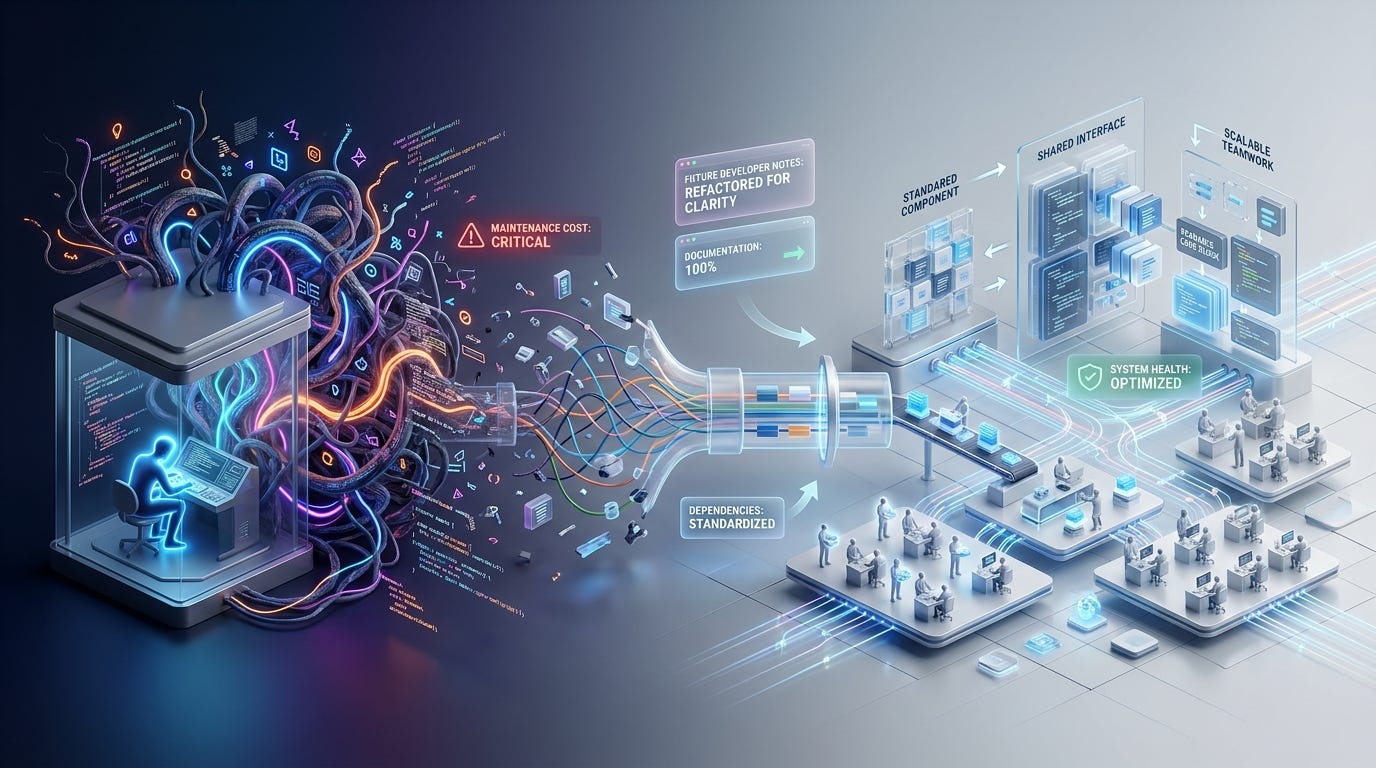
Why Your Future Self Will Probably Hate You (And How to Fix It)
Imagine waking up, grabbing a cup of coffee, and opening a project you finished six months ago. You look at the lines of text on the…

Why Your Future Self Will Probably Hate You (And How to Fix It)
Imagine waking up, grabbing a cup of coffee, and opening a project you finished six months ago. You look at the lines of text on the screen. You recognize the font, you recognize the logic, and you know for a fact that your hands typed every single character. But there is one glaring problem: you have absolutely no idea what any of it means.
It feels like reading a diary written in a language you used to speak fluently but have since forgotten. This is the “Great Developer Amnesia,” and it is the inevitable tax paid by anyone who refuses to write things down.
The Myth of the “Self-Documenting” Code
In the tech world, there is a common fairy tale told to beginners: “If you write clean code, you don’t need documentation.” The idea is that if the logic is simple enough, anyone should be able to look at it and understand it instantly.
This is a trap.
Clean code tells a reader how a program works. It shows the steps, the loops, and the logic. But even the cleanest code in the history of software cannot explain why a specific decision was made. It doesn’t explain why a certain shortcut was taken, why a specific library was ignored, or what the external constraints were at 3:00 AM on a Tuesday. Without documentation, the “why” vanishes into thin air the moment you hit “save” and close your laptop.
A Love Letter to Your Future Self
Documentation shouldn’t be viewed as a boring homework assignment or a corporate chore. Instead, it is best understood as a love letter to your future self.
Think of it as leaving a breadcrumb trail through a dark forest. Right now, the path is clear because you are standing on it. You know where the pits are and where the bridge is broken. But six months from now, the trees will have grown, the weather will have changed, and you will be a different person with a hundred other projects occupying your brain space.
By writing a simple README file or adding clear comments to a project, a developer is essentially saying, “Hey, I know you’re going to be stressed and tired when you come back here, so I’ve mapped out the tricky parts for you.” It is an act of empathy for the person you haven’t become yet.
Writing for Humans, Not Just Machines
The biggest mistake students and fresh graduates make is thinking that documentation is for “other people.” While it certainly helps a team, the primary beneficiary is almost always the author.
Professional documentation doesn’t need to be a thousand-page manual. It just needs to be human. It’s about explaining the “vibe” of the project:
- What is this thing supposed to do?
- How do I get it running?
- Where are the “gotchas” that caused a headache during development?
When these questions are answered in plain English, the barrier to entry for resuming a project drops to zero. You stop being a detective trying to solve a cold case and start being a builder who can pick up a hammer and get back to work immediately.
The Thoughtful Takeaway
Coding is a conversation between a human and a machine. Documentation is a conversation between a human and another human (even if that human is just you in six months). Don’t let your future self inherit a mess of “clever” logic and zero context. Break the myth that good code is enough on its own. Write it down, leave a map, and be the person who makes life easier for the next version of you.
메타데이터
- post_id
- d1a5ba10ee1e
- slug
- why-your-future-self-will-probably-hate-you-and-how-to-fix-it-d1a5ba10ee1e
- url
- https://medium.com/@caksaji/why-your-future-self-will-probably-hate-you-and-how-to-fix-it-d1a5ba10ee1e
- canonical_url
- https://medium.com/@caksaji/why-your-future-self-will-probably-hate-you-and-how-to-fix-it-d1a5ba10ee1e
- author_url
- https://medium.com/@caksaji
- status
- ok
- fetched_at
- 2026-06-09 15:37:30