How Quick Release Couplings Improve Efficiency and Safety
In modern industrial and mechanical systems, efficiency and safety are not optional — they are critical. Whether you’re working with…
How Quick Release Couplings Improve Efficiency and Safety
In modern industrial and mechanical systems, efficiency and safety are not optional — they are critical. Whether you’re working with hydraulic systems, pneumatic tools, or fluid transfer applications, the components you choose can significantly impact performance. One such essential component is the **quick release coupling**. Designed for fast and secure connections, these couplings simplify operations while reducing risks.
In this guide, you’ll learn how quick release couplings improve efficiency and safety, and why they are widely used across industries.
What Are Quick Release Couplings?
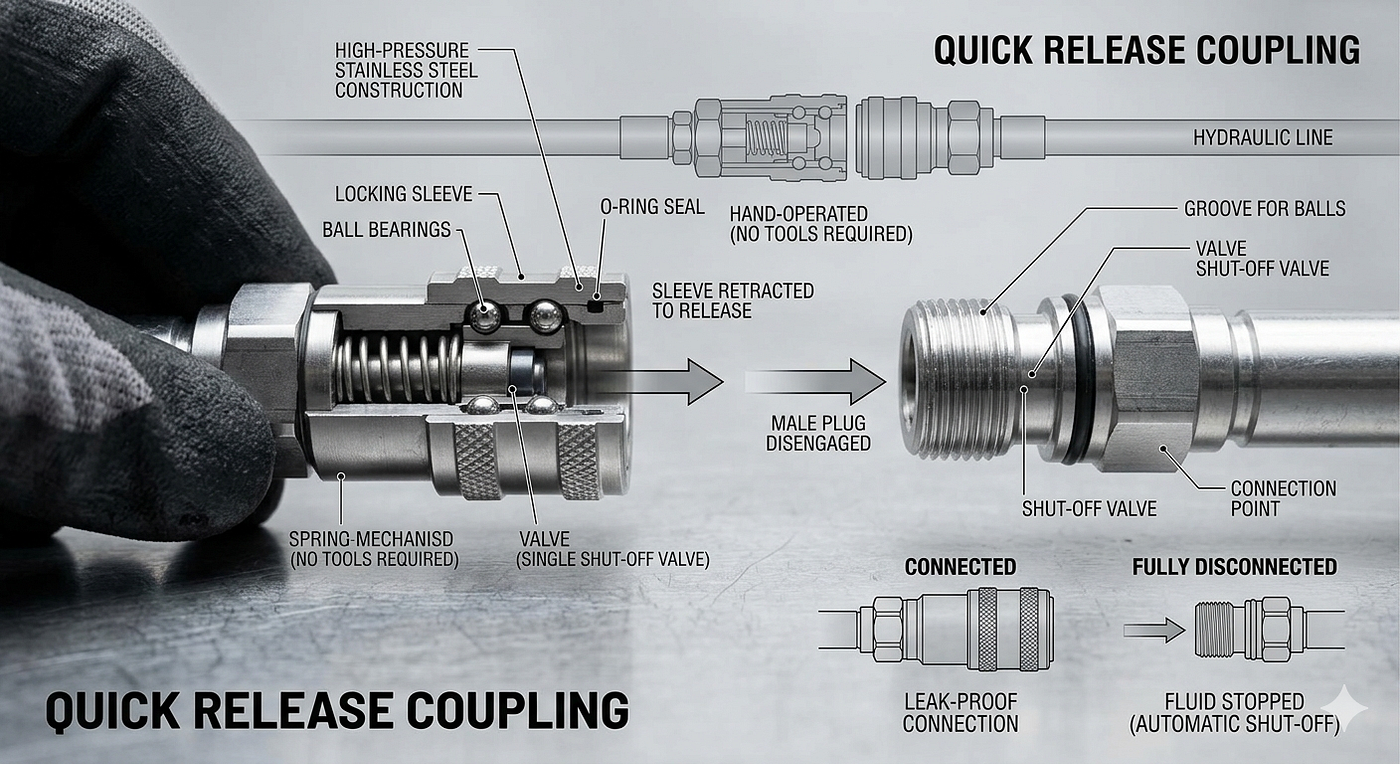
Quick release couplings, also known as quick disconnect couplings, are devices that allow you to connect and disconnect fluid or air lines quickly without the need for tools. They are commonly used in hydraulic systems, pneumatic systems, and industrial fluid transfer applications.
These couplings consist of two main parts:
- A male plug
- A female socket
When connected, they create a secure seal that prevents leaks. When disconnected, they automatically shut off flow, minimizing spillage.
How Quick Release Couplings Improve Efficiency
1. Faster Connection and Disconnection
One of the biggest advantages of quick release couplings is speed. Unlike traditional threaded fittings, you don’t need tools or extensive time to connect or disconnect lines.
Benefit: You can complete maintenance tasks or switch equipment quickly, reducing downtime and improving productivity.
LSI Keywords Used: quick connect fittings, fast fluid connections, tool-free coupling
2. Reduced Downtime in Operations
In industries like manufacturing, construction, and agriculture, time is money. Delays caused by complicated connections can slow down workflows.
Quick release couplings allow operators to:
- Change tools rapidly
- Perform maintenance efficiently
- Minimize equipment idle time
Result: Improved operational efficiency and smoother workflow.
3. Easy Maintenance and Replacement
With traditional systems, replacing components can be time-consuming. Quick disconnect couplings simplify this process.
You can:
- Isolate sections of a system easily
- Replace damaged parts without shutting down the entire system
Outcome: Lower maintenance costs and increased system uptime.
4. Versatility Across Applications
Quick release couplings are used in a wide range of applications, including:
- Hydraulic machinery
- Pneumatic tools
- Water and chemical transfer systems
Their adaptability means you can standardize connections across multiple systems.
Advantage: Greater flexibility and simplified system design.
How Quick Release Couplings Enhance Safety
1. Leak Prevention and Spill Control
One of the key safety features of quick release couplings is their ability to prevent leaks. Many couplings include automatic shut-off valves that stop fluid flow when disconnected.
Why it matters:
- Reduces exposure to hazardous fluids
- Prevents environmental contamination
- Maintains clean working conditions
2. Minimizing Human Error
Traditional threaded connections require careful tightening. Improper installation can lead to leaks or system failures.
Quick release couplings are designed for simple, error-free operation:
- Push-to-connect mechanisms
- Audible or tactile locking feedback
Result: Reduced risk of incorrect installation.
3. Improved Worker Safety
In high-pressure systems, accidental disconnections can be dangerous. Quick release couplings are engineered with secure locking mechanisms to prevent unintended release.
Some models also include:
- Pressure relief features
- Safety locking sleeves
Impact: Protects workers from injuries caused by sudden fluid discharge.
4. Safe Handling of Hazardous Materials
In industries dealing with chemicals or gases, safety is paramount. Quick disconnect couplings help ensure controlled handling.
They:
- Limit fluid exposure during disconnection
- Provide tight seals to prevent leaks
Benefit: Safer handling of hazardous substances and compliance with safety standards.
Key Benefits at a Glance
- Faster installation and removal
- Reduced downtime and increased productivity
- Leak-proof and spill-resistant design
- Enhanced operator safety
- Lower maintenance costs
- Versatile for multiple industrial applications
How to Choose the Right Quick Release Coupling
To maximize efficiency and safety, selecting the right coupling is essential. Consider the following factors:
- Material compatibility: Ensure it matches the fluid or gas used
- Pressure rating: Choose a coupling that can handle system pressure
- Size and flow rate: Match your system requirements
- Connection type: Hydraulic, pneumatic, or fluid-specific
- Safety features: Look for locking mechanisms and shut-off valves
Conclusion
Quick release couplings are a small component with a big impact. By enabling fast connections, reducing downtime, and preventing leaks, they significantly improve operational efficiency. At the same time, their safety features protect workers and ensure reliable system performance.
If you’re looking to optimize your industrial systems, investing in high-quality quick release couplings is a smart and practical choice. They not only streamline your workflow but also create a safer and more efficient working environment.
메타데이터
- post_id
- d1abd87fd512
- slug
- how-quick-release-couplings-improve-efficiency-and-safety-d1abd87fd512
- url
- https://medium.com/@Hydrofit/how-quick-release-couplings-improve-efficiency-and-safety-d1abd87fd512
- canonical_url
- https://medium.com/@Hydrofit/how-quick-release-couplings-improve-efficiency-and-safety-d1abd87fd512
- author_url
- https://medium.com/@Hydrofit
- status
- ok
- fetched_at
- 2026-06-27 18:20:27