I Simulated 100 Indians Debating AI and Jobs for 20 Rounds
They never reached consensus. But halfway through, one thing flipped their conclusions almost instantly, and it wasn’t new data.
I Simulated 100 Indians Debating AI and Jobs for 20 Rounds
They never reached consensus. But halfway through, one thing flipped their conclusions almost instantly, and it wasn’t new data.
A few weeks ago I got tired of a question I keep seeing argued badly: will AI replace human jobs in India by 2030? Everyone has a take. Almost nobody moves an inch. So instead of adding one more opinion to the pile, I tried something else. I built a room full of synthetic people and let them fight about it.
The tool was MiroFish, an open-source multi-agent simulation framework. The premise is strange and a little addictive. You give it source material about a scenario, it builds a knowledge graph out of that material, and then it spins up a population of AI agents, each with its own personality and memory, and runs them as a social simulation. They post, argue, persuade, change their minds, dig in. You get to watch a small society reason out loud.
I gave it one question, 100 agents, and 20 rounds of interaction. Here is what came out, and why the result that stuck with me had almost nothing to do with jobs.
One thing before we start: everything below is output from the simulation, not my forecast. I will come back to why that line matters more than it sounds.
The setup
MiroFish doesn’t ask you to script behavior. You hand it a scenario and a question, it grounds a set of agent personas in that material, and then it lets them interact. My population was meant to reflect the people who actually argue about this in India: IT employees, fresh graduates, mid-career professionals carrying real financial weight. Twenty rounds gave them enough cycles to talk past each other, find each other, and occasionally shift.
I expected the swarm to converge on something. It refused.
Finding 1: no consensus, just divided anxiety
There was no answer. Not a tie, not two camps screaming across a divide. Something in between that I started calling divided anxiety. Nearly everyone was worried. Nobody agreed on what to do with the worry. The system simply could not resolve it into a clean position.
That reads like a failure of the experiment. I have come to think the opposite. If a hundred agents had neatly agreed on whether AI takes their jobs by 2030, that tidiness would have been the suspicious part. The real question is messy, so a messy result is the honest one.
Finding 2: I changed two headlines and the conclusions flipped
This is the part I keep turning over in my head.
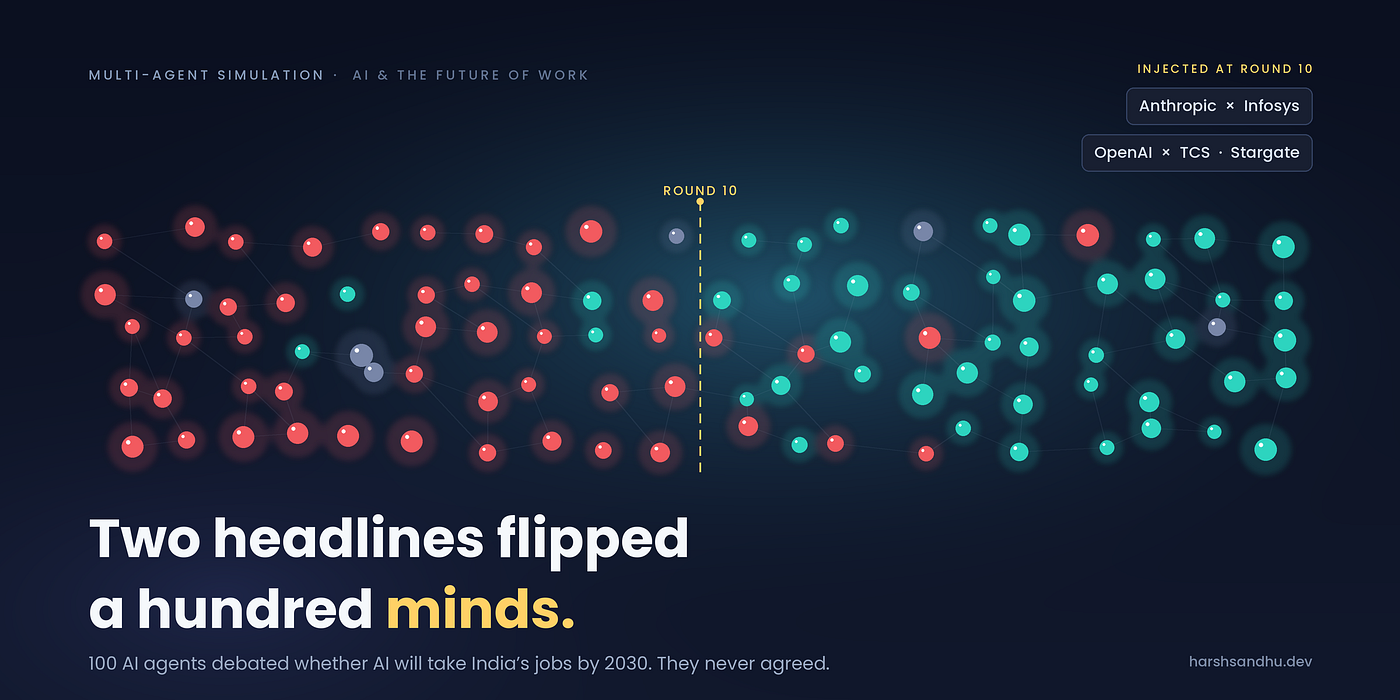
At round 10, the midpoint, I injected exactly two pieces of news into the world:
- Anthropic partnering with Infosys
- OpenAI and TCS (the Stargate news)
That was the entire intervention. No new arguments about automation. No fresh data on whether specific jobs survive. Two partnership announcements.
The agents pivoted almost at once. “AI will replace us” turned into “AI will partner with us.” Same agents. Same underlying data they had been working with the whole time. The only thing that changed was the story they were being told about whose side AI is on.
Narrative changed. Conclusions changed.
If you have ever watched public mood swing on the back of a single press release, this will feel familiar. What made it land for me was seeing it inside a controlled box, the same population before and after, nothing different except the framing. You could watch the belief move.
Finding 3: who didn’t budge, and why it matters more
Not everyone moved. Two groups stayed almost exactly where they started: IT workers and fresh graduates.
The simulation produced lines from these agents that I have not been able to shake:
“I’m 40. EMI ₹45K. AI doesn’t pay my loan.”
“200 applications. 0 offers. Where are these jobs?”
You cannot reframe your way out of a loan payment. That is the thing hiding in this result. For people whose exposure to AI is abstract, the story they hear shapes how they feel about it. For people sitting on concrete personal risk, the story bounces off. This is not a data problem. It is a personal-risk problem, and the two do not respond to the same inputs at all.
The numbers the room kept circling back to
Underneath the mood swings, the agents kept anchoring to a set of structural signals. I am reporting them as they surfaced in the run, and I would source each one independently before quoting it anywhere serious (more on that at the end):
- BPO hiring falling from roughly 130,000 to under 17,000
- 733 Indian startups shut down in 2025
- EdTech funding down 56%, with BYJU’S in bankruptcy
- entry-level hiring sliding across sectors
And one figure that no agent could meaningfully push back on:
Only 4.1% of workers who need AI retraining have actually received it.
That number did a lot of quiet work in the simulation. It is hard to hold onto “AI will partner with us” when almost nobody is being trained for the partnership.
What the simulation concluded, and what I did not
Pull the threads together and the swarm did not land on “AI eliminates jobs.” It landed somewhere quieter and, frankly, more believable. AI is reshaping career pathways rather than deleting them. Senior roles persist. Entry points narrow. The people most exposed are not necessarily today’s mid-career workers. They are the fresh graduates walking up to a ladder with its bottom rungs missing.
I want to be clear that this is the system’s conclusion, not mine. I did not seed it with a thesis and wait for it to agree with me. I asked a question and watched a hundred agents argue toward an answer I did not hand them.
On MiroFish itself: useful, not magic
A few practical notes from running it, because the tooling shaped the output more than I expected.
Context window matters far more than you would guess. The default of 4096 tokens (and if you run locally, that is Ollama’s default) is too small for a real multi-agent simulation. Agents start losing the thread of who said what. Bumping num_ctx to 16384 made a visible difference in coherence.
Model choice changes the texture of the whole thing. Running with Gemini 2.5 Flash produced stronger psychological signals, the emotional and social side of the agents. Qwen3 14B produced stronger structural patterns, the economic and systemic reasoning. Same scenario, different lens on it.
And the limitation that matters most: the agents are too rational. They update their beliefs cleanly when handed new information, the way a textbook Bayesian would. Real people do not. Real decisions are slower, more emotional, and a lot more stubborn.
That gap is the whole game. A simulation where everyone reasons well is not a model of humans. It is a model of how a debate would go if everyone argued in good faith and actually listened to each other, which, as you may have noticed, is not the world we live in.
So what is any of this good for?
I did not run this to predict 2030. Treat it as a forecast and you will be wrong with confidence. What it is good for is narrower and more useful: watching how a narrative spreads through a population, finding which groups are immune to which messages, and catching your own assumptions the moment the swarm refuses to behave the way you expected it to.
The narrative-injection result is the one I am keeping. Two headlines moved a hundred minds without changing a single underlying fact. If that holds inside a box of unusually well-behaved AI agents, it almost certainly holds outside the box, where nobody is well-behaved.
I ran two passes in the end, one tuned for psychological signal and one for structure, and used Claude to merge them into a single consolidated report. [Link to the full report.]
Last thing, and it is the important one: none of these are my opinions. They are emergent outcomes from the system. That is both the strength and the catch of this whole approach. The machine will tell you what a crowd might do. It will not tell you what is true.
메타데이터
- post_id
- d1cf4db5810a
- slug
- i-simulated-100-indians-debating-ai-and-jobs-for-20-rounds-d1cf4db5810a
- url
- https://medium.com/@harshsandhudev/i-simulated-100-indians-debating-ai-and-jobs-for-20-rounds-d1cf4db5810a
- canonical_url
- https://medium.com/@harshsandhudev/i-simulated-100-indians-debating-ai-and-jobs-for-20-rounds-d1cf4db5810a
- author_url
- https://medium.com/@harshsandhudev
- status
- ok
- fetched_at
- 2026-06-21 07:44:09



