My dream video game-to-film adaptation (Charming and Open)
And how I’d cast it
My dream video game-to-film adaptation (Charming and Open)
This month, my friend Ian from Adventure Rules hosted this year’s edition of his annual community event Charming and Open, inspired by the game-play mechanic from Dungeon World. His followers ask him a question in the comments section, which he responds to with another post, as well as asking them a question in return, which they respond to with a post of their own.
One of the games I’m playing at the moment is Portal 2, so I asked Ian “if you had a Portal gun, how would you use it?” Despite not being familiar with the Portal and Half-Life games, he did some research on the mechanics of the Portal gun to give quite a detailed response, describing the various ways he might apply it to his own life. You can read his breakdown of the question here.
In return, he asked me a much broader question:
“I know you’re a big cinema guy, so I’d be curious what your dream game-to-film adaptation would be and how you would cast it?”
It didn’t take me very long to know what my answer to this is. I’m sure it’s no surprise to learn that there is — and has, for years, been — a particular video game that I want to see adapted into a film.
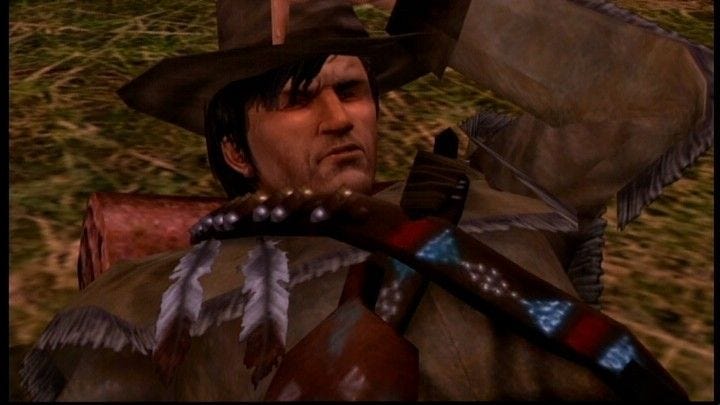
That game is called, quite simply, GUN.

This game has such a tremendous story that’s crying-out for a film adaptation. There’s so much potential to it and I’ve thought that since I first played the game. I really believe that, done properly and with the right changes made, an adaptation of GUN could make for a great movie. The premise of the story is very much the standard template for an adventure film: there’s a MacGuffin, some bad guys want it and the hero has to stop them getting it. But as that story develops, character backstories are expanded and the protagonist discovers things about himself that changes the way he sees both his own life as well as the American frontier.
Our protagonist is Colton White, a mountain man in Montana who hunts game with his father, Ned, to sell to the steamships travelling the Missouri River. One day, the Whites board the Morning Star, where Ned inspects a mysterious safe. They’re greeted by a sinister priest, Josiah Reed, who then launches an attack on the Morning Star. As Reed’s militia overwhelms the crew and passengers, Ned reveals to Cole that he isn’t really his father, before pushing him overboard to safety. When Cole awakens, he’s told the Morning Star has sunk to the bottom of the Missouri River with no survivors. Thus, Cole begins a journey to discover what was in the safe, why Reed wanted it and — most importantly — who his father, if it wasn’t Ned, really is. Along the way, he comes into contact with various stock characters and, as he finds the answers to his questions, realises he’s part of a much bigger picture than he ever imagined. It’s a simple formula but it works. There’s exciting action but also character development. It’s an old-fashioned adventure story but part of that adventure is one man’s profound journey of self-discovery as he experiences the most important thing to ever happen to him. You get the theme park version of the American frontier from the classic westerns of the 1940–1960s as well as the introspective drama of later, revisionist westerns. There are plenty of popular movie tropes but the story actually means something to the main character.
GUN — written by one-time video game writer Randall Jahnson — was nominated for the D.I.C.E. Award for Outstanding Achievement in Story by the Academy of Interactive Arts & Sciences. That’s the video game equivalent to a film being nominated for one of the Academy Awards’ screenplay categories. It is, essentially, a list, compiled by the video game industry, of the video games with the best narratives. The challenge of adapting video games to film is that video games are intended, first and foremost, to deliver an engaging game-play experience; whereas, in film, story is supposed to come first. So, when it comes to picking which video games to adapt, this award’s winners and nominees is where Hollywood should be looking.
Which is not to say that it’s a simple matter of transposing the game into a screenplay. Adaptation is all about understanding what to keep and what to change. GUN may be one of the most narrative-oriented video games but film isn’t “oriented” toward narrative: it just is narrative. The video game takes certain liberties with the story that are understandable for a video game but that just wouldn’t be acceptable for a film. A film can’t fall-back on engaging game-play, it would have to take what story there is and expand it; omitting the parts that only serve the game-play while developing the parts of it that are more essential.
While the video game’s narrative has a lot of potential to be a great movie, adapting it to film would also require the story to be improved. The cut-scenes in GUN are fairly short — even the longest ones last only a couple of minutes — which means some of the biggest moments in the story don’t seem as big as they should. For instance, there’s the scene in which Cole discovers the truth of his parentage. Up to that point, Cole, as a character, has been motivated by the desire to find out who he really is and where he really comes from. It’s the classic tale of “who am I?”, a story form as old as myth itself. Getting the answer to this question is what comes to define his identity and, ultimately, his ideology, as well as revealing how the different disparate elements of the plot all fit together. It’s the scene that the entire story hinges around and yet, because the cut-scenes are so short, it’s presented more as a matter-of-fact than as the world-shifting moment it would actually be. But, in a film, the audience isn’t waiting to get back to the game so they can play the next mission. If a scene needs to be long and indulgent, it can be. You have the time to do that because you’ve cut out parts of the narrative that aren’t strictly relevant. The audience doesn’t need a scene based on a tutorial mission or a part of the game that was only there just to give it some game-play variety and, as a result, the biggest moments in the story really can be big. That’s what would excite me the most about GUN done as a film: the idea of finally getting to go beneath the surface. Being a video game, the plot is more-or-less as one battle sequence after another with the actual story happening in the cut scenes between them; Whereas a film would be able to focus more on those in-between scenes and explore the depth that the game never got the chance to go into.
Which brings me to the second part of Ian’s question for me… if there were a film based on GUN, who would I cast?
Generally speaking, all that really matters to me is that the characters are portrayed by good actors. But, to engage with the question in good faith, I’ll imagine that I’m in the position of making those decisions myself.

Austin Butler photograph by Eric Ray Davidson
The casting of Colton White would be a significant problem because he discovers that — spoiler alert — he’s actually half-Native American. Now, it may seem unlikely that someone could be half-Native American without that being apparent but there are some half-Native Americans who don’t actually present Native American — Cody Christian (the English dubbing artist for Cloud Strife in Final Fantasy VII Remake) and the politician David Holt are both people who have one Native American parent despite otherwise appearing Caucasian. Similarly, Kyrie Irving is also half-Native American despite otherwise appearing African American. The character being half-Native American doesn’t necessarily mean the actor playing them also has to be — it’s actually not unrealistic to cast a Caucasian actor — the question is whether a studio would want to take that risk. They probably wouldn’t. Cole’s discovery of his Native American heritage causes him to see Native Americans more sympathetically — it’s the most significant part of his character development and also part of the larger themes of the story of presenting the American frontier in a less glorified way. But still, I can’t imagine a major film studio being willing to not cast a half-Native American actor, even if the character doesn’t actually present half-Native American. That sort of thing would easily stir-up the kind of controversy that would overshadow the film itself with inevitable accusations of anti-Native American racism and erasure, regardless of the fact that its story is about an American frontiersman coming to sympathise with the Native American plight. Personally, I can imagine Austin Butler fitting the role of Colton White perfectly but I know the subject would be too contentious for that to realistically happen.
But what about the other characters?
“Soapy” Jennings is the outlaw safe-cracker who helps Cole retrieve the content of the safe on the Morning Star. For that role, you want a freaky, scrawny little guy — so, naturally, I thought of Timothée Chalamet.
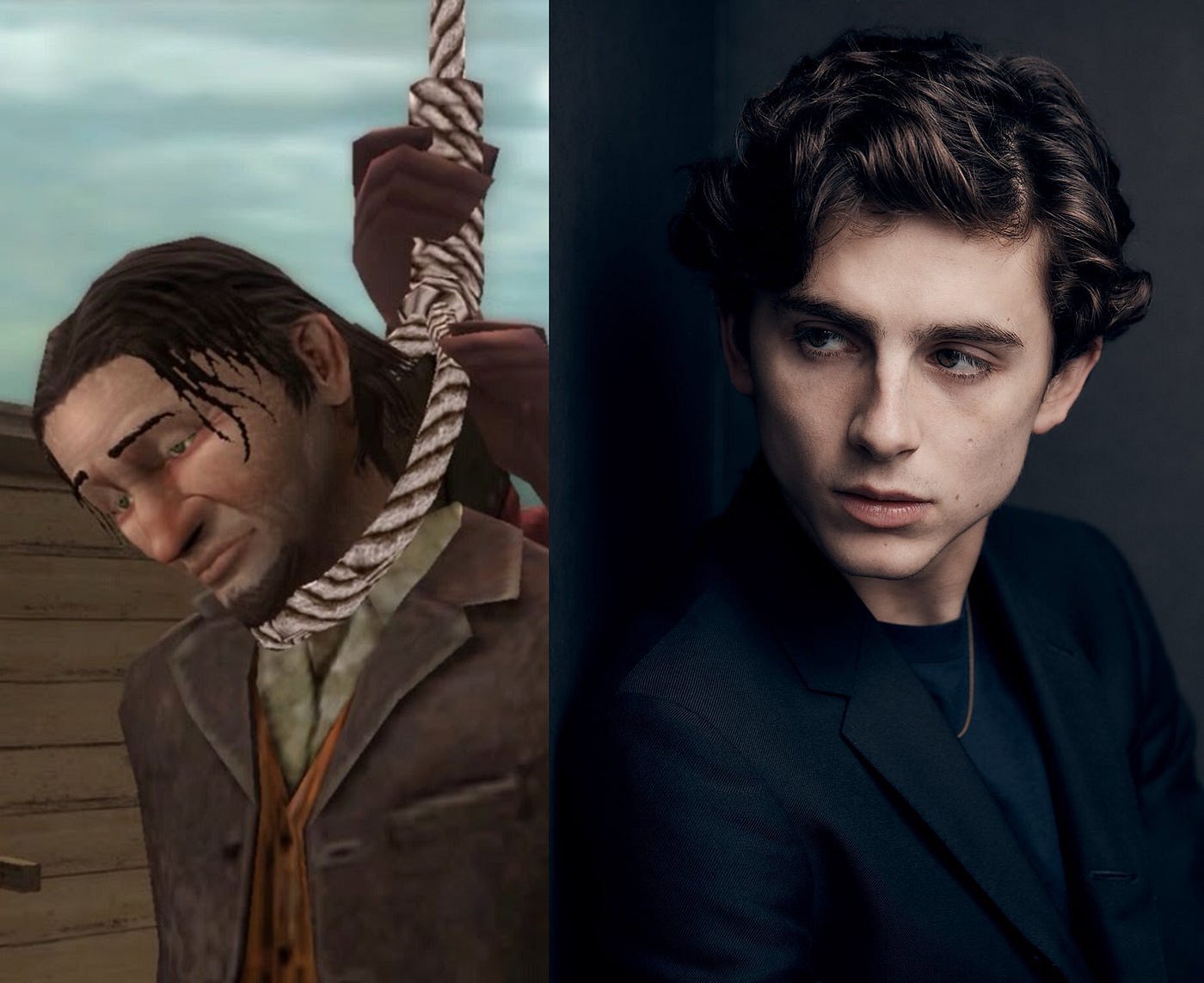
Timothée Chalamet photograph by Shayan Asgharnia
Tom Magruder is the former Confederate commander-turned-railroad magnate who’s connected to the death of Cole’s parents in a way that’s also the reason for him losing an eye. He’s searching for the ultimate treasure and believes the lost item in the safe will lead him to it. An obvious choice for the role would be someone like Jeff Bridges but he’s famously already been in a western film in which he wore an eye patch and casting him as Magruder might seem a bit derivative. Instead, I’d go with someone else who also has a weighty gravitas, like Clancy Brown (who’s racked-up quite the video game filmography, including the motion-captured role of Hank Anderson in Detroit: Become Human).
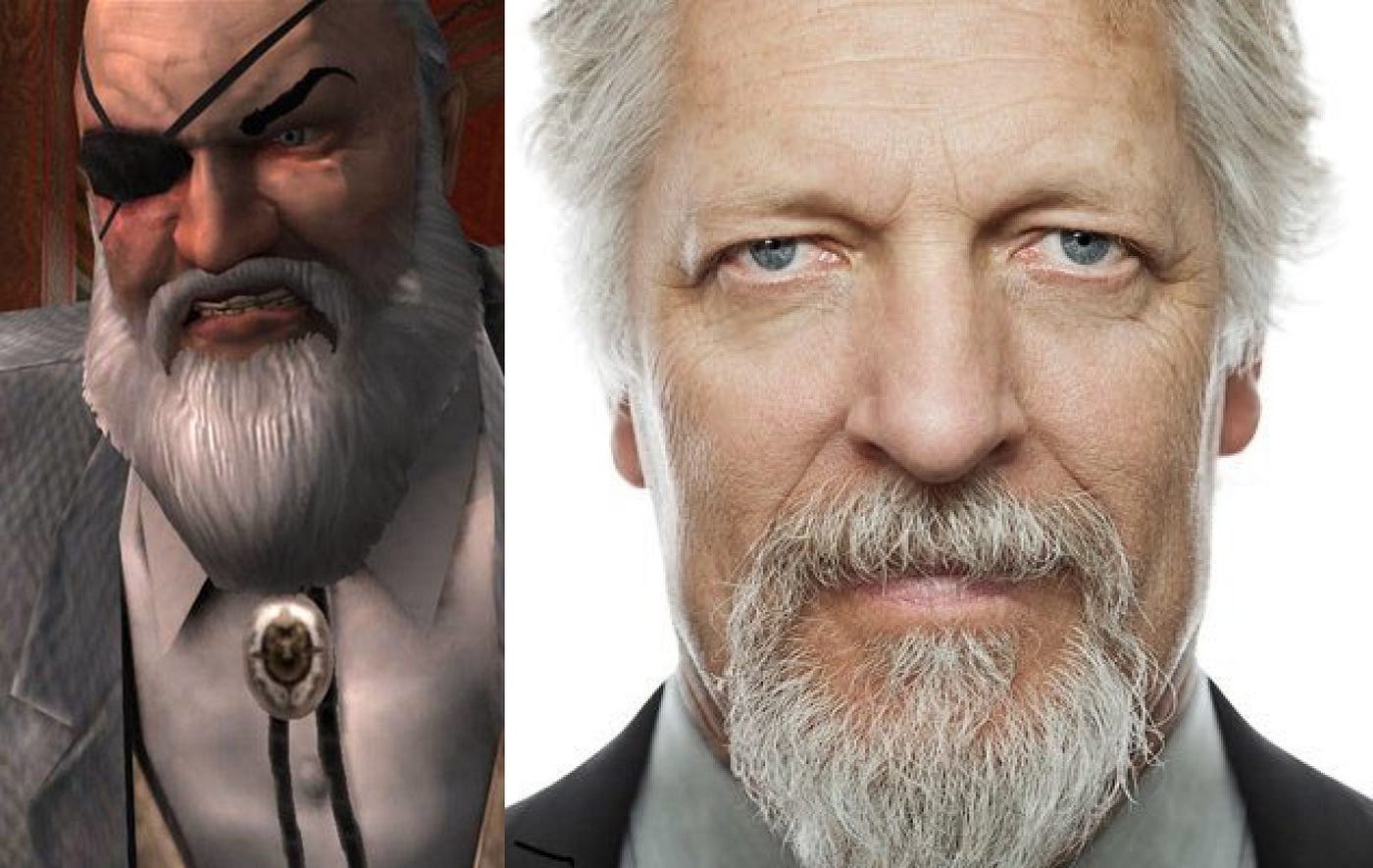
Clancy Brown’s Twitter avatar
Ned White appears only sparsely, at the beginning before being killed-off and then again in a flashback explaining how he came to be Cole’s adoptive father. But a character like this — an old, world-weary wise man of the wilderness — lends himself really well to someone like Sam Elliott. He even has the facial hair to match.

Sam Elliot photograph by Valerie Macon via Getty
Josiah Reed is an interesting one. He’s the reverend who works for Magruder and is the agent he’s dispatched to retrieve the treasure in the safe. He’s creepy and sinister but also emotionally unstable and psychotic. He may have limited range but, for roles like this, John Malkovich always delivers.

John Malkovich photograph via HBO
Some of the characters Cole meets on his adventure are based on real historical figures. The first is “Hoodoo” Brown, the mayor of Empire and owner of Hoodoo’s Palace, who, we soon learn, is controlling the city on Magruder’s behalf. He welcomes Cole to Empire as a friend while secretly planning to frame him for murder and have him executed. This really reminded me of — stick with me here — Kurt Russell’s performance as Ego in Guardians of the Galaxy Vol. 2; someone who starts off as the perfect host while harbouring evil plans.

The second is Clay Allison. He leads the Resistance fighting back against Magruder and, while he doesn’t play a huge role in the story, an actor who’s really been making a name for himself in supporting roles over the past few years is Paul Dano. I’d cast him as Allison.

Paul Dano photograph by Emilio Madrid-Kuser
Jenny, the Alhambra bar maid, isn’t involved in the story much — her only real purpose is being the connection between Cole and Hoodoo — but, right now, where there’s a role for her, the studios will always try and cast Florence Pugh.

Florence Pugh photograph by Matt Easton

When it comes to the Native American characters, this is where I think race-accurate casting does matter. The two main Native American characters are Fights-At-Dawn, chief of the Blackfoot tribe, and Many Wounds, chief of the Apache tribe. These were the two most difficult roles to cast because, while there are plenty of resources for finding Native American actors, I had to narrow it down to just two of them. But eventually, I discovered the American Indian Film Institute, which holds an annual film festival that specialises in Native American film-making. The festival has a best actor award but only two actors have won it more than once: Adam Beach and Chaske Spencer (the voice of various background characters in Red Dead Revolver). They’re of similar age, as are the characters, and the characters themselves are written with such little distinction between them, so I think I’d have to screen test them to decide which of the two characters to cast them as.

Adam Beach headshot via Indspire; Chaske Spencer photograph by Pete Hurley
Cole first meets Fights-At-Dawn when he’s taken prisoner inside Hollister’s fort with Soapy. Hollister has Ned’s rifle, leading Cole to realise that it was he who lead the militia attack on the Morning Star. After Cole and Soapy help Fights-At-Dawn and his fellow Blackfeet escape, Cole must then face-off against Hollister. He’s only in two missions but is the standout character of the game; he looks like a zombie and speaks with a slow, sadistic drawl — which is why he’s also the scariest boss I’ve ever fought. There’s only one actor I can see in the role, which he may fit more perfectly than any other actor in my fan-casting for the game: Willem Dafoe. He performed the motion-captured role of Nathan Dawkins in Beyond: Two Souls and was the first actor I thought of when I started planning my answer to Ian’s question. He’s just such an obvious fit.
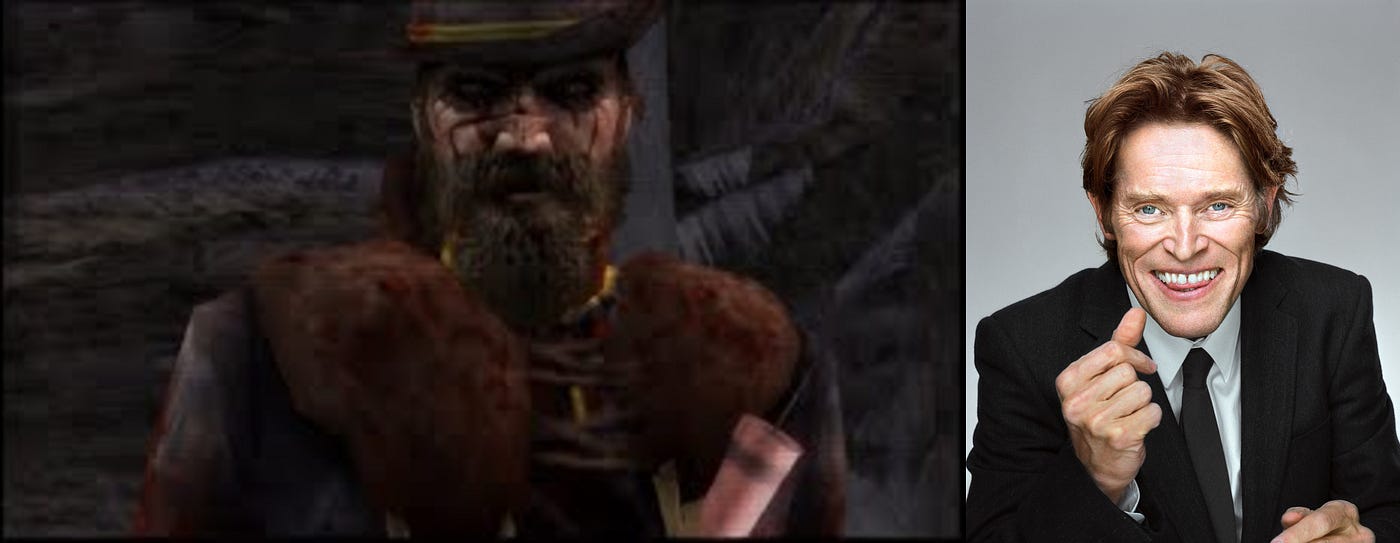
Willem Dafoe photograph by Martin Schoeller
Finally, I’m going to add my own, third part to the question by considering who’d direct the film. Casting the actors is one thing but the choice of director is really what determines the film’s artistic identity. The three major western directors working today would be Kevin Costner, Clint Eastwood and the Coen brothers but I don’t see this sort of thing fitting their unique idiosyncrasies. Instead, I’ll go with a lesser-known director: Daniel Minahan. He’s one of the directors of the television series Deadwood, which then-president of Neversoft Joel Jewett has cited as the main inspiration for GUN — something alluded-to with the casting of Brad Dourif, who portrayed Cochran in the series — as the voice of Reed. Minahan returned to the world of Deadwood five years ago as the director of the film based on the show. Minahan would be a great choice of director to give the film the same edge as the series that inspired the original game.
So there you have it. My dream video game-to-film adaptation and how I’d cast it. Thanks to Ian for giving me such a stimulating prompt (I had to really reign myself in when writing this, otherwise I’d have ended up posting an essay about the cultural cross-pollination of films and video games in general).
I may generally not do much blogging these days but this blog is still semi-active. Stick around for more video game content — trust me, I’ve got a lot coming…
메타데이터
- post_id
- d1d6c41fbe87
- slug
- my-dream-video-game-to-film-adaptation-charming-and-open-d1d6c41fbe87
- url
- https://medium.com/@alex.sigsworth/my-dream-video-game-to-film-adaptation-charming-and-open-d1d6c41fbe87
- canonical_url
- https://medium.com/@alex.sigsworth/my-dream-video-game-to-film-adaptation-charming-and-open-d1d6c41fbe87
- author_url
- https://medium.com/@alex.sigsworth
- status
- ok
- fetched_at
- 2026-06-09 15:37:30




