Resilience Matters As Much As Uptime
Every founder dreams of a product that never breaks. No incidents. No 3 AM pages. No angry tweets. Just a quiet, perfect machine humming…
Resilience Matters As Much As Uptime
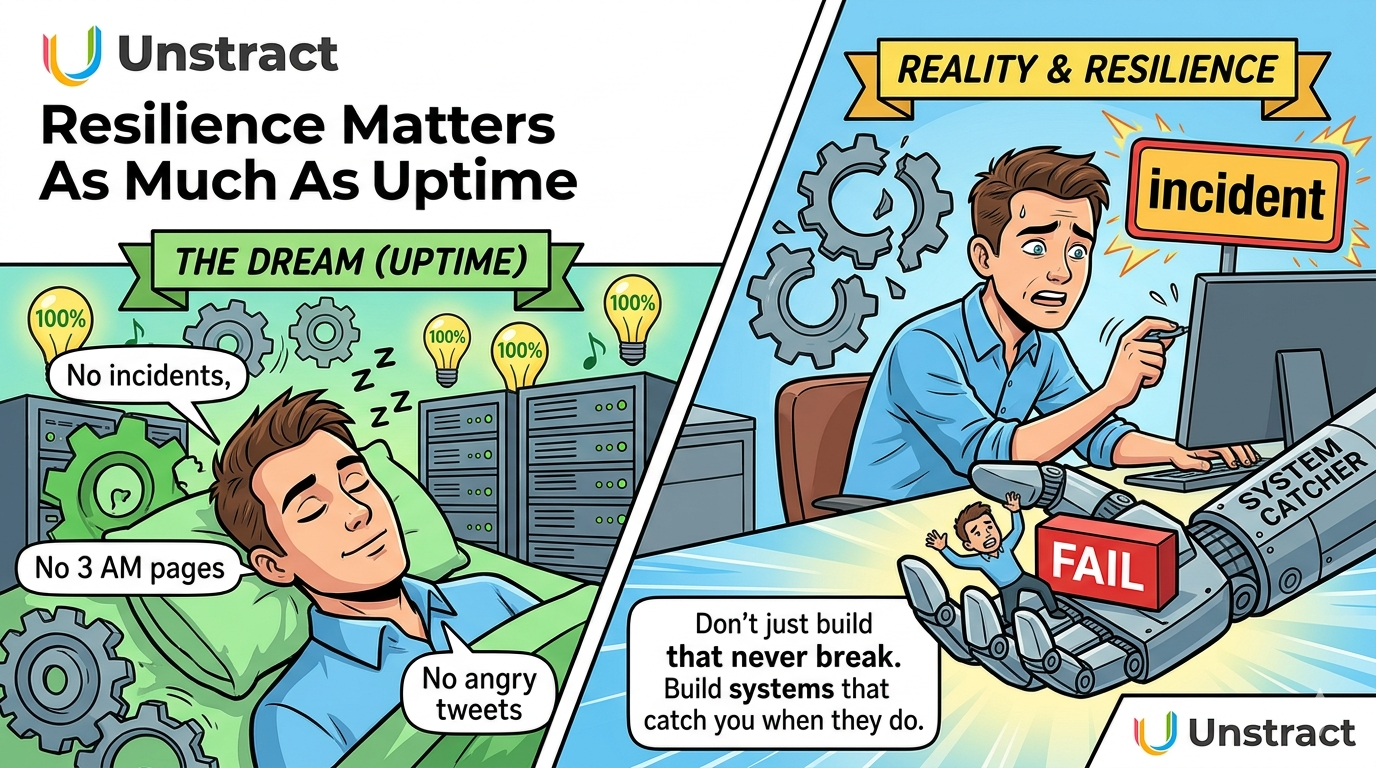
Every founder dreams of a product that never breaks. No incidents. No 3 AM pages. No angry tweets. Just a quiet, perfect machine humming along while they sleep.
That’s a worthy goal. But it’s only half the picture.
My founder said something that completed the picture for me:
“Don’t just build products that never break. Build systems that catch you when they do.”
Uptime is the dream. Resilience is what makes the dream survive contact with reality.
The Other Half of Reliability
Teams obsess over “five nines” availability (99.999%) — about five minutes of downtime per year. Four nines is 52 minutes. Three nines is almost nine hours. Aiming high here is good. We should.
But here’s the part we often skip: even hyperscalers don’t hit five nines consistently. AWS goes down. Google goes down. Cloudflare goes down — and when Cloudflare sneezes, half the internet catches a cold. If companies with thousands of SREs and billions in infrastructure can’t promise zero downtime, the rest of us need a plan for what happens when our products break.
Because they will break. A migration will go sideways. A dependency will ship a bad version. A region will lose power. A junior engineer will run DROP TABLE on the wrong env.
The teams that handle this well aren’t the ones that try harder to prevent failure. They’re the ones that invest equally in preventing it AND recovering from it.
What Resilience Actually Looks Like
When my founder said “systems that catch you,” he wasn’t talking about a customer success team firing off apology emails. He meant the system around the product — the layer that holds when gravity wins.
1. You see it before your customer does. Never let the customer be your monitoring tool. If your user tweets “is X down?” before your phone buzzes, you’ve already failed.
2. Recovery time matters as much as failure rate. MTTR is the partner to MTBF, not its opposite. A product that breaks once a month but recovers in 90 seconds is more reliable than one that breaks once a year but takes six hours to come back. Users feel duration, not frequency.
3. Runbooks beat heroics. If incidents only get resolved because Senior Engineer X knew the magic incantation, you don’t have a system — you have a single point of failure who occasionally talks.
4. Blameless postmortems or it didn’t happen. The goal isn’t to find the human who pressed the wrong button. It’s to find the system that let one wrong button cause a catastrophe.
5. Tell customers the truth, fast. Silence kills trust faster than the outage itself. A clear “we’re seeing elevated errors, investigating” buys more goodwill than two hours of strategic ambiguity.
How We Do This at Unstract
This isn’t theory for us. Unstract runs across multiple regions for customers who care a lot about reliability. We chase uptime — and we invest just as much in what happens when uptime doesn’t hold. The tools we use have evolved over the years; the practices haven’t.
Everything lives in version control. Every cluster, every workload, every configuration. When something breaks, recovery is a revert — not a heroic debugging session at 2 AM. Disaster recovery stops being a 40-page runbook and becomes a workflow.
Identity-bound secrets. Workloads authenticate as themselves, with permissions scoped to exactly what they need. No static credentials in config files, no rotation panic, no “who has the key” mystery during an incident.
Telemetry pages us before customers notice. Database and infrastructure signals flow to on-call automatically. The day we set this up properly, we stopped finding out about issues from customer Slack messages and started finding out from our own alerts — two steps ahead.
Regional isolation by design. Staging plus multiple production regions, each independent. When one region has a bad day, the others keep serving traffic. Impacted customers see minutes of degradation, not hours.
Every deploy is reversible. A bad release is one click away from being a previous release — through the same workflow that pushed it. We’ve shipped major database version upgrades across production primary and replica without a single late-night call, because every step was reversible.
Postmortems on near-misses. When we caught a capacity issue on staging before it hit prod, we still wrote it up. The fix made production more resilient too. Near-misses are free lessons — take them.
Notice what’s missing from that list: any specific tool. The names change. The practices don’t.
The Mindset Shift
When teams optimize only for “no downtime,” they often end up optimizing for the wrong thing. Guardrails stack on guardrails. Every deployment becomes a ceremony. Velocity dies. Engineers hide small risks to avoid process pain — which means when something does break, nobody sees it coming.
The mindset shift is this: chase uptime AND design for recovery. Both, not either.
This is how the best companies in the world operate. Netflix runs Chaos Monkey — software that intentionally breaks production, so engineers learn that broken is just a state, not a crisis. AWS has region failovers because they know regions fail. Stripe publishes incident reports because transparency compounds.
These companies aren’t fighting failure or ignoring uptime. They’re holding both together.
Closing Thought
Uptime is a goal worth chasing. But uptime alone is a fragile contract — one bad incident can break the trust a thousand good days built.
Resilience is what makes the contract hold. The system around the product — observability, reversible deploys, regional isolation, blameless postmortems — is the layer that turns inevitable failure into a quiet recovery instead of a crisis.
When you invest in both, something strange happens: outages stop being crises. They become just another Tuesday. The team handles it. The customers stay. The trust compounds.
That’s the product nobody talks about — the one underneath the product.
Build both. The rest gets easier.
To know more — https://unstract.com/
메타데이터
- post_id
- d1e25a2b834f
- slug
- resilience-matters-as-much-as-uptime-d1e25a2b834f
- url
- https://medium.com/@mathumathiv247/resilience-matters-as-much-as-uptime-d1e25a2b834f
- canonical_url
- https://medium.com/@mathumathiv247/resilience-matters-as-much-as-uptime-d1e25a2b834f
- author_url
- https://medium.com/@mathumathiv247
- status
- ok
- fetched_at
- 2026-07-15 07:25:57