Fine-Tuning NLLB for Twi on 6GB VRAM — What Happened When Scaling Plateaued and Human Alignment…
This article is not about teaching but sharing my path and maybe learning from you. And this is not a final perfect model — it is just a…
Fine-Tuning NLLB for Twi on 6GB VRAM — What Happened When Scaling Plateaued and Human Alignment Took Over
This article is not about teaching but sharing my path and maybe learning from you. And this is not a final perfect model — it is just a beginning.
Most machine learning projects start with access to powerful compute. Mine started with a limitation.
I built NLLB-Twi-QLoRA on a local machine with 6GB VRAM, with no cloud GPUs, no rented compute, and no external training infrastructure. The goal was straightforward: fine-tune Meta’s NLLB-200 (600M) for Twi ↔ English translation while staying entirely within consumer hardware constraints.
What I expected to be a technical experiment in parameter-efficient fine-tuning quickly became something much more interesting. It became an investigation into how scaling, synthetic data, and human-aligned refinement behave in low-resource machine translation — and where performance begins to plateau.
At the center of it all was a simple question:
How far can you push translation quality for Twi using local hardware alone?
Starting with Scale
The project began with large-scale synthetic corpus generation.
To create enough data for training, I worked with approximately 192,000 synthetic sentence pairs, generated to give the model broad exposure to Twi-English translation patterns. This became the foundation for Phase 1: Synthetic Scaling.
The results were immediately strong.
The zero-shot baseline from NLLB-200 scored 18.94 BLEU.
After training on the synthetic corpus, the model reached 43.37 BLEU, with a chrF score of 63.16 on the synthetic held-out set.
That jump was massive.
At first glance, it looked like scaling had solved the problem.
More data, better BLEU.
Case closed.
But once I looked deeper, it became clear that the story wasn’t finished.
The Plateau
Although the synthetic model performed extremely well numerically, something became obvious when examining outputs more closely.
The gains had started to plateau.
The model was learning broad translation patterns from synthetic data, but that performance didn’t always translate cleanly into human-level linguistic quality. There were still issues around naturalness, phrasing, fluency, and culturally appropriate expression.
This became one of the most important moments in the project.
The question shifted from:
“How much more can synthetic scaling improve BLEU?”
to:
“What happens when we move from scale to alignment?”
That shift led to the project’s core comparison.
Two Training Paradigms
To better understand the tradeoff, the project explored two distinct training paradigms.
Paradigm A — Single-Stage Direct Fine-Tuning
The first approach was direct fine-tuning using 3,888 human-curated Twi-English sentence pairs.
This phase was developed collaboratively and focused on adapting the model directly on clean human data without the synthetic scaling stage.
The model achieved:
27.18 BLEU 48.36 chrF
These results were meaningful because the evaluation used a 100% unseen clean human held-out set, making it a stronger indicator of real translation quality than purely synthetic evaluation.
The outputs were cleaner and more natural than expected given the relatively small dataset size.
Still, there was room for improvement.
Paradigm B — Two-Stage Curriculum Alignment
This became the final direction of the project.
Rather than choosing between synthetic scale and human quality, I combined both.
The model was first trained on the 192k synthetic corpus, then refined with 4.3k human-verified translation pairs.
This created a two-stage curriculum alignment pipeline:
first scale, then alignment.
Broad multilingual exposure first.
Human correction and refinement second.
This turned out to be the most important design decision in the entire project.
The final model achieved:
41.99 BLEU 61.21 chrF
While slightly below the synthetic-only peak BLEU of 43.37, the human-aligned model produced stronger translation quality where it mattered most: naturalness, correctness, and cleaner generalisation.
That distinction became one of the key findings of the project.
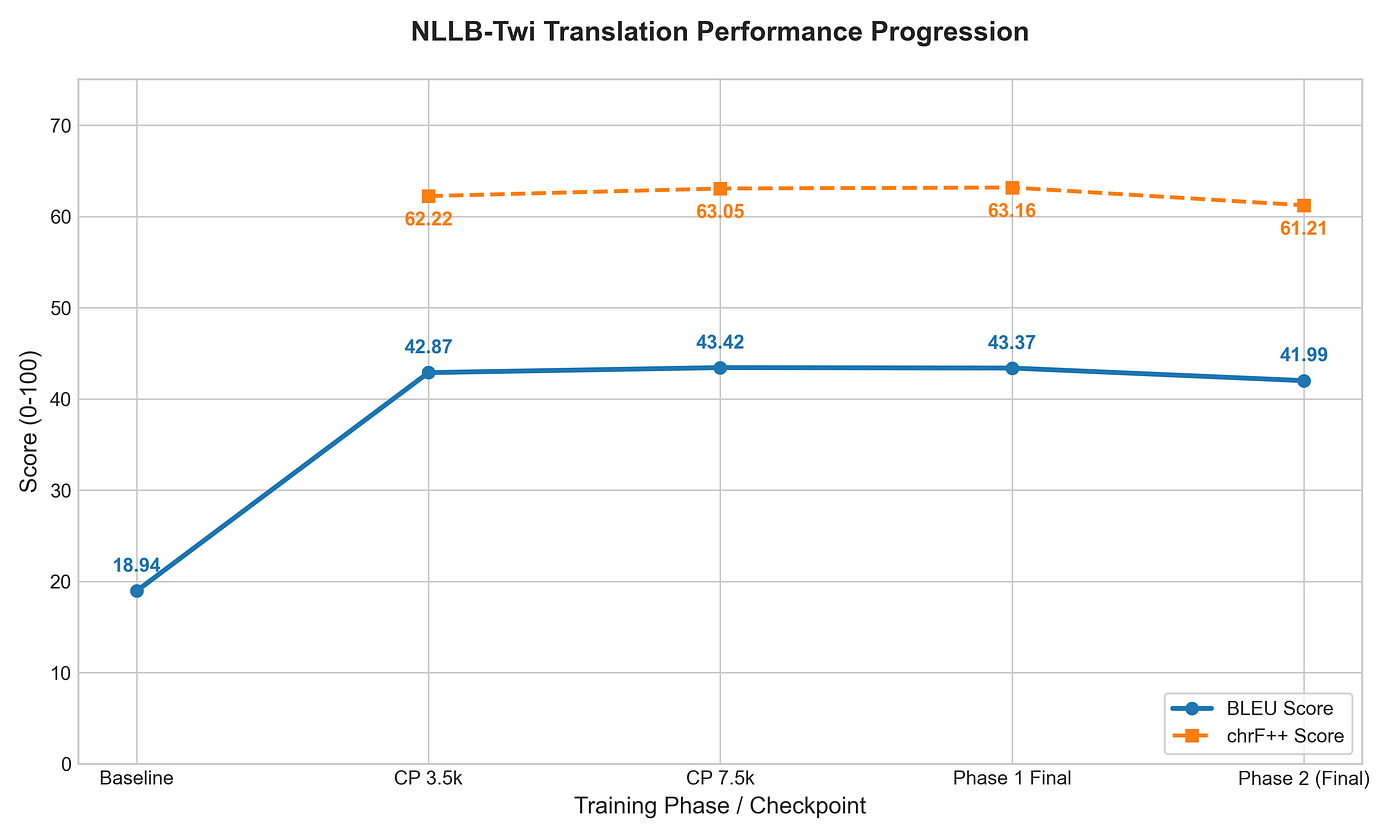
perfomance progression for training progress
What the Results Revealed
One of the most interesting takeaways was that the highest BLEU score did not necessarily represent the best final system.
Synthetic scaling gave the strongest early boost and demonstrated how powerful large-scale generated data can be in low-resource settings.
But eventually the gains flattened.
That plateau revealed the limitation of synthetic-only optimisation.
The second-stage human refinement did not simply increase performance — it improved the model’s alignment with real language usage.
This made the final system stronger beyond benchmark numbers alone.
In other words:
scale got the model far. human alignment made it usable.
That insight became more valuable to me than any single metric.
Building Everything Locally
What makes this result even more meaningful to me is how it was achieved.
Everything was trained locally on 6GB VRAM.
That meant every part of the workflow had to be engineered around memory constraints:
4-bit quantization through QLoRA, LoRA adapters, careful sequence management, gradient accumulation, checkpoint control, and evaluation scheduling.
The project was not just about machine translation.
It was also about proving that meaningful NLP experimentation for African languages can still happen without expensive infrastructure.
No cloud GPUs.
No A100s.
No compute cluster.
Just local hardware, optimisation, iteration, and persistence.

hugginface space test
Final Thoughts
Presenting this work to the Ghana NLP community was especially rewarding because the conversations went beyond the model itself.
The project opened up bigger discussions around low-resource NLP, data quality, language representation, and what becomes possible when efficient training methods make advanced models more accessible.
What started as an experiment in fine-tuning NLLB for Twi became a deeper study of scaling limits, curriculum learning, and human alignment under compute constraints.
More than anything, it reminded me that progress in local language AI does not always come from bigger infrastructure.
Sometimes it comes from asking the right question, pushing against constraints, and paying close attention when the model stops improving — because that plateau often has something to teach you.
Project Repository
Hugginface Space
https://huggingface.co/spaces/mclanorjeff/NLLB-Twi-Translator
메타데이터
- post_id
- d1ea3c5e72fe
- slug
- fine-tuning-nllb-for-twi-on-6gb-vram-what-happened-when-scaling-plateaued-and-human-alignment-d1ea3c5e72fe
- url
- https://medium.com/@mclanorjeff/fine-tuning-nllb-for-twi-on-6gb-vram-what-happened-when-scaling-plateaued-and-human-alignment-d1ea3c5e72fe
- canonical_url
- https://medium.com/@mclanorjeff/fine-tuning-nllb-for-twi-on-6gb-vram-what-happened-when-scaling-plateaued-and-human-alignment-d1ea3c5e72fe
- author_url
- https://medium.com/@mclanorjeff
- status
- ok
- fetched_at
- 2026-06-09 15:37:30




