On Parshat Eikev
Devarim (Deuteronomy) 7:12–11:25
On Parshat Eikev
Devarim (Deuteronomy) 7:12–11:25
Humility, Gratitude, and Blessings
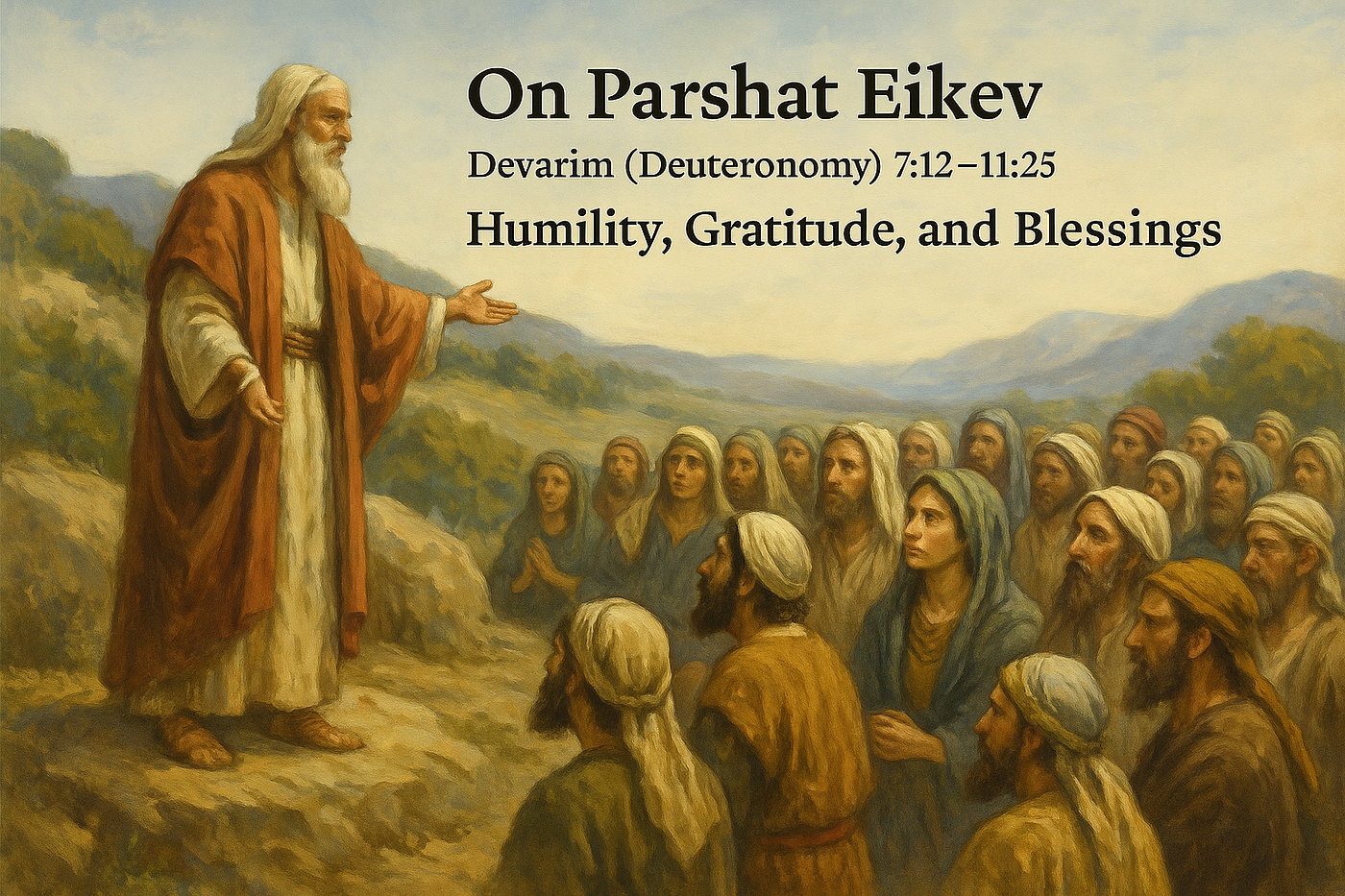
Parshat Eikev is packed with Moses’s heartfelt advice to the Israelites. It’s got stories and laws, blessings and warnings. But running through it all is a unifying theme of humility and gratitude, especially in times of prosperity.
Right from the opening words, the Torah drops a hint. It says, “Vehaya Eikev tishme’un et hamishpatim ha’eleh…” ….“And it will be, because (eikev) you listen to these rules…” The word “eikev” literally means “because” or “as a consequence of.” But in Hebrew it also means “heel.” Rashi notices the unusual wording. He quotes a Midrashic insight, “If you will heed the minor commandments that people usually trample underfoot with their heel, then God will reward you.” Isn’t that fascinating? The Torah implies that no mitzvah is trivial and even those little duties that we might step on like a heel on a stray leaf matter to God. “Don’t brush off the ‘small stuff’ in Judaism,” says Rashi. “Doing the little mitzvot consistently, with care, brings big blessings.”
Notice also the very first word “Vehaya.” Our sages say vehaya is an expression of joy. It’s as if the Torah is winking to us, “If you embrace even the humble mitzvot that tend to get trampled, it will bring you joy and good fortune.” In other words, there’s joy in the small acts of goodness, the everyday Jewish practices that might seem mundane. We often think spiritual greatness is in grand gestures, but here God hints it’s really in the humble, routine deeds, like saying a blessing over your sandwich, giving a coin to charity, helping a neighbor, that true joy and blessing are actually found.
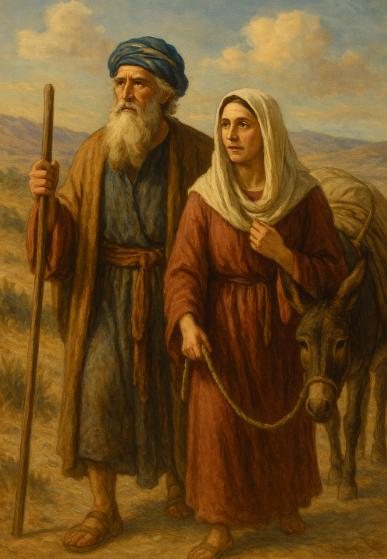
This sets the tone for the entire parsha. Eikev, the “heel,” symbolizes humility. The Baal HaTurim points out that the heel is the lowest part of the body, always following the head and heart, and never ever taking the lead. The choice of this word teaches us that humility is the foundation for receiving God’s blessings. In fact, a few verses later Moses reminds the people why God chose them, “Not because you are so numerous or righteous… for you are the least of all peoples.” Rashi, citing the Midrash, explains this to mean “I loved you because you make yourselves small.” Our ancestors, like Abraham who said “I am but dust and ashes,” and Moses who pleaded to God on behalf of others, embodied humility. God cherishes that trait. Wherever God’s greatness is found, His humility is found too, the Talmud says. So, He treasures a humble spirit in us as well.
Moses keeps hammering this point in Parshat Eikev. He’s painfully aware that the Israelites are about to enter the Promised Land, a place of abundance and success, and that such success can easily go to one’s head. “Take care,” Moses warns, “lest your heart grow haughty and you forget the Lord your God.” He paints a vivid scenario, You’ll eat to your heart’s content, build fine houses, and increase your gold and silver… and then you might say, “My own power and the might of my hand have won this wealth for me!” Sound familiar? It’s essentially the ancient version of “I’m a self-made success; I earned all of this all by myself.” Moses calls this out as a spiritual danger. He says, Don’t even think it. Remember that all blessings ultimately come from God.
To guard against this, the Torah gives a beautiful antidote, gratitude. The famous verse “Ve’achalta ve’savata u’verachta” …“You will eat, you will be satisfied, and you shall bless the Lord your God for the good land He has given you” ….is actually the source of the Jewish practice of bentching, the Grace After Meals. The Torah commands us to say thank you after eating. Picture a family finishing a hearty Shabbat meal, then singing Birkat HaMazon, acknowledging that our food and our fill come from the One Above. It’s a built-in humility exercise. Every time that you eat until you’re comfortably full, remember where the nourishment really came from and voice your thanks.
“When you have eaten and are satisfied, you shall bless the LORD your God for the good land He has given you”
That verse is profound. It’s so easy for us to cry out to God when we’re in need or hungry, but here we’re told to cry out in thanks when we’re satisfied. Gratitude keeps us humble. It reminds us that our prosperity is a gift, and not an entitlement. I’ll be honest, reading this always makes me reflect on my own life. How often do I pause after a success like a promotion, a good business quarter, even an especially good batch of chocolate chip cookies, and say “Thank you Hashem?” This mitzvah is nudging me (and all of us) to do exactly that.
Moses goes even further, recalling the painful lesson of the Golden Calf. In Eikev, he retells how the people, not long after experiencing miracles, fell into arrogance and idolatry. He doesn’t sugarcoat it at all, “You have been rebellious against God from day one,” he says (ouch). But why bring that up now? Because it’s a case study in spiritual forgetfulness. The people became complacent and boom, they stumbled. Moses admits even he had to shatter the first tablets of the Ten Commandments in response, and then humbly beg God for forgiveness on Israel’s behalf. Humility, both Moses’ and the people’s, was the only thing that saved them. Moses spent 40 days in prayer and fasting to atone for that sin, literally falling before God in supplication. Finally, God relented and gave second tablets, that is, a second chance. The subtext here is, “Learn from this, my friends. When you mess up, own it with humility. And when you succeed, don’t forget Who helped you get there.”
In fact, Moshe explicitly tells them, “Understand that it is not because of your righteousness that the LORD is giving you this good land to possess, for you are a stiff-necked people.” Talk about brutal honesty! One can almost imagine Moshe lovingly shaking his head at them, “Guys, it’s not that you’re so great. It’s that God is great, and He’s keeping His promise to your forefathers, and the Canaanite nations there have dug their own grave with wickedness.” This could sound a bit harsh, but it’s actually liberating. It means the gift of the Land and its blessings are acts of divine grace, and not trophies of our ego. And if it’s grace, it calls for our gratitude, and not our pride.
Ramban underscores this point. He notes that no level of Israel’s virtue alone could justify inheriting the land; it was God’s promise and the nations’ corruption that led to Israel’s success. In other words, don’t strut into Israel like you earned VIP access by your own merit. Walk in humble and thankful, knowing that it’s God’s kindness (and yes, the former inhabitants’ moral failures) that paved your way. That mindset would keep the people grounded and connected to God, rather than self-congratulating.
Now, you might be thinking of some modern vignettes. I know that I am. I recall a story of a successful entrepreneur who once admitted that after he “made it big,” he started to believe his own hype,“kochi ve’otzem yadi asah li et hachayil hazeh,” as the Torah puts it, “My strength and the power of my hand made me all this wealth.” He became less charitable, and less empathetic. Only when an economic downturn hit did he finally wake up, humbled, and realizing how not in control of everything he truly was. He then turned back to gratitude and to faith, rebuilding with a new perspective. It’s essentially a contemporary replay of Parshat Eikev’s warning. We’ve all seen some version of that, whether it’s ourselves or others, forgetting our roots and blessings when times are good, and life has a way of delivering us a wake up call.
So Eikev is telling us, Don’t wait for the humbling downfall! Proactively practice humility and gratitude while you’re on top. Count your blessings, literally. The portion even alludes to the idea of reciting 100 blessings a day (a rabbinic tradition derived from Deut. 10:12, which says, “What does God ask of you…?” — reading “mah” (what) as “me’ah”, one hundred). Blessings, before eating, after eating, in prayer, pepper our day so that we constantly remember we’re standing on God’s shoulders, and not solely on our own two feet.
The Baal Shem Tov taught that **“When we hold a small part of an object, we hold the entire essence of it.” In this context, it means that every little mitzvah contains the whole light of God. By grabbing hold of one “small” mitzvah, you are in fact connecting with the Infinite. So, thus, there are no “small” mitzvot! Each one is a cosmic connection. This aligns perfectly with Rashi’s comment about the “heel-mitzvot” that people tread on. The Baal Shem Tov would urge, don’t tread on them, treasure them! They hold the secrets of divine light. He also emphasized serving God with simchah and simplicity. Serving with joy transforms even very simple acts like making a sandwich for a child or giving a casual kind word to a friend into holy deeds. Perhaps that’s another reason Vehaya starts the parsha, do these mitzvot happily, not as a burden**. When done with joy, the “small” deeds shine really brightly.
The Sfas Emes offers an insight that ties humility to sustenance. He notes that in the desert, Hashem sustained Israel with manna from heaven, food that was literally falling from the sky each day. This taught the people absolute dependence on God. In Parshat Eikev, Moses says God fed them manna “in order to afflict you and test you, to do good for you in the end.” But that sounds paradoxical, afflict and do good? The Sfas Emes explains that the “affliction” of not having bread in the pantry, of feeling your livelihood come only from Heaven, was precisely what forged a humble, trusting character in Israel. It was a test that ultimately did good for their souls. Depending on God for daily bread made them spiritually resilient and also incredibly grateful. The Sfas Emes teaches that even when we later transition to plowing fields and baking bread (i.e., a more natural economy in the Land), we’re supposed to carry that same dependence and humility with us. In our lives, that might mean recognizing that our paycheck, though it comes from our job and our effort, is still manna from Heaven in disguise. Maintaining that perspective keeps us both humble and anxiety-free. After all, if it’s in God’s hands, I can breathe easier and just do my best.
Parshat Eikev as a whole is teaching us humility and gratitude as the keys to spiritual success. Moses, Rashi, Ramban ….they all implore us, Don’t let your blessings make you arrogant. Instead, let them deepen your gratitude. Keep the commandments, even the ones that may seem trivial, because they shape your character and bring down blessing. And remember that ultimately everything, that is, your food, your wealth, and all your victories, is a gift from Hashem. When we live with that awareness, we stay connected to our Source. We remain grounded (like the lowly heel on the ground) even as we soar to the heights of success.
It’s a recipe for a joyous life. Humility leads to gratitude; gratitude leads to joy; and that joy in turn leads us to embrace even more mitzvot. It’s a virtuous cycle. As the verse promised at the start, “And it will be, because you listen… God will bless you, multiply you, and love you.” Divine love and blessing flow when we get the humility piece righ. And that’s not just ancient history. No, it’s true for each of us, right now, in our own personal journeys.
May we all remember that when our hearts are low enough to the ground to notice all of the little things, that is when we become tall enough to touch Heaven. And in that place, grounded yet reaching, we find the deepest joy of all, the kind that can carry us through any season, with Hashem’s blessings raining down on us in their time.
Good Shabbos.
Thank you for Reading.
메타데이터
- post_id
- d1eb6ecda74e
- slug
- on-parshat-eikev-d1eb6ecda74e
- url
- https://medium.com/@natashaarosenberg/on-parshat-eikev-d1eb6ecda74e
- canonical_url
- https://medium.com/@natashaarosenberg/on-parshat-eikev-d1eb6ecda74e
- author_url
- https://medium.com/@natashaarosenberg
- status
- ok
- fetched_at
- 2026-07-18 05:29:19