Introduction to Cloud Computing
This article focuses on theory and foundational concepts. The goal is to give you the right context so you can understand why the cloud is…
Introduction to Cloud Computing
This article focuses on theory and foundational concepts. The goal is to give you the right context so you can understand why the cloud is useful and how it works.
How Do Websites Work?
Let’s start with the basics.
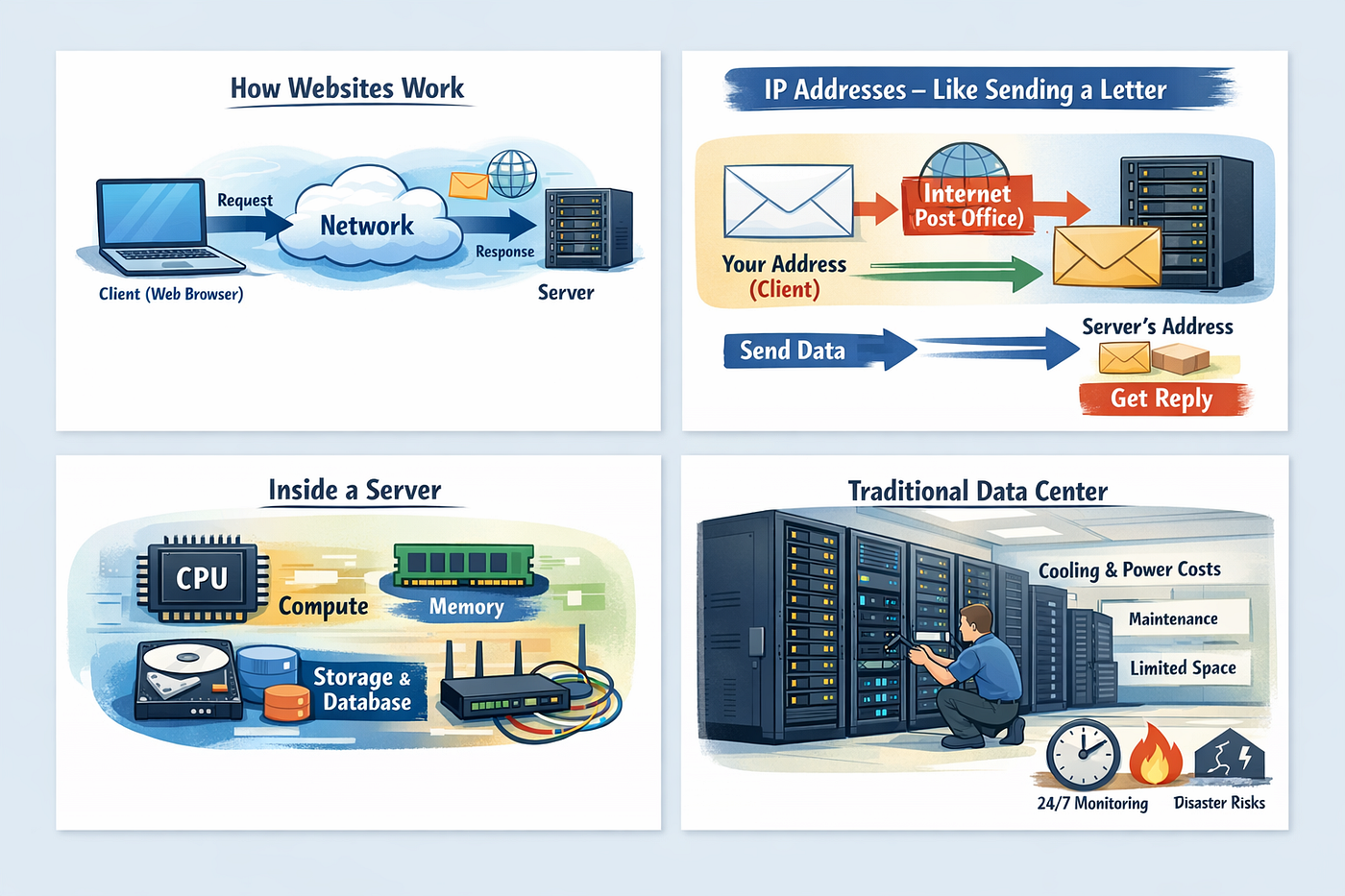
A website works because there is a server hosted somewhere. As users, we access that server through a web browser to view the website.
When we visit a website, we act as a client. The client uses a network to send data packets to the server. The network routes these packets to the correct destination. The server then processes the request and sends a response back to the client, allowing us to see the website.
This is a simplified explanation, but it captures the core idea.
IP Addresses Explained
For clients and servers to find each other, they need IP addresses.
- Clients have IP addresses
- Servers also have IP addresses
When a client sends a request to a server’s IP address, the server knows exactly where to send the response back.
Mail Analogy
Think of this like sending a letter:
- The letter is your data
- You are the client
- The post office network is the internet
- The recipient’s address is the server’s IP address
When the recipient replies, they use the return address on the envelope to send the response back to you. This is how servers and clients communicate over the internet.
What Is Inside a Server?
A server is made up of several key components:
CPU (Compute)
The CPU performs calculations and processes instructions. It is responsible for doing the “thinking” work.
RAM (Memory)
RAM is very fast memory used to temporarily store data that needs to be accessed quickly.
Together, the CPU and RAM act like a brain:
- The CPU performs computations
- RAM stores short-term information
Storage
Servers also need long-term storage to save files and data. This can include:
- File systems
- Databases (structured data that can be searched and queried efficiently)
Networking
Servers include networking components such as:
- Routers
- Switches
- DNS servers
These components allow servers to communicate with other machines over the network.
Basic Networking Concepts
Before moving forward, here are a few simple definitions:
- Network: A collection of cables, routers, switches, and servers connected together
- Router: A device that forwards data packets between networks and decides where data should go on the internet
- Switch: A device that sends data to the correct computer within a local network
How Data Travels
- The client sends data
- The data goes through a router
- The router forwards it across the internet
- A switch delivers it to the correct server
Traditional IT Infrastructure
Before cloud computing, companies typically hosted their own servers.
In the early days:
- People bought physical servers
- They hosted them at home or in garages
- Many famous companies, like Google, started this way
As a website grew:
- More servers were needed
- Eventually, companies moved into offices
- A dedicated room called a data center was created to host servers
Problems with Traditional Data Centers
While this approach worked for many years, it has several drawbacks:
- High costs (rent, electricity, cooling)
- Hardware maintenance and failures
- Slow scaling (ordering and installing servers takes time)
- Limited space
- Need for a 24/7 operations team
- Risk of disasters (fires, earthquakes, power outages)
Scaling quickly becomes difficult, especially if demand suddenly increases.
The Need for the Cloud
So the big question becomes:
Can we outsource all of this infrastructure?
The answer is yes.
That solution is cloud computing — where compute, memory, storage, and networking are provided on demand by cloud providers.
메타데이터
- post_id
- d1f6ccb3ef6e
- slug
- introduction-to-cloud-computing-d1f6ccb3ef6e
- url
- https://medium.com/@rudrakshkanungo2022/introduction-to-cloud-computing-d1f6ccb3ef6e
- canonical_url
- https://medium.com/@rudrakshkanungo2022/introduction-to-cloud-computing-d1f6ccb3ef6e
- author_url
- https://medium.com/@rudrakshkanungo2022
- status
- ok
- fetched_at
- 2026-08-06 11:45:10