Karpathy’s system is brilliant. But here’s what people get wrong about it.
The one thing an LLM can’t build for you.
Karpathy’s system is brilliant. But here’s what people get wrong about it.
The one thing an LLM can’t build for you.
Photo by Galina Nelyubova on Unsplash
In the 1600s, a scholar at Oxford would sit down after a long day of lectures and open a blank book. He’d copy down a passage that struck him, a line from Seneca maybe, or something Bacon said about memory, and file it under a heading. F
Friendship. Time. The nature of kings.
They called it a commonplace book.
Serious thinkers in medieval and early modern Europe kept one. Montaigne kept one. Francis Bacon kept one. John Milton filled notebooks with passages he’d return to decades later when writing Paradise Lost.
But nobody uses commonplace books anymore. Something better came along, and the commonplace book quietly became a historical curiosity and hobbies.
In the 20th century, a German sociologist named Niklas Luhmann built something he called as a Zettelkasten, a slip box. Tens of thousands of index cards, each one an atomic idea, each one linked to others. He published 70 books and over 400 papers. When people asked how, he’d point at the box. Said it was his conversation partner.
Now as computers tools came along, Zettelkasten went massively viral in productivity circles. Popularized by Tiago Forte with “Building a Second Brain”, the whole thing went digital. Obsidian. Roam. Notion. Thousands of YouTube tutorials on optimal folder structures and linking strategies.
And then two weeks ago, Andrej Karpathy, co-founder of OpenAI, the man who coined “vibe coding,” posted a tweet that got 19 million impressions. He described a system where he dumps raw research into a folder and an LLM builds the whole linked wiki from scratch. Said that his knowledge base on one topic alone has grown to 400,000 words.
He rarely touches it directly.
And that’s exactly the problem worth thinking about.
What Luhmann was actually doing
The slip box he built was never really about the notes.
Luhmann wrote every card by hand, in his own words, compressing each idea into its simplest possible form. One card, one idea. So when you have to fit a complex argument onto a single index card in your own language, you find out very quickly whether you actually understand it. Most of the time you don’t, but the struggle to write the card is where the thinking happens.
That compression is what made the system work. Because every card was built from his own understanding, the connections the box surfaced were always built on real ground.
Luhmann would pull a card looking for one thing and find an unexpected connection he’d forgotten he made. The box talked back because he had put everything in. Every connection in that system came from his own mind, compressed into his own words, over decades of slow deliberate work.
That’s what made it generative. The system could only surprise him with things he already understood, recombined in ways he hadn’t consciously noticed.
How the digital version quietly broke it
When Forte took it digital, the tools got better. Search replaced manual browsing. Backlinks appeared automatically. You could dump a highlight directly from your Kindle into your vault without ever pausing to rewrite it in your own words.
The friction dropped, and most people didn’t notice what they were giving up: the compression.
Rewriting an idea in your own words is hard. It takes time, and it forces a reckoning with whether you actually understood what you read. Most people using digital Zettelkasten skipped that step, or did it halfway. They pasted quotes instead of writing summaries, tagged notes instead of linking arguments, or built elaborate architectures around ideas they’d never actually processed.
The result is what you see everywhere in productivity forums today. Someone built a beautiful vault with hundreds of notes, carefully organized. And then one day they stopped opening it. The notes sat there, perfectly structured, completely useless.
They thought they had a thinking system, but they didn’t.
What Karpathy’s tweet actually shows
On April 2, 2026, Karpathy posted his knowledge system that massively went viral.
The architecture looks like a Zettelkasten. Linked notes, concept articles, backlinks, a growing interconnected knowledge base. Obsidian as the interface, an LLM maintaining everything underneath. His research wiki on one topic has grown to 100 articles and 400,000 words.
It’s genuinely impressive engineering. Karpathy himself is one of the sharpest people in AI and he built this deliberately, knowing exactly what it is and what it isn’t.
But the problem isn’t Karpathy. The problem is the 19 million people who saw that tweet and thought: finally, someone solved the graveyard problem.
But they didn’t, it was just automation.
The digital Zettelkasten failed because people reduced the friction of compression. Yet, Karpathy’s system removes that friction entirely. The LLM reads the sources, writes the summaries, creates the links, builds the wiki. You dump raw material in and a knowledge base comes out.
It gives you the feeling that your second brain is piled in. But in reality, it doesn’t come with understanding.
The Librarian and the Scribe
Here’s the distinction worth holding onto.
A librarian organizes, retrieves, surfaces connections across a large body of material. A scribe writes things down for you. Both are useful, but they do completely different things.
The mistake people are about to make with Karpathy’s system is treating AI as a scribe when it should be a librarian.
Luhmann was his own scribe. Every card, every compression, every moment of wrestling an idea into its atomic form — that was him. The slip box could then act as his librarian, surfacing unexpected connections across decades of his own thinking.
When you let AI do the scribing, you get a very organized library of things you don’t fully understand. It looks like knowledge and it retrieves well. But the understanding never happened because the compression never happened because you never did the work of writing the card.
The researchers and knowledge workers who figure this out are going to use AI very differently from everyone else. They’ll use it to retrieve, to surface connections across large bodies of material, to find things they’ve already processed.
This is how I work. I read, I process, I write my own notes. Then I use a tool to map what I’ve built — to see what connects, to find where the gaps are.
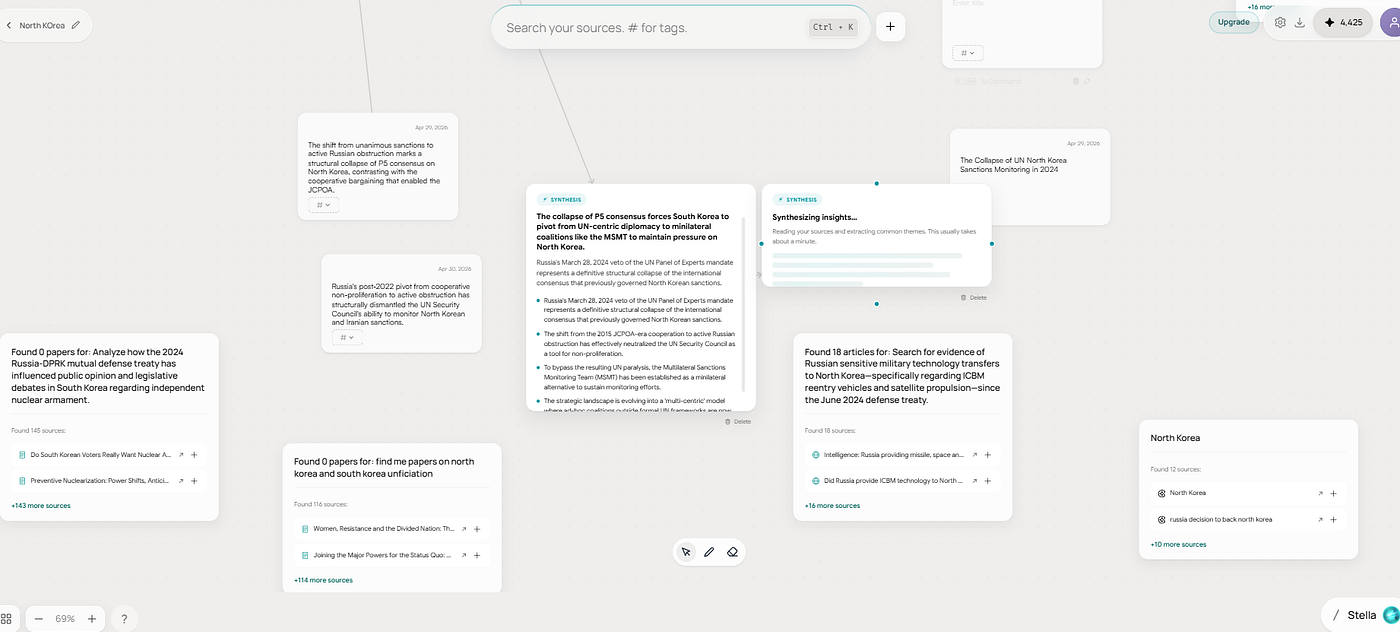
My research canvas in Constella
And then they’ll sit down and write the card themselves.
That’s the part that can’t and shouldn’t be automated. The moment you automate it, you don’t have a thinking system anymore.
Luhmann’s slip box talked back because he built it with his own understanding.
A Zettelkasten that an LLM built for you, on the other hand, will never surprise you the same way. It can only recombine what it knows. But it has no idea what you actually understand.
메타데이터
- post_id
- d2000b4d8202
- slug
- karpathys-system-is-brilliant-but-here-s-what-people-get-wrong-about-it-d2000b4d8202
- url
- https://medium.com/ai-ai-oh/karpathys-system-is-brilliant-but-here-s-what-people-get-wrong-about-it-d2000b4d8202
- canonical_url
- https://medium.com/ai-ai-oh/karpathys-system-is-brilliant-but-here-s-what-people-get-wrong-about-it-d2000b4d8202
- author_url
- https://medium.com/@rfbryan
- status
- ok
- fetched_at
- 2026-06-15 20:49:13