What Is Generative Search? How Search Is Moving Beyond Traditional SEO
Search is changing quickly.
What Is Generative Search? How Search Is Moving Beyond Traditional SEO
Search is changing quickly.
For years, most businesses treated search visibility as a relatively straightforward SEO problem rank on Google, earn clicks, optimize pages, improve backlinks, repeat. But that model is evolving.
Today, users increasingly get answers directly from AI-powered systems like ChatGPT, Google’s AI Overviews, Perplexity, Gemini and Bing Copilot — often without clicking through to traditional search results at all.
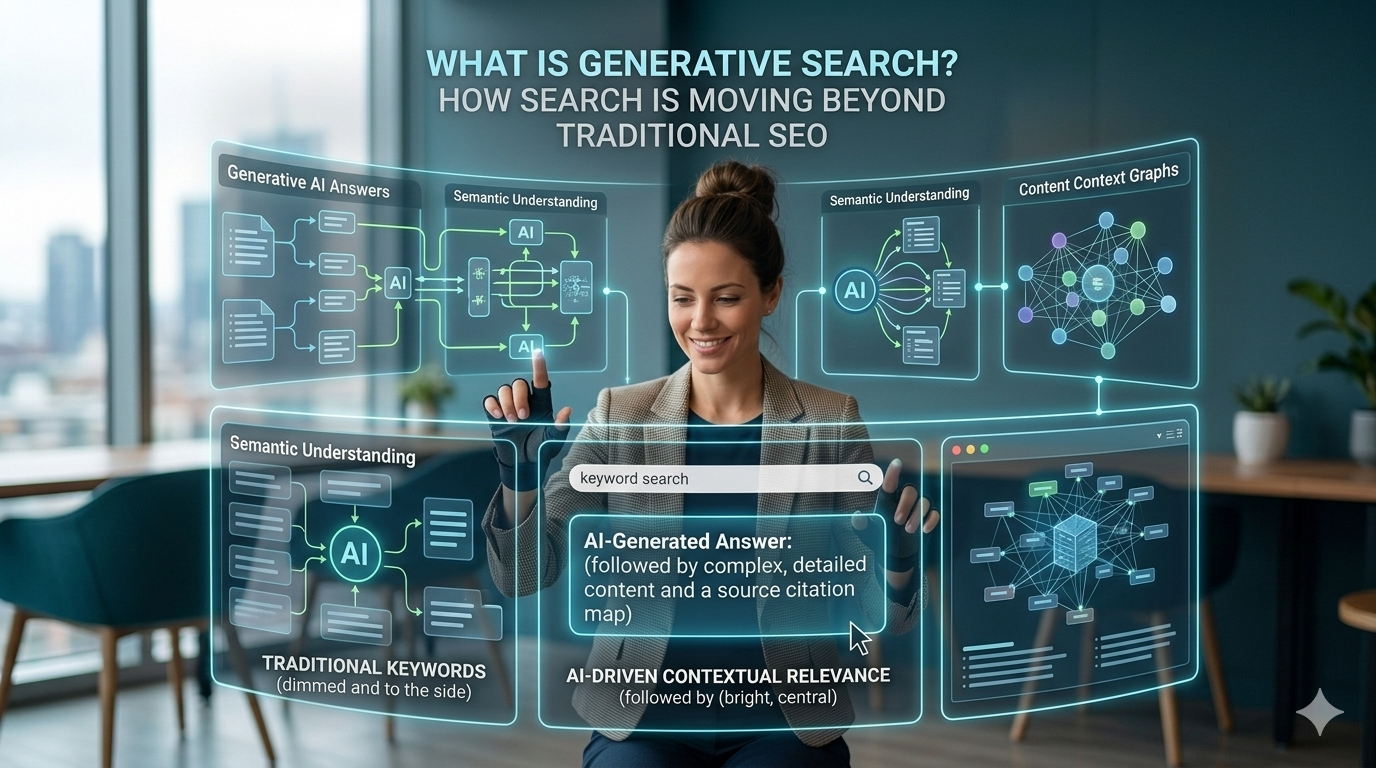
This shift is driving the rise of the Generative Search Engine model search experiences where AI generates answers, summaries, recommendations and product suggestions based on multiple data sources rather than simply returning a ranked list of links.
For brands, publishers and eCommerce operators, this changes how discoverability works.
Traditional SEO still matters. But ranking alone is no longer enough.
The new challenge is becoming visible, understandable and trustworthy to AI systems that synthesize information before the user ever visits your site.
What Is a Generative Search Engine?
A **Generative Search Engine** is a search system that uses large language models (LLMs) and retrieval systems to generate direct answers or recommendations instead of only displaying a list of ranked links.
Rather than asking:
“Which pages should I show?”
These systems increasingly ask:
“What is the best answer I can generate for this user based on available information?”
Examples include:
- Google AI Overviews
- Perplexity
- ChatGPT search experiences
- Bing Copilot
- Gemini-integrated search experiences
In practice, this means search engines now often summarize information, compare products, explain concepts, or recommend providers directly within the interface.
How Is Generative Search Different from Traditional SEO?
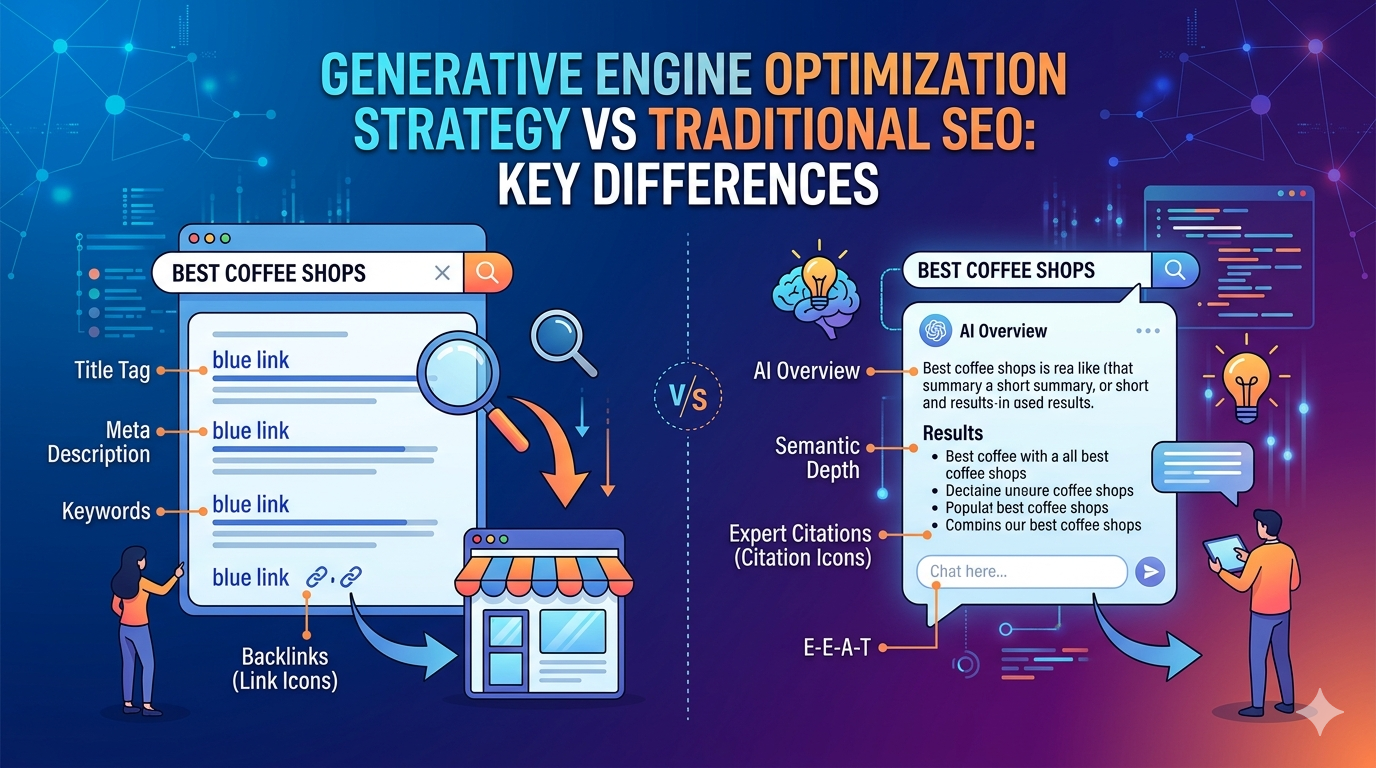
Traditional SEO focuses on helping pages rank well in search engine results pages (SERPs).
Generative search changes the visibility model.
Traditional SEO Model
- User searches a query
- Search engine ranks pages
- User clicks a result
- Website earns traffic
Generative Search Model
- User asks a question
- AI system retrieves multiple sources
- AI synthesizes an answer
- User may never click a source
This matters because visibility increasingly depends on whether AI systems can:
- understand your content
- trust your expertise
- retrieve your information cleanly
- cite or reference your brand in generated answers
Why Does Generative Search Matter for Businesses?
Because many search journeys are becoming zero-click.
Users increasingly get enough information from the AI-generated answer itself to make decisions without visiting multiple websites.
That affects:
- Organic traffic patterns
- Lead generation models
- Content strategy
- Brand discovery
- Product research journeys
For eCommerce and service businesses, it also changes how buyers shortlist vendors and compare providers.
If your business is not visible in AI-generated answers, you may lose exposure even if your traditional rankings remain stable.
Does Traditional SEO Still Matter?
Yes — but its role is changing.
Traditional SEO remains important because AI systems still rely heavily on web content, search indexes and structured site data to retrieve information.
However, traditional SEO alone is no longer sufficient.
A page that ranks reasonably well may still fail to appear in generative search if it is:
- poorly structured
- hard for AI systems to parse
- lacking direct answers
- missing topical depth
- technically weak
- not trusted relative to competing sources
The emerging reality is:
SEO helps you get indexed and discovered. GEO helps you get interpreted and cited.
What Is GEO and How Does It Relate to Generative Search?
GEO (Generative Engine Optimization) refers to optimizing content and site structure for AI-driven search and answer engines.
It focuses on improving how AI systems:
- interpret your business
- understand your expertise
- retrieve your content
- cite your pages
- recommend your products or services
This includes tactics such as:
- Structuring content around real questions
- Using entity-rich, semantically clear language
- Publishing self-contained answers
- Improving structured data and schema
- Strengthening topical authority
- Reducing ambiguity across pages
Generative search readiness is increasingly part of modern search strategy — not separate from SEO, but an extension of it.
What Content Performs Better in Generative Search?

Generative systems tend to favor content that is:
Clear and Direct
Pages that answer questions plainly and early.
Structured for Retrieval
Content with logical headings, FAQs, summaries and scannable sections.
Topically Comprehensive
Pages that cover a topic in enough depth to be useful.
Entity-Rich
Content that clearly identifies products, services, platforms, industries and concepts.
Trustworthy
Content supported by expertise signals, consistency and authority.
Thin keyword-targeted pages often perform poorly in generative retrieval compared to well-structured, useful resources.
Check your AI visibility with our free GEO audit.
What Businesses Often Get Wrong About Generative Search
Many teams assume generative search is simply “SEO with AI buzzwords.”
It is not.
The common mistakes include:
Treating It as a Trend Rather Than a Structural Shift
AI-generated discovery is already affecting real buyer journeys.
Assuming Rankings Automatically Equal AI Visibility
Many well-ranking pages are poorly surfaced in generative answers.
Publishing Generic AI Content
Thin, repetitive content rarely performs well in retrieval-based systems.
Ignoring Technical and Structural Foundations
Site architecture, schema, crawlability and content formatting all influence retrievability.
Webgarh’s Point of View
Generative search is not replacing SEO overnight.
But it is changing how visibility works.
The businesses likely to perform well over the next few years will be those that treat search visibility as broader than rankings alone.
That means building content and technical systems that support:
- search engine indexing
- AI interpretation
- structured retrieval
- brand/entity recognition
- consistent topical authority
At Webgarh, we view generative search readiness as part of a broader AI visibility strategy — not a gimmick or isolated tactic.
The goal is not to chase trends.
The goal is to ensure your business remains discoverable as search behavior evolves.
Free Download: AI Commerce Readiness Checklist
Want to assess whether your site is prepared for generative search and AI-driven discovery?
Download: Webgarh AI Commerce Readiness Checklist A practical framework for reviewing your content, structure and technical readiness for AI visibility.
Frequently Asked Questions
Is generative search replacing Google?
No. Traditional search remains dominant, but search interfaces are increasingly becoming AI-assisted.
Will SEO become obsolete?
No. SEO remains foundational, but optimization strategies are expanding beyond rankings.
Can eCommerce stores benefit from generative search?
Yes. Product discovery, comparisons and recommendations are increasingly influenced by AI-generated answers.
How do I know if my site is visible in AI search?
You need to assess how AI systems interpret, retrieve and cite your content across major generative platforms.
Final Thoughts
The move toward the Generative Search Engine model is changing how digital visibility works.
Search is no longer just about ranking blue links.
It is increasingly about whether AI systems understand your business well enough to include you in the answer.
Businesses that adapt early can improve their visibility across both traditional and emerging search channels.
Those that do not may find that rankings alone no longer protect discoverability.
메타데이터
- post_id
- d20f54d0a0fb
- slug
- what-is-generative-search-how-search-is-moving-beyond-traditional-seo-d20f54d0a0fb
- url
- https://medium.com/@upkepr/what-is-generative-search-how-search-is-moving-beyond-traditional-seo-d20f54d0a0fb
- canonical_url
- https://medium.com/@upkepr/what-is-generative-search-how-search-is-moving-beyond-traditional-seo-d20f54d0a0fb
- author_url
- https://medium.com/@upkepr
- status
- ok
- fetched_at
- 2026-06-12 07:40:50