I Got a Lemur (Sort Of)
Turning simple web searches and AI help into real-world tree planting and forest recovery in Madagascar.
I Got a Lemur (Sort Of)
I recently discovered something pretty cool through the Ecosia browser: a lemur collectible. It’s part of a feature where you collect different tree species, animals, and tools while learning about how Ecosia supports conservation projects.
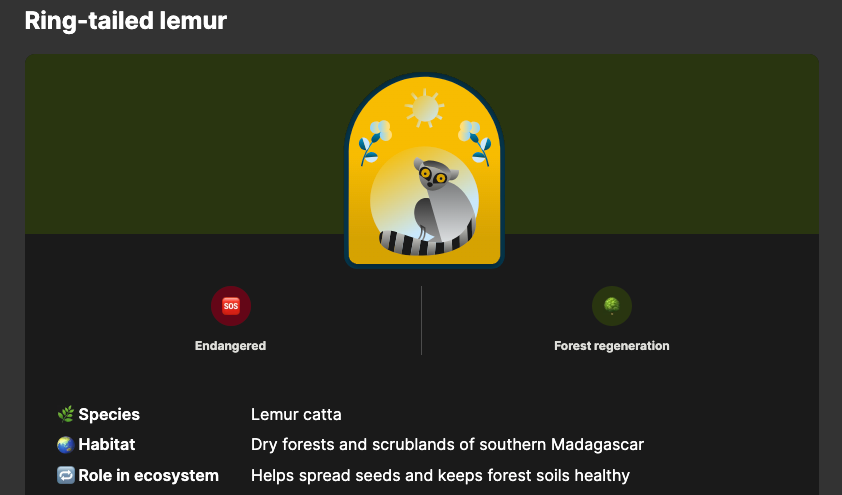
Every time you use Ecosia, you earn “seeds” that contribute to planting real trees. I admit, I’m drawn to this kind of gamification, but it’s a clever way to make tree planting more engaging.
The lemur collectible introduced me to an innovative forest restoration method called “Foxhole Forests.” This technique combines rainforest nucleation, fire protection, and agroforestry methods to restore rainforest quickly and cost-effectively.
I am not the most fully equipped person to talk about this, but think of forest nucleation as creating tiny neighborhoods with passionate residents — small patches of native plants, called cells, that grow close together. Sounds adorable too!
Instead of scattering plants widely across dry, fire-prone landscapes (which suffer about 350,000 fires annually, a reality that does not cute at all).

Screenshot from The Phoenix Conservancy Madagascar Project — https://www.phoenixconservancy.org/madagascar
With these pockets approach, plants can grow and spread faster, eventually connecting naturally with one another turning into larger, and hopefully, stable forest.
Each Foxhole Forest is planted by hand with more than 7,000 native seeds, including species like the drought-tolerant and fire-resistant Marula (Sclerocarya birrea) and Pigeon Pea (Cajanus cajan) that grow quickly in dry, exposed environments. These species can “pioneer” the ecological transition. As they develop, the pioneer species create the cool, moist microenvironments mature forest tree species need to survive.
Photo by Martin Brechtl on Unsplash
As these forest patches develop, they attract seed dispersers such as endangered lemurs and birds, which bring in even more plant species, helping the forest rebuild itself naturally.
Ecosia is collaborating with The Phoenix Conservancy to implement this method in Ivohiboro, Madagascar. Their goal is to plant over 5,000 Foxhole Forests around the area, which will help double the size of the forest and connect fragmented patches to the north. This project is made possible by the collective effort of the Ecosia community, other supporters, and most specially the surrounding community of Ivohiboro.
What Is Ecosia and Why It Matters Ecosia is a search engine with a simple but powerful mission: to use the profits from your web searches to plant trees worldwide. Unlike typical search engines focused on advertising revenue, Ecosia donates at least 80% of its profits to reforestation projects. Since its start in 2009, Ecosia has helped plant over 240 million trees globally, with transparent reporting so users can see where their searches are making a difference. See their reporting HERE.
Recently, Ecosia has been focusing on more than just planting trees. They are supporting innovative restoration methods like Foxhole Forests that help restore entire ecosystems, improve biodiversity, and support local communities. This approach combines scientific innovation with hands-on conservation, aiming for long-term impact on climate and habitat loss.
Madagascar’s Unique Species and Their Dependence on Trees Madagascar is a biodiversity hotspot like no other. Over 90% of its wildlife exists nowhere else on Earth. The island’s forests are home to thousands of species, many of which depend directly on native trees for survival.
[embed]Sounds of Ivohiboro — Madagascar Rainforest Soundscape
Lemurs, including the ring-tailed species featured in the collectible, rely on forest habitats for food, shelter, and movement. They feed on fruits, leaves, and flowers and use the trees to travel through the canopy. But deforestation and frequent fires have destroyed much of their habitat, pushing many lemur species toward endangerment or extinction. Other animals, such as the Madagascar flying fox (these are megabats, not foxes, and there some in the Philippines too), chameleons, and numerous bird species, also depend heavily on these forests. Protecting and restoring Madagascar’s trees is therefore crucial not only for the trees themselves but for the entire ecosystem they support.
*A Few Quick Facts About Lemurs
- Ring-tailed lemurs play an important role in their environment by spreading seeds as they move through the forest.
- Their long, striped tails help them communicate and maintain balance.
- These lemurs live in groups led by dominant females.
- And yes, the most famous ring-tailed lemur? King Julien from the Madagascar movies.*
The Phoenix Conservancy’s Role in Forest Restoration The Phoenix Conservancy is a Madagascar-based nonprofit focused on restoring endangered ecosystems while supporting local communities. Their restoration work goes beyond planting trees; it includes managing firebreaks, cultivating native seeds, and developing innovative restoration techniques tailored to Madagascar’s unique environment.
Foxhole Forests are the cornerstone of their restoration efforts. These small forest patches are hand-planted with thousands of native seeds and carefully maintained to survive harsh conditions and frequent fires. The Conservancy works closely with local people, providing tools and training, recognizing that successful conservation depends on community involvement and benefit.
Their approach combines scientific research with traditional knowledge, creating sustainable methods that rebuild forest structure and biodiversity. The Phoenix Conservancy’s collaboration with Ecosia brings together local expertise and global support to address urgent environmental challenges in Madagascar.
Photo by Gio L on Unsplash
A Useful Tool That Does More Than Search Ecosia also offers an AI mode that’s handy if you ever get stuck searching for the right word, want a quick rewrite, or need to find specific information — like a mathematical formula on Shannon’s entropy. It’s a practical feature that supports your work while still contributing to tree planting.
Right now, the Ecosia community is just about 300,000 trees away from reaching their goal of planting 250 million trees. That’s a huge milestone, and it’s inspiring to be part of it. This was during the time of this writing.
So, yeah — I got a lemur. And if you’re curious, you might want one too.
P.S. Parts of this text has been co-written with Ecosia’s AI tool. Let me know if there is anything inaccurate or incorrect and I will gladly fix it. Take care!
/seanaguinaldo
메타데이터
- post_id
- d2186bb552d9
- slug
- i-got-a-lemur-sort-of-d2186bb552d9
- url
- https://medium.com/@seanjra/i-got-a-lemur-sort-of-d2186bb552d9
- canonical_url
- https://medium.com/@seanjra/i-got-a-lemur-sort-of-d2186bb552d9
- author_url
- https://medium.com/@seanjra
- status
- ok
- fetched_at
- 2026-06-23 19:38:28






