Why Keeping Track of ICF Coaching Hours Is Harder Than It Should Be — And What I Did About It
Mock up of the ICF Coaching Hours Tracker: Chronological Coaching Hours Log Sheet
Why Keeping Track of ICF Coaching Hours Is Harder Than It Should Be — And What I Did About It
Mock up of the ICF Coaching Hours Tracker: Chronological Coaching Hours Log Sheet
When I enrolled in my coach education program, I expected that I’d learn about coaching. I didn’t expect to end up building spreadsheets.
I’m not an Excel guru either. I learned mostly by watching YouTube videos. Honestly, this is how I learn most things these days.
This became important as I learned early on that I would need to keep tabs on several things for International Coaching Federation (ICF) credentialing.
I started with the ICF website, where they had an ICF Coaching Log Template. It was decent. It’s a simple ICF coaching hours log…an Excel spreadsheet for tracking ACC, PCC, and MCC hours, with fields for client names, contact information, whether it’s individual or group coaching, start and end dates, and the number of paid and pro bono hours.
Accurate ICF coaching hour tracking is important because the required hours may need to be verified. An audit would mean that client records need to be ready. I have no idea how often this happens, but I wanted to be diligent because if someone gets audited, it’s often me.
Case in point…I seem to get pulled for additional screening at airport security. I guess I look suspicious or something.
Anyhow, I started using the ICF coaching log, and at first, it was fine. But once I started accumulating hours, I wanted a running total and a visual of where I was.
So, I created a second spreadsheet to record, by session date, the number of hours coached and whether it was paid or pro bono. That seemed to work better for me. So now I had two spreadsheets. What could go wrong with this system?
The Google Sheet tracker got really long, so I decided to add tabs for each calendar year. That worked better. Over time, I stopped using the ICF tracker and just used my own.
As I got closer to the hours required for PCC certification, I had a terrifying thought: What if I were asked for an audit? After all these hours, it would be a pain to start adding the information ICF requires.
I’d been diligently logging in my own tracker for months. But what information would the ICF actually need? I’d forgotten about that.
The All-In-One Coach Log I Couldn’t Find
That’s when I had the inspiration to create an all-in-one ICF coaching hours tracker.
It would have to start with the information that ICF requires. So I created a tab for the client information that’s necessary for an audit.
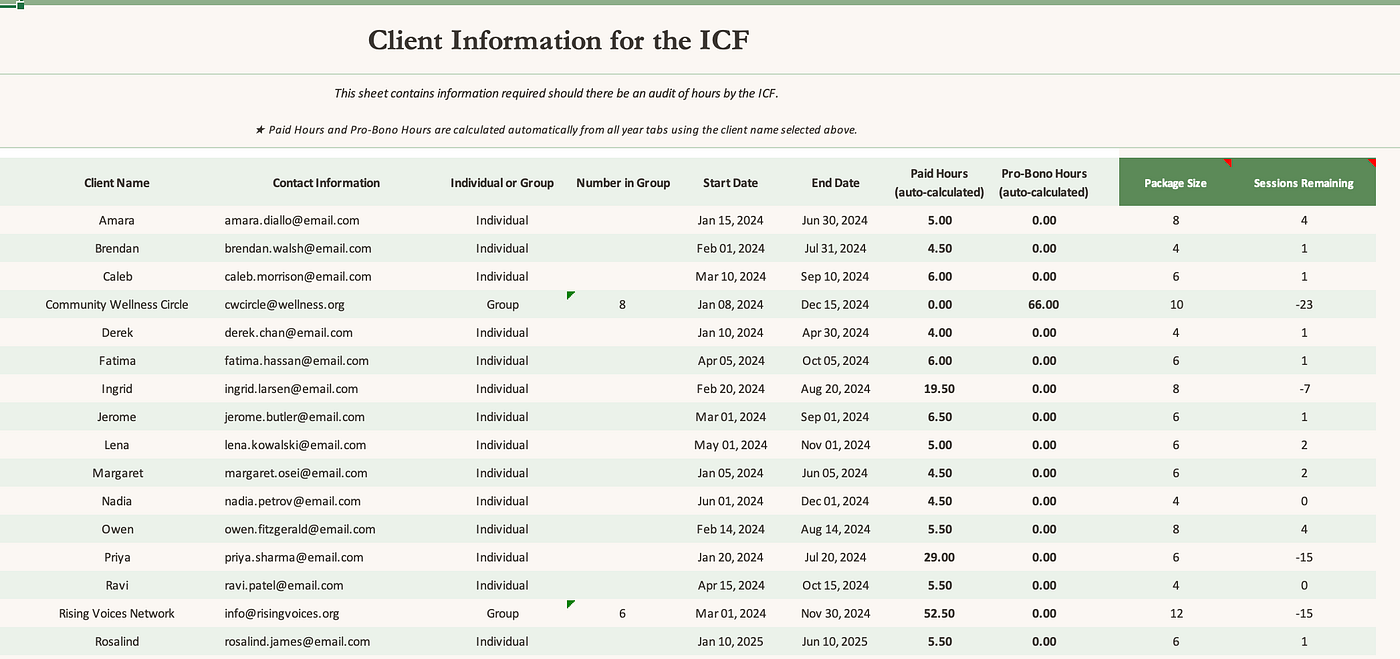
Mock up of the ICF Coaching Hours Tracker Client Information Sheet
Next, I created a tab to track coaching hours in chronological order as they occurred throughout the year. This sheet kept a running total of my hours. Each year had its own tab.
This would be the place I’d keep track of day-to-day coaching sessions once I’d added people to my Client Information Sheet.
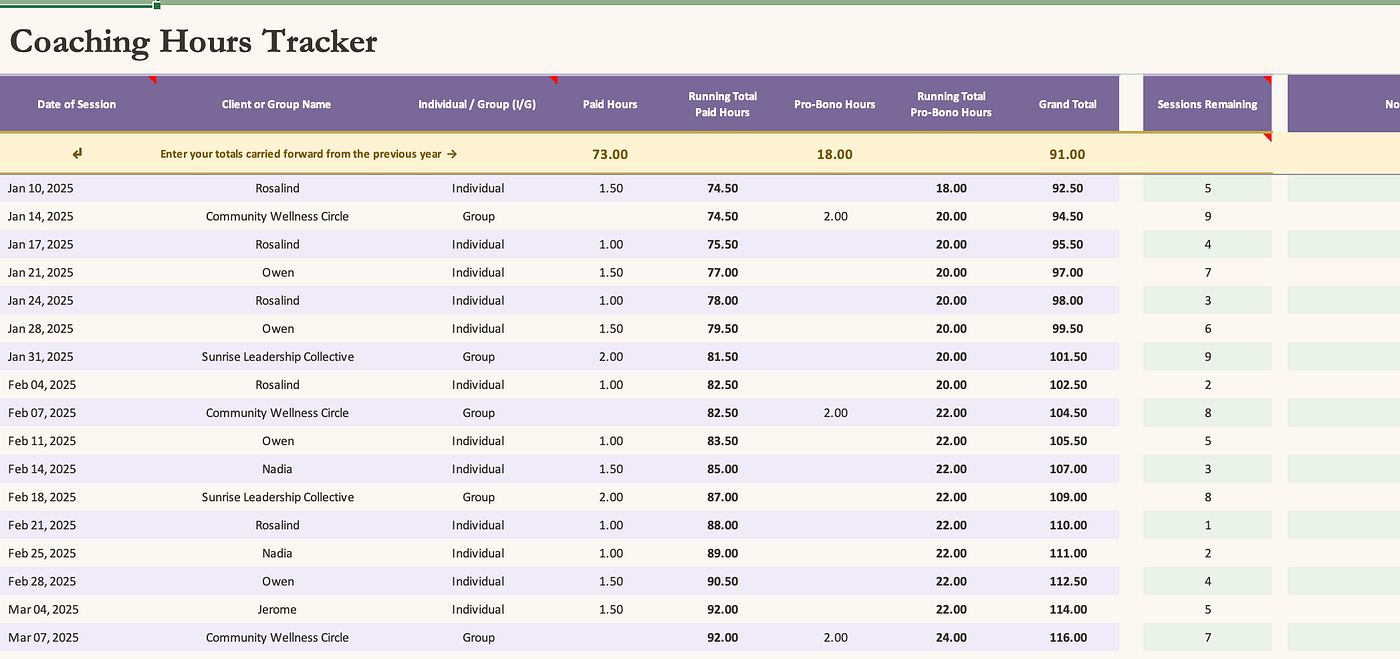
Mock-up of the ICF Coaching Hours Tracker Chronological Coaching Sessions Tracker Sheet
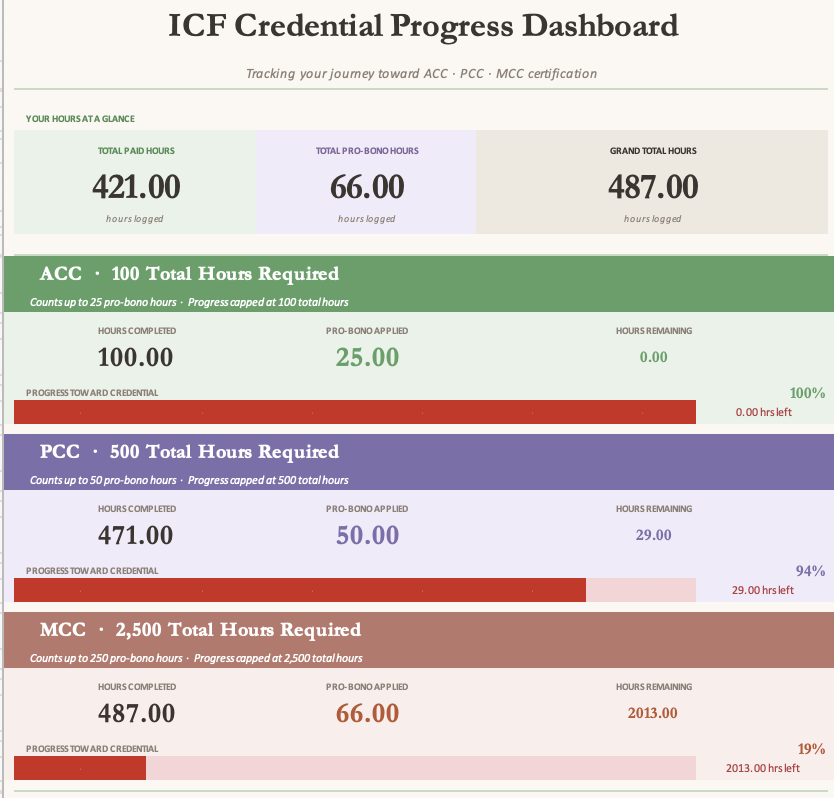
Finally, I built what was missing for me: a visual representation of my progress towards ACC, PCC, and MCC with all of the requirements from the ICF:
- ACC — 100 hours (25 pro bono maximum)
- PCC — 500 hours (50 pro bono maximum)
- MCC — 2,500 hours (250 pro bono maximum)
The tracker caps pro bono hours, so it stops counting once the maximum for each level is reached. The credential progress dashboard updates as you enter hours in each tab.
This meant that once I’d set up a client on the client page, I’d only have to log hours in one place, on the yearly tab, and everything else would update.
One spreadsheet. One place. That was the whole goal.
This might sound like a lot. And it was. But it solved a problem for me that I just hadn’t found a good solution for.
I only wish I’d had it when I started. I guess if I had, I wouldn’t have learned to love spreadsheets as much as I do now, though.
If you’re somewhere along your ICF credentialing journey and this sounds familiar, the tracker is available now. You can find it at wildtransformation.gumroad.com/l/ICFtracker.
If you do decide to give it a try, I’d love to hear what you think.
👉 Did you find this article interesting? Consider reposting and adding up to 100 claps so more people can see and read it. Thank you!
메타데이터
- post_id
- d22c3dcac925
- slug
- why-keeping-track-of-icf-coaching-hours-is-harder-than-it-should-be-and-what-i-did-about-it-d22c3dcac925
- url
- https://medium.com/never-stop-writing/why-keeping-track-of-icf-coaching-hours-is-harder-than-it-should-be-and-what-i-did-about-it-d22c3dcac925
- canonical_url
- https://medium.com/never-stop-writing/why-keeping-track-of-icf-coaching-hours-is-harder-than-it-should-be-and-what-i-did-about-it-d22c3dcac925
- author_url
- https://medium.com/@joni_69074
- status
- ok
- fetched_at
- 2026-07-09 16:18:44