3-channel parametric stereo image mixer
Compact 3-Channel Ambient Capture Array (Jecklin Disk + Decca-Style Center) Operates as a 3-channel parametric stereo image mixer
3-channel parametric stereo image mixer
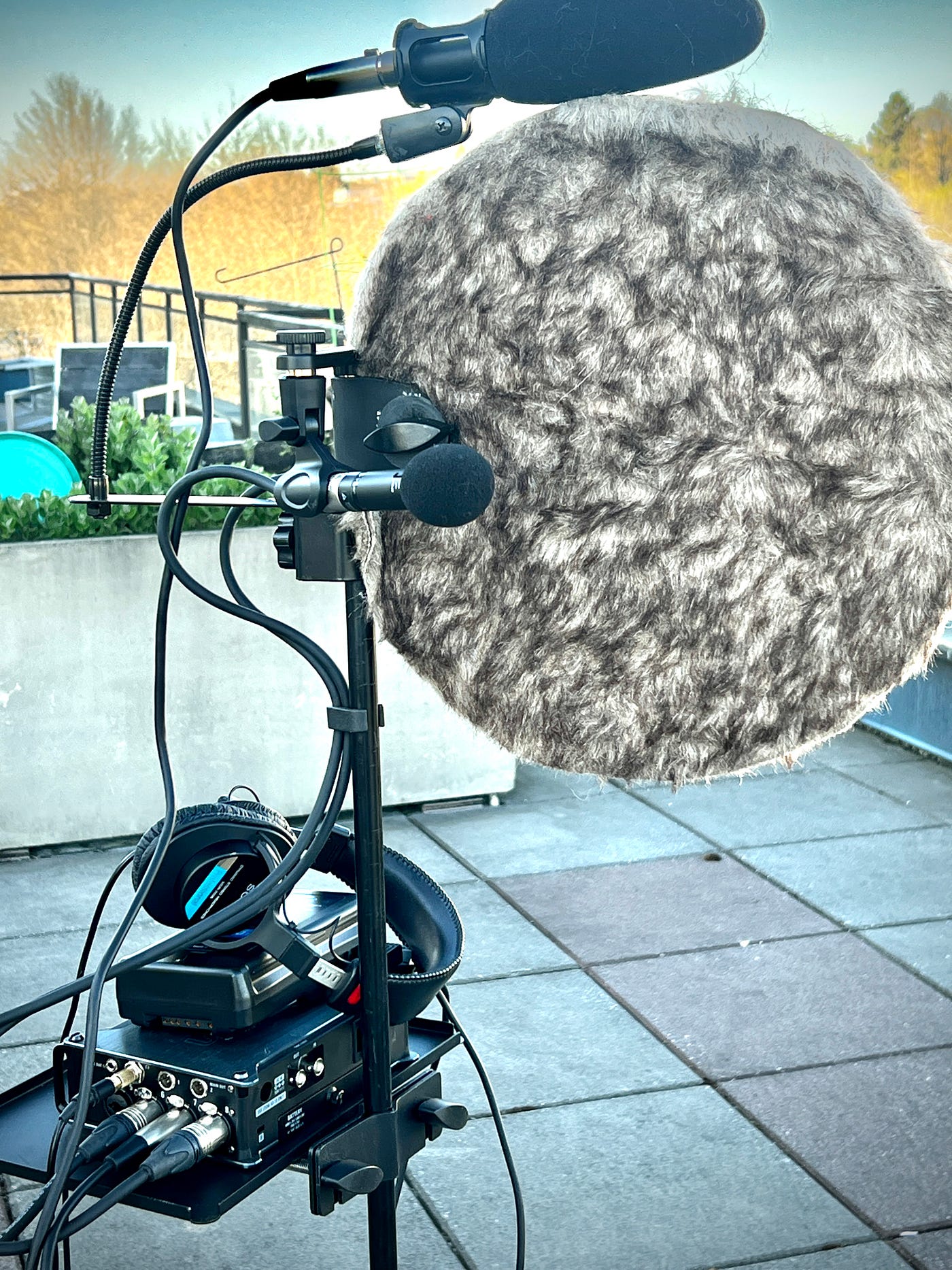
Compact 3-Channel Ambient Capture Array (Jecklin Disk + Decca-Style Center) Operates as a 3-channel parametric stereo image mixer
1. Overview
Three-microphone array using a ~13-inch Jecklin disk with spaced left/right capsules (9–11 inches) and a discrete center channel. The system is designed for rapid deployment and post-defined imaging.
Left/right channels operate as a wide AB pair with acoustic shadowing, forming the primary spatial image and low-frequency continuity. The center channel functions as a controlled mid-field reinforcement path used to tune the inherent Jecklin midrange “hollow” and adjust perceived width, depth, and center solidity.
The system is intentionally under-committed at capture. Final spatial characteristics are constructed in post.
2. Physical Configuration
- Disk: ~13" diameter absorptive/diffusive baffle
- L/R spacing: 9–11 inches (symmetry within millimeters required)
- L/R height: matched
- Center: on-axis, same height, aligned to disk plane
- Mounting: rigid to maintain phase stability
3. Signal Roles
- L/R (primary pair) Wide AB with acoustic shadowing Defines spatial field, width, and low-frequency structure
- Center (control channel) Non-coincident reinforcement Adjusts mid-field density, localization bias, and depth
4. Capture Method
- Record all channels clean (no processing printed)
- Maintain consistent gain staging
- Center recorded conservatively (approx. 10–14 dB below L/R reference)
- No intentional delay or phase manipulation applied at capture
Capture goal: preserve a flexible spatial dataset, not a finished image.
5. Parametric Image Control (Post)
The system functions as a 3-parameter spatial mixer:
- Center Level → controls width vs center density
- Center Delay → controls arrival priority and depth (precedence weighting)
- Center Spectrum → controls perceptual presence and tonal integration
L/R remain fixed as the spatial reference. Center is introduced incrementally.
6. Center Delay / Haas Positioning
- 0 ms (impulse-aligned) Center dominates; image narrows and pulls forward
- +0.15–0.3 ms (baseline) Center integrates without collapsing width
- +0.3–0.8 ms Center recedes; introduces depth layering
- 1 ms Perceptual detachment or smear
At this scale, sub-millisecond adjustments are audible and significant.
7. Capsule Configurations
Omni L/R + Omni C (neutral fill)
- Maximum coherence and LF continuity
- Soft center; requires higher level
- Best for open outdoor ambiences
Omni L/R + Cardioid C (balanced control)
- Controlled center reinforcement
- Mild tonal seam, stable behavior
- General-purpose configuration
Omni L/R + Hypercardioid C (forward bias)
- Increased center definition and depth
- Rear-lobe contamination possible
- Requires conservative level
Omni L/R + Shotgun C (spot bias)
- Strong forward isolation
- Phase coloration in upper mids
- Stylized or corrective use
Cardioid L/R + Omni C (room control)
- Reduced ambient pickup
- Center restores LF and mid presence
- Suitable for reflective interiors
Cardioid L/R + Cardioid C (fully directional)
- Narrower field, strong front focus
- Tonally consistent
- Risk of flattening if overused
Cardioid L/R + Hyper C (aggressive control)
- Tight, forward image
- Increased coloration
- Limited practical use
Hyper L/R + Omni C (maximum rejection)
- Strong side rejection
- Reduced spatial scale
- Noise-control scenario only
8. Center Omission / Hollow Utilization
The center channel may be reduced or omitted:
- Preserves Jecklin midrange dip
- Creates a natural center “slot”
- Enables clean insertion of mono dialogue or focal elements
- Most effective with omni L/R
9. Dialogue Integration Workflow
- Fade center down gradually (no hard mute)
- Begin fade before dialogue onset
- Restore after dialogue ends
- Maintain L/R unchanged
Result:
- Clear center placement for dialogue
- Stable ambient field
- Minimal corrective processing
10. Operational Constraints
- Sub-millisecond timing sensitivity
- Gain changes of 2–3 dB significantly alter imaging
- Capsule mismatch introduces phase/tonal variance
- System is not phase-coincident
- Imaging is perceptual, not mathematically coherent
- Configurations should remain fixed per session
11. Use Cases
- Outdoor ambiences with adjustable center solidity
- Interior environments requiring room control
- Hybrid production workflows combining ambience and dialogue
- Rapid field recording with post-defined imaging
12. Limitations
- Not mono-compatible in the traditional sense
- Dependent on post-processing decisions
- Requires careful alignment and gain discipline
- Mixed polar patterns introduce tonal discontinuities
13. References
Haas H. Über den Einfluss eines Einfachechos auf die Hörsamkeit von Sprache. Acustica. 1949. https://www.akustik.rwth-aachen.de/global/show_document.asp?id=aaaaaaaaaaxlqjp
Wallach H, Newman EB, Rosenzweig MR. The precedence effect in sound localization. Am J Psychol. 1949. https://psycnet.apa.org/record/1950-03754-001
Blauert J. Spatial Hearing: The Psychophysics of Human Sound Localization. MIT Press. https://mitpress.mit.edu/9780262523454/spatial-hearing/
Rayleigh L. The Theory of Sound. 1907. https://archive.org/details/scientificpapers04raylrich
Jeffress LA. A place theory of sound localization. J Acoust Soc Am. 1948. https://asa.scitation.org/doi/10.1121/1.1906448
Duda RO, Martens WL. Range dependence of the response of a spherical head model. JASA. 1998. https://pubs.aip.org/asa/jasa/article/104/5/3048/570570
Møller H, et al. Binaural technique: Do we need individual recordings? JASA. https://pubs.aip.org/asa/jasa/article/104/4/2181/570321
Williams M. Microphone array analysis for stereo and surround sound recording. AES. https://www.aes.org/e-lib/browse.cfm?elib=6326
Griesinger D. Spaciousness and envelopment in listening rooms. AES. https://www.aes.org/e-lib/browse.cfm?elib=5657
Rumsey F. Spatial Audio. Focal Press. https://www.routledge.com/Spatial-Audio/Rumsey/p/book/9780240516232
Pulkki V. Virtual Sound Source Positioning Using Vector Base Amplitude Panning. JAES. 1997. https://www.aes.org/e-lib/browse.cfm?elib=7853
메타데이터
- post_id
- d2316cf7953e
- slug
- 3-channel-parametric-stereo-image-mixer-d2316cf7953e
- url
- https://medium.com/@robert_74120/3-channel-parametric-stereo-image-mixer-d2316cf7953e
- canonical_url
- https://medium.com/@robert_74120/3-channel-parametric-stereo-image-mixer-d2316cf7953e
- author_url
- https://medium.com/@robert_74120
- status
- ok
- fetched_at
- 2026-06-10 22:22:12