Europe’s Quantum Race
AI bubble, quantum bubble, they are both right and wrong. Science sometimes feels less like science and more like drama with people at the…

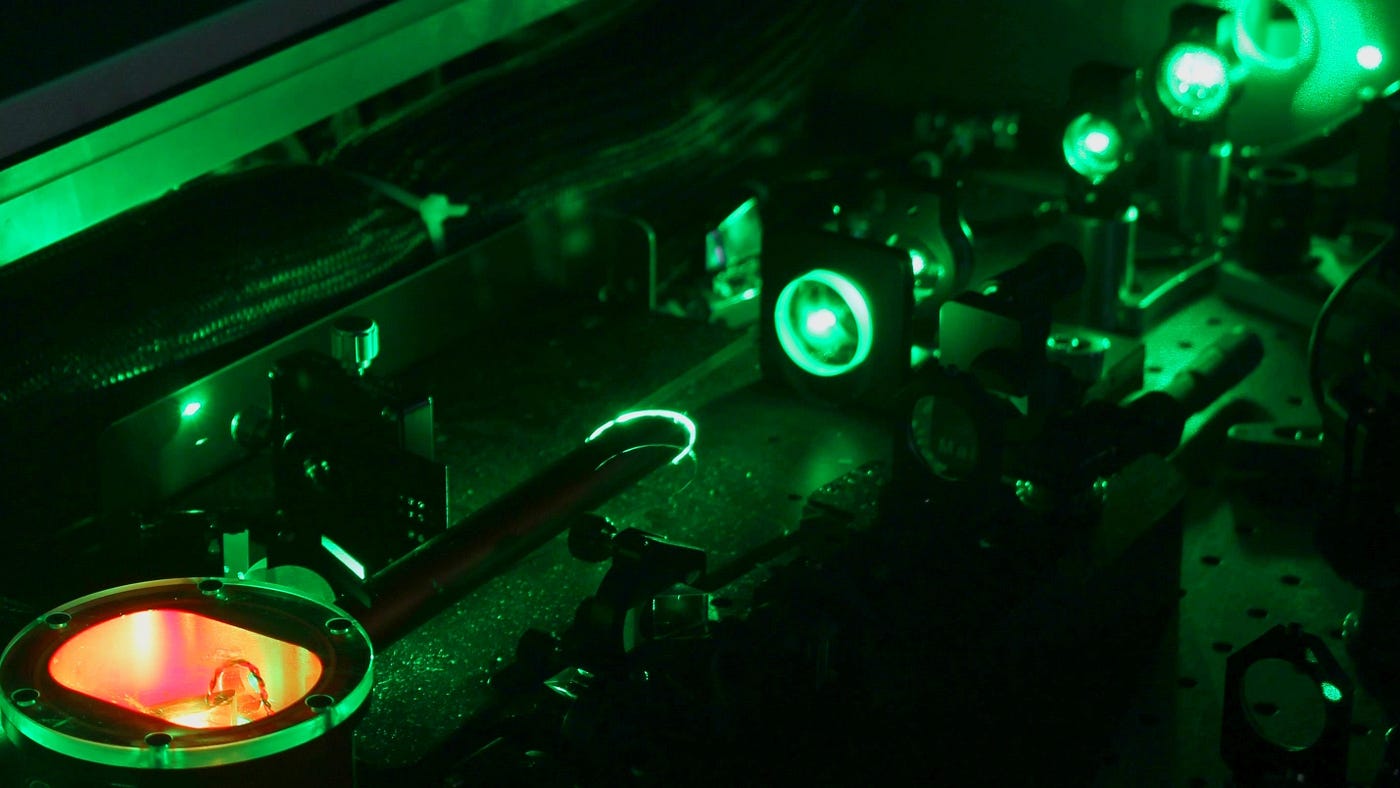
Photo by Jason Leung on Unsplash
Europe’s Quantum Race
AI bubble, quantum bubble, they are both right and wrong. Science sometimes feels less like science and more like drama with people at the center. This uncertainty and confusion make it harder for people to know what they should pursue in their careers. Should a career follow passion, or be driven by goals and obligations? Ideally, both, but in reality very few people get that opportunity.
I imagine some of you will relate to this, but I’ve received many questions about career orientation and the possibility of working in Europe in data science or in the United States. The real question is, are these careers still worth pursuing today?
In this series on Quantum Machine Learning, I have already covered some concepts, from algorithms to gates. But beyond the mathematics, for me, understanding the ecosystem is just as crucial
In this second episode, I will focus on investments in quantum technologies in Europe, including major national initiatives. Keep in mind that the quantum computing path comes with real forecasts for research and job opportunities, as many of the programs I will highlight are preparing a quantum-ready workforce at PhD and Master’s level by 2030
As always, if you find my articles interesting, don’t forget to clap and follow 👍🏼 These articles take time and effort to create!
Before we begin, if you’re new to my series, please read the first article first!
Europe still clearly dominates quantum research more than a century after the foundational work. To maintain that lead, it launched the European Quantum Flagship in 2018 with a €1 billion budget over 10 years. This initiative includes several sub-programs, one of the most notable being EuroQCI, which brings together 27 member states to build a secure quantum communication infrastructure across the EU. But where are they now?
By 2026, Europe has shifted from research to real-world deployment of quantum technologies. Building on the European Quantum Flagship, it is now focusing on industrialisation and technological sovereignty, while EuroQCI is being actively deployed across member states.
Additionally, the Digital Europe Programme supports workforce development through initiatives like DigiQ and QTIndu, addressing the growing demand for a quantum-ready workforce. Let’s explore the national initiatives
Quantum national initiatives in Europe
Spain :
1/ — Quandum Spain : founded in 2021, the program brings together the Spanish Supercomputing Network (A distributed infrastructure that connects supercomputers across Spain to provide high-performance computing (HPC) services to the scientific community) and top research centers to build Spain’s first quantum computing infrastructure. The government is investing €60M to develop a quantum computer at Barcelona Supercomputing Center, integrated with MareNostrum 5 (Europe’s most advanced research supercomputer, capable of 314 quadrillion calculations per second)

BSC-CNS — Barcelona Supercomputing Center | FIB — Barcelona School of Informatics. Image Source : https://www.fib.upc.edu/en/research/research-centers/bsc-cns-barcelona-supercomputing-center
Just to give an idea of the computing scale of that pre-exascale supercomputer, capable of performing hundreds of petaflops of calculations per second: if every person on Earth carried out one calculation per second, it would take the entire global population more than 400 years to match what a pre-exascale computer can do in just one second. Crazy, right?
BSC. Image Source : https://www.bsc.es/join-us/why-work-at-bsc
2 — Spain’s Quantum Technologies Strategy (2025–2030) : Launched in 2025, Spain’s Quantum Technologies Strategy aims to position the country as a global leader, building on €300M already invested and supported by €808M from the ERDF (European Regional Development Fund) and national recovery plan. It focuses on quantum computing, communication, and sensing !
France :
France has also set out its own roadmap for quantum technologies. The government launched a national strategy focused on building three quantum hubs ; Paris–Saclay, Paris-Centre and including one in Grenoble, where work is underway on a silicon-based quantum computer.
Detail of a quantum machine, QCMX laboratory (Quantum Circuits and Matter Lab)©Jeremy Barande — École Polytechnique. Image Source : https://www.ip-paris.fr/en/news/quantum-saclay-bringing-quantum-together
In January 2021, President Emmanuel Macron announced a €1.8 billion investment plan over five years to accelerate quantum development in France
Ireland :

Minister Simon Harris, TD, at the launch event in UCD. Image Source : Leigh Mc Gowran/SiliconRepublic.com
In November 2023, Ireland launched Quantum 2030, its national strategy for quantum technologies. It is built around five pillars:
- Support world-class fundamental and applied quantum research
- Build a skilled, diverse quantum talent pipeline (with strong focus on education, EDI, and workforce development)
- Strengthen national and international collaboration in quantum technologies
- Boost innovation and entrepreneurship, including support for SMEs and academia–industry partnerships
- Develop a quantum-literate society so the benefits of quantum tech are widely accessible
United Kingdom
The UK launched its national quantum programme in 2013, starting with £270M over five years, creating four quantum research hubs involving around 30 universities and industry partners.
- University of Oxford: QCI3 Hub (Quantum Computing via Integrated and Interconnected Implementations). Focuses on building scalable quantum hardware and software. Oxford Hub Website
- University of Birmingham: QuSIT Hub (Sensing, Imaging and Timing). Develops ultra-precise sensors for brain scanning (dementia/epilepsy), gas leak detection, and infrastructure monitoring. Birmingham Hub Website
- Heriot-Watt University (Edinburgh): IQN Hub (Integrated Quantum Networks). Aiming to create a “Quantum Internet” with secure, interlinked communications. Heriot-Watt Hub Website
- University of Glasgow: QEPNT Hub (Quantum Enabled Position, Navigation and Timing). Working on atomic clocks and sensors for navigation where GPS isn’t available, like underwater or in space. Glasgow Hub Website
- University College London (UCL) & Cambridge: Q-BIOMED Hub (Quantum Biomedical Sensing). The first hub dedicated to health, using quantum tech for early cancer and Alzheimer’s diagnosis. UCL Q-BIOMED Page
In 2019, a second phase added £350M, focusing on industrialising quantum technologies and advancing quantum computing (This phase also introduced the plan for a National Quantum Computing Centre)
By 2023, the UK released its National Quantum Strategy, outlining a 10-year vision and committing an additional £2.5B from 2024 onward, plus extra targeted funding.
The Netherlands :
Quantum Delta NL. Image Source : https://quantumdelta.nl/news/quantum-delta-nl-awarded-273-million-by-the-national-growth-fund-for-the-third-phase
In 2019, the government launched a national quantum agenda with:
a — €350M for QuTech for hardware
b — €615M for Quantum Delta NL, a a broader national program funded by the Netherlands National Growth Fund to turn research into a massive industry
- Funding specialized labs and “House of Quantum” campuses across five hubs (Delft, Amsterdam, Leiden, Eindhoven, and Twente)
- Providing seed funding and support for new quantum companies to ensure the NL leads the market
- Creating specialized PhD programs and training a workforce of 2,000+ experts by 2030
- Handling the ethics, legal frameworks, and security (Quantum-Safe Cryptography) for the country
Switzerland :

SCNAT. Image Source : https://scnat.ch/en/for_a_sustainable_society/policy_advice
How can I not talk about Switzerland here? Even if the program is small in terms of investment, the initiative is still here! The Swiss Quantum Initiative (SQI), launched in 2023, aims to strengthen Switzerland’s position in quantum technologies, including computing, communication, and sensing with around CHF102M ≈ $124M
It is led by the Swiss Quantum Commission (SQC) and hosted by the Swiss Academy of Sciences (SCNAT) under a federal mandate
Italy :
I had the opportunity to join a university in Italy back in 2023, offering a Master’s in Quantum Computing. I know for sure that there are many initiatives there to also train a quantum-ready workforce
Italy invested €227.4M between 2021–2024 to strengthen quantum research, industrial use, and like I said, workforce development
Hungary :
ELKH Wigner Research Centre for Physics. Image Source : https://wigner.hu/
Hungary launched its National Programme in 2018, receiving HUF 3.5B over four years to develop quantum cryptography, communication systems, and basic quantum bit operations
Building on this, the Quantum Information National Laboratory, led by the ELKH Wigner Research Centre for Physics, received an additional HUF3.5B in 2023 for a new three-year phase.
The goal is to build a regional quantum communication network aligned with the European EuroQCI initiative, strengthening integration with EU quantum communication systems.
Sweden :

Chalmers University of Technology. Image Source : https://www.study.eu/university/chalmers-university-of-technology
Sweden’s quantum efforts are led by the Wallenberg Centre for Quantum Technology (WACQT) in collaboration with the Swedish Research Council
- Initial program: ~SEK1.6B for national quantum research (quantum computers, sensors, simulators, communication). Led by Chalmers University of Technology with participation from KTH Royal Institute of Technology and Lund University
- They had an additional SEK1.3B funding to scale research and ~SEK6.5B planned for research, innovation, infrastructure, and commercialization
Finland :
VTT. Image Source : https://www.vttresearch.com/en/contact-us
Finland’s quantum strategy combines national RDI funding and EU industrial programs.
- €20.7M for VTT (Technical Research Centre of Finland) + IQM Quantum Computers (A private, commercial startup and a “spinoff” from Aalto University) to build Finland’s first quantum computer
- €3.3M from Business Finland for innovation support
- €13M for the Finnish Quantum Flagship (FQF) launched in 2024
Denmark :
In 2023, Denmark launched its National Strategy for Quantum Technology, with DKK1.5B over five years, building on prior investments from Innovation Fund Denmark and the Novo Nordisk Foundation, including efforts to develop Denmark’s first fully functional quantum computer. They had also additional initiatives
Germany :
In July 2020, Germany committed €2B to a national quantum technology program, announced by Angela Merkel.
Industry has also played a key role, with IBM deploying its first quantum computer in Europe in Germany.
In 2023, Germany introduced a quantum action plan targeting the development of a universal quantum computer by 2026, bringing total public investment to €3B
Austria (2021) :
The Austrian federal government, led by the Federal Ministry of Science, Education and Research, is investing €107 million in quantum research and quantum computing. This initiative aims to strengthen Austria’s position globally and mitigate the long-term impacts of COVID-19 on innovation and competitiveness.
I think that’s enough for this episode of the series. The goal here was not just to list numbers or initiatives, but to help you understand the ecosystem behind quantum technologies in Europe at a macro level and what it means in terms of real opportunities, research directions, and future careers.
In the next episode, we will go deeper into other regions and compare how different countries are positioning themselves in this global race, so you can build a clearer and more realistic vision of where this field is actually going, beyond the hype and trends
If there’s a specific subject you’d like us to cover, please don’t hesitate to let me know! Your input will help shape the direction of my content and ensure it remains relevant and engaging 😀
Resources
[embed]BSC-CNS Barcelona Supercomputing Center - Centro Nacional de Supercomputacionwww.bsc.es
[embed]European Regional Development Fund EuropeanCommission - Regional Policy - Inforegioec.europa.eu
Please consider the following and subscribe to the newsletter for more articles about business, data science, machine learning, and extended reality, it’s FREE! You can find my lists in the following links :
- Data Science Digest : https://medium.com/@soulawalid/list/statistics-data-science-65305693779d
- Generative AI : https://medium.com/@soulawalid/list/generative-ai-ee31117869a9
- Programming with Python : https://medium.com/@soulawalid/list/programming-c0a3ef000f5f
- Linguistic AI Lab : https://medium.com/@soulawalid/list/linguistic-ai-lab-9eb7d30369c1
- Strategic Business Intelligence : https://medium.com/@soulawalid/list/strategic-business-intelligence-1528f08575a7
- AI for Health Professionals : https://medium.com/@soulawalid/list/ai-for-health-professionals-f8b87eeab19f
- The Neuroscience of Consumer Behavior : https://medium.com/@soulawalid/list/the-neuroscience-of-consumer-behavior-8f94149e3c73
- Beyond Reality : https://medium.com/@soulawalid/list/beyond-reality-bf03607b0b80
- Quantum Leap : https://medium.com/@soulawalid/list/quantum-leap-be0b06f7a986
If you have any questions, you can ask me on LinkedIn, here is my profile: https://www.linkedin.com/in/oualid-soula/ Let’s connect!
메타데이터
- post_id
- d239ff3c2655
- slug
- europes-quantum-race-d239ff3c2655
- url
- https://medium.com/@soulawalid/europes-quantum-race-d239ff3c2655
- canonical_url
- https://medium.com/@soulawalid/europes-quantum-race-d239ff3c2655
- author_url
- https://medium.com/@soulawalid
- status
- ok
- fetched_at
- 2026-06-09 14:34:10