Enterprise AI Upskilling Part 7: Comprehensive AI Practitioner Track — Cross‑Functional…
I’ve observed a persistent and widening gap between the promise of AI and the ability of most organizations to deliver on it. The issue…
Enterprise AI Upskilling Part 7: Comprehensive AI Practitioner Track — Cross‑Functional Knowledge and Toolkits to Plan, Build, Deploy, and Sustain High‑Value AI Solutions
I’ve observed a persistent and widening gap between the promise of AI and the ability of most organizations to deliver on it. The issue isn’t access to technology; it’s a critical deficit in practical, production-oriented talent. We’ve moved past the point of simple proofs-of-concept. To build a durable competitive advantage, we must systematically equip our technical teams with a new and specific set of skills. This document lays out a direct, evidence-based plan to build that internal capability engine.
This is last post among the series of seven articles I have written on the topic of Enterprise AI Upskilling in which I laid out a comprehensive cross functional cirriculum for learning AI.
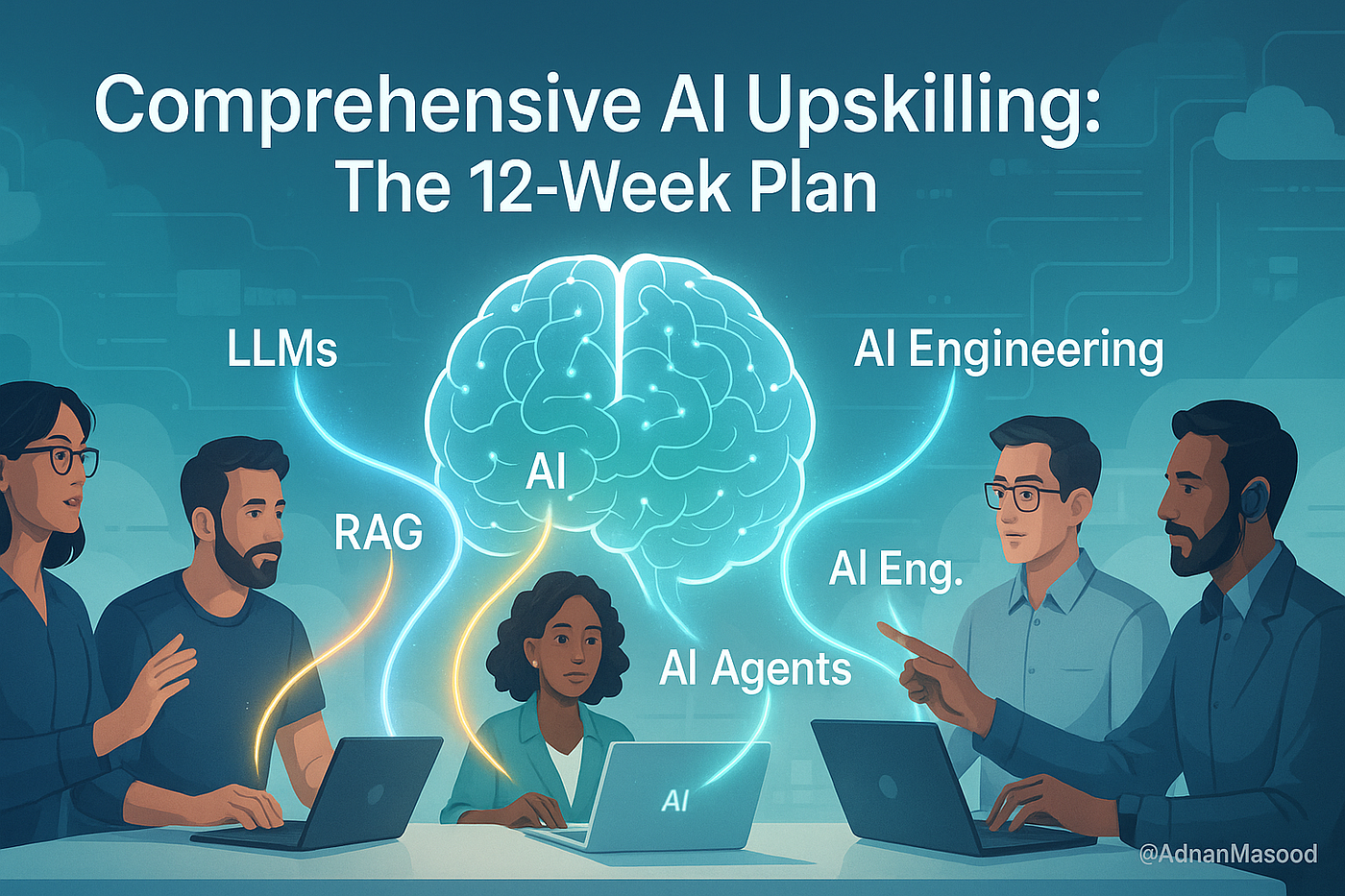
I have structured this upskilling framework around five key areas that I believe are non-negotiable for building robust, scalable, and reliable AI solutions. First, Large Language Models (LLMs), the foundational technology, but with a focus on steering and control, not just generation. Second, Retrieval-Augmented Generation (RAG), the critical skill for grounding these models in our proprietary data, which is essential for accuracy and relevance. Third, Agentic AI, the next step in automation, which allows us to orchestrate multi-step workflows. Fourth, AI Engineering, the discipline of taking a model from a notebook to a resilient, secure, and cost-managed production service. Finally, ML Engineering, the bedrock fundamentals of data quality and validation that prevent most AI projects from failing in the first place.
This report details a 12-week, hands-on program designed for our existing software engineers, data scientists, and product managers. It’s not a theoretical overview; it’s a practical roadmap with specific projects, tools, and outcomes for each week. By investing in this structured upskilling, we are not just chasing a trend. We are making a strategic investment in our people to build the in-house expertise required to deploy AI systems that are not only innovative but also trustworthy, maintainable, and aligned with our core business objectives. This is how we transition from experimenting with AI to operating as an AI-native organization.
The AI Capability Engine: A 12-Week Strategic Plan for Upskilling Technical Teams
Target Audience: Software engineers, data scientists, product managers, and general tech professionals.
Objective: Provide a detailed 12-week upskilling plan covering five critical AI areas — Large Language Models, Retrieval-Augmented Generation, Agentic AI (AI Agents), AI Engineering, and ML Engineering — with actionable skills, tools, and real-world insights. All recommendations are evidence-based (avoiding hype) and emphasize strategic business and tech implications.
1. Large Language Models (LLMs)
Introduction: LLMs (e.g. OpenAI GPT-4, Anthropic Claude, Google Gemini) have become foundational in modern AI applications, revolutionizing natural language processing (NLP), automation, and human-computer interaction [1], [2]. These models are pre-trained on vast text corpora and can generate human-like language, enabling advanced chatbots, virtual assistants, translation systems, and more [2], [1]. LLMs are disruptive technologies redefining how we process information and interact with machines [1]. Organizations leverage LLMs to streamline operations (e.g. automating customer service queries) and augment decision-making, yielding efficiency gains [1]. However, deploying LLMs requires new skills to ensure they perform reliably and ethically.
Key Skills and Knowledge: To excel with LLMs, focus on the following core competencies:
- Prompt Design and Engineering: Crafting effective prompts is essential for steering LLM behavior. Learn techniques like zero-shot prompts (no examples, just an instruction), chain-of-thought (CoT) prompts (guiding the model to reason step-by-step), and role-based prompts (priming the model to assume a specific role or persona) [3]. For example, adding the phrase “Let’s think step by step” to a prompt can invoke zero-shot CoT reasoning, improving the model’s ability to solve complex problems [3]. Mastering prompt engineering enables you to maximize an LLM’s output quality and relevance — a skill emphasized in courses like Learn ChatGPT Prompt Engineering for Developers [3]. Hands-on practice with real examples will build intuition on how slight prompt tweaks impact responses.
- Fine-Tuning and Adaptation: Understanding how to fine-tune LLMs on domain-specific data is crucial. Techniques such as Low-Rank Adaptation (LoRA) and Parameter-Efficient Fine-Tuning (PEFT) allow you to adapt large models to specialized tasks with relatively small datasets and compute [3]. Fine-tuning can dramatically improve performance on niche applications (e.g. a healthcare chatbot fine-tuned on medical transcripts will give more relevant answers in that domain). Learning to apply these methods (as covered in advanced courses and open-source guides) will enable you to tailor general models like GPT-3/4 to your organization’s needs.
- Embeddings and Semantic Search: LLMs generate vector representations (“embeddings”) for text, which encode semantic meaning. Embeddings are powerful for building semantic search and recommendation systems [4]. By converting text into vectors in a high-dimensional space, similar content can be identified via nearest-neighbor search. Understanding how to use pretrained embedding models (from providers like OpenAI or Cohere) and how to index these vectors in a database is vital. This skill enables features like semantic document search, deduplication, and topic clustering. For instance, an e-commerce app can use embeddings to suggest similar products based on description text.
- Function Calling and Tool Integration: Modern LLMs can interface with external tools and APIs via function calling, turning natural language into API calls or code execution. Mastering this allows you to extend an LLM’s capabilities beyond text generation [5]. For example, GPT-4 can be instructed to call a weather API when asked about today’s forecast, then incorporate the result into its answer. Learning to design function call schemas and secure tool-use by the model (e.g. using plugins or libraries like LangChain) is key for building LLM-powered agents that perform actions (searching databases, executing calculations, etc.).
- Handling Hallucinations and Ensuring Reliability: LLMs sometimes generate factually incorrect or fabricated information (“hallucinations”). Developing strategies to detect and mitigate these is critical for production use. Skills in this area include adding verification steps or feedback loops, restricting model outputs to provided context, and incorporating human-in-the-loop review for sensitive tasks. Retrieval-augmentation (Section 2) is one effective technique to ground model outputs in factual data [6]. You should also familiarize yourself with evaluation techniques for generative models — e.g. using hidden benchmarks or truthfulness checks — as highlighted in courses on Quality and Safety for LLM Applications and Red Teaming LLMs [6]. By mastering these methods, you can build LLM solutions that are not only creative but also trustworthy and aligned with user expectations.
Essential Tools and Technologies:
- OpenAI GPT-4: A leading multimodal LLM known for its advanced language understanding and generation capabilities. GPT-4 can accept image and text inputs, making it versatile for a range of applications [1]. Developers access it via the OpenAI API, and it’s often the benchmark for state-of-the-art performance. (Use Case: building a customer support chatbot that handles complex inquiries in natural language.)
- Claude by Anthropic: An alternative LLM focused on helpfulness and safety. Claude is designed to minimize toxic or biased outputs, thanks to Anthropic’s constitutional AI approach. It’s a good choice when interpretability and aligned behavior are priorities [1]. (Use Case: a financial advisory assistant where responses must remain cautious and ethically guided.)
- Google Gemini: A family of multimodal LLMs from Google DeepMind, positioned as competitors to GPT-4 [7]. Gemini models (Ultra, Pro, Nano, etc.) integrate text processing with image and potentially other modalities, and excel in certain reasoning tasks due to combined techniques from AlphaGo and PaLM [7]. While still emerging, Gemini is expected to power Google’s next-gen products (Bard, Search, etc.) and is worth tracking for future deployments.
- Hugging Face Transformers Library: An open-source toolkit that provides implementations of dozens of LLMs (GPT-2/3, T5, BERT, etc.) and utilities for training and inference [1]. Hugging Face also hosts a Model Hub where you can find fine-tuned models for various tasks. This library is indispensable for AI engineers, as it allows you to experiment with LLMs locally, fine-tune models using techniques like Trainer, and deploy models with optimized inference pipelines.
- Cohere Platform: Cohere offers API access to large language models with a focus on enterprise applications. Notably, Cohere provides powerful embedding models and natural language generation models that can be fine-tuned. Cohere’s embeddings are often used to build semantic search and classification systems efficiently. (Use Case: indexing a knowledge base with Cohere embeddings to enable semantic FAQ lookup.)
- Additional Tools: Other useful LLM-related tools include LangChain (framework to chain prompts and integrate LLMs with external data/tools), OpenAI Evals (for testing model quality), and LLM debugging tools like LangSmith or Gradio for creating interactive model demos. Familiarity with these will streamline LLM development and help you move from prototypes to production more quickly.
Practical Insights and Applications: LLMs are being applied across industries — often fine-tuned to domain-specific data — to automate and augment tasks. For example, in healthcare, an LLM fine-tuned on medical literature can assist doctors by suggesting possible diagnoses or summarizing patient reports (with humans validating the suggestions). In finance, banks deploy GPT-based chatbots to handle customer queries about account services, only escalating to humans for complex issues. Fine-tuning LLMs on proprietary data is a common strategy: one case study reported a custom 500M-parameter model fine-tuned on call center transcripts outperforming a generic 100B+ model on support ticket queries, with faster responses and lower cost [8]. This illustrates that bigger isn’t always better — domain-specific training can yield efficient and accurate solutions.
To manage hallucinations in customer-facing products, practitioners implement grounding techniques such as Retrieval-Augmented Generation (next section) or ask the LLM to cite sources for its answers, which can then be checked [6]. Companies also use human review for a percentage of LLM outputs, especially in high-stakes fields like legal or medical advice, to catch any errors before they reach the end-user. Continuous monitoring of an LLM in production (via feedback loops, user ratings, or logging when the model says “I’m not sure”) is used to improve the model over time. For instance, OpenAI’s own deployment of ChatGPT logs user feedback on problematic answers, which informs future model updates [6].
Actionable Takeaways: As a professional starting with LLMs, focus on gaining prompt engineering fluency (try out many prompts and study OpenAI’s best practices), experiment with a small open-source model (like GPT-2 or an instruction-tuned model) to grasp fine-tuning, and learn to use at least one LLM API (OpenAI, Cohere, etc.). Make a habit of reading about the latest failures and successes with LLM deployments — often documented in research blogs — to stay aware of common pitfalls. Above all, maintain an ethical lens: ensure you have plans to mitigate misuse, bias, or privacy issues when deploying an LLM solution (for example, anonymize sensitive data during training and use content filters on model outputs). This foundation will prepare you to effectively leverage LLMs in real-world projects and to keep pace with rapid advancements in this space. Consider starting with “AI for Everyone” by DeepLearning.AI to get a high-level overview, followed by “Generative AI for Everyone” for a deep dive into generative models like LLMs and their business implications.
2. Retrieval-Augmented Generation (RAG)
Introduction: Retrieval-Augmented Generation is an approach that combines LLMs with information retrieval to produce more accurate, up-to-date, and contextually relevant outputs. In a standard RAG pipeline, when a user asks a question, the system first retrieves relevant data (documents, knowledge base entries, etc.) and provides those as additional context to the LLM, which then generates a response grounded in that retrieved evidence [9], [28]. This framework is crucial for AI assistants and chatbots that need real-time knowledge or factual correctness beyond the LLM’s static training data. By augmenting generation with retrieval, RAG systems can overcome the closed-book limitations of LLMs — reducing hallucinations and increasing the truthfulness and specificity of responses [6]. For example, OpenAI’s ChatGPT plugins and Bing’s AI Chat use RAG: they search the web or a database for information and feed it to the model to ground its answers in real-world data.
Why is RAG so important now? As LLMs move into business applications, companies often need them to incorporate proprietary data (like internal documents or user-specific info) and to ensure responses are up-to-date (e.g. an AI assistant that knows today’s news or a customer’s recent orders). RAG provides a solution by storing external knowledge in a retrievable form (usually a vector database) and injecting relevant pieces into the LLM’s context on the fly [9], [6]. This significantly boosts accuracy and user trust, since the model’s answers can be traced back to actual sources. According to DeepLearning.AI, “RAG helps large language models generate more accurate and useful responses by retrieving relevant information…giving an LLM more context to provide grounded answers.” [6]. In essence, RAG marries the strengths of search engines (precision in fetching facts) with the strengths of LLMs (fluent natural language generation).
Key Skills and Knowledge: Working effectively with RAG systems requires a mix of data engineering and prompting skills:
- Document Chunking & Indexing: You must learn how to preprocess and chunk documents into passages (e.g. splitting a PDF into paragraphs or sections) for efficient retrieval [10]. Chunks should be sized to fit LLM context windows and contain semantically coherent info. Once chunked, documents are indexed in a vector store or search index. Skills here include choosing the right embeddings for your data and understanding how to use vector indexes (like IVF, HNSW in FAISS) to enable fast similarity search over millions of chunks [11]. Effective chunking and indexing ensure that at query time, the system can quickly retrieve the most relevant pieces of information. Example: Breaking a 100-page manual into Q&A pairs or paragraph chunks, and indexing them by embedding vectors, so that a question about a specific feature finds the exact section with the answer.
- Smart Retrieval Pipelines: Building a robust retrieval pipeline involves more than a simple database query. Learn to implement hybrid search (combining keyword search with vector similarity) and apply filters or rerankers to improve relevance [6]. For instance, you might use ElasticSearch or BM25 for an initial keyword filter, then a vector similarity search to fine-tune results. Additionally, multi-step retrieval can handle complex queries: one approach is iterative retrieval, where the LLM analyzes initial results and issues a refined query if needed (sometimes called “conversational search”). Being able to integrate tools like BM25, DPR (Dense Passage Retrieval), or cross-encoders for re-ranking will make your RAG system more accurate. This skill set is emphasized in the Retrieval-Augmented Generation course by DeepLearning.AI, which covers search techniques and vector databases in depth [6].
- Dynamic Context Injection: Master the art of constructing prompts that inject retrieved facts into the LLM’s input effectively. This often means designing a prompt template like: “Context: [retrieved text]\n\nQuestion: [user question]\nAnswer:”. The model then uses the provided context to formulate its answer. Key here is ensuring the inserted context is relevant and fresh for each query. This may involve programmatically selecting the top k passages returned by the retriever (where k is tuned for optimum performance vs. context length). Advanced RAG systems even do on-the-fly prompt construction, selecting different contexts or using query-specific prompt prefixes to guide the model. Skill in prompt engineering for RAG means you know how to prevent the model from ignoring the provided text — e.g. by explicitly instructing: “Answer based only on the above context” — thus keeping responses grounded in retrieved data. Practical tip: always test prompts with various retrieved inputs to see if the model is utilizing them as intended; if it’s not, adjust your phrasing or formatting (like bulleting facts) to make it more salient.
- Multi-Source Data Retrieval: In real applications, relevant information might reside in multiple sources (a database, an API, and a filesystem). Being able to integrate data from diverse sources is a valuable skill. For example, a customer support assistant might pull a user’s order history from an API, policy documents from a vector database, and latest shipping status from a web service — all to answer a single question. This requires orchestrating multiple retrieval actions and merging the results. Knowledge of building such composite pipelines (possibly using frameworks like LangChain or Haystack) will set you apart. It involves writing logic for what source to query first and how to handle when one source lacks results (fallbacks). Understanding how to normalize results from different sources (e.g. converting everything into a text snippet format for the LLM) is part of this skill. Multi-source retrieval makes your AI assistant more comprehensive and data-driven in responses, which businesses value.
- Prompt Engineering for Grounded Responses: Finally, ensure your prompt and overall system are engineered to produce truthful, concise, and source-backed answers. This may involve instructing the model to say “I don’t know” if the answer is not in the retrieved context, or asking it to quote the source. For example, your prompt to the LLM might end with: “Using only the information above, answer the question. If the answer is not in the provided text, say you are unsure.” By doing this, you significantly reduce hallucinations and increase the transparency of the system. In some applications, you might even have the model output references (as we do in this report). A skillful RAG practitioner knows how to tweak these instructions to balance informativeness with caution. Courses and tutorials on RAG often highlight this aspect — e.g., the DeepLearning.AI RAG course teaches how to craft prompts that make the most of retrieved context and evaluate the system’s performance [6].
Tools and Technologies:
- FAISS (Facebook AI Similarity Search): An open-source C++/Python library for efficient vector similarity search developed by Meta AI. FAISS enables indexing of large vector sets (up to billions of vectors) and provides algorithms for approximate nearest neighbor search with configurable trade-offs between speed and accuracy [11]. It’s memory-optimized and offers GPU acceleration for lightning-fast searches. FAISS is often used to power the vector store in RAG systems when dealing with huge datasets. Example: indexing 10 million article embeddings and querying FAISS (with HNSW or IVF indices) to retrieve the top 5 relevant articles for a given question in milliseconds.
- Pinecone: A popular managed vector database service. Pinecone abstracts away the complexity of maintaining indexes and provides a simple API to upsert vectors and query for nearest neighbors. It automatically handles scaling, updates, and offers features like metadata filtering. Pinecone is designed for production use, ensuring low latency and high throughput for similarity search [10], [29]. If your organization doesn’t want to manage FAISS infrastructure, Pinecone is a go-to solution (it’s used in many LLM-powered apps to store embeddings for RAG).
- LangChain Framework: LangChain provides end-to-end components to build context-aware AI applications, including integrations for LLMs, vector stores, and prompts. For RAG, LangChain can help chain the steps: it has modules to perform a vector DB lookup, then format the retrieved chunks and insert them into an LLM prompt, and even post-process the answer. It supports Pinecone, Weaviate, Chroma, FAISS, and more as backends [12]. It also provides memory capabilities if you need the assistant to remember conversation context. Essentially, LangChain simplifies RAG prototyping — you can set up a QA system in a few dozen lines of code using its
RetrievalQAchain. It's a must-know tool in the LLM developer's toolkit. - Weaviate: An open-source vector search engine that comes with rich features (like a GraphQL interface, hybrid search, and modular AI pipelines). Weaviate can store your vectors along with data objects (with schema) and offers built-in modules for text, image, and soon multimodal search. It’s highly scalable and can be self-hosted or used via SaaS. One powerful aspect of Weaviate is Hybrid Search — combining lexical and vector search out-of-the-box, which can improve result relevance for certain queries. In a RAG context, Weaviate serves as the knowledge store you query for relevant info to feed your LLM.
- ChromaDB: A lightweight, open-source vector database optimized for embedding storage and retrieval. ChromaDB is easy to set up (it can even run in-memory or on-device for smaller apps) and integrates well with Python applications. It’s a great choice for quick prototypes or smaller-scale RAG systems embedded in applications (it’s the default vector store used in some LangChain examples). Chroma emphasizes simplicity — with a few lines you can add documents and query, without needing to manage index tuning.
- Haystack by deepset: An end-to-end framework specifically for building question-answering systems and RAG pipelines. Haystack allows you to construct Pipelines consisting of nodes like retrievers, readers (LLMs or traditional QA models), and filters. It has components for DensePassageRetrieval, integration with Elasticsearch, and uses Hugging Face models for reading. Haystack is especially useful if you plan to also incorporate extractive QA (where a model highlights answer spans from text) alongside generative QA. It also provides evaluation tools to check answers against ground truth. If you prefer a more traditional QA system approach with the flexibility to plug in generative models, Haystack is a solid choice. (It’s used in many enterprise solutions for building knowledge-base chatbots.)
Practical Insights: To illustrate RAG in action: consider a customer support chatbot deployed by an e-commerce company. Without RAG, the chatbot (even if powered by a strong LLM) might respond with generic or incorrect answers if asked about specific product details or a customer’s order status (since that info isn’t in its training data). With RAG, the chatbot can retrieve the customer’s order history from a database, fetch the relevant product FAQ from a vector index, and then generate a precise answer like “Your order #12345 (a size M blue jacket) was shipped on Nov 10 and is expected to arrive by Nov 15. The product is water-resistant; as per the manual, it should handle moderate rain [6].” This grounded answer, citing specifics, greatly improves user trust and satisfaction. In an enterprise knowledge management scenario, RAG systems allow employees to query company policies or technical docs in natural language and get answers with reference excerpts, increasing efficiency of information lookup.
One challenge that arises is ensuring the retrieved context is actually used correctly by the LLM. Sometimes the model might ignore or misinterpret the provided text. A common practice to address this is prompting the model to always refer to the context (e.g. “According to the above documents…’”) and to handle instances where no relevant info is found. Another challenge is data freshness and indexing: if your knowledge updates frequently, you need pipelines to re-index new content (or use a real-time search approach). Many teams set up automated jobs to update their vector DB with new documents (say, every 24 hours or even in real-time via streaming ingestion).
Dynamic context length is another consideration. If a user asks a very broad question, you might retrieve many chunks, potentially exceeding the model’s input length. Solutions include retrieving the top k and summarizing them before feeding to the LLM, or using a splitting strategy (where the model answers in parts). These advanced techniques highlight why RAG is not just about plugging in a database — it requires thoughtful engineering and testing.
Outcome: Mastering RAG means you can design AI systems that speak with your data. It’s a highly sought-after skill because it unlocks business value by combining AI with proprietary knowledge. As an actionable next step, you might follow a tutorial or project such as “Build a QA system with RAG using Haystack and FAISS” [13]. Also consider the “Retrieval-Augmented Generation (RAG)” short course by DeepLearning.AI for a structured deep dive into these concepts and tools [6]. By the end of your upskilling in RAG, aim to build a simple QA chatbot over a set of documents (your company’s public docs or a Wikipedia subset) — this project will solidify the retrieval, prompting, and integration skills in a tangible way.
3. Agentic AI & AI Agents
Introduction: Agentic AI refers to AI systems composed of multiple agents that can autonomously perceive, reason, and act to accomplish complex goals. Instead of a single monolithic model, you have a team of AI agents collaborating, often in a role-based fashion, to perform tasks like research, scheduling, writing code, or orchestrating workflows. This is seen as a next frontier in AI automation — moving from using one model in isolation to an “AI society” of models working together (and even with humans in the loop). For example, an agent team might consist of a Planner agent that breaks a goal into sub-tasks, and multiple Executor agents that carry out each sub-task (such as querying data or drafting content), with a Coordinator agent overseeing the process. This paradigm is inspired by how human teams operate and promises to handle more complex, multi-step problems than a single-shot LLM prompt can [14].
Recent projects like AutoGPT, BabyAGI, and frameworks like LangChain’s agents or Microsoft’s Autogen have popularized the concept of autonomous AI agents that can take actions (tool use, web browsing, API calls) in a loop until they achieve an objective. Agentic AI is particularly powerful for tasks that require long-term memory, tool use, and iterative planning. As noted in one Medium article, “CrewAI enables AI agents to work together like a well-orchestrated team… each AI agent has a specific role and responsibility.” [14]. This multi-agent approach is being applied in use cases like automated market research (one agent generates questions, another finds data, another analyzes it), intelligent assistants that manage your email or calendar (one reads emails, one drafts replies, another schedules meetings), and even in AI-driven software development (where agents write code, review each other’s code, run tests, etc.).
The strategic implication for businesses is significant: Agentic AI can automate workflows that were once too complex for a single bot. It can function continuously (not just turn-by-turn with a user) and achieve goals like a human intern or assistant might. However, this added autonomy also introduces challenges in controlling and monitoring agents, ensuring they don’t stray from desired behavior (hence the emerging field of AgentOps as an analogue to MLOps). Upskilling in this area prepares you to build and manage the AI “workers” and “assistants” of the near future.
Key Skills and Knowledge: Developing Agentic AI systems will require proficiency in several specialized areas:
- Agent Design & Role Assignment: Learn how to design individual agents with specific roles, goals, and expertise to decompose a complex task [14]. For instance, if building an AI research team, you might have a Researcher agent (scans documents and collects facts), an Analyst agent (interprets and synthesizes information), and a Writer agent (produces the final report). Defining clear agent roles is critical so that each agent knows its scope and the team avoids redundant work. This skill involves prompt engineering for persona creation (e.g. telling one agent “You are a meticulous researcher, output facts only”) and deciding the overall architecture (will agents work in parallel? feed sequentially? or iterate?). There’s an art to deciding how granular each agent’s job should be. A good practice is to mirror human team structures: e.g., planner, executor, validator roles in a loop. Hands-on practice: try using frameworks like CrewAI, which explicitly emphasizes role-based agent design, to familiarize yourself with setting up multiple agents with different goals [14], [15].
- Long-Term and Shared Memory: Unlike a single chat session, multi-agent systems may need to remember information over many steps or even across sessions. Understanding how to implement memory systems for agents is key. This can include short-term memory (storing recent dialogue context for an agent), long-term memory (knowledge base each agent can draw from or update), and shared memory (a common store where agents post information for others to use) [15], [4]. Techniques involve using vector databases as memory (each agent can store and fetch embeddings of important facts), or simple in-memory object stores for the duration of a task. You should also learn about episodic memory (remembering specific events) vs semantic memory (general facts learned) and how they apply to agents [4]. A concrete example: in a coding agent scenario, an agent might have memory of what functions have been implemented so far (to avoid duplication) — storing this in a shared list that all coding agents refer to. Achieving persistent memory may require logging state to files or databases between agent runs. The IBM article “What Is AI Agent Memory?” gives an excellent overview of how to approach memory in agents [4]. Mastering memory design ensures your agents can handle tasks that require accumulating knowledge, learning from previous errors, and maintaining context over time.
- Multi-Agent Communication & Coordination: In a team of agents, they must communicate effectively — both to avoid conflict and to collaborate on sub-tasks. You should become familiar with messaging protocols or patterns for agents to talk to each other. This could be as simple as a shared conversation thread that all agents contribute to, or more structured like passing JSON messages in a loop. Some frameworks provide a message-passing mechanism (e.g. Microsoft’s Autogen uses an “assistant<>assistant” chat for agents to converse). Key concepts include turn-taking (ensuring agents don’t all speak at once), broadcast vs directed messages (does one agent address another specifically?), and possibly a central orchestrator vs decentralized communication. In CrewAI, for example, there is often a coordinator that delegates tasks to role-specific agents [14]. You will want to learn strategies like having a “brainstorm” phase where agents share findings, or a “debate” setup where two agents discuss to reach a conclusion. Coordination also involves conflict resolution — if two agents have different answers, is there a tie-breaker or validation agent? Practicing with multi-agent simulations (like the “AI Society” experiments where agents can chat and negotiate) can build intuition here. This skill ensures that adding more agents actually yields synergy and not chaos.
- Feedback Loops and Self-Improvement: One exciting aspect of agentic systems is the ability to incorporate feedback loops where agents critique or evaluate each other to improve outcomes. For instance, one agent could be assigned as a “critic” to analyze the solution from another agent and point out errors, which the first agent then attempts to fix (an approach inspired by human peer review). Building such loops requires skill in defining evaluation criteria and handling iterative refinement. Another pattern is reflexion: an agent periodically reflects on its progress and can adjust its strategy (possibly spawning new sub-agents or revising its plan). You should understand techniques for implementing this safely — e.g., limiting the number of iterations to prevent infinite loops, and injecting reminders into the loop prompt like “If you’re repeating yourself, stop.” There’s also overlap with Reinforcement Learning concepts: you might simulate reward signals (a successful outcome vs failure) to let agents learn better strategies over time (though online learning in agents is a cutting-edge area). The goal of feedback loops is improved reliability and problem-solving capability — as an AI engineer, having agents that can catch and correct their own mistakes is extremely powerful. Keep in mind the need for guardrails: for instance, use timeouts or step limits so an agent doesn’t get stuck in a loop (one of CrewAI’s key features is providing guardrails to handle errors or infinite loops [15]). This skill area benefits from experimentation; you might start by having a single-agent solve a task, then add a second agent to judge the solution, and iterate — observe how it improves the outcome.
- Tool Use and Orchestration: Similar to LLM function calling but on a larger scale — multi-agent systems often integrate numerous external tools/APIs/plugins, so agents can take actions in the world. One agent might have access to a calculator API, another to a database, etc., or all agents share a pool of tools. You need to learn how to orchestrate tool use among agents: for example, ensuring that only one agent calls a given API at a time to avoid race conditions, or designing the workflow such that the right agent calls the right tool when needed. This often ties back to role design (e.g., a
DatabaseAgentsolely responsible for queries). Familiarize yourself with frameworks like LangChain Agents or OpenAI's function calling that let you define a suite of tools and allow an agent to decide which to use when. An important skill is parsing the outputs of tools and feeding them back into agent dialogues. Suppose an agent calls a weather API and gets JSON data – you may need to parse that and share the relevant info with other agents in natural language form. Orchestrating complex sequences of actions (like a multi-step plan: search web → summarize result → use summary to ask another tool) is a hallmark of advanced agent systems. Practically, you should also become comfortable with monitoring these actions for safety (making sure an agent doesn't call a disallowed API or perform an unintended operation). Tools like ReAct (Reason+Act prompting) come into play here, as they provide a framework for agents to decide when to act (tool use) vs when to just reason [5]. Building a small project – say an agent that reads an email and schedules a meeting via a calendar API – will expose you to orchestrating multiple steps and tools.
Tools and Technologies:
- CrewAI: An open-source Python framework specifically designed for orchestrating role-playing autonomous agents in a collaborative manner [14]. CrewAI provides a structure to define “Crews” of agents, each with a role (e.g. Data Analyst, Content Writer, Editor) working together on a process [14]. It manages task delegation, messaging between agents, and has support for integrating tools. CrewAI’s philosophy is inspired by real-world teams: you assemble a crew, assign roles and tools, and then let them at it. It’s production-oriented with features for saving outputs and connecting to various LLMs (OpenAI or local) [14]. If you want to jump into multi-agent systems quickly, CrewAI is an excellent playground. For example, a CrewAI template use case demonstrates a resume tailoring task, where one agent analyzes a job description, another agent tweaks a resume to fit, and another reviews it [15]. CrewAI handles the sequential hand-off between these agents. By using CrewAI, you can concentrate on what the agents should do rather than low-level message passing.
- LangGraph: A framework built on LangChain for stateful, graph-based agent workflows. LangGraph allows you to design complex agent systems as a graph of nodes (agents) and edges (communication or data flow). It emphasizes resilience and long-running agents, with built-in memory and the ability to do human-in-the-loop interventions [16]. Essentially, LangGraph gives you low-level primitives to customize control flows — whether you need a chain, a tree of agents, loops, etc. [16]. It’s useful for scaling up agent applications that need robust control over execution steps. For instance, you could have a hierarchical setup: a Manager agent breaks a task into parts handled by Worker agents, and LangGraph can coordinate this with proper error handling and context passing. It also integrates with LangChain’s tooling and LangSmith for monitoring. LangGraph is relatively new, but it’s worth exploring if you anticipate building production-grade multi-agent systems where reliability and state management are crucial.
- AgentOps Platforms: As agentic systems grow, the need for Agent Operations (AgentOps) emerges — tools to monitor, debug, and optimize agent performance (similar to MLOps but for multi-agent workflows). Platforms and SDKs under the “AgentOps” umbrella (some open-source, some experimental from research) help track agent decisions, messages, and outcomes [17]. For example, IBM’s AgentOps toolkit provides observability into each agent’s steps, logging every action and enabling replay of agent dialogues for debugging [17]. It might include dashboards for cost tracking (since multi-agent systems can be API-intensive) [17], and alerting if agents get stuck or produce errors [17]. Knowing how to use such tools — or even just setting up comprehensive logging on your own — is important once you deploy agent systems in production. Key features to leverage are session replays (step-by-step traces of what agents did) and performance metrics by agent (to find bottlenecks or high error rates) [17]. In summary, AgentOps tools ensure you maintain control and insight over your autonomous agents, which is essential for trust and safety.
- FlowiseAI: An open-source, low-code platform for visually building AI agent workflows. Flowise provides a drag-and-drop interface to connect building blocks (like data sources, LLM actions, tool calls) to create agentic systems [18]. It supports multi-agent setups and is great for those who prefer a visual orchestration or are not as comfortable coding everything from scratch. Flowise allows you to configure multi-agent workflows, set triggers, and include human approval steps if needed. It also touts features like human-in-the-loop and observability (tracing executions) in a user-friendly way [18]. Teams use Flowise to prototype automation before committing to code. If you like Node-RED or workflow automation tools, Flowise will feel familiar but geared to LLM agents. Even if you primarily code, trying Flowise can give you a higher-level understanding of how to structure agent flows (and you can always inspect the underlying code it generates). It’s also useful for demonstrating agent concepts to stakeholders via a UI.
- Superagent Framework: Superagent (by Superagent.sh) is an open-source infrastructure for deploying AI coding agents (and other agents) with an emphasis on developer tools integration [19]. It provides primitives for agent orchestration and sandboxing, specifically to handle use cases where agents write and execute code autonomously. For example, a Superagent setup might allow an AI agent to spin up a secure sandbox environment, write code files, run tests, and deploy an app — all while you monitor. Superagent is designed with safety in mind (sandboxing prevents the agent from harming real systems) and developer-facing interfaces to manage agents [19]. This is cutting-edge stuff for scenarios like AI-based code assistants that can build entire projects. If your interest or domain leans toward software development automation, exploring Superagent is worthwhile. It can also be used for general autonomous agents and offers features like agent templates and an “agent store” to reuse community-built agents.
- ReAct Framework: More a methodology than a software tool, ReAct (Reason + Act) is a prompting framework for agentic behavior within LLMs [5]. It’s worth mentioning as a conceptual tool. ReAct prompts an LLM to generate not only an answer, but also a chain of thought and an action (like a tool use) iteratively [5]. Many agent frameworks (including LangChain’s agents) rely on the ReAct pattern under the hood. Knowing how ReAct works helps you understand and debug agent decisions. For instance, in ReAct the model might output: “Thought: I need to search for X. Action: SearchTool[‘X’]. Observation: …” and so on [5]. This interleaving of reasoning and acting continues until a solution is reached. As a practitioner, you should learn to craft ReAct-style prompts (or leverage libraries that do) to imbue your agent with the ability to decide when to use a tool vs when to conclude an answer. By explicitly producing the reasoning, ReAct also provides a level of transparency which is useful for diagnosing where an agent’s process might be going wrong. In sum, ReAct is a foundational technique for building AI agents that are both autonomous and auditable.
Practical Insights: Multi-agent systems are still a frontier area, so many lessons come from experimentation and case studies. A notable example is an automated research team: imagine tasking a group of agents to perform market research on a topic. One agent gathers information from the web (using tools to scrape or search), another agent compiles the findings into a report, and a third agent proofreads and verifies the content. This was demonstrated by folks using GPT-4 agents to, say, research “the impact of climate change on rice production” — the agents divided the work (data collection, analysis, writing) and completed a decent report autonomously. The key challenge noted was coordination — e.g., ensuring the researcher agent didn’t fetch redundant data and that the writer agent didn’t start writing before research was complete. The solution was to implement a simple protocol: the researcher agent signals “done” after posting summaries, only then the writer agent begins. This kind of handshaking is crucial to avoid chaos.
Another illustrative case: intelligent workflow automation for a sales process. Suppose an inbound email arrives from a potential client. You could have an agent that reads the email and extracts key details (budget, requirements) using NLP. Then a second agent takes those details and queries the company’s CRM and knowledge base to prepare a brief. A third agent drafts a personalized response email. A fourth agent, acting as a QA, reviews the draft against the original email and company policy, then either approves or asks for tweaks. Finally, the approved draft is sent, possibly after human approval. Companies experimenting with this have reported huge time savings on routine emails — agents handle the first 90%, humans just quickly oversee. However, they also learned that fail-safes are important: for instance, if any agent is unsure or the QA flags an issue, the process should escalate to a human rather than forcing agents to continue. This highlights the importance of setting boundaries and error handling in agent systems (e.g., after 2 failed loops, notify a human).
Scaling agent coordination is tricky. As you add more agents or more autonomy, you might encounter unexpected behaviors (two agents getting stuck disagreeing with each other, or an agent using a tool inappropriately). It’s wise to start with minimal autonomy — maybe the agents do one step and then ask a human or a master agent for confirmation — and gradually increase it as confidence grows. Monitoring logs is essential; one story recounts how an agent system started to loop infinitely because the stop condition was mis-specified — it kept generating plans to improve the plan it just made (a form of analysis paralysis). The developers caught this by reviewing the verbose logs and then implemented a global loop counter to stop it. This underlines the need for AgentOps as discussed: tools or at least custom logging to see what’s happening internally.
From a strategic viewpoint, agentic AI can be overkill for simple tasks and shines for complex, multi-step processes. So identify opportunities in your workflow where multiple decisions or tools are involved in sequence — those are good candidates. Also, keep humans in the loop initially: maybe use agents to draft or suggest, and humans to final-approve, until the system has proven accuracy. This not only manages risk but also helps the agents learn (via feedback or at least via developers tuning them based on human catches).
Finally, consider the ethical implications: an autonomous agent team can amplify mistakes or biases if not carefully checked. If one agent generates a biased output and others trust it, errors compound. So injecting checks (like an agent assigned to “ethical oversight” or content filtering at certain points) might be prudent for sensitive domains. Always have an emergency stop — e.g., an agent monitoring for certain triggers to shut down others if something goes awry (like runaway costs or obviously harmful output).
Agentic AI is rapidly evolving. To dive in, you can take “Multi-Agent Systems with CrewAI”, a short online course that guides you through building a team of AI agents with practical examples [15]. Also, projects like AutoGPT on GitHub are great sandboxes to play with — try giving AutoGPT a task and see how it creates sub-agents and manages a memory file. By observing it, you’ll gain insights into the challenges (like why it sometimes gets stuck) and think of how you’d do it differently. This hands-on experimentation, combined with structured learning, will develop your skills in orchestrating AI agents and prepare you to implement agentic solutions responsibly and effectively.
4. AI Engineering
Introduction: The role of an AI Engineer sits at the intersection of data science, machine learning research, and software engineering — it’s about taking AI models (like LLMs or ML algorithms) and making them work in real-world production systems. If we draw an analogy, AI researchers create the “engines” (models and algorithms), while AI Engineers build the “vehicles” that deliver that power to end-users reliably, efficiently, and safely. In practice, this means an AI Engineer needs broad skills: understanding model capabilities, deploying models as scalable services, integrating them into applications, and maintaining them over time. They are the bridge between proof-of-concept and deployed solution [20]. Organizations rely on AI Engineers to operationalize AI — ensuring models are serving predictions to users, are version-controlled, monitored for performance, and improved continuously through feedback. This role has become critical as more companies move from AI pilots to AI-driven products.
For example, when a data scientist builds a prototype of a recommendation model in a notebook, the AI Engineer’s job might be to turn that into a REST API that the customer-facing app can call, containerize it with Docker, set up CI/CD so that improvements can be pushed frequently, monitor the API latency and costs, and implement fallbacks if the model fails. They also must address aspects like security (is the model API secured behind auth?), scalability (can it handle 100k requests per minute?), and reliability (what if the model or hardware crashes — is there an automatic failover?). In the context of LLM applications, AI Engineers manage things like prompt versioning, evaluating prompt changes, and service integration (like connecting the LLM to a database or memory).
As Andrew Ng notes, “the role of an AI engineer extends to both research and production, ensuring the integration of AI into real-world systems.” [20]. In a way, AI Engineers ensure that the brilliant models data scientists build actually deliver value in production — they are the ones who glue together the pieces (data pipelines, models, front-end/back-end) and adhere to software best practices to build reliable AI-powered systems. For a beginner, upskilling in AI Engineering means learning how to take all the exciting AI algorithms and deploy them in the wild, responsibly and efficiently.
Key Skills and Knowledge: Key competencies for AI Engineers include:
- AI Workflow Design & Orchestration: This involves designing end-to-end pipelines that incorporate models, tools, and memory into a cohesive application [20]. For instance, if building a chatGPT-like application that uses RAG, you need to orchestrate the retrieval step, the LLM call, and perhaps a post-processing step (like formatting or moderation). AI Engineers often use frameworks or create pipelines that handle data flow between components (model A’s output goes to model B’s input, etc.). Understanding frameworks like Airflow or Kubeflow Pipelines can help schedule and manage complex workflows (e.g. a training pipeline: data -> training -> evaluation -> deployment). For real-time systems, orchestration might mean managing asynchronous tasks — e.g., user input triggers a sequence: first an LLM, then an image generator, then a response aggregator. Being able to blueprint these workflows, whether through diagrams or code (using tools like LangChain for chaining LLM and tool calls, or custom orchestrators), is crucial. Tip: Always start by clearly delineating each step and deciding which components are needed, then implement a minimal version, and gradually add features like error handling and concurrency.
- Model Deployment & Versioning: AI Engineers must know how to serve models in production. This includes choosing the right deployment modality — options include embedding models in a web service (e.g. a Flask/FastAPI app serving a sklearn or PyTorch model), using model-serving frameworks (like TensorFlow Serving, TorchServe, or newer solutions like BentoML), or leveraging cloud AI platforms (AWS Sagemaker, GCP Vertex AI, etc.). You should learn how to containerize models with Docker for consistency across environments. Equally important is versioning: treating models as deployable artifacts similar to code. This means using tools like MLflow or DVC to track model versions (with metadata like training data used, hyperparameters, performance metrics) [20]. When pushing a new model, versioning allows rollback if something goes wrong. Familiarize yourself with the concept of a “model registry” — a storage of models with their versions — often integrated with CI/CD so that a new model passing tests can auto-deploy. In summary, this skill is about ensuring that at any given time you know which model is running in production, how it was produced, and being able to update it safely.
- API Development, Security & Management: Most AI models are consumed via APIs in production (internal or external). So, AI engineers need solid backend development skills, especially with frameworks like FastAPI (Python) or Node/Express or Flask to wrap models into HTTP endpoints. Beyond just writing the API, you must implement security best practices: authentication (e.g. API keys or OAuth), rate limiting (to prevent abuse or overloading the model service), and encryption (SSL, not exposing sensitive data in logs). If your model will be used in a mobile app or third-party client, consider using an API gateway or managed service (like Azure API Management, or Cloudflare Workers for scaling edge deployment) to handle auth and throttling. AI Engineers also manage API versioning — if you change the input/output format of the model, how do you introduce that without breaking clients? Knowledge of versioning your endpoints or supporting multiple versions in parallel is needed. Additionally, gateway management might involve caching frequent responses to reduce model load (especially for expensive LLM calls) or logging calls for monitoring. In sum, treat your model like any other microservice: use the same rigor of secure coding and robust API design. A course like “Building AI APIs with FastAPI” (there are Coursera projects on this) or simply practicing by deploying a toy model behind an endpoint can build this skill. Cloudflare Workers, for example, can be used to deploy lightweight inference logic at the edge for ultra-low latency, which is a modern approach for specific use cases (though stateless and limited compute).
- CI/CD for AI Systems: Bringing continuous integration/continuous deployment practices to AI. This means automating the testing of models and the deployment process. Familiarize yourself with tools like GitHub Actions, Jenkins, or GitLab CI to create pipelines that: run unit tests (e.g. does the model interface work?), run integration tests (e.g. call the API with sample data, ensure outputs meet certain criteria), package the app (container build), then deploy to a staging environment, run a smoke test, and finally deploy to production. Special considerations for AI: you may include a step to evaluate the new model on a validation dataset and ensure it meets a performance threshold before deploying (like not dropping below current model accuracy by more than X%). If it fails, the pipeline can stop — this prevents bad models from going live. Also, implementing canary deployments or A/B testing for models is valuable: route a small percent of traffic to the new model, compare metrics, then gradually increase. AI Engineers should also incorporate monitoring hooks in CI/CD — e.g., after deployment, automatically start monitoring memory/cpu usage or response times. Tools like LangChain’s LangSmith are emerging to monitor LLM application performance (catching things like prompt failures or drifts) — integrating such tools into the CI/CD loop (for continuous evaluation of quality) is a cutting-edge skill [21]. Essentially, aim for an automated, repeatable process to take models from development to production, reducing human error and speeding up iteration.
- Performance Optimization (Latency & Cost): In production, every second and cent counts. AI Engineers need to optimize models and systems for low latency and cost-efficiency. Techniques include model compression (quantization, distillation) to make models run faster and cheaper, choosing appropriate hardware (GPU vs CPU vs specialized accelerators) and scaling infrastructure properly (auto-scaling VM instances or using serverless for spiky loads). For LLMs, strategies like prompt optimization (removing unnecessary tokens to cut costs, since most APIs charge by token) [22], caching frequent responses (using tools like GPTCache for semantic caching [22]), and batching requests (grouping multiple queries into one for throughput, if the model/framework supports it) are common. For example, if your model is behind an API and gets many small requests, you could aggregate some and run them together for better GPU utilization. Monitoring plays a role too: use profiling to identify bottlenecks — is the model I/O bound, CPU bound, GPU bound? — and address accordingly (maybe more threads, or move pre/post-processing to GPU). Cloud-specific knowledge helps: e.g., on AWS, using Inf1 instances for inference can be cheaper than generic GPUs for certain models. Also consider cost optimization at the architectural level: do you need an expensive model for all requests or can a simpler model handle some cases? Some systems use a tiered approach: a lightweight model handles easy requests, only passing to the big model if unsure — drastically cutting cost. Familiarize yourself with guidelines and case studies (such as OpenAI’s tips on reducing GPT-4 usage costs, or papers like “LLM.int8()” for quantization) [22], [23]. By honing this skill, you’ll ensure your AI system not only works but is efficient — a key business concern. A reference point: a ZenML blog noted that a domain-specific 500M model fine-tuned on calls both outperformed a larger model and cut response time from ~15s to ~8s, thus improving latency and cost [8]. Always be on the lookout for such optimizations.
- Responsible AI (Ethics, Privacy, Fairness): Deploying AI responsibly is a core part of the AI Engineer’s mission. This means implementing measures to ensure privacy (e.g. anonymizing or encrypting sensitive user data flowing into models, complying with regulations like GDPR), fairness (monitoring model outputs for bias against protected groups and mitigating if found), and explainability (where needed, providing explanations or at least a confidence score or provenance for model decisions). As an AI Engineer, you might incorporate bias detection tests into your model evaluation pipeline — for example, verifying that a hiring model’s recommendations don’t disproportionately reject a certain demographic. If issues are found, you’d work with data scientists to retrain on more balanced data or apply post-processing corrections. You should also be aware of adversarial robustness: someone might try to trick your model (e.g. malicious inputs to an LLM to get it to produce disallowed content). Implementing safety filters (like OpenAI’s content filter or your own regex checks) is often necessary for public-facing systems [17]. There’s also the aspect of user transparency — providing disclaimers that “This answer was generated by AI” or logging model decisions for later audit. These considerations often align with company AI governance policies or industry standards (like NIST’s AI Risk Management Framework). A course like “AI for Good” can provide a broader perspective on ethical AI use. From a practical standpoint, building kill-switches or fallback modes (e.g., if the model is unsure or flagged for sensitive content, maybe default to a safe response or human handoff) is something an AI Engineer might implement. Ensuring responsible AI isn’t just a moral imperative, it also protects your system from legal and reputational risks. This holistic perspective differentiates a skilled AI Engineer who not only gets the model out there, but does so in a way that’s acceptable to users and society.
Tools and Technologies:
- Docker & Kubernetes: Containerization via Docker is foundational for deploying AI services consistently across environments. You’ll containerize model servers, ensuring all dependencies (libraries, model files) are included, which eliminates “it works on my machine” issues. Kubernetes (or cloud container services like AWS ECS/EKS, GCP GKE) then helps you run these containers at scale, handle load balancing, and manage updates with minimal downtime. As an AI Engineer, you might use K8s to deploy multiple replicas of a model API and automatically scale them based on CPU/GPU usage. Knowing how to set resource limits (so one model container doesn’t hog the entire GPU), and how to configure things like ConfigMaps/Secrets (for passing model configs or API keys securely) is valuable. For instance, deploying a transformer model with a GPU on K8s might involve using the NVIDIA device plugin and scheduling pods to GPU nodes.
- FastAPI (or Flask): FastAPI in Python has become a popular choice for serving ML models due to its speed (asynchronous by design) and ease of use. You might wrap a model inference call in a FastAPI endpoint with Pydantic models defining input/output schemas (great for validation). FastAPI also automatically documents your API with Swagger, which is useful when others need to consume your service. If you prefer other languages, similar frameworks apply (e.g. Express in Node, Java Spring Boot, etc.), but Python is common given many models are in Python. In practice: you can build a microservice with FastAPI that loads your ML model at startup, and then on each request, preprocesses input, calls the model, and returns the prediction. You’d also use middlewares for tasks like logging or authentication.
- Hugging Face Hub: The HF Hub is a platform to store and discover models and datasets. As an AI Engineer, you can use it to download pretrained models (which speeds up development) and also to publish your own models for use by others or for deployment via Hugging Face Inference API. It also has versioning — each model repo can have commits and tags. If you fine-tune a model, you might push it to the Hub and tag it as v1.0.0, etc., to keep track. The Hub’s integration into tools (like you can directly use
from_pretrainedto load a model from Hub) simplifies deployment if you bake that into your code. Additionally, consider Hugging Face Spaces (which uses Gradio apps) to quickly prototype a web UI for your model - this can be handy to demo the model to stakeholders. - Vercel / Streamlit / Gradio: These are tools for deploying AI-powered web applications easily. Vercel is more general (deploy any frontend/backend, often used for Next.js React apps) — you might deploy a simple dashboard that calls your model API. Streamlit and Gradio are Python libraries for whipping up UI components (inputs, buttons, graphs) around your models without needing full web development skills. They’re great for internal tools or demos. As an AI Engineer, knowing how to spin up a Streamlit app that allows product managers to test the model’s outputs with various inputs can foster better collaboration. While not directly “production”, these tools can also be used in production for data apps (Gradio, for example, is used in some cases to provide user interfaces to models on Hugging Face Spaces).
- LangSmith: LangSmith (by LangChain) is a tool for debugging and monitoring LLM applications [21]. It can trace all the calls in an LLM chain/agent, log prompt inputs/outputs, and help evaluate success/failure cases. For an AI Engineer dealing with complex LLM workflows, LangSmith provides a way to instrument your app so you can later analyze where things might be going wrong or which prompts are causing latency spikes. It’s essentially observability for LLM chains. Integrating LangSmith means you can catch, say, that a certain user query led to an abnormally long chain of calls or hit an error — useful info for debugging and improving the system. This reflects a broader point: having specialized monitoring for AI logic (beyond just server metrics) is increasingly important, and tools like LangSmith or WhyLabs’ ML monitoring platform serve that niche.
- OpenAI API (and other AI service SDKs): Many AI Engineers act as integrators of external AI services. Knowing how to use SDKs/APIs like OpenAI’s (for GPT-4 etc.), Anthropic’s, or Azure Cognitive Services is key. This involves managing credentials, handling rate limits, batching calls to minimize latency, parsing the responses, and handling errors (e.g., timeouts, API returning 429 Too Many Requests). Often you’ll also implement retries with exponential backoff for robustness. For example, if OpenAI API fails due to transient issues, your code should catch that and retry a couple of times. Also, cost control: you might implement accounting of tokens used per request to chargeback or to log usage per user. Being the one who integrates these models, you also have to wrap them in your system’s logging/monitoring — e.g., log OpenAI request/response IDs to trace issues with provider support if needed. If your company uses on-prem models, similar applies but via different libraries (like using the Transformers library for local models, or Azure’s endpoints for hosted ones).
- Cloudflare Workers / Edge Functions: Deploying AI logic to the edge is an emerging approach for ultra-low latency and high scalability for certain tasks. Cloudflare Workers can run lightweight JavaScript/Wasmtime on Cloudflare’s global network. They won’t run a heavy ML model (16ms CPU time limit etc.), but they can be used to orchestrate requests or do light preprocessing/postprocessing at the edge. For instance, an AI Engineer could deploy a Worker that takes in a user’s query, does some regex cleaning or routing (maybe decide which regional backend to hit), and then forwards it to an appropriate model API. Workers could also cache popular Q&A pairs — if someone else asked “What’s the weather?”, you might cache that response at the edge for a short time. Additionally, consider serverless functions at the edge or not, like Vercel Functions or Netlify Functions, which can host smaller ML models (like maybe a distilled model for quick inference). The idea is to reduce latency by serving from a location close to the user. If you manage IoT or mobile-heavy applications, understanding edge deployment can be important for realtime AI.
- GitHub Copilot (and similar dev tools): This is more about productivity — Copilot is an AI pair programmer that can autocomplete code and suggest functions. For an AI Engineer, tools like Copilot can accelerate writing boilerplate (like FastAPI endpoint code or Terraform configs for infrastructure). While not a “skill” to learn per se, being adept at using these AI-assisted coding tools can make you more efficient. There are also emerging tools like AWS CodeWhisperer or Tabnine. They might help generate unit tests for your model service or create data classes quickly. Just be mindful of any corporate policy on their usage (some companies restrict them for IP reasons). Embracing these tools aligns with the meta-skill of being an AI-augmented software developer — since AI Engineers should be at the forefront of using AI to build AI systems faster.
Practical Insights: Deploying AI at scale comes with unique challenges that pure software engineering doesn’t always encounter. One common story: A team deployed a bunch of ML models as microservices, each consuming a lot of memory (due to model weights). It worked in testing, but in production, when all services scaled up under load, they hit memory limits and crashed nodes. Lesson learned — capacity planning for ML is tricky. The fix involved using model server that could host multiple models in one process to share memory, and using multi-threading rather than multi-processing where possible to avoid duplicating model loads. This highlights that AI Engineers must pay attention to resource usage of models (memory, GPU VRAM, etc.) and test in conditions that mimic production (e.g., load test your services with concurrent requests to see if latency or memory blows up).
Another example: managing API costs for an externally-hosted model (like OpenAI) in production. One financial startup gave all its users access to a GPT-4 feature without proper rate limiting or user-specific quotas, and got a shock when the bill came in 10x higher than expected. The AI Engineering remedy was to implement caching for repeated queries, limit how often a single user could invoke the expensive model, and even fine-tune a cheaper model for simpler queries. This reduced API calls by ~60%, saving a lot of money while keeping user experience roughly the same. The takeaway is that cost optimization is not a one-time thing — you need to actively monitor usage patterns and optimize continuously. Setting up dashboards that show $ per day spent on each model or service can inform decisions (like noticing an uptick and investigating which feature or user caused it).
Ensuring model fairness in production can be surprisingly challenging. Consider an AI loan approval system: offline it passed fairness checks, but once deployed, real user input distribution was slightly different and the model started showing a bias in certain regions. The AI Engineering team had to implement a monitoring job that regularly computes approval rates by demographic categories and alerts if they skew. They also added a rule-based adjustment as a short-term mitigation (like lightly increasing scores for underrepresented group applicants to compensate) until a retraining fixed it. This shows that responsible AI isn’t a set-and-forget; you need ongoing checks. Incorporating such checks into the pipeline (even if just logging metrics) is worthwhile.
On a positive note, CI/CD for AI can dramatically speed up improvement cycles. A company with an e-commerce recommendation model set up automated retraining and deployment weekly — if the new model performed better on a holdout test, it would replace the old one. This led to incremental gains without manual intervention, and the team could focus on bigger modeling changes while the pipeline handled routine improvements. However, they learned to also include a manual override; one week the data had an issue and the new model was actually worse on some long-tail metric, so they rolled back. A robust CI/CD allowed that rollback easily due to versioning.
Monitoring is another area to highlight: beyond typical server logs, AI Engineers set up monitoring for model quality in production. For example, for an LLM-based support chatbot, they track the user satisfaction rating of each chat and if it drops below a threshold, that’s considered a model issue requiring investigation (maybe fine-tuning or prompt changes). They even log the conversation content for failed cases and feed that back into model improvement (with privacy measures for user data). This kind of closed-loop is what makes AI systems improve after deployment, and AI Engineers often coordinate this loop.
In summary, AI Engineering is about marrying solid software engineering with an understanding of ML/AI’s special needs. Key practical advice: Automate everything you can (from model testing to deployment to monitoring), because manual steps become untenable as systems scale. Also, collaborate closely with data scientists/researchers — you provide them with the platform to easily deploy and test their models, and in turn they can focus on improving models. It’s a symbiotic relationship. As a beginner, start by deploying a simple model end-to-end on a cloud (e.g., a Flask app for MNIST digit classification on Heroku or AWS). Then incrementally add complexity: containerize it, add CI, add monitoring, etc. Resources like “Machine Learning in Production” by DeepLearning.AI or Coursera’s “MLOps” series (including an LLMOps hands-on project) can provide guided practice in these areas. By the end, you should be comfortable taking a model from a notebook and turning it into a robust service that users can rely on.
5. ML Engineering
Introduction: While the buzz is often around deep learning and LLMs, classical machine learning engineering remains highly relevant. Not all problems require a massive deep model — many business tasks are effectively solved with simpler models (like gradient boosting, logistic regression, SVMs) especially on structured data. ML Engineers specialize in the entire lifecycle of these models: from data preprocessing to feature engineering, model training/tuning, evaluation, and deploying/monitoring them. They also handle the infrastructure for large-scale training and serve as a bridge between data engineering and data science teams. In an AI team, an ML Engineer ensures that the models (deep or classical) are built on clean, well-understood data and that the pipeline from raw data to predictions is reliable and efficient.
For example, consider a fraud detection system for a bank. An ML Engineer would work on collecting and cleaning transaction data, engineering features (e.g., transaction frequency, geo-location consistency), selecting an appropriate algorithm (maybe XGBoost or a neural network), training it (including cross-validation to tune hyperparameters), and setting up a system to regularly re-train or update the model as new fraud patterns emerge. They would also put in place monitoring — like the distribution of model scores, fraction of flagged transactions — to detect model drift. This often involves a lot of hands-on with data, and iterative experimentation. It’s not as glamorous as throwing GPT-4 at a problem, but it’s the bread-and-butter of many data science applications.
Importantly, the fundamentals that ML Engineers excel at (data cleaning, feature engineering, model evaluation) complement the newer AI fields. For instance, if you eventually fine-tune an LLM on custom data, many of the same steps apply: you need to ensure the fine-tuning data is clean and representative, perhaps engineer prompts as features, and evaluate properly. So strengthening classical ML skills builds a mindset of rigorous analysis and systematic debugging of models. It also tends to instill a practical mindset: use the simplest effective method. As one LinkedIn article headline noted, “Classical ML models like linear regression, decision trees…continue to quietly outperform deep learning in numerous practical scenarios.” [24] — meaning an ML Engineer who knows both simple and complex methods will choose what fits the problem rather than defaulting to deep learning. In essence, ML Engineering ensures that the right model with the right data is used to solve the right problem, and that this solution is maintainable over time.
Key Skills and Knowledge: For ML Engineering, key areas include:
- Data Cleaning & Feature Engineering: Raw data is often noisy, incomplete, or inconsistent. You need to master methods to clean data — handling missing values (drop, impute, or flag), removing outliers or errors, normalizing formats (dates, categories), and so on. This might involve writing data processing pipelines (using SQL, pandas, or big data tools like Spark). Once data is clean, feature engineering turns raw data into informative inputs for models [20]. This could mean: creating ratios, differences, logs of numerical variables; one-hot encoding categorical variables or using embeddings; aggregating transaction history of a user into features like “average spend past 7 days”; extracting text features (like keyword counts or sentiment) for a model that isn’t using full NLP. A good ML Engineer develops an intuition for what features might be predictive and uses domain knowledge combined with systematic testing. Techniques like feature crosses (combining two categorical features to capture an interaction) or dimensionality reduction (PCA, t-SNE for exploration) are part of the toolbox. Modern tools like Feature Stores (e.g., Feast) help manage features in production — you should be aware of how to keep feature engineering consistent between training and serving. For instance, if you create a feature “last 5 transaction average” in training, you need a mechanism to compute that on the fly in production as new transactions come. This skill is often what differentiates a successful ML project — it’s said “better data beats fancier algorithms,” so strong feature engineering can make a simple model perform extremely well. It’s also an area where creativity and domain insight pay off. Practice by taking a public dataset (like from Kaggle) and spending time just on cleaning and feature creation, before even choosing a model — it’s enlightening.
- Classical ML Algorithms & When to Use Them: You should be comfortable with the popular ML algorithms: linear and logistic regression, decision trees, random forest and especially XGBoost/LightGBM (boosted trees have won many Kaggle competitions), Support Vector Machines, K-Nearest Neighbors, naive Bayes, and clustering methods (k-means, hierarchical). Understand their strengths/weaknesses and typical use cases [24]. For example, decision trees handle heterogeneous data types and are interpretable but can overfit if not pruned; SVMs are powerful for high-dimensional but relatively small data (like text with many features but need careful kernel/hyperparameter tuning); linear models are fast and work well when relationships are roughly linear and data is abundant relative to features (and are easier to interpret and deploy). Learn the assumptions each algorithm makes: e.g., linear regression assumes linear relationship and independent errors, naive Bayes assumes feature independence, etc. Also, familiarize yourself with at least one ML library like scikit-learn (which covers many algorithms in a consistent API) [20]. Knowing how to quickly try multiple algorithms on a problem (say via scikit-learn’s estimator interface or using AutoML tools) is handy to see what baseline performs best. Classical algorithms still dominate in tabular data tasks — e.g., in many business analytics problems like customer churn prediction, a gradient boosted tree is often the go-to for its mix of accuracy and interpretability (via feature importance). And as the LinkedIn piece pointed out, simpler models often excel when data is limited or when interpretability is crucial [24]. So an ML Engineer should be the voice saying “Let’s try a simpler approach first and get a baseline” before jumping into deep nets unnecessarily.
- Deep Learning Frameworks (TensorFlow/PyTorch): Even though we emphasize classical ML, deep learning is also part of an ML Engineer’s toolkit, especially for tasks like computer vision, NLP (where LLMs come in), or when dealing with very large datasets and complex patterns. You should learn at least one major framework — TensorFlow/Keras or PyTorch — for building and training neural networks [25]. This includes understanding how to construct models, define layers (CNNs, RNNs, transformers, etc.), specify loss functions, and use optimizers. Also, skills like using the GPU for training, monitoring training with TensorBoard or similar, and troubleshooting issues like vanishing gradients or overfitting via regularization. Knowing deep learning also helps you work with transfer learning — e.g., using a pre-trained ResNet for an image classification with fine-tuning. Keep in mind, as an ML Engineer, you might not be inventing new network architectures (that’s more the ML researcher’s realm), but you should be able to implement and modify known architectures and integrate them into the whole pipeline. For instance, you might combine a deep learning model’s output as features into a larger system (some companies do things like use a deep model to featurize raw data, then a simpler model on top of those features — the two-stage model approach). If you have time, explore both TF and PyTorch to see which one clicks; PyTorch is very popular in research for its flexibility, while Keras (TF) is user-friendly and often used in enterprise. Also, frameworks like ONNX for model interchange can be good to know when deploying models across different environments.
- Model Evaluation & Validation: A critical skill is properly evaluating model performance and avoiding common pitfalls like overfitting or data leakage. You should be adept at setting up train/validation/test splits (or cross-validation for robust estimates) [20]. Know metrics appropriate for the problem: accuracy vs F1 vs ROC-AUC for classification, MSE vs MAE for regression, silhouette score or purity for clustering, etc. Also, understand confidence intervals and significance tests to judge if a performance difference is meaningful or just noise. For classification, be able to analyze precision/recall and choose thresholds based on business needs (e.g., high recall vs high precision). You should routinely perform cross-validation especially in low-data scenarios to ensure your model generalizes. And be cautious of leakage — e.g. if time is involved, do time-based splits (train on past, test on future) to mimic real deployment. Tools like scikit-learn or xgboost have built-in cross-val functions; using them and also sometimes manually inspecting certain cases is good. Another aspect: error analysis — dig into instances the model got wrong. An ML Engineer often spends time analyzing patterns in the errors to suggest improvements (maybe certain feature is missing or a certain subgroup of data is underperforming — which might lead to either adding data or engineering a new feature or using a different model). Also, perform ablation studies (remove or add features to see their impact) to identify what’s important. For more advanced tasks, understand techniques like confusion matrix, calibration (is predicted probability well-calibrated to actual likelihood?), and for deep models maybe use validation curves or learning curves to see if the model is over/under-fitting. By mastering model validation, you ensure that what you deploy will actually work on unseen data and you’re not fooling yourself with an overly optimistic test. Andrew Ng’s short course “Structuring Machine Learning Projects” provides great insights on how to diagnose bias vs variance errors and systematically improve a model’s performance — highly recommended to develop this “evaluation mindset.”
- Hyperparameter Tuning & Optimization: Most ML models have hyperparameters (tree depth, regularization strength, number of neurons, learning rate, etc.). ML Engineers should know how to efficiently search for good hyperparameter values. This includes grid search (trying combinations systematically), random search (often more efficient for many parameters), and more advanced methods like Bayesian optimization (with libraries like Optuna or scikit-optimize) or even evolutionary algorithms for hyperparams. For example, tuning an XGBoost model might involve searching over tree depth, learning rate, number of estimators, and L1/L2 regularization terms. Rather than manual trial-and-error, you should set up an automated search (maybe using cross-val score as the target metric). Be mindful of overfitting during hyperparam tuning — nested cross-validation or using a separate validation set helps. Also, early stopping is a hyperparam for iterative learners like boosting or neural nets — use it to avoid over-training. In deep learning, you’ll deal with choices like network architecture, activation functions, optimizer type, batch size, etc. An ML Engineer often builds intuition like “if model is overfitting, try stronger regularization or fewer parameters; if underfitting, try more complex model or more features.” But systematically, they also perform searches. Tools like Ray Tune or Azure HyperDrive can distribute tuning across many CPUs/GPUs which is useful in larger contexts. Remember, hyperparameter tuning can yield substantial improvements — sometimes turning a mediocre model into a great one. But it’s also compute-intensive, so knowing when to do a coarse search vs fine search and how to constrain the search space (based on theory or prior experiments) is key to not wasting time. For example, it’s known that XGBoost isn’t too sensitive to small changes in learning rate if you adjust trees accordingly; or that SVM’s RBF kernel has two parameters that often can be searched on log scales. Experience (or good defaults from literature) will guide your search strategy.
- MLOps & Model Lifecycle Management: Beyond building models, ML Engineers implement MLOps practices to manage the model lifecycle. This includes using tools to track experiments (like MLflow, Weights & Biases) — logging hyperparams, code version, and metrics for each training run so you have a record of what you’ve tried [20]. It also involves model version control and serving multiple models (A/B testing or champion-challenger setups in production). You should understand how to set up automated retraining pipelines if the application calls for it (for instance, retrain a recommendation model weekly with latest data). Part of MLOps is also data versioning (using tools like DVC or even just proper database snapshotting) because if data changes, models can change. An ML Engineer might maintain a feature store which ensures the features used in training are computed the same way for inference in production — eliminating training/serving skew. Knowledge of workflow orchestrators (like Apache Airflow or Prefect) might be needed to schedule periodic retraining or monitoring tasks. Logging and alerting on model performance is also in your purview — e.g., if the model’s accuracy on a rolling window of production data suddenly drops, trigger an alert or auto-retrain. MLOps also covers deployment automation (some overlaps with AI Engineering earlier). Importantly, ML Engineers work closely with DevOps/IT — maybe containerizing the model, deploying to cloud (for example, using Google Vertex AI or AWS SageMaker which provide managed services for training and deployment). Being familiar with one cloud’s ML stack (like knowing how to spin up a SageMaker training job and deploy an endpoint, or using GCP’s AI Platform) is valuable for real-world jobs. Lastly, consider experiment management: developing a habit of carefully designing experiments (change one thing at a time) and tracking them will make you more effective. MLOps tools are essentially there to help with these processes, so learning them is both a time-saver and something many companies look for. Coursera’s “Machine Learning Engineering for Production (MLOps)” specialization covers a lot of this in a structured way.
- Scaling & Big Data Handling: Sometimes your dataset is huge (gigabytes to terabytes) and won’t fit in memory for training. ML Engineers should know how to scale either vertically (using more powerful machines) or horizontally (distributed computing). This might involve using frameworks like Apache Spark MLlib for distributed training of classical algorithms, or using distributed training in TensorFlow/PyTorch for deep learning (multi-GPU or multi-node setups). It also includes optimizing data pipelines: using batch processing or streaming as appropriate. For example, if you need to update a model daily with millions of new records, you might use a distributed ETL pipeline to aggregate data quickly. Or if the model inference needs to handle massive throughput, you might use a cluster of servers behind a load balancer, or specialized inference servers (Nvidia Triton Inference Server can serve multiple models on GPUs efficiently). Knowledge of cloud data warehouses (BigQuery, Redshift) and how to leverage them in ML workflows (like doing heavy data aggregation in SQL at the warehouse, then exporting a manageable dataset for model training) can be extremely useful. There is also emerging tech like Federated Learning — training across data on multiple devices/servers without centralizing it (useful for privacy) — which an ML Engineer might need to implement depending on the use case (e.g., training on user phones). In essence, be prepared to work beyond your laptop: use cluster computing, optimize algorithms (maybe using approximate methods or subsampling when full data is too large), and know how to use hardware like GPUs/TPUs effectively. Cloud platforms often have AutoML or big data ML tools — while you shouldn’t rely solely on them, knowing them can speed up certain tasks. For instance, Google’s AutoML Tables might quickly give a benchmark for a tabular problem, which you can then improve manually. Or using AWS’s SageMaker Batch Transform to do inference on a million records without writing custom code to chunk the data. Being resourceful with these services is part of scaling skill.
Tools and Technologies:
- scikit-learn: The go-to Python library for classical ML. It provides implementations of almost every standard algorithm (regression, SVM, tree-based models, clustering, etc.) along with tools for preprocessing (StandardScaler, encoders), model selection (GridSearchCV), and evaluation metrics. Its consistent API (fit/predict) makes it easy to swap models. ML Engineers heavily use scikit-learn for experimentation and even in production for medium-scale models. It’s worth reading the user guide — it not only tells how to use functions but often covers theory and practical tips. For example, scikit-learn’s documentation on feature scaling explains why scaling is needed for algorithms like SVM or k-NN [25]. Also, scikit-learn integrates well with pandas and numpy, which are essential for data manipulation.
- XGBoost / LightGBM: These are specialized libraries for gradient boosting (decision tree-based) that are highly optimized and often top-performers on structured data. XGBoost has a C++ core and can run distributed, and LightGBM (by Microsoft) is optimized for speed and memory (using histogram-based bins for splitting). Both support advanced features like handling missing values natively, regularization parameters, and custom loss functions. As an ML Engineer, you’ll likely use XGBoost/LightGBM in many projects (they often outperform neural nets on typical business data unless there are complex interactions that only a deep net can capture). Get familiar with their hyperparameters (e.g.
max_depth,n_estimators,learning_rate,colsample_bytreein XGBoost) and their APIs. They also have sklearn API wrappers, so you can use GridSearchCV on them easily. Understand differences: LightGBM can be faster on large datasets and has some different parameters (likenum_leaves). These libraries also support GPU acceleration for training which can be a big win on large datasets. And they can output feature importance easily, aiding interpretability. In many Kaggle competitions, some ensemble of XGBoost/LightGBM models are among the winners, which underscores their value. - TensorFlow & Keras: Google’s TensorFlow is a deep learning framework widely used in production for its scalability and serving capabilities (TensorFlow Serving). Keras, now integrated, provides a high-level API to build models. An ML Engineer using TensorFlow might build and train models in Python, then export a SavedModel to be deployed. TF’s strengths include a stable C++ runtime, good support for deploying on different platforms (mobile via TensorFlow Lite, web via TensorFlow.js, etc.), and a large ecosystem (TFX for end-to-end pipelines, TensorBoard for visualization, etc.). Familiarize yourself with writing Keras code (Sequential or Functional API) to define networks, and using the
fitmethod with callbacks (like EarlyStopping). For more complex cases, knowledge of writing custom training loops or custom layers in TF is useful. Additionally, TensorFlow Extended (TFX) provides components for data validation, model validation, and model deployment which align with MLOps - exploring that can give insight into how to productionize deep models systematically. If your work is likely to involve Google Cloud, note that Vertex AI integrates nicely with TensorFlow (though it supports PyTorch too). - PyTorch: PyTorch (by Facebook) is extremely popular, especially in research and increasingly in industry. Its dynamic computation graph and pythonic feel make it intuitive. ML Engineers using PyTorch might also leverage libraries like PyTorch Lightning or Fast.ai to simplify training loops. PyTorch has a strong ecosystem: e.g., TorchVision for image models/datasets, TorchText, etc. Deploying PyTorch models can be done via TorchServe or exporting to ONNX and running in an ONNX Runtime, or using a high-level serving platform. Knowledge of PyTorch’s autograd, how to move tensors to GPU, etc., is assumed. If you foresee doing custom deep learning work (like developing a new architecture or custom loss), PyTorch is often the go-to for initial development because of ease of debugging. Being proficient in both TF and PyTorch is ideal, but many roles use one or the other. Learn whichever is dominant in your field of interest (CV and NLP lean heavily PyTorch, some enterprise might lean TF). PyTorch’s deployment options are catching up — e.g., TorchScript can serialize models (though a bit tricky), and there’s ONNX for interoperability.
- MLflow / Experiment Tracking Tools: MLflow is an open-source platform by Databricks that covers experiment tracking, model packaging, and even deployment. The tracking component lets you log parameters, metrics, and artifacts (like model files) for each run, and then compare them in a UI. This is extremely useful when you do lots of experiments — you won’t rely on scribbling results in a notebook or spreadsheet; MLflow will be your record. It also has a Model Registry which allows you to version models and mark them as staging/production, etc. ML Engineers often set up MLflow on a server so the team can collaborate on experiments. Alternative tools include Weights & Biases (wandb), which is a SaaS with a great UI for tracking and visualizing experiments (it’s become very popular in deep learning circles). Using these tools not only helps you keep track, but they enforce a discipline of logging everything, which makes your work reproducible. You can link runs with the git commit used, etc. MLflow can also package models with a standard format (flavors) and deploy them (for example, launch a simple REST server for the model). Being familiar with at least one experiment tracking tool is now a common expectation. It connects to the MLOps theme: an ML Engineer uses these to manage the model lifecycle. So maybe take a small project, use MLflow to log different model runs, and practice retrieving the best model from the registry to deploy.
- Cloud ML Platforms (Vertex AI, SageMaker, etc.): While not mandatory, knowing one cloud’s ML offering can be very beneficial. AWS SageMaker, for example, provides managed Jupyter notebooks, training jobs that autoscale, hyperparameter tuning jobs, model deployment endpoints, and even feature store and pipelines. GCP’s Vertex AI similarly integrates data preparation, AutoML, custom training, and deployment, plus monitoring. Azure has Azure ML studio. These platforms can simplify some parts of ML Engineering by providing out-of-the-box solutions (like one-click deploy or automated drift detection) — at the cost of some flexibility. But many companies prefer using them to reduce engineering overhead. If you have access, try doing a project on one: e.g., use SageMaker to train an XGBoost model (they have built-in algorithms so you don’t even have to bring your code), or deploy a model on Vertex AI and call it from a test client. Even if your main workflow is custom, you might end up using these for specific tasks (like hyperparameter tuning or data storage). Also, cloud ML certification materials can provide a guided tour of features (AWS has an Machine Learning Specialty certification that covers SageMaker and other AWS ML services, which is one way to systematically learn).
- Airflow / Prefect / Luigi: These are workflow orchestration frameworks (Airflow being the most popular, used for scheduling pipelines). For ML, they can be used to automate data and training pipelines. For example, an Airflow DAG might: extract new data, process features, train a model, evaluate it, and if metrics are good, push it to deployment — all as separate tasks with dependencies. ML Engineers might coordinate with data engineers to incorporate ML steps into broader data pipelines. Airflow’s ability to schedule (say nightly retrain) and manage dependencies (don’t retrain until new data is available) is invaluable. Prefect is a newer alternative with a Pythonic interface and better handling of dynamic tasks, and Luigi is an older one. Learning at least Airflow basics (writing a DAG, setting schedules, handling task failures) will allow you to productionize the automation of ML workflows, not just the models. This goes hand-in-hand with CI/CD sometimes: for example, your CI might trigger an Airflow job to retrain when new data arrives or when code changes. Or you use Airflow to periodically run batch predictions for analytics. Many ML systems rely on such orchestration under the hood.
- DVC (Data Version Control): DVC is like git for data and models. It doesn’t store data in git but tracks data files via small metafiles and you can push actual data to remote storage (like S3). This is useful because git can’t handle big data or model binary files well. With DVC, you can version datasets and link them to code versions. A typical use case: you have a
data.csvand amodel.pkl. Using DVC, you add them, and DVC creates pointers. When youdvc push, it uploads the actual files to remote storage. Team members candvc pullto get the exact version of data needed for a given git commit. This ensures experiments are reproducible - you know which data and model were used for which run. DVC also can do pipelines (similar to makefiles for data processing). ML Engineers might use DVC to maintain training sets over time (especially if data updates frequently). If not DVC, at least be conscious of data versioning conceptually: even storing data snapshots with timestamps or hash checksums. Similarly, model versioning we discussed (MLflow can cover that too). The principle is: always be able to trace back from a model in production to exactly how it was created (data, code, parameters). Tools like DVC facilitate that traceability, which is crucial in regulated industries (for audit) or just for sanity when debugging. - Kubeflow / Kubernetes for ML: Kubeflow is a toolkit to run ML workloads on Kubernetes. It includes Jupyter notebooks, pipelines (similar to Airflow but native to k8s, with a UI and integration with hyperparameter tuning and model tracking), and deployment components. It’s a bit complex to set up but powerful for large teams. If your company is heavy into Kubernetes, Kubeflow might be in play to standardize ML workflows. It allows you to define pipeline steps as Docker containers and run them on the cluster, and serves models via KFServing. Not every place uses it (some prefer simpler approaches or cloud-managed services), but familiarity with it could be a plus for certain environments (especially if they emphasize open source and avoiding lock-in). If not Kubeflow, at least know how to containerize and schedule jobs on k8s (which goes back to Docker/K8s knowledge from AI Engineering section). For big training jobs, you might run them on a k8s cluster with say Argo Workflows or custom YAMLs rather than fully manual.
Practical Insights: Classical ML and MLOps often involve more “data wrangling” and dealing with messy realities than the clean and shiny world of pre-trained deep models. A real example: a team was building a model to predict equipment failure in a factory. The data came from various sensors and manual logs. They spent 80% of time just merging data sources and cleaning (sensors had different timestamps, units, some logs were missing etc.). Initial model was a simple logistic regression which gave some lift. Then they tried a random forest and got better results. However, in validation they noticed certain days where the model did poorly — digging in, those days had sensors offline (so certain features were zero or NaN). They then engineered features to indicate sensor health and retrained, which improved robustness. This illustrates: data issues can dominate, and feature engineering to handle anomalies is crucial.
Another scenario: a recommendation system for an e-commerce used a gradient boosting model. It worked well on offline metrics. But when deployed, it didn’t update often and started degrading as item popularity changed (data drift). The ML Engineer implemented a pipeline to retrain the model weekly with the latest data and monitored a metric “click-through rate of recommendations.” When the CTR dropped by more than 5%, that triggered an immediate re-training outside the schedule. This kept performance up. They also used the live user interactions to identify new patterns (like if a new category emerges, might need a feature for it). So, maintaining a model is an ongoing effort: monitoring and feeding back new data (closed-loop).
Interpretability is often a reason classical models are chosen. An ML Engineer might be asked: “Why did the model make this decision?” For a tree-based model, they could use SHAP values to show which features contributed. For a logistic reg, they can show the weights. One project in healthcare used a simple decision tree specifically so that doctors could validate the decision path — even if a black-box might’ve been a bit more accurate, they prioritized trust. As an ML Engineer you should be prepared to sometimes sacrifice a bit of accuracy for interpretability if the use case demands it (especially in regulated or high-stakes fields). Knowing techniques for explainability (LIME, SHAP, partial dependence plots) is handy to answer stakeholders’ questions and debug models [24].
On the MLOps side, a war story: a company had multiple ML models in production but no systematic monitoring. One model gradually degraded (maybe due to data schema change upstream — one feature was no longer being populated correctly) but no one noticed until performance issues became obvious. After that, they set up monitoring of input feature distributions and model outputs (e.g., average score, % of extreme values) — which would alert if something drifted significantly from training. Indeed, later an alert fired when an upstream system started sending all zeros for a feature due to a bug. The ML Engineer caught it early, preventing a drop in business metrics. The moral: monitor not just model accuracy (if you even can get labels later) but also input data stats and usage patterns. Often, data drift is an early warning that something’s wrong, even if you don’t have immediate ground truth to measure accuracy in real-time.
Another insight: automation vs human oversight trade-off. In one project for moderating user-generated content, they combined a basic ML classifier with human moderators — the ML would auto-approve obvious good content and auto-reject obviously bad (with high confidence), but send the gray zone to humans. This semi-automated approach was more efficient and had lower error rates. ML Engineers can design systems where models handle the low-hanging fruit and humans handle the rest (active learning setups). This often yields better overall outcomes than pure automation, especially initially when models might not be fully trusted. So always consider the end-to-end process: how will human expertise interplay with the model predictions? Are there failsafes or manual review steps at critical points?
In conclusion, ML Engineering is about being methodical and holistic: you deal with data in all its messiness, you pick models that are appropriate, you rigorously test, and you set up the glue and plumbing to deploy and maintain these models. It’s less about state-of-the-art algorithms and more about consistent delivery of value from data using whatever techniques work. As a new ML Engineer, working through the full lifecycle on a project (like the famous Titanic survival prediction or a house price prediction, but pushing it through deployment on a simple web app) will teach you a lot. Competing in a Kaggle competition can sharpen your data cleaning and feature engineering skills and model tuning (you quickly learn tricks from the forums). And reading case studies or post-mortems of ML deployments will expose you to common challenges. Keep in mind the wise saying: “Simple solution in production beats a complex one on paper.” And always validate on real data and monitor in real usage — reality has a way of humbling theoretical performance if you’re not careful. By mastering these ML Engineering skills, you’ll ensure that your AI projects are grounded, robust, and continuously delivering business value.
Actionable Takeaways: Build a strong foundation in data handling and classical modeling — for example, undertake the DeepLearning.AI Data Analytics Professional Certificate to solidify data analysis skills and follow it up with hands-on ML projects. Use scikit-learn and XGBoost on Kaggle datasets to practice feature engineering and hyperparameter tuning. Implement end-to-end pipelines with tools like MLflow for experiment tracking and Docker for deployment. Make sure to incorporate MLOps best practices — continuous training or at least periodic re-training with new data, and monitoring dashboards for your deployed models. A good exercise is to create a model card for each model (document what data, what performance, what ethical considerations) — this habit forces you to think responsibly about each model.
Conclusion & 12-Week Upskilling Plan Summary
In this report, we explored five critical areas of AI upskilling — Large Language Models, Retrieval-Augmented Generation, Agentic AI, AI Engineering, and ML Engineering — and demonstrated how they interrelate in the development of robust AI systems. Modern AI solutions often combine these components: for example, an AI assistant might use an LLM (LLM skills) with RAG to stay factual, operate as a team of specialist agents for complex tasks, and be deployed/maintained through solid AI engineering and MLOps practices. The key takeaways from each area are:
- LLMs: Master prompt engineering, fine-tuning, and tool integration to unlock language model capabilities, while always implementing strategies to ensure reliable, truthful outputs [1], [6]. LLMs are powerful but need careful steering and supplementation with data (via RAG) to truly shine in real-world use.
- RAG: Augment models with retrieval to ground them in up-to-date knowledge [6]. This improves accuracy and user trust significantly. Skills in building efficient search indexes and smart prompts are essential as they turn an isolated model into a knowledgeable assistant that can cite sources and handle queries about custom data.
- Agentic AI: The next generation of AI applications will see multiple AI agents collaborating (and collaborating with humans). Designing effective agent teams (with clear roles, memory sharing, and robust communication) can automate multi-step workflows [15]. However, it’s crucial to monitor and constrain such systems (AgentOps) to ensure they remain aligned with objectives and don’t go astray.
- AI Engineering: To take AI from lab to production, you need to combine software engineering rigor with AI know-how. This means establishing scalable, secure APIs for models, automating the CI/CD and deployment of models, optimizing latency/cost, and embedding ethical guardrails. AI Engineers ensure that the brilliant model in a notebook becomes a reliable service in the cloud that real users can depend on [20].
- ML Engineering: The fundamentals of machine learning — data cleaning, feature engineering, trying interpretable models first, rigorous validation — remain as important as ever [24]. Many AI failures trace back to data issues or evaluation flaws, not the algorithm choice. ML Engineers focus on data quality and process, making sure that any model (be it a linear regressor or a deep net) is trained on the right data and evaluated fairly. They also create the infrastructure to continuously improve models and track their performance over time (MLOps).
Overall, a recurring theme across all these areas is continuous learning and adaptation. The AI field is rapidly evolving — new models, libraries, and techniques emerge frequently. Professionals aiming to excel in AI must commit to lifelong learning. This could be reading research papers (to keep up with the latest LLM or multi-agent advancements), taking new online courses/certifications as they come (for instance, if a new “LLMOps” framework becomes popular, getting up to speed on it), and importantly, learning from real-world deployments. Every time you deploy an AI system, monitor it and conduct post-mortems on its mistakes — these lessons are invaluable to inform future projects.
From a strategic perspective, understanding these five areas allows you to not only build sophisticated AI applications but also to do so in a way that is maintainable and aligned with business goals. For example, knowing ML engineering and MLOps means you can deliver an AI solution with clear metrics and reliability — which is what management cares about (hyped model accuracy means little if it can’t run in production). RAG and Agentic AI skills mean you can design systems that are data-driven and action-oriented, likely to be the core of next-gen AI products (like autonomous customer service agents or analytical tools that compile reports for you).
Crucially, always consider the ethical and human aspect: keep humans in the loop appropriately, design for fairness and privacy, and be transparent about AI’s capabilities and limitations. As you upskill, it might be beneficial to also engage with the AI community (open-source projects, forums, conferences) — this keeps you updated and provides support when tackling tough problems.
Below is a 12-week plan that integrates all these areas into a coherent learning journey. Each week includes specific focus topics, practical exercises, and recommended resources (courses, articles) to solidify the concepts. By following this plan, a beginner can progress from foundational knowledge to hands-on experience building and deploying AI systems that leverage LLMs, retrieval, agents, and solid engineering principles. Remember that this field is hands-on — reading and courses are great, but make sure to apply each concept in either a personal project or at work, as that’s when the real understanding deepens.
12-Week AI Upskilling Plan
Week 1: AI Foundations and Overview
Focus: Gain a high-level understanding of AI concepts, applications, and terminology. Understand where LLMs, RAG, agents, etc., fit into the AI landscape and identify personal learning goals.
- Learn: Complete “AI for Everyone” by DeepLearning.AI — a non-technical overview of how AI is used in business [20]. This will give context on the strategic implications of AI, key terms, and case studies across industries.
- Read: A gentle introduction to Large Language Models and their significance (e.g., “Large Language Models: Revolutionizing AI and NLP” [1]). Note how LLMs differ from “traditional” ML.
- Hands-On: Set up your development environment. Install Python and key libraries (scikit-learn, pandas, PyTorch, Hugging Face Transformers, etc.). If comfortable, also set up a cloud account (AWS/GCP) — but not mandatory this week.
- Outcome: By end of week, you should be able to articulate what AI can do (and not do), identify the five focus areas (LLM, RAG, Agents, AI Eng, ML Eng) and why each is important. You’ll also ensure you have the tools ready for subsequent weeks.
- Recommended Resources: Andrew Ng’s short article “Why AI is the New Electricity” for inspiration; Coursera AI for Everyone. Ensure you understand ethical considerations at a high level (AI for Good specialization can be browsed for inspiring examples of AI applied responsibly).
Week 2: Introduction to Generative AI and LLMs
Focus: Dive into Large Language Models — concepts like transformers, prompt tuning, and basic usage. Practice using an LLM API and basic prompt engineering.
- Learn: Take “Generative AI for Everyone” by DeepLearning.AI. This course demystifies generative models (not just text, but also image/music). Focus on the LLM portions — how models like GPT-3/4 work conceptually and what they’re capable of.
- Practice Prompts: Using the OpenAI API (or a local model via Hugging Face), try out different prompts. For example, prompt the model to summarize an article, then to summarize in bullet points, then to summarize for a 5-year-old — observe differences. Experiment with zero-shot vs giving an example (few-shot). Implement a simple script to call an LLM (OpenAI’s
openaiPython library ortransformersfor a model like GPT-2). - Read: “Prompt Engineering Guide” (a popular online guide by OpenAI or others) to learn tips like setting role, using delimiters, asking step-by-step [3]. Also read about limitations of LLMs (e.g. OpenAI’s documentation on hallucinations and how to mitigate).
- Outcome: You should be comfortable with basic LLM usage: know how to formulate a prompt to get desired output and how to handle the API response (e.g., parsing JSON if you prompt it to output JSON). You’ll also have a sense of model limitations — sometimes seeing the model go wrong is instructive (e.g., ask it a tricky factual question and see it make up an answer).
- Recommended Resources: OpenAI’s Playground for quick prompt tests, the “Learn ChatGPT Prompt Engineering for Developers” (2-hour project) to solidify prompting skills in a systematic way (it covers techniques like role prompt, CoT prompting). Save some interesting prompts and responses for reflection. If you have time, start the “Quality and Safety for LLM Applications” project to learn about hallucination handling and safe completion techniques.
Week 3: Fine-Tuning and Embedding Basics
Focus: Learn how to adapt LLMs to specific tasks via fine-tuning and understand embeddings for semantic similarity. Also explore function calling ability of LLMs.
- Learn: Watch a tutorial or read a blog on fine-tuning LLMs, e.g., Hugging Face’s “Fine-tuning transformers”. If possible, run a simple fine-tuning experiment: use a small model (like distilGPT2) and fine-tune on a custom text dataset (perhaps product descriptions -> product category as a prompt-completion pair). Use Hugging Face’s
Traineror a Google Colab with a free GPU. This will teach you about preparing data, training, and evaluating loss. Alternatively, use PEFT (parameter-efficient fine-tuning) techniques if resources are limited. - Learn: Complete the “ChatGPT Prompt Engineering for Developers” (if not already) and then “Generative AI with Large Language Models” on Coursera which covers fine-tuning and embeddings.
- Embeddings: Read about what embeddings are (the Google Developers link on “Embeddings make it easier to do machine learning on large inputs” [9]). Experiment: use OpenAI’s embedding API or Hugging Face’s
sentence-transformersto get embeddings for a set of sentences. Then compute cosine similarities – see that similar sentences have higher similarity. Possibly use FAISS (just in-memory) to build a small vector index and query it. For example, embed a list of FAQs, then given a new question, find the closest FAQ by embedding similarity. This hands-on will foreshadow RAG implementation. - Function Calling: If you have access to OpenAI GPT-4, try out function calling: define a few functions (even dummy Python functions) and prompt GPT-4 with the function schema. See how it returns a JSON for the function when appropriate. This is a new skill but one that’s increasingly important for connecting LLMs with tools.
- Outcome: By end of week, you’ll understand how LLMs can be tailored (fine-tuning) and represented (embeddings). You should have a basic embedding-based search working (which is the backbone of RAG). You’ll also grasp how LLMs can output structured data for function calls, which is critical for building agent/tool systems later.
- Recommended Resources: Hugging Face Course: Chapter on Fine-tuning Transformers, OpenAI Cookbook examples on fine-tuning GPT-3, DeepLearning.AI’s LLM Specialization courses 2 and 3 (on fine-tuning and on building LLM-powered apps). These provide structured guidance and code examples. Also consider the short course “LLMOps” which includes fine-tuning and deploying LLMs; it might overlap with week 3–4 content.
Week 4: Retrieval-Augmented Generation (RAG) in Practice
Focus: Build a simple RAG application: use a vector database to provide context to an LLM. Learn the mechanics of chunking documents, indexing, and dynamic context injection.
- Learn: Go through “Retrieval-Augmented Generation (RAG) Course” by DeepLearning.AI (a short course) [6]. This will solidify your understanding of RAG architecture, including query parsing, vector search, and prompt construction.
- Build: Choose a set of documents (for instance, a bunch of Wikipedia articles or your company’s public knowledge base if available). Implement a pipeline: split documents into chunks (use a rule of thumb like 500 tokens per chunk with overlap), compute embeddings for each chunk (e.g., using OpenAI or SentenceTransformers), store them in a simple vector store (could be as simple as a list of (embedding, text) in memory for now, or use ChromaDB for a local vector DB). Then write a function that given a user query, embeds the query, finds top-k similar chunks (use FAISS or cosine similarity), and feeds those chunks + query into the LLM prompt (e.g., “Using the context, answer the question…”). Evaluate it on a few queries: does it pull relevant info? How does the answer look [9]?
- Experiment: Try the pipeline with and without the retrieval context to see difference. Induce a hallucination scenario (ask a question not in docs with and without retrieval). This will give you intuition on the value of RAG [6].
- Learn Tools: If time permits, experiment with a managed vector DB like Pinecone or an open source one like Weaviate. Pinecone has a free tier — you can push your embeddings there and query via their API (learn about indexes, namespaces, etc.). Similarly, you might try LangChain’s abstraction: they have
VectorstoreandRetrievalQAclasses that can simplify RAG. Using LangChain for a quick QA demo could speed things up, but ensure you also understand the underlying steps it abstracts. - Outcome: By end of week 4, you’ll have a working prototype of a QA system that uses RAG — a miniature version of how Bing Chat or other grounded QA works. This is a huge milestone because it combines LLM, embeddings, and data pipelines. You’ll appreciate the role of each component. Document any challenges (e.g., chunk too large or too small, irrelevant chunks being retrieved) — this is normal and part of tuning a RAG system (maybe in week 5 or later you’ll refine it).
- Recommended Resources: Haystack’s Tutorial on RAG (to see an alternative implementation) [13], Hugging Face blog “Advanced RAG” series for deeper knowledge. The DeepLearning.AI RAG course includes hands-on labs and is directly aligned with what you need. Also consider watching “Retrieval-Augmented Generation” lecture from OpenAI dev day if available.
Week 5: Advanced RAG and QA System Refinement
Focus: Improve the RAG system and learn dynamic prompting techniques. Also, incorporate prompt engineering for grounded responses (ensuring the model sticks to retrieved info).
- Improve RAG: Analyze where your QA bot fails. Do you need better chunking? This week, implement chunking & indexing strategies you learned: e.g., try splitting by semantic boundaries (maybe use a text splitter that respects paragraphs or semantic unit) rather than random 500 tokens. If using FAISS, experiment with different metrics or try a hybrid search: maybe filter chunks by keyword and then use vector similarity. If your domain has multiple sources, test multi-source retrieval by adding, say, an API call or a second dataset. This will reinforce integration skills.
- Context Injection: Work on prompt formatting for RAG. Perhaps use a format like: “Background:
<chunks>\n\nQuestion:<user Q>\nAnswer:". See if the answers improve. Add instructions "If the answer is not in the context, say you don't know." to reduce hallucination [6]. Practice grounded prompting - e.g., ask the model to identify which chunk has the answer and only use that. You can also attempt a simple chain-of-thought: "First, find relevant info from context. Then answer." to nudge it to use context. - Evaluation: Create a small set of test questions (maybe 5–10) with known answers from your docs. See how often your system gets them right. This is essentially a QA evaluation. If you have time, measure qualitative aspects too: are the answers concise? Do they include unnecessary info? Use this feedback to adjust retrieval k or prompt wording. This is akin to few-rounds of prompt tuning but manual.
- Learn Multi-turn RAG: If applicable, think about multi-turn conversations. If user asks follow-ups, how will your system handle it? Possibly keep previous QAs in context or use an retrieval augmentation for each turn independently. Multi-turn is advanced, but consider reading a bit on conversational memory (maybe LangChain memory classes). If time, implement a trivial memory (append previous answer as part of context for next question if related).
- Documentation: Document your RAG pipeline steps clearly. Consider turning it into a reusable function or class. This is practicing AI engineering principles (writing clean code, maybe using classes for Retriever, PromptManager, etc.).
- Outcome: By end of week 5, you have a more robust RAG-based QA system and you understand how to tune such systems. You likely also encountered real issues (like model still using outside knowledge or struggling when context is large), which is valuable experience. You’re effectively doing a mini-project that touches data processing, model integration, and prompt design — great preparation for larger projects.
- Recommended Resources: The “OpenAI Cookbook” has examples like “Question Answering with Embeddings” — ensure you’ve read those [9]. Coursera QA with RAG project if available. Possibly try out LangChain’s Q&A chain for comparison with your implementation (just to see if you missed something like re-ranking or using the LLM to refine search queries). If you didn’t in week 4, the Haystack documentation and their sample pipelines can show best practices (like using
PromptNodefor an LLM with context).
Week 6: Agentic AI — Building Your First Agent
Focus: Step into Agentic AI by creating a simple multi-agent system or using an agent framework. Learn how to define agent roles, allow them to communicate, and integrate tools.
- Learn: Start with DeepLearning.AI’s short course “AI Agents in LangGraph” or “Multi-Agent Systems with CrewAI” if accessible [15]. These will introduce concepts like role assignment, inter-agent communication, and memory from a high-level and practical perspective (the CrewAI one particularly gives concrete examples).
- Hands-On (Option 1 — Manual): Implement a very simple agent collaboration manually. For example, build a two-agent script: Agent A plans steps for a task, Agent B executes a step. Concretely, perhaps have Agent A (LLM) given a goal “research topic X and give summary”, it breaks into steps (search for X, summarize info), then Agent B (could be a function or another LLM call) does the search and returns results, then Agent A compiles final answer. This is akin to the ReAct pattern (Reason+Act) but with you orchestrating roles [5]. Alternatively, simulate a conversation between two agents solving a problem (you alternate LLM calls, feeding each the other’s last message). Keep it simple to observe emergent behavior.
- Hands-On (Option 2 — Framework): Try using LangChain’s Agent or AutoGPT/BabyAGI frameworks. For LangChain: use an agent with a tool (like Wikipedia API) — LangChain provides out-of-the-box agents that decide when to use tools. Run a query through it and see how it decides to call the tool and get answer. For a more multi-step experience, if you have the environment, install an experimental project like AutoGPT and give it a task with internet access (be mindful of not letting it do anything harmful or expensive). Observing its process (it will create sub-tasks for itself) is eye-opening regarding the potentials and pitfalls of autonomous agents.
- Memory: Explore simple memory: for example, give an agent a list of past actions or a summary of dialogue. If using LangChain, implement a
ConversationBufferMemoryto see how an agent carries context. Or in your manual agent, just keep a log and provide it on each step. - Tool Use: Ensure the agent can use at least one tool (like a web search or a calculator). If manual, you can simulate by writing a function
tool_search(query)and if agent outputs something like "SEARCH(query)", you intercept and call the function (like how ReAct loop works). This solidifies understanding of how agents extend beyond pure LLM output. - Outcome: At the end of week 6, you should have a rudimentary agent or multi-agent interaction working. It might not be very reliable — that’s normal, building robust agents is hard. But you’ll have learned how to structure a problem into an agent workflow (roles & tools). You’ll also likely see where things can go wrong (agents looping, or doing irrelevant things). Importantly, you will have touched an Agent framework which prepares you for more complex projects.
- Recommended Resources: ReAct paper or summary [5], AutoGPT GitHub README (even if not running it, read how it’s structured). The CrewAI Medium article “Understanding CrewAI” [14] for conceptual clarity. Maybe watch a YouTube demo of multiple agents collaborating (there are cool “AI intern” demos). Since this is a heavy week, focus on simple implementations rather than perfecting an agent. The goal is to demystify agentic AI and get a sense of what frameworks like LangChain or CrewAI can do.
Week 7: Advanced Agentic AI & Agent Operations
Focus: Improve your agent system, introduce multiple agents if not already, and learn to monitor/limit agents. Also incorporate long-term memory or shared knowledge base if possible.
- Learn: Dive a bit deeper into Agent design patterns. Read about “Planner-Executor” pattern (an agent plans tasks, another executes) — LangChain has a concept of Plan-and-Execute agents. Also read about AgentOps/observability: skim IBM’s “What is AI Agent Memory” [4] and Medium articles about AgentOps (the one in IBM research about monitoring agents [17]). The goal is to be aware of pitfalls and the need for tooling.
- Improve Agents: If last week you did single-agent with tool, try multi-agent communication this week. For example, set up a scenario with two chat agents with different personas (like one is optimistic, one pessimistic) discussing a topic to reach a conclusion — and see if they do. Or a coder-agent and tester-agent where coder writes code (in plain English pseudocode perhaps) and tester critiques it. Use LLM for both roles. This could be done via a loop of prompt: [Role A message] -> LLM (Role B) -> [Role B message] -> LLM (Role A)… for a few turns. Observe the dynamic: do they stick to their roles? Possibly, use OpenAI’s GPT-3.5 with system messages to enforce role behavior. This teaches coordination.
- Long-Term Memory: Try integrating a vector store as agent memory. For example, after each agent turn, store a summary or the conversation in a vector DB; allow the agent to retrieve from it in later turns if needed. (LangChain has
ConversationBufferMemoryandConversationSummaryMemorywhich you can experiment with). Or manually, have the agent occasionally call a "Recall" tool that searches its memory (a doc of past interactions). This is forward-looking, as memory is crucial for long-run agents [15]. - Guardrails: Implement at least one guardrail: e.g., a simple loop limit (stop after N steps to prevent infinite loops). If using LangChain, use the
max_iterationsparameter for agents. Another guardrail: define forbidden actions and stop if agent tries (you likely won't get that in small scale, but conceptually, e.g., if an agent says "format disk", you'd have a check to kill it). If using OpenAI, maybe use their moderation API on agent outputs as a content filter. Document these safety considerations for yourself. - Outcome: By end of week 7, you have a better grasp of how to orchestrate multiple agents and how to keep an eye on them. You also likely have ideas on what each agent’s limitations are and how to improve (maybe you saw them get confused or stuck). You’re essentially learning to be an Agent Operator, not just a builder — monitoring their dialogues or state to ensure quality. This will pay off in more complex projects or if you consider something like “AI project manager” or complex workflow automation in future.
- Recommended Resources: “Automated Curriculum Learning for LLM Agents” (if you want a research-y view), but more practically, LangChain documentation on Agents and Memory — read about different agent types and the supported tools. The Medium article “The Essential Guide to AgentOps” [17] to understand what kind of telemetry one might collect from agent systems (this may spark ideas like logging each agent action in your experiments). Possibly join the AutoGPT Discord or forums to see what issues users face — that community often discusses challenges with agent alignment and you can learn from it.
Week 8: AI Engineering — Deploying an ML Model (MLOps Pipeline)
Focus: Shift to AI engineering. Take one of your earlier models (could be the RAG QA or a simpler ML model) and deploy it as an API service. Implement version control and CI/CD basics for it.
- Learn: Go through an MLOps tutorial. For example, “Machine Learning in Production” (DeepLearning.AI) or Coursera’s MLOps specialization will cover deployment patterns, setting up CI/CD, etc. Focus on one thing to implement: e.g., containerizing a model and deploying on a cloud instance.
- Select Model: If your RAG QA system is working well, deploy that as an API (this is a bit involved due to dependencies on vector DB and LLM API; you might simulate it by bundling a small model for answering or rely on live calls). Alternatively, deploy a simpler model first: say a scikit-learn classifier or a small Keras model. The key is to go through steps: save model artifact, write a Flask/FastAPI app that loads it and provides a predict endpoint, containerize it with Docker.
- Implement CI: Write a couple of tests (e.g., a simple unit test that model.predict on a sample input returns expected shape, and an integration test hitting the API returns 200). Set up GitHub Actions (or another CI) to run tests and perhaps build the Docker image on each push. This gives a flavor of CI/CD. If comfortable, use something like Heroku or Render to deploy your container/app directly from GitHub. Or deploy manually to an AWS EC2 instance or Google Cloud Run.
- Security & Logging: Add basic auth to your API (even if just a fixed token). Also, integrate logging — e.g., log each request input and output to a file or console (useful for monitoring usage). Think about scaling: if this were to handle 1000 req/min, how would you scale? Note down ideas (maybe load balancing multiple containers).
- Outcome: By end of week 8, you have taken a model from the research environment to a production-like environment (accessible via HTTP). You also have the skeleton of CI/CD (automated tests on commit). This experience is crucial as it ties together the engineering part — writing code not just experiments — and forces consideration of issues like dependency management (your requirements.txt for the app), reproducibility (ensuring the model artifact and code sync), and basic DevOps. If all goes well, you can even call your deployed model from a local script or web page and see it working live.
- Recommended Resources: FastAPI documentation (very user-friendly for building APIs quickly), Docker’s beginner tutorials if new to containers, GitHub Actions guide for CI. Also, review DeepLearning.AI “Team AI Engineering” course, which covers how to work in teams with AI projects — it gives perspective on tools and collaboration (e.g., using Git for code and DVC for data). Since MLOps is broad, focus on practical pipeline over reading too much theory — you learn by doing in this case.
Week 9: AI Engineering — Monitoring & Continuous Improvement
Focus: Extend your deployed solution with monitoring and a plan for continuous learning. Also, ensure Responsible AI practices (bias check, privacy) are considered.
- Monitoring: Set up at least one simple monitoring metric for your deployed model. For a QA system, it could be something like length of answer or whether it said “I don’t know”. For a classifier, it could be distribution of predicted classes. Implement an endpoint or script that calculates these from logs. Or integrate with a monitoring tool: e.g., use AWS CloudWatch for an EC2 app, or simply have your app push metrics to a service like StatsD or an Excel sheet (for learning sake). The idea is to simulate that you would track model health. If possible, simulate data drift: feed some inputs that are out-of-distribution and see if your model struggles (maybe log confidence or something).
- Continuous Learning: Outline how you would retrain the model when new data arrives. Perhaps create a dummy new dataset, retrain your model offline, and then update the model artifact and bump a version. If using MLflow, you could log the new model version. Or if using CI/CD, you could automate that retraining in pipeline (but that’s advanced). At least document the steps for retraining and deploying new version (this is analogous to a playbook or automation script).
- Responsible AI Checks: Revisit your model and data from an ethics lens. Is there any sensitive attribute? If so, test bias: e.g., if your model is a sentiment analyzer, does it produce different results for different genders or races in text (you can find some bias audit dataset small samples). Or if it’s image-based, does it work equally well across demographics? If not applicable, consider a scenario: articulate potential risks of your deployed AI (e.g., users relying on QA bot for medical advice — you’d then say, add a disclaimer or a constraint). Incorporate at least one safety feature: if your model output is questionable, what do you do? For the QA, you already put “say you don’t know if not sure” — that’s one. Maybe also ensure personally identifiable info isn’t leaked — e.g., in your logs, mask any email addresses or such (privacy consideration).
- Documentation: Write a short README or model card for your project: describe model purpose, performance (if you have any metrics from test set or from usage), intended users, limitations, and ethical considerations. This is a great habit and often expected in industry to communicate model details to stakeholders.
- Outcome: By end of week 9, your project is essentially production-ready in a basic sense and you have thought through maintaining it. You’ve gone through a full cycle: design -> build -> deploy -> monitor -> update. You also have a concrete piece to potentially show or discuss in job contexts (if that’s a goal) because you can demonstrate end-to-end capability, not just modeling. Most importantly, you internalize that deploying AI responsibly involves more than just coding — it’s about processes and foresight (like, what if data changes? what if users abuse it?).
- Recommended Resources: Google’s People + AI Guidebook for human-centered design hints, NIST AI Risk Management Framework (skim for main ideas), Model Cards for Model Reporting (paper by Mitchell et al.) — might inspire your model card writing. Also, consider exploring an APM (application performance monitoring) tool like NewRelic or Sentry just to see error logging (optional). If you didn’t earlier, the Coursera “Quality and Safety for LLMs” and “Red Teaming LLMs” provide structured ways to think about evaluation and adversarial testing — apply some of those concepts to test your app’s limits.
Week 10: ML Engineering — Data and Classical Model Mastery
Focus: Circle back to classical ML (which might not have been deeply covered in earlier weeks due to focus on LLMs/agents). Strengthen data handling and traditional modeling skills.
- Learn & Practice: Take a classic dataset (e.g., Titanic survival, Iris, MNIST if want to do basic NN) and go through the full ML workflow without shortcuts: load raw data, explore (visualize distributions), clean (impute or drop missing, etc.), feature engineer (create at least 1–2 new features that improve signal), split data, train multiple models (logistic reg, random forest, XGBoost, maybe an SVM) using scikit-learn. Use cross-validation to pick the best model. Tune hyperparameters (grid search or random search). Evaluate on test set and check for overfitting. This thorough exercise solidifies a lot: you exercise pandas skills, model intuition, and evaluation metrics.
- Compare with a deep learning approach: If dataset is appropriate, also train a simple neural network (e.g., a few dense layers for tabular data via Keras, or a simple CNN for images) and see how it fares vs classical. This will show when deep learning is or isn’t needed (often the classical will be as good or better for small/medium tabular data). This comparison also helps highlight interpretability differences.
- Tooling: Use scikit-learn’s Pipeline and ColumnTransformer to automate preprocessing + modeling steps. This is good practice for managing transformations consistently. Possibly try out DVC for dataset versioning in this small project: track the raw vs processed data as versions.
- MLOps for classical model: If you have time and interest, deploy this classical model behind an API as well (week 8/9 training can help here). Even integrate it into your existing application if feasible — e.g., an endpoint that uses a decision tree to do something. This could simulate a scenario where you have multiple models (like a portfolio of services).
- Outcome: You reinforce your understanding that not all problems require LLMs — classical ML is powerful and often simpler to deploy (no third-party API calls, smaller footprint). You’ll be more confident in feature engineering and evaluating models properly (which transfers to better prompt/embedding engineering too in a way, since it’s analogous to features, and better evaluation of LLM outputs). You can now say you’ve done both the new wave AI (LLMs/agents) and the traditional ML, making you a well-rounded AI professional.
- Recommended Resources: Coursera “Structuring Machine Learning Projects” by Andrew Ng — covers how to diagnose bias vs variance, which is crucial in classical ML tuning. Also Kaggle’s micro-courses on Pandas and Data Visualization if you felt weak in those areas during exploration (they take a few hours each). Perhaps revisit Iain Brown’s LinkedIn article on classical vs DL [24] after doing your project to relate to its points. If you want a challenge, participate in an ongoing Kaggle competition for a week to apply skills under a competitive setting — it forces you to be clever in feature engineering and model tuning.
Week 11: Integrating Skills — Capstone Project
Focus: Undertake a mini capstone project that integrates several areas: for example, build an AI-driven web app that uses an LLM for some tasks and classical ML for others, with a simple front-end. The idea is to simulate a real product.
- Project Selection: Pick something interesting and manageable. Ideas: “Intelligent Resume Analyzer” — uploads a resume PDF, uses an LLM to extract info or score it, uses a classification model to predict job fit; or “Personalized News Summarizer” — uses RAG to fetch news on topics a user likes (maybe a classifier to detect user preference and an LLM to summarize those relevant articles); or “AI Assistant for Customer Support” — an agent that tries to answer FAQs (RAG from a knowledge base, and if confidence low, flags a human). Choose one that excites you because you’ll put together various pieces you learned.
- Build: Use streamlit or a simple Flask+HTML to create a user interface. It could be as simple as a text box and a “Submit” button. On backend, combine components: e.g., when user submits, pipeline might vector search for relevant info, prompt an LLM, then maybe run the LLM output through a sentiment model or something (mixing classical and LLM). If you have an agent framework, you could incorporate that for multi-step interactions. Ensure to include logging of interactions and maybe a way to update any ML model with new data (e.g., user feedback goes into a log for retraining later). This is essentially a microcosm of a full AI product.
- Test: Manually test end-to-end, fix bugs. Particularly, test edge cases (nonsense input, extremely long input, etc.) to see how robust it is. If it’s a web app, invite a friend or colleague to try it and give feedback on quality. This will give you insight into user experience issues (maybe the response is slow, or unclear). Optimize or refine accordingly (maybe adjust prompts or pre/post-processing).
- Document & Present: Write documentation for this capstone: what it does, how it works (maybe a block diagram of components), and instructions to run (if you’re sharing code). Also note which parts were most challenging and how you overcame them — this reflection solidifies learning. If you can present it to someone (or even record a demo for yourself), do it — teaching or demonstrating is a great way to consolidate knowledge.
- Outcome: By end of week 11, you have a portfolio piece that demonstrates your comprehensive AI skill set — integrating LLM (NLP), retrieval, possibly multi-agent logic, plus classical ML and solid engineering (API, UI, etc.). More than the artifact, you gain confidence in juggling multiple moving parts of an AI system and making them work together. You likely also learned time management and scope management by doing a project in a limited time — a key skill in professional settings.
- Recommended Resources: You’ll draw on everything from previous weeks rather than new materials. However, if your project hits something new (e.g., PDF parsing or OCR), you might use tools like PyMuPDF or Tesseract — quick googling and learning new libs on the fly is normal and part of the exercise. Also check if there’s an example similar to your idea on HuggingFace or LangChain docs to borrow ideas. Since this is near the end, lean on community forums (StackOverflow, etc.) if you get stuck with integration issues — problem-solving these will further ingrain skills.
Week 12: Review, Future Trends, and Continuous Learning Plan
Focus: Consolidate what you learned, identify areas for improvement, and look ahead to emerging trends to continue learning beyond these 12 weeks.
- Review Each Area: Revisit notes or outputs from each week. For LLMs, are there advanced topics you want to explore next (maybe larger models, or fine-tuning with RLHF)? For RAG, did you fully solve the problems you encountered (if not, research solutions now with your advanced understanding)? For Agents, reflect on what was hardest (maybe maintaining coherence?) and see if new tools (like better memory vector DB) could help. For MLOps, list what parts of a full pipeline you didn’t get to (maybe automated retraining or advanced monitoring) and plan to cover those.
- Assess Strengths/Weaknesses: Maybe you found you love prompt engineering but struggled with Docker, or vice versa. Make a plan to shore up weaknesses. For example, if data science stats knowledge felt shaky (e.g., p-values, statistical significance of model differences), you could plan a short course or reading on that. If coding was a bottleneck (did you end up doing a lot manually that could be automated?), consider spending time improving your software engineering practices (maybe a course on design patterns or a simple coding project with focus on clean code).
- Future Trends: Read up on where AI is headed late-2025 and beyond. Perhaps new models like Google Gemini are coming — keep an eye on those [7]. Areas like multimodal AI (image+text models), edge AI (deploying models on devices), federated learning, or AI safety research might interest you. Pick one or two to follow. For instance, you could decide to follow a specialized blog or newsletter (like The Batch by deeplearning.ai, or Import AI). Also, consider if any certifications would benefit your career — e.g., an AWS Machine Learning Specialty cert or a Professional Certificate in a specialization (like Generative AI for Software Dev which you might have partially done). These can provide structured learning and credibility.
- Continuous Learning Plan: Map out the next 6 months: allocate perhaps 20% of your time to learning new things while 80% applying what you know. This could mean contributing to an open-source project (LangChain or others always need help, even documentation improvements can teach you), or writing blog posts about your learnings (teaching is learning). Identify a challenging project to tackle next — maybe something like training a model from scratch on a custom dataset (to get more ML engineering at scale experience), or building an AI plugin for an existing platform.
- Network and Community: As part of continuous learning, engage with the community. Attend a local AI meetup or online webinars. Joining communities (like the Hugging Face forums, Kaggle discussions, or LinkedIn groups) can keep you updated and inspired. If you can, showcase your 12-week capstone on GitHub or a personal site — not only for job prospects but to solidify what you learned by articulating it to others.
- Outcome: You finish the 12-week program not as the end, but as the beginning of more confident independent learning. You have a realistic perspective of what it takes to build AI systems and a toolkit of skills to do so. You also know how to keep yourself current in this ever-changing field. By reflecting and planning, you ensure the time invested translates to long-term growth.
- Recommended Resources: Stanford’s HAIML (Human-Centered AI) or CS Ethics courses materials for deeper ethical insight if interested, ArXiv Sanity or Papers With Code to discover new research (set a goal to read one paper summary a week perhaps), and AI newsletters/podcasts (like Lex Fridman podcast episodes with AI leaders, or TWIML AI podcast, or Chai Time Data Science on YouTube). For community, consider signing up for DeepLearning.AI events or Kaggle Days meetups. Basically, ensure you have feeds of information that will naturally keep you learning regularly.
Finally, embrace continuous iteration: the field will throw new tools and concepts at you (just like LLMs emerged suddenly); with the solid foundation you built in these 12 weeks across LLMs, RAG, agents, and ML engineering, you can more easily evaluate and adopt new technologies. Keep the habit of building and experimenting — it’s the best teacher. Good luck on your AI journey!
References & Further Readings
[1] Covisian, “Large Language Models: Transforming AI and Natural Language Processing,” Covisian US Tech Post, 2025. [Online]. Available: https://covisian.com/us/tech-post/large-language-models-ai-nlp/.
[2] K. A. Owusu, “Large Language Models (LLMs) and their Impact on Natural Language Processing (NLP),” Medium, Aug. 2023. [Online]. Available: https://medium.com/@owusukevin17_68721/large-language-models-llms-and-their-impact-on-natural-language-processing-nlp-80411a232515.
[3] Vellum AI, “Chain of Thought Prompting (CoT): Everything you need to know,” Vellum AI Blog, 2023. [Online]. Available: https://www.vellum.ai/blog/chain-of-thought-prompting-cot-everything-you-need-to-know.
[4] IBM, “What Is AI Agent Memory?,” IBM Think, 2025. [Online]. Available: https://www.ibm.com/think/topics/ai-agent-memory.
[5] Tahir, “React Framework for LLMs (Reasoning and Action in AI),” Medium, 2023. [Online]. Available: https://medium.com/@tahirbalarabe2/%EF%B8%8Freact-framework-for-llms-reasoning-and-action-in-ai-d40966a6a21f.
[6] DeepLearning.AI, “Retrieval Augmented Generation (RAG) Course,” DeepLearning.AI, 2023. [Online]. Available: https://www.deeplearning.ai/courses/retrieval-augmented-generation-rag/.
[7] Wikipedia, “Gemini (language model),” Wikipedia, 2025. [Online]. Available: https://en.wikipedia.org/wiki/Gemini_(language_model.
[8] ZenML, “Optimizing LLM Performance and Cost: Squeezing Every Drop of Value,” ZenML Blog, 2023. [Online]. Available: https://www.zenml.io/blog/optimizing-llm-performance-and-cost-squeezing-every-drop-of-value.
[9] H. OA, “Better RAG 1: Advanced Basics,” Hugging Face Blog, 2023. [Online]. Available: https://huggingface.co/blog/hrishioa/retrieval-augmented-generation-1-basics.
[10] F22 Labs, “Pinecone Vector DB Guide: Core Concepts Explained,” F22 Labs Blog, 2023. [Online]. Available: https://www.f22labs.com/blogs/pinecone-vector-db-guide-core-concepts-explained/.
[11] Facebook Research, “faiss: A library for efficient similarity search and clustering of dense vectors,” GitHub, 2023. [Online]. Available: https://github.com/facebookresearch/faiss.
[12] Stream, “Best 5 Frameworks To Build Multi-Agent AI Applications,” Stream Blog, 2023. [Online]. Available: https://getstream.io/blog/multiagent-ai-frameworks/.
[13] deepset, “Tutorial: Creating Your First QA Pipeline with Retrieval-Augmentation,” Haystack, 2023. [Online]. Available: https://haystack.deepset.ai/tutorials/27_first_rag_pipeline.
[14] P. Tiwari, “Understanding CrewAI: A Deep Dive into Multi-Agent AI Systems,” Medium, Feb. 2024. [Online]. Available: https://medium.com/accredian/understanding-crewai-a-deep-dive-into-multi-agent-ai-systems-110d04703454.
[15] DeepLearning.AI, “Multi AI Agent Systems with crewAI,” DeepLearning.AI, 2024. [Online]. Available: https://www.deeplearning.ai/short-courses/multi-ai-agent-systems-with-crewai/.
[16] LangChain, “LangGraph,” LangChain Docs, 2024. [Online]. Available: https://www.langchain.com/langgraph.
[17] B. Ghosh, “The Essential Guide to AgentOps. The Essential Framework for Reliable…,” Medium, 2023. [Online]. Available: https://medium.com/@bijit211987/the-essential-guide-to-agentops-c3c9c105066f.
[18] FlowiseAI, “Flowise — Build AI Agents, Visually,” FlowiseAI, 2024. [Online]. Available: https://flowiseai.com/.
[19] Superagent, “Superagent — Open Source Infrastructure for Coding Agents,” Superagent.sh, 2024. [Online]. Available: https://www.superagent.sh/.
[20] Neural Concept, “What Is an AI Engineer? Key Skills, Roles, and Career Paths Explained,” Neural Concept Blog, 2023. [Online]. Available: https://www.neuralconcept.com/post/what-is-an-ai-engineer-key-skills-roles-and-career-paths-explained.
[21] LangChain, “LangSmith,” LangChain Docs, 2024. [Online]. Available: https://www.langchain.com/langsmith.
[22] Pond House, “11 Proven Strategies to Reduce Large Language Model (LLM) Costs,” Pond House Blog, 2023. [Online]. Available: https://www.pondhouse-data.com/blog/how-to-save-on-llm-costs.
[23] Helicone, “How to Monitor Your LLM API Costs and Cut Spending by 90%,” Helicone Blog, 2023. [Online]. Available: https://www.helicone.ai/blog/monitor-and-optimize-llm-costs.
[24] I. Brown, “The Forgotten Models: Why Classical Machine Learning Still Outperforms Deep Learning in Many Cases,” LinkedIn Pulse, 2025. [Online]. Available: https://www.linkedin.com/pulse/forgotten-models-why-classical-machine-learning-still-iain-brown-phd-vwibe.
[25] IBM, “AI vs. Machine Learning vs. Deep Learning vs. Neural Networks,” IBM Think, 2023. [Online]. Available: https://www.ibm.com/think/topics/ai-vs-machine-learning-vs-deep-learning-vs-neural-networks.
[26] A. Ng, “AI for Everyone,” DeepLearning.AI, 2019. [Online Course]. Available: https://www.deeplearning.ai/courses/ai-for-everyone/. [
27] Hugging Face, “RAG,” Hugging Face Transformers Docs, 2023. [Online]. Available: https://huggingface.co/docs/transformers/en/model_doc/rag.
[28] A. Ng, Structuring Machine Learning Projects. Coursera, 2018. [Online Course]. Available: https://www.coursera.org/learn/machine-learning-projects
[29] DeepLearning.AI, Machine Learning in Production. DeepLearning.AI, 2020. [Online Course]. Available: https://www.deeplearning.ai/courses/machine-learning-in-production/.
메타데이터
- post_id
- d23ca55be4e2
- slug
- enterprise-ai-upskilling-part-7-comprehensive-ai-practitioner-track-cross-functional-knowledge-d23ca55be4e2
- url
- https://medium.com/@adnanmasood/enterprise-ai-upskilling-part-7-comprehensive-ai-practitioner-track-cross-functional-knowledge-d23ca55be4e2
- canonical_url
- https://medium.com/@adnanmasood/enterprise-ai-upskilling-part-7-comprehensive-ai-practitioner-track-cross-functional-knowledge-d23ca55be4e2
- author_url
- https://medium.com/@adnanmasood
- status
- ok
- fetched_at
- 2026-07-11 02:50:30