Crossplane Explained: Kubernetes as Your Universal Control Plane
Modern cloud infrastructure has become increasingly complex.
Crossplane Explained: Kubernetes as Your Universal Control Plane
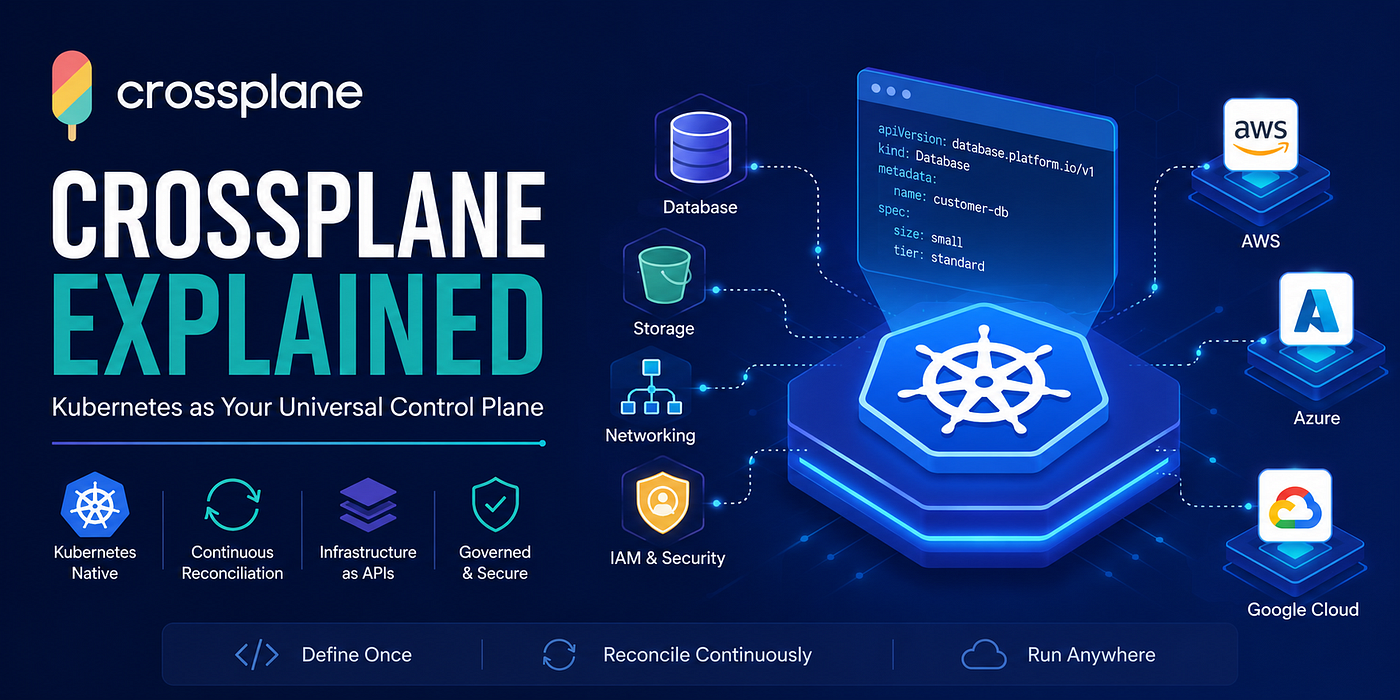
Modern cloud infrastructure has become increasingly complex.
Organizations deploy applications across AWS, Azure, Google Cloud, Kubernetes clusters, databases, networking services, storage platforms, SaaS products, and dozens of managed services. While Infrastructure as Code (IaC) tools like Terraform have simplified provisioning, many teams still struggle with:
- Infrastructure sprawl
- Inconsistent deployments
- Platform engineering challenges
- Self-service infrastructure requests
- Governance and compliance enforcement
What if Kubernetes could manage not only containers but also your entire cloud infrastructure?
That’s exactly what Crossplane enables.
Crossplane transforms Kubernetes into a universal control plane capable of provisioning and managing cloud resources across multiple providers using Kubernetes-native APIs.
In this article, we’ll explore how Crossplane works, its architecture, key concepts, and why many platform engineering teams are adopting it.
What is Crossplane?
Crossplane is an open-source Kubernetes add-on that allows teams to provision and manage cloud infrastructure using Kubernetes Custom Resources (CRDs).
Instead of writing Terraform configurations or manually provisioning resources, developers can create Kubernetes objects that represent infrastructure.
For example:
apiVersion: rds.aws.crossplane.io/v1beta1
kind: DBInstance
metadata:
  name: customer-db
spec:
  forProvider:
    region: us-east-1
    dbInstanceClass: db.t3.micro
When applied to Kubernetes:
kubectl apply -f database.yamlCrossplane automatically provisions:
- AWS RDS
- Azure SQL
- GCP Cloud SQL
- S3 Buckets
- VPCs
- IAM Roles
- Kubernetes Clusters
- Hundreds of other services
using the same Kubernetes API experience.
Why Crossplane Was Created
Traditional infrastructure management often looks like this:
Developer
    ↓
Terraform
    ↓
Cloud Provider APIs
Problems include:
State Management
Terraform requires:
- Remote state storage
- State locking
- State synchronization
Limited Self-Service
Developers often need platform teams to:
- Review code
- Run pipelines
- Approve deployments
Governance Challenges
Every team may create infrastructure differently.
Result:
- Resource sprawl
- Security gaps
- Naming inconsistencies
Operational Complexity
Separate systems manage:
- Applications
- Infrastructure
- Policies
Crossplane solves these issues by making Kubernetes the single control plane.
Crossplane Architecture
At a high level:
Kubernetes API
                       │
                       ▼
                Crossplane Core
                       │
      ┌────────────────┼───────────────┐
      │                │               │
      ▼                ▼               ▼
 AWS Provider   Azure Provider   GCP Provider
      │                │               │
      ▼                ▼               ▼
 AWS APIs       Azure APIs      GCP APIs
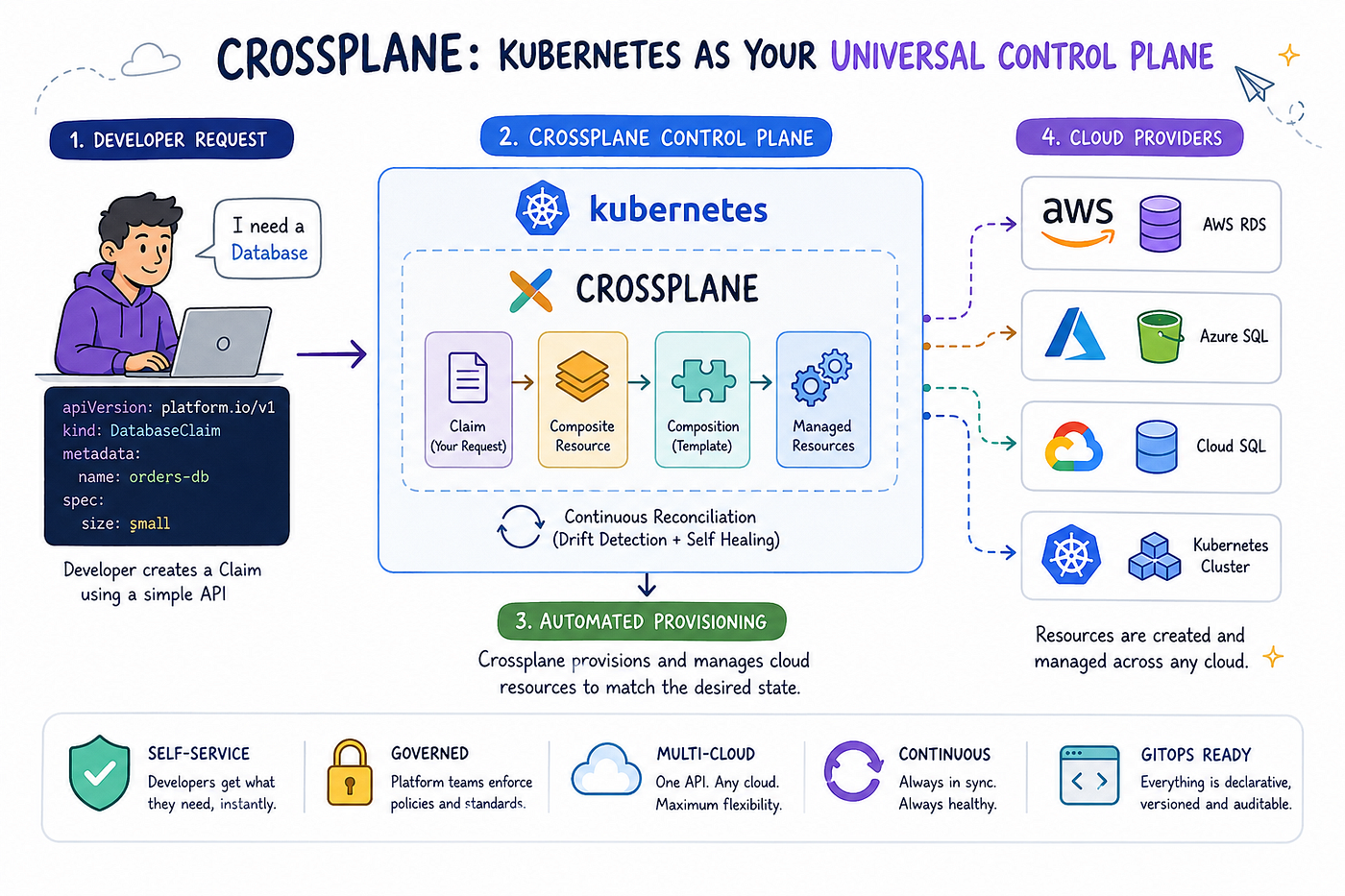
Crossplane extends Kubernetes using:
- Controllers
- Operators
- Custom Resources
- Reconciliation loops
Similar to how Kubernetes manages Pods.
Core Components
1. Crossplane Core
Crossplane Core provides:
- API extensions
- Reconciliation engine
- Package management
- Composition engine
It acts as the orchestration layer.
2. Providers
Providers connect Crossplane to external systems.
Examples:
AWS Provider
Manages:
- EC2
- RDS
- S3
- IAM
- EKS
Azure Provider
Manages:
- AKS
- Azure SQL
- Storage Accounts
- Virtual Networks
GCP Provider
Manages:
- Cloud SQL
- GKE
- BigQuery
- Storage Buckets
Installation example:
kubectl crossplane install provider \
crossplane/provider-aws:v0.54.2
3. Managed Resources
Managed Resources represent actual cloud resources.
Example:
apiVersion: s3.aws.crossplane.io/v1beta1
kind: Bucket
metadata:
  name: logs-bucket
spec:
  forProvider:
    locationConstraint: us-east-1
Crossplane continuously reconciles:
Desired State
S3 Bucket ExistsActual State
S3 Bucket MissingAction
Create BucketThis is Kubernetes-style infrastructure management.
The Reconciliation Loop
Crossplane follows Kubernetes’ reconciliation model.
Desired State
      │
      ▼
Crossplane Controller
      │
      ▼
Cloud Provider API
      │
      ▼
Actual State
If someone deletes a resource manually:
AWS Console → Delete RDSCrossplane detects drift and recreates it automatically.
This provides continuous infrastructure reconciliation.
Crossplane Compositions
Compositions are Crossplane’s most powerful feature.
Think of them as:
Terraform modules powered by Kubernetes APIs.
A Composition bundles multiple infrastructure resources into a reusable platform abstraction.
Without Composition
Developers create:
- VPC
- Security Group
- RDS
- S3 Bucket
- IAM Role
Multiple YAML files.
Lots of complexity.
With Composition
Developers create:
kind: ApplicationDatabaseThat’s it.
Platform engineers define the underlying resources.
Crossplane provisions everything automatically.
Example Composition
Developer Request:
apiVersion: platform.company.io/v1
kind: Database
metadata:
  name: customer-db
spec:
  size: small
Behind the scenes:
Database
   │
   ├── VPC
   ├── Security Group
   ├── RDS Instance
   ├── Backup Policy
   └── Monitoring
This enables true self-service infrastructure.
Composite Resources (XRs)
Crossplane introduces Composite Resources.
Example:
kind: XDatabaseInstead of exposing AWS-specific resources:
kind: DBInstancePlatform teams expose:
kind: DatabaseBenefits:
- Cloud abstraction
- Simplified developer experience
- Consistent deployments
- Multi-cloud portability
Claims
Claims are developer-facing infrastructure requests.
Example:
kind: DatabaseClaimA developer simply requests:
apiVersion: platform.io/v1
kind: DatabaseClaim
metadata:
  name: orders-db
Crossplane:
- Processes claim
- Creates composite resource
- Creates managed resources
- Provisions infrastructure
The developer never sees cloud complexity.
Crossplane vs Terraform
Terraform remains excellent for provisioning.
Crossplane excels at platform engineering and self-service infrastructure.
Crossplane and GitOps
Crossplane works exceptionally well with GitOps tools like:
- Argo CD
- Flux
Architecture:
Git Repository
       │
       ▼
 ArgoCD / Flux
       │
       ▼
 Kubernetes
       │
       ▼
 Crossplane
       │
       ▼
 Cloud Infrastructure
Infrastructure becomes fully declarative.
Everything is version-controlled.
Real-World Platform Engineering Example
A platform team wants developers to deploy databases safely.
Instead of allowing direct AWS access:
Developers create:
kind: DatabaseClaim
spec:
  tier: standard
Crossplane automatically provisions:
✓ VPC
✓ Security Groups
✓ Encryption
✓ Backups
✓ Monitoring
✓ Database
Policies are enforced automatically.
No cloud expertise required.
Multi-Cloud Infrastructure
Crossplane supports:
AWS
Azure
Google Cloud
Kubernetes
Cloudflare
GitHub
Datadog
MongoDB Atlas
Snowflake
Many others
Organizations can build cloud-agnostic APIs.
Example:
kind: DatabaseThe platform decides whether that database lives on:
- AWS RDS
- Azure SQL
- Cloud SQL
without changing developer workflows.
Security Benefits
Crossplane improves security through:
Centralized Governance
Platform teams control:
- Resource types
- Configurations
- Networking
- Security policies
Least Privilege
Developers no longer require cloud administrator access.
Standardization
Every environment follows approved patterns.
Auditability
Everything exists as Kubernetes resources and Git history.
Common Challenges
Crossplane is powerful but introduces complexity.
Learning Curve
Teams must understand:
- Kubernetes Operators
- CRDs
- Controllers
- Compositions
Debugging
Issues can span:
Developer Claim
      ↓
Composition
      ↓
Managed Resource
      ↓
Cloud API
Troubleshooting requires understanding the entire chain.
Kubernetes Dependency
Crossplane requires Kubernetes expertise.
Organizations without Kubernetes maturity may struggle initially.
When Should You Use Crossplane?
Crossplane is ideal if you:
✅ Run Kubernetes extensively ✅ Adopt GitOps workflows ✅ Build internal developer platforms ✅ Need self-service infrastructure ✅ Operate multi-cloud environments ✅ Want infrastructure reconciliation
Crossplane may not be the best fit if:
❌ You only provision infrastructure occasionally ❌ Your team lacks Kubernetes expertise ❌ Terraform already meets all requirements
The Future of Platform Engineering
The industry is shifting from:
Infrastructure as Codetoward:
Infrastructure as APIsPlatform teams increasingly provide:
Database API
Kafka API
Storage API
Networking API
instead of raw cloud resources.
Crossplane sits at the center of this movement by turning Kubernetes into a universal control plane.

Conclusion
Crossplane extends Kubernetes beyond containers and transforms it into a powerful infrastructure management platform.
By leveraging Kubernetes APIs, reconciliation loops, compositions, and managed resources, organizations can create self-service cloud platforms that are secure, scalable, and developer-friendly.
Rather than managing infrastructure through dozens of provider-specific tools, teams can define standardized platform APIs and let Crossplane handle the complexity behind the scenes.
As platform engineering continues to evolve, Crossplane is rapidly becoming one of the most important technologies for organizations seeking to unify application and infrastructure management under a single control plane.
In short:
Terraform provisions infrastructure.
Crossplane builds platforms.
And that distinction is reshaping modern cloud operations.
crossplane #kubernetes #platformengineering #devops #cloudcomputing
메타데이터
- post_id
- d26d5a8a35e2
- slug
- crossplane-explained-kubernetes-as-your-universal-control-plane-d26d5a8a35e2
- url
- https://medium.com/aegisops/crossplane-explained-kubernetes-as-your-universal-control-plane-d26d5a8a35e2
- canonical_url
- https://medium.com/aegisops/crossplane-explained-kubernetes-as-your-universal-control-plane-d26d5a8a35e2
- author_url
- https://medium.com/@cloudsignal
- status
- ok
- fetched_at
- 2026-06-15 20:49:13