What People Get Wrong About NVLD
Many people are not aware of what Nonverbal Learning Disorder/NVLD is unless they live with the disorder or know someone who does. This is…
What People Get Wrong About NVLD

Many people are not aware of what Nonverbal Learning Disorder/NVLD is unless they live with the disorder or know someone who does. This is because NVLD is not currently in the so it doesn’t get the same attention as some other common neurodivergent conditions like autism, ADHD, or Dyslexia.
However, even among those who are aware of NVLD, many misconceptions persist. It is essential to debunk these to provide a clearer, more accurate picture of NVLD to ensure that those living with it receive the understanding and support they need.
Below, we will go over the most common myths and misconceptions and explain the truth about them.
Myth: People With NVLD Aren’t Intelligent
NVLD is characterized by a significant gap between someone’s verbal abilities and nonverbal/visual-spatial abilities. Most people with NVLD have average to above-average verbal intelligence, meaning they can communicate and understand complex information (when presented verbally) just as well as everyone else.
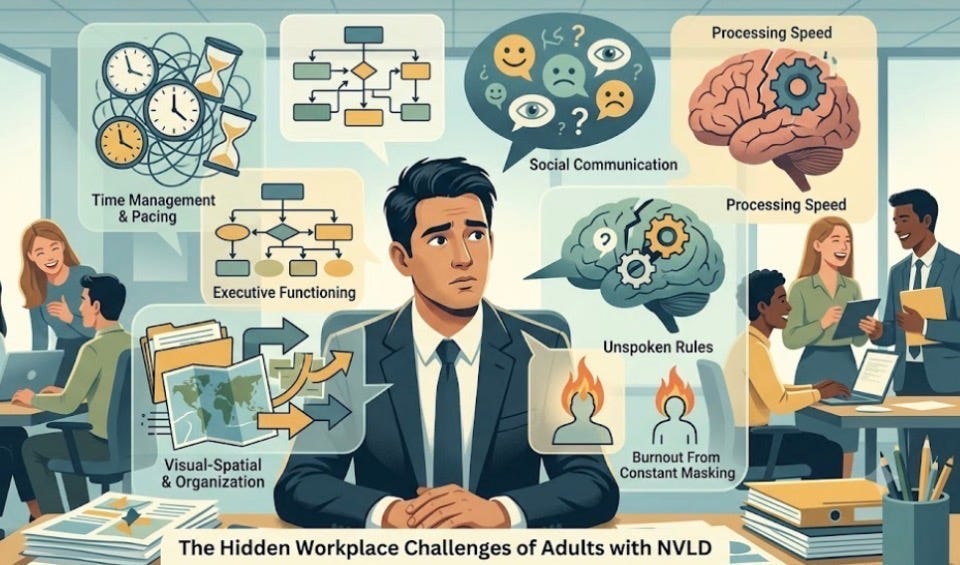
However, they struggle significantly with tasks involving visual-spatial processing, such as understanding maps, charts, and diagrams; math; driving; navigating unfamiliar places; executive functioning; and reading nonverbal social cues.
Myth: NVLD Is The Same As Autism
Although there are many overlapping traits, NVLD and autism are considered distinct conditions. People with NVLD primarily struggle socially because they have difficulty interpreting nonverbal cues, such as facial expressions, body language, and tone of voice. Individuals with autism usually struggle with both nonverbal communication and the intuitive understanding of social interaction itself.
In addition, the biggest challenge for those with NVLD is visual-spatial processing, while many autistic people excel in visual-spatial skills. It is worth noting, however, that it is possible and not uncommon to have both conditions.
Myth: People With NVLD Are Lazy Or Unmotivated
Unfortunately, this is a common misconception regarding learning disabilities/neurodivergence in general. The reality is that most people with NVLD have to work harder than others to complete everyday tasks. Difficulties with organization, planning, and time management are related to executive functioning, not motivation or laziness.
Myth: If Someone Speaks Well, They Can’t Have A Learning Disability
Strong vocabulary and verbal skills are a hallmark of NVLD, and these strengths can often mask the significant challenges a person experiences in other areas.
Myth: NVLD Only Affects Children
NVLD, like all other forms of neurodivergence, is lifelong. While many people develop coping strategies as they get older, many continue to experience challenges throughout their lives. In fact, many adults with NVLD struggle in higher education, employment, relationships, and independent living.
Driving is also a common challenge because it directly involves visual-spatial processing. Many adults with NVLD take longer than others to learn how to drive or forgo it completely due to anxiety or concerns over safety.
Myth: People With NVLD Just Need To Try Harder
Trying harder doesn’t change how the brain is wired. Appropriate strategies, accommodations, and structured supports are far more effective than simply increasing effort.
Myth: Everyone With NVLD Is The Same
NVLD exists on a spectrum of strengths and challenges and varies greatly in severity. Two people with NVLD can have very different abilities, support needs, and life experiences.
Myth: People With NVLD Can’t Be Successful
Although success for someone with NVLD can look a little different from that for a neurotypical person, many adults with NVLD can build successful careers and live fulfilling lives by understanding their strengths, developing effective strategies, and finding the right environments where they can work, learn, and thrive.
There are many myths and misconceptions surrounding NVLD, but these are the most common ones. Hopefully, you learned something new, and if you have NVLD, you were reminded that you’re not alone and there are people who get it.
Originally published at https://uniquelywired.substack.com.
메타데이터
- post_id
- d27f846199fa
- slug
- what-people-get-wrong-about-nvld-d27f846199fa
- url
- https://medium.com/neurodivergent-life/what-people-get-wrong-about-nvld-d27f846199fa
- canonical_url
- https://medium.com/neurodivergent-life/what-people-get-wrong-about-nvld-d27f846199fa
- author_url
- https://medium.com/@stphanieslozberg
- status
- ok
- fetched_at
- 2026-07-09 05:26:43