Ion Dose for Static and dynamic SIMS
Chengge Jiao, Thursday, February 20, 2025
Ion Dose for Static and dynamic SIMS
Chengge Jiao, Thursday, February 20, 2025
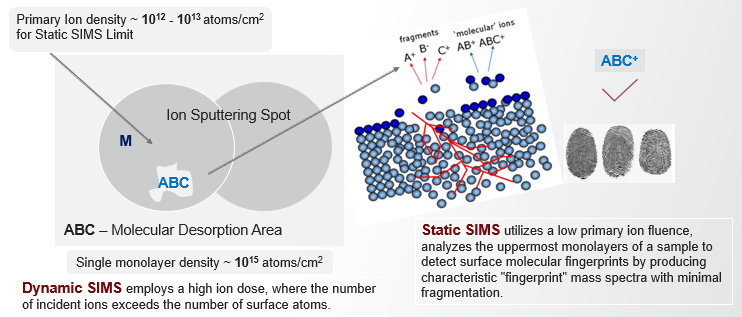
Figure 1. Schematic of Static SIMS principle
Secondary Ion Mass Spectrometry (SIMS) is a surface analysis technique that provides information about the elemental and molecular composition of materials. It works by bombarding a sample surface with primary ions and analyzing the secondary ions ejected from the surface. These secondary ions are then separated by mass using a mass, allowing for the identification and quantification of the surface constituents. SIMS can be operated in two distinct modes: dynamic SIMS and static SIMS, each offering unique advantages and addressing different analytical needs. The key distinction between these two modes lies in the magnitude of the primary ion dose, which directly influences the extent of surface erosion, chemical damage, and the type of information obtained.
Static SIMS:
Static SIMS (S-SIMS) is primarily used for molecular characterization of organic matter, where preserving molecular information is crucial for structural identification. This is achieved by utilizing a significantly lower primary ion dose. The defining principle of static SIMS is that the number of incident ions is about an order of magnitude (or more) less than the number of surface atoms. Specifically, if the primary ion fluence is kept low
(< 10^12 to 10^13 ions/cm^2), less than 1% of the surface atoms are bombarded (compared to a silicon surface atom density of ~10^15/cm^2 ) limiting chemical damage and preserving molecular fragments containing valuable chemical bond information. In this static regime, each incident ion has a high probability of interacting with an unperturbed region of the sample, further ensuring the preservation of surface integrity. This makes static SIMS ideal for analyzing molecular species.
The resulting mass spectra often exhibit characteristic “fingerprints” used to identify specific molecules and differentiate materials. However, this low ion dose also leads to low count rates. Consequently, images acquired in static SIMS typically have only a few counts per pixel, limiting spatial resolution and making trace species detection challenging. Furthermore, due to minimal sputtering, the information obtained is limited to the outermost surface layers (typically a few monolayers). Clustered ion sources are required to minimize molecular fragmentation, a process where molecular ions break down into smaller ions, radicals, and/or neutral molecules.
While Ga+ ions are not the most efficient projectiles for desorbing molecular ions compared to heavier ions, they are often used for high spatial resolution imaging. This is because achieving small spot sizes, necessary for high resolution, requires high kinetic energies for Ga+ ions. However, this high energy causes deeper penetration into the sample, reducing desorption efficiency as many incident Ga+ ions do not contribute to the process. Reactive ion beams are unsuitable for static SIMS imaging because they can alter the surface’s molecular composition through chemical reactions, defeating the purpose of preserving and analyzing the original molecular structure. Additionally, the low primary ion dose in static SIMS renders reactive bombardment ineffective.
Static SIMS measurements are particularly sensitive to sample preparation, as overlayer contaminants can significantly affect results. This sensitivity often leads to inconsistencies between laboratories, even with identical instrumentation, due to variations in sample preparation protocols. Finally, the TOF analyzer is best suited for static SIMS imaging due to its parallel mass detection configuration and high transmission. Its pulsed nature, however, makes it less suitable for dynamic SIMS experiments, as the pulsed primary ion beam results in a low effective dose.
Dynamic SIMS:
Dynamic SIMS employs a high primary ion dose, where the number of incident ions significantly exceeds the number of surface atoms. This high ion flux leads to substantial sputtering, a process where surface atoms are ejected due to the momentum transfer from the incident ions. In a typical dynamic SIMS experiment, a focused ion beam to a current density of 1nA/um2 delivers a large number of primary ions to the sample surface.
Assuming a desorption yield of around 10 surface atoms per incident ion, the erosion rate can reach several microns per minute. This continuous erosion allows for depth profiling, where the composition of the sample is analyzed as a function of depth. By acquiring images over time, dynamic SIMS provides a three-dimensional map of the elemental distribution within the sample. Due to the high ion dose, dynamic SIMS generally yields high count rates, enabling the detection of trace elements and providing excellent sensitivity. However, the aggressive sputtering process inherent in dynamic SIMS leads to significant chemical damage, making it unsuitable for the analysis of fragile molecules. Therefore, dynamic SIMS is primarily used for elemental depth profiling, and applications requiring high sensitivity.
In order to enhance the ionization yield, dynamic SIMS uses reactive primary ions (mostly oxygen or caesium) at an energy range between 4–16 kV. Molecules on the surface are split, it is little or no molecular information is preserved in dynamic SIMS or FIB SIMS, but only elemental ions, isotopic information and small clusters can be observed. A high data rate is mandatory to achieve sensitivity, achieved with continuous sputtering, the mass analysis typically performed with a magnetic sector or a quadrupole mass spectrometer for dynamic SIMS.
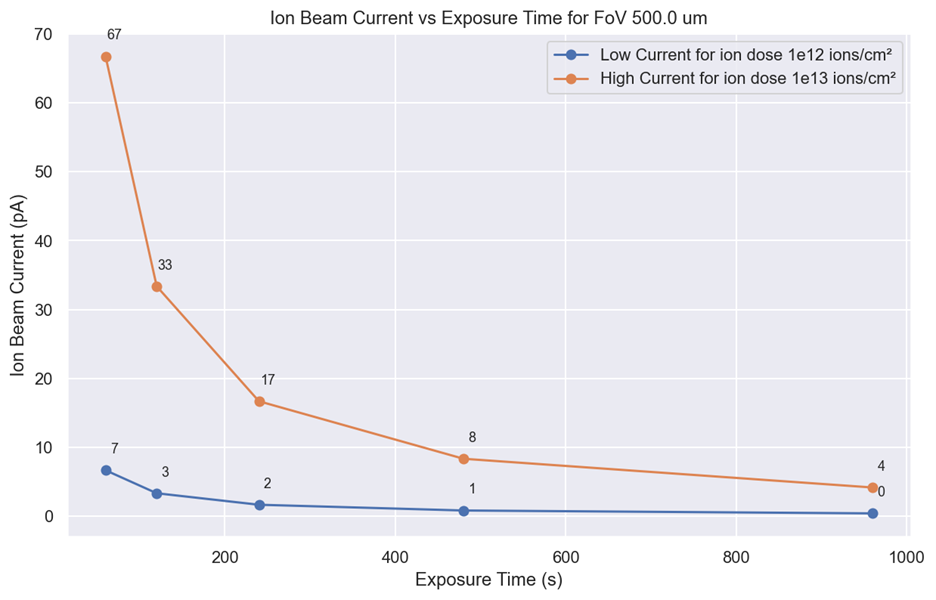
Figure 2. Ion beam current and exposure time optimization for static SIMS, maintaining a constant raster width.
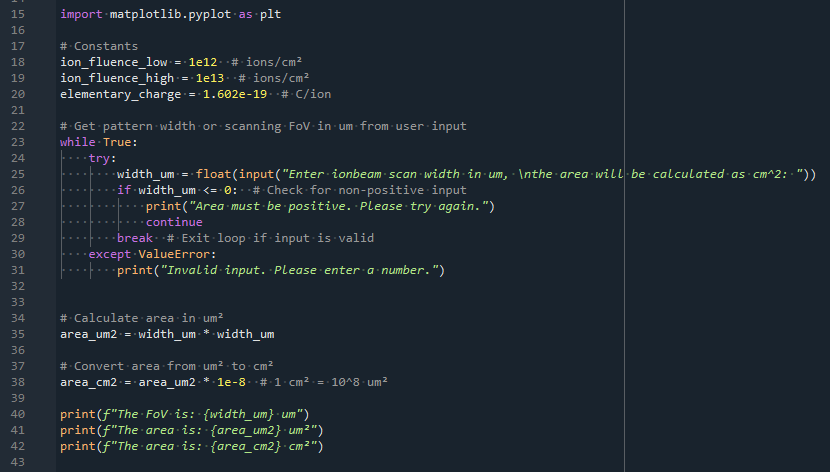
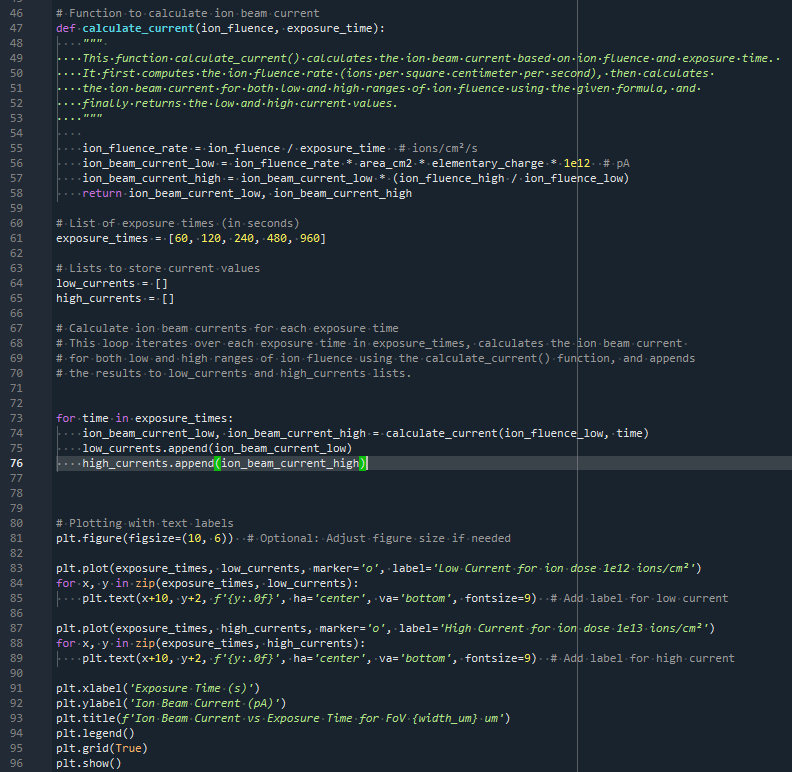
Python code generated the low and high ion beam currents:
메타데이터
- post_id
- d27fbbd2830c
- slug
- ion-dose-for-static-and-dynamic-sims-d27fbbd2830c
- url
- https://medium.com/@cgjiao/ion-dose-for-static-and-dynamic-sims-d27fbbd2830c
- canonical_url
- https://medium.com/@cgjiao/ion-dose-for-static-and-dynamic-sims-d27fbbd2830c
- author_url
- https://medium.com/@cgjiao
- status
- ok
- fetched_at
- 2026-06-26 21:52:29