Lake Orta, Piedmontese Jewel
Ahead of me is a deep, luscious ochre colored seventeenth-century palazzo in the medieval square of Orta da Giulio, to my right lies a…
Lake Orta, Piedmontese Jewel
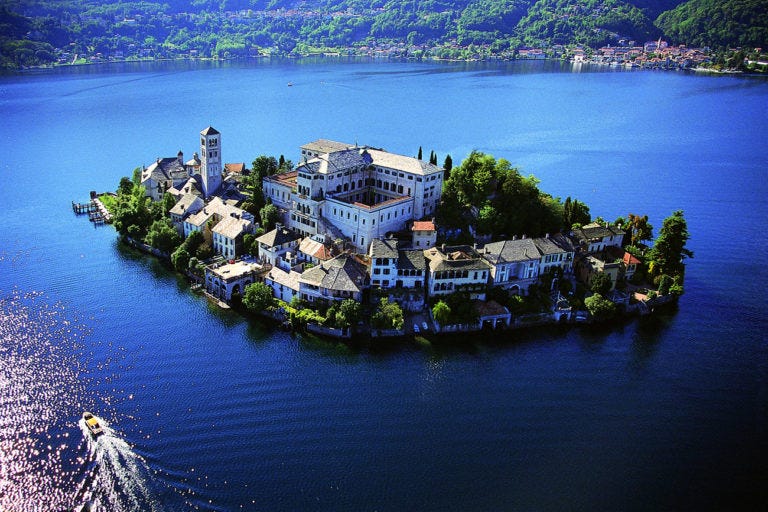
Ahead of me is a deep, luscious ochre colored seventeenth-century palazzo in the medieval square of Orta da Giulio, to my right lies a picturesque tiny island crowned with a twelfth century Basilica, the site of handsome serpents and monsters according to legend. But don’t worry if you come here, the serpents were banished by Orta’s St. Julius in 390 who founded the precursor of the Basilica. In the Basilica are carvings of griffons and serpents on the black marble pulpit, attesting to the enchanted aura of the lakes. There is also a decapitated skeleton from the 1600’s in the church.
In Orta San Giulio’s charming main square, Piazza Mario Motta (named after a partisan), tranquility and beauty abound: there is the sound of the gently lapping water, there is the light everywhere, as though 1000 sparkling ballerinas of shining light flicker through the waves in the bay as we sit at a table in the piazza.
About 500 meters in front of the piazza is the shimmering Basilica di San Giulio, with colorful frescos. Even the via or street that surrounds the tiny island portends the peacefulness here. It is call Via Del Silenzio. It makes for a peaceful walk around the island. There is also Via della Meditazione.
Ferries depart hourly for the island.
“It is the light on Lago Orta that is furtive, special, melancholy,” muses the Swiss woman who sits next to me at Cafe Venus, only a few feet from the lapping sea, where we sip capuchinos, frothy and warm — the best I have had on this trip. I like to take my time with capucchinos in Italy, first find a beautiful setting; by a lake is the “ottimo” or ultimate, then slowly sip the deeply flavorful dark roasted brew.
“I come here for the spring from Switzerland. When I want company, I come to this piazza,” she says.
“My house is across the lake, in a very tiny village, it is so quiet there, but it is just what I want. I like the melancholiness of the lake; at times, the dark clouds hang over it…”
This day was full of sunlight, the shore was alive with boats going to Isola Giulio, there were small craft stores with their wares in the piazza — hand embroidered white cotton tea towels enscribed with Isola Bella, fragrant wisteria along the water’s edge, and narrow cobblestone streets leading to old cantínas, beckoned me to “here and now, here and now.”
If you want to visit the Lake District of Northern Italy, without anyone else, try Lake Orta, a tiny Piedmontese jewel, only 14 kilometers long, nestled next to Lake Maggiore.
My cousin Gisella who lives in an ancient Northern Piedmontese hamlet about an hour away, confided a few days ago, “This is my favorite lake, there are tiny churches full of art, an island where you take a boat to a medieval nunnery and steep village paths ending at the water’s edge.”
I had never heard of Lago Orta, perhaps the other 321 million Americans hadn’t heard of it either. In fact, not an American in sight that day in early spring, only one Swiss tourist.
We had parked by what she told me were a series of tiny churches, built on a wooded mountainside, overlooking the lake. This is called the Sacro Monte of Orta… Declared a UNESCO site, it was dedicated to St. Francis of Assisi. It was built during the Renaissance. 20 chapels line the walkway. We wandered the walkway surrounded by pine and beech forests. There is contemplative spell that descends here, above the shining waters, as we followed the path to the 376 terracotta statues illustrating the life of St. Francis. I thought about the quote by Nietsche when he gazed at the Sacro Monte or Orta. I wondered if it was the fragrant pine forest or the light dancing on the brilliant lake below us or the peacefulness surrounding the chapels built in memory of the kind St. Francis that inspired Nietsche to say, “This is one of the most charming places in the world.”
The Sacro Monte is easily accessible from the main road surrounding the lake. It is only a 15 minute walk through the protected forest, down to the central piazza, Piazza Marco Motta. At the lake’s edge are restaurants and a seventeenth century church.
The Piedmontese Lake is surrounded by the Osola valley known for its cheeses.
Local Cheeses
How to pick an Italian cheese — first find out the regional cheese that is actually an umbrella for many fine varieties. If you go with a regional name you won’t be disappointed. In Piedmont, my cousins always serve me Gorgonzola, a flavorful blue-veined, rich blue cheese. Creamy and smooth, the toma has a sweet pleasant taste and a delicate fragrance; freshly made from Valle d’Aosta or Piedmonte, cheese rounds 4″ across.
The grand mountains surrounding the lake were rich and verdant, abounding with forms
Gian Luigi, my Piedmontese cousin, serves tomas with the antipasto, or with a green salad after the main course. They vary from the aged, deep full body to the fresh variety, you can even fry them. Last time he served a toma as an antipasto with a mareschino cherry, the food fad in Italy this year.
So I choose my familiar toma, this time from a village called Valsesia, close to Lake Orta. It’s ancient square was bombed in World War II.
At the Piedmontese village farmer’s market I head straight for tomas, if I am very lucky they are surrounded by grape skins or hay as part of the aging process. Both hay and grape skins render a delicate formidable cheese.
But these “rinds of nature” are getting harder to find. So I opened the cheese, the toma Valsesla, at the roadside. I used my pointer finger to grab the first bite, it was delicate, yet deeply flavorful, creamy, I had never tasted anything like it. I ate three more bites — WOW.
On a train trip a few days later, a silver-haired conductor checked my ticket and we talked about his job. When I learned that he had risen at 4:30 a.m. that morning in him home in Valsesia to arrive in Milano for the morning shift, I had to talk to him about the toma. “Oh, the wonderful cheese the toma Valesia,” I sighed. I knew that I surely wouldn’t find this unpasteurized cheese in Berkeley.
His face lit up and he talked of the mountains, the will-fed cows, the delicious cheeses. He was alive, full of the joy that eating brings to Italians. Then he started to talk about the bombing of his historical village during World War II, he was fiercely proud, his eyes full of light.
Italians are overjoyed when you 1) venture forth a few words in their language 2) mention a food you enjoy 3) mention a food you like from their region.
My cousin Elizabetta, who comes from Val D’Aosta, nestled in the Italian Alps, explained to me that each Italian cheese requires the particular vegetation and the temperature the region possesses.
“Oh yes, I understand,” I thought. I was born in San Francisco, my father had always told me that San Francico sourdough could only be created under the specific atmospheric conditions provided by the fog and the temperature of the city, just like the cheeses.
Now Elizabetta claims that she read how some researchers once tried to make parmesean cheese in the mountains of Val D’Aosta, but the diet of the grasses on the hillside would not produce the parmesean that comes out of Parma with those particular conditions. “Plus,” she says. “The cows walked up and down the mountainside, that exercise produced a different cheese from the cows grazing in Emilia-Romagna. That helps account for why Italians want products from their own region where a specific set of conditions prevail to ensure the best quality food. So maybe next time I shop for monterey jack I will ask for the variety made in Monterrey. (It is actually much more flavorful and has a distinctive taste.
The toma cheese appetizer I recalled was so delicate: the smooth creamy cheese, a subtle contrast with the Dijon mustard and maraschino cherry garmish it wore. My cousin Elizabetta announced, in her jovial enthusiastic manner, “this cheese and cherry is the vogue in Italy this year.”
FIND US
ABOUT THIS SITE
I keep returning to Italy for the people via the experience of food. Italians are jubilant when they eat, every meal is a celebration. Why is it so much fun to eat there? Let’s find out and bring that home — import this sacred ritual with it’s health benefits, extraordinary tastes and lingering memories.
Do you have a lingering memory of the last fast-food hamburger you ate? How about the last heart-shaped wood fired margarita pizza? I searched Napoli, the home of the first pizza, for the best pizza in the world.
메타데이터
- post_id
- d2b9e83de4fb
- slug
- lake-orta-piedmontese-jewel-d2b9e83de4fb
- url
- https://medium.com/@crystalpub/lake-orta-piedmontese-jewel-d2b9e83de4fb
- canonical_url
- https://medium.com/@crystalpub/lake-orta-piedmontese-jewel-d2b9e83de4fb
- author_url
- https://medium.com/@crystalpub
- status
- ok
- fetched_at
- 2026-07-29 12:50:16