Mutation of rpoB gene in Tuberculosis
Overview
Mutation of rpoB gene in Tuberculosis
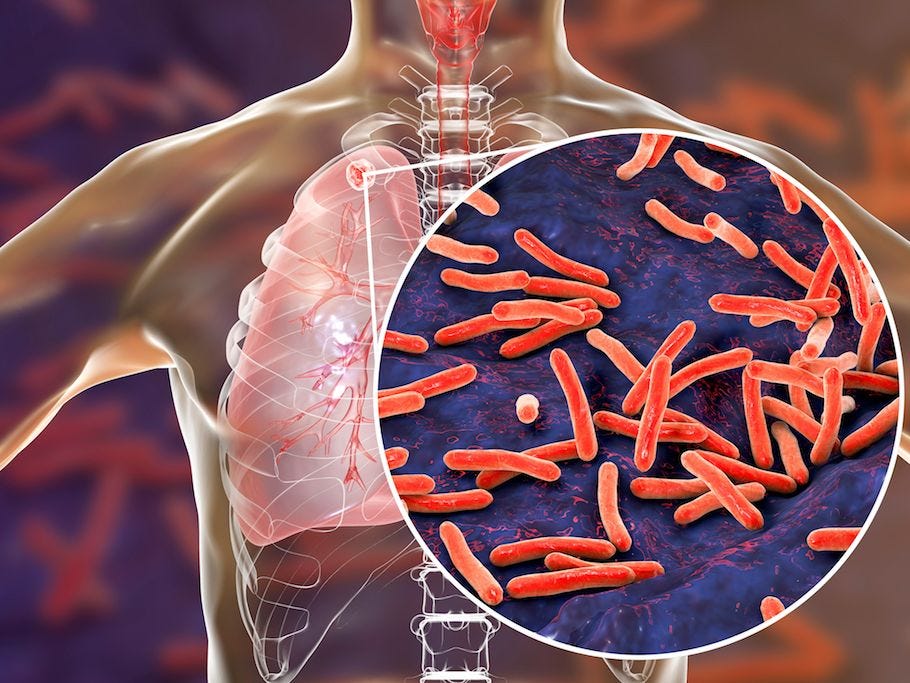
Mycobacterium tuberculosis — an infectious disease that attacks primarily the lungs
Overview
Tuberculosis is an infectious disease caused by a bacterium called Mycobacterium tuberculosis, which spreads through airborne particles when an infected person coughs, sneezes, or speaks. First comes the primary infection, when the bacterium first enters a host’s body. The immune system detects it and attempts to neutralize the infection. If it isn’t able to neutralize then the immune system changes its approach, and tries to contain the infection, which is called latent infection. It starts to build a wall around the lung tissue to trap the leftover tuberculosis within. However, the drawbacks from this is that without visible symptoms and the ability to detect with x-rays, this inactive TB could potentially break out … .and spread rapidly. Once the tuberculosis becomes active, the immune system cannot control the infection. As it continues to multiply it travels to other areas of the body such as to the kidneys, liver, brain and spinal fluids, heart muscles bones etc… by blood vessels. The symptoms include coughing with blood, chest pain, fever, chills, weight loss, and fatigue.
In 2020, the number of people with multi-drug resistant TB was 410,000 globally — with the number of deaths being 160,000 in just a year alone.

Estimated number of cases of MDR/RR-TB in 2022
There isn’t a single reason for a mutations to occur, it can naturally occur in diseases and viruses like other living organisms to adapt to their changing surrounds to survive. Especially in the past 30 years with the introduction of a variety of antituberculosis drugs, tuberculosis selectively change so that it could survive to reproduce. Human factors has also contributed to the mutations including poverty, which results in overcrowding living conditions, malnutrition, and limited access to healthcare infrastructure. High-burden countries are disproportionately affected by TB; India (26%), Indonesia (10%), China (6.8%), the Philippines (6.8%) and Pakistan (6.3%) making up 56% of global TB cases. In 2023 alone 1.25 million people died from TB. with an estimated 10.8 million contracting it — 6 million men, 3.6 million women and 1.3 million children. With these obstacles in the way, it can be challenging for infected people to sustain longer term treatment plans as they can last a minimum of 6 months, leading to drug misuse or insufficient use which allows for the disease to build immunity and spread.
This is supported by a study conducted by the Iran University of Medical Science, who assessed the number of TB and HIV related cases based on the human development index (HDI) globally. They took the HDI of 168 countries from 2000, 2005, 2010 and 2015 and found that 95% of TB deaths are from developing countries
- 2016: 45% of TB cases in Asia, and in Africa with 25% of another of cases

This graph shows the correlation between TB cases and GDP per capita from India, China, and the UK.
Rifampin — First Line Drug
Rifampin is a part of the antimicrobial class of drugs that is used to treat a variety of mycobacterial infections, not limited to Mycobacterium tuberculosis. How rifampin works is by inhibiting the production of RNA polymerase that are essential to the transcription of DNA to RNA through binding with the TB’s beta-subunits. When bonded with the subunits the Rifampin obstructs the path of the elongating RNA at its 5’ end or by reducing the RNA polymerase’s affinity for short RNA transcripts.
Rifampin is administered orally or via IV injection, recommended for the critically ill patients to receive it intravenously as oral formula is less effective in this scenario. In addition, to allow for the drug to be as effective as possible at combatting the infection, it is also recommended to take rifampin 1–2 hours after meals so that the food doesn’t hinder the absorption of rifampin.
rpoB Gene — How it becomes resistant to Rifampin
Drug resistance is caused when genes in the Tuberculosis code mutate, making the current treatment drugs ineffective at binding with the disease’s receptors, inhibiting replication. The highest mutation rate (93%) is the rpoB gene that codes for the beta subunit of RNA polymerase, an enzyme for bacterial transcription. When isolating strains from multi-resistant TB rpoB genes, high levels of resistance are seen in the S450L and H455Y strains, where a serine (S) is replaced by a leucine (L) at the 450th amino acid position and a histidine (H) replaced by a tyrosine (Y) at the 455th amino acid position. Strains with the highest high-level resistance in the rpoB gene are the S450L, meaning serine (S) is replaced by a leucine (L) at the 450th amino acid position. With the change to the strains code reduces the ability of the Rifampin to bond, leading to the resistance and the immune system’s ability to activate.
New Diganosis — GeneXpert
As treating tuberculosis is a time sensitive matter, it is important for doctors to be able to identify the infection, especially if it is a drug-resistant strand of TB.

GeneXpert family system
A solution for this is to use GeneXpert, a machine created by Cepheid that tests clinical samples to identify infectious diseases such as TB. GeneXpert is a closed-system PCR machine that performs molecular testing through the amplification of specific genetic sequences, this innovation enables doctors to do same-day diagnosis and treatment, 2 hours, instead of waiting weeks or months for lab results from smear microscopy or culture tests, thereby reducing the disease transmission.
However, this is a perfect world scenario as previously mentioned there are many places with high TB prevalence that don’t have the infrastructure or resources to afford this type of testing. With the machines ongoing high cost and use of many resources used in TB diagnosis, especially for detecting mutations, something that is ever evolving, this form of diagnosis is imperfect, varying not only due to mutation geography, but the risk of false-susceptible risk and exact translation of information provided still exists.
TL;DR
Tuberculosis is still the number one deadliest infectious disease. Its mutation of the rpoB gene has only amplified its deadliness, causing Rifampin, a first-line defence drug, to be less effective at combating the spread of the infection. However, with the help of technology, GeneXpert has been created as a way to make diagnosis faster, identifying mutations quicker than previous diagnosis methods. The only issue is that there are countries that are facing financial setbacks that hinder their access to this technology. In order to make a significant change there needs to be more done to help improve a country’s economic standing, development of infrastructure, and address other health and social problems.
— — — — — — — — — —
About Me
Hi! I’m Alexis Wong, a 16 year old interested in how diseases interact with the immune system and how we utilize technology to overcome challenges such as gene mutation. If you enjoyed this article, check out my profile to connect for updates on my research.
- LinkedIn: https://www.linkedin.com/in/alexis-wong-a5b601361/
- Email: alexiswcwong@gmail.com
— — — — — — — — — —
References
Beloor Suresh, A., Rosani, A., Patel, P., & Wadhwa, R. (2023, November 12). Rifampin — StatPearls — NCBI Bookshelf. NCBI. Retrieved October 25, 2025, from https://www.ncbi.nlm.nih.gov/books/NBK557488/
Khader, S. A., Divangahi, M., Mathema, B., Larsen, M. H., Thirunavukkarasu, S., Tang, L., Ahmed, M., Das, S., Howard, N. C., & Bobba, S. (2023, September 8). Mycobacterium tuberculosis carrying the rifampicin drug-resistance-conferring rpoB mutation H445Y is associated with suppressed immunity through type I interferons. Mycobacterium tuberculosis carrying the rifampicin drug-resistance-conferring rpoB mutation H445Y is associated with suppressed immunity through type I interferons. Retrieved October 25, 2025, from https://pmc.ncbi.nlm.nih.gov/articles/PMC10653897/
Kumar, S., & Jena, L. (2014, December 31). Understanding Rifampicin Resistance in Tuberculosis through a Computational Approach. PubMed Central. Retrieved October 25, 2025, from https://pmc.ncbi.nlm.nih.gov/articles/PMC4330266/
Li, M.-C., Lu, J., Lu, Y., Xiao, T., Liu, H., Lin, S., Xu, D., Li, G., Zhao, X., Liu, Z., Zhao, L., & Wan, K. (2021, October 5). rpoB Mutations and Effects on Rifampin Resistance in Mycobacterium tuberculosis. rpoB Mutations and Effects on Rifampin Resistance in Mycobacterium tuberculosis. Retrieved October 25, 2025, from https://pmc.ncbi.nlm.nih.gov/articles/PMC8502021/
Mayo Clinic. (2023, March 22). Tuberculosis-Tuberculosis — Diagnosis & treatment. Mayo Clinic. Retrieved October 25, 2025, from https://www.mayoclinic.org/diseases-conditions/tuberculosis/diagnosis-treatment/drc-20351256
McGrath, M., Gey van Pittius, N. C., van Helden, P. D., Warren, R. M., & Warner, D. F. (2013, September 26). Mutation rate and the emergence of drug resistance in Mycobacterium tuberculosis. Oxford Academic. https://academic.oup.com/jac/article-abstract/69/2/292/712832?redirectedFrom=fulltext#google_vignette
National Academies Press. (2014, February 28). Rapid Diagnostic Technologies: Status and Limitations — The Global Crisis of Drug-Resistant Tuberculosis and Leadership of China and the BRICS — NCBI Bookshelf. NCBI. Retrieved October 25, 2025, from https://www.ncbi.nlm.nih.gov/books/NBK195973/
Pan American Health Organization. (2024, November 1). Tuberculosis resurges as top infectious disease killer. Pan American Health Organization. https://www.paho.org/en/news/1-11-2024-tuberculosis-resurges-top-infectious-disease-killer
Patterson, T. (2023, September 14). Why GeneXpert Matters to PIH and Global Health. Partners In Health. Retrieved October 25, 2025, from https://www.pih.org/article/why-genexpert-matters-pih-and-global-health
Prozorov, A. A., Zaichikova, M. V., & Danilenko, V. N. (2012, January). [Mycobacterium tuberculosis mutants with multidrug resistance: history of origin, genetic and molecular mechanisms of resistance, and emerging challenges]. PudMed. https://pubmed.ncbi.nlm.nih.gov/22567849/
Rigouts, L., Keysers, J., Rabab, R., Fissette, K., van Deun, A., & de Jong, B. C. (2023, July 14). GeneXpert MTB/RIF Ultra performance to detect uncommon rpoB mutations in Mycobacterium tuberculosis. PubMed. Retrieved October 25, 2025, from https://pubmed.ncbi.nlm.nih.gov/37452349/
Samy, A. M. (2021, January 20). Drug resistance gene mutations and treatment outcomes in MDR-TB: A prospective study in Eastern China. Drug resistance gene mutations and treatment outcomes in MDR-TB: A prospective study in Eastern China. Retrieved October 25, 2025, from https://pmc.ncbi.nlm.nih.gov/articles/PMC7850501/
Van Deun, A., Decroo, T., Aung, K. J. M., Anwar Hossain, M., Gumusboga, M., Bram De Rijk, W., Tahseen, S., & de Jong, B. C. (2021, September 1). Mycobacterium tuberculosis borderline rpoB mutations: emerging from the unknown. ERA Publications. https://publications.ersnet.org/content/erj/58/3/2100783
World Health Organization. (2025, March 14). Tuberculosis (TB). World Health Organization (WHO). Retrieved October 25, 2025, from https://www.who.int/news-room/fact-sheets/detail/tuberculosis
메타데이터
- post_id
- d2bc17cd1624
- slug
- mutation-of-rpob-gene-in-tuberculosis-d2bc17cd1624
- url
- https://medium.com/@alexiswcwong/mutation-of-rpob-gene-in-tuberculosis-d2bc17cd1624
- canonical_url
- https://medium.com/@alexiswcwong/mutation-of-rpob-gene-in-tuberculosis-d2bc17cd1624
- author_url
- https://medium.com/@alexiswcwong
- status
- ok
- fetched_at
- 2026-06-21 19:25:17