The People of Ad in the QuranThe People of Ad in the QuranWho Were The Lost People of ‘Ad In The…
Over 2,000 years before the common era, after the catastrophic flood of Prophet Nuh (Noah, peace be upon him), a new civilization emerged…
The People of Ad in the QuranThe People of Ad in the QuranWho Were The Lost People of ‘Ad In The Quran: Full Story 2025
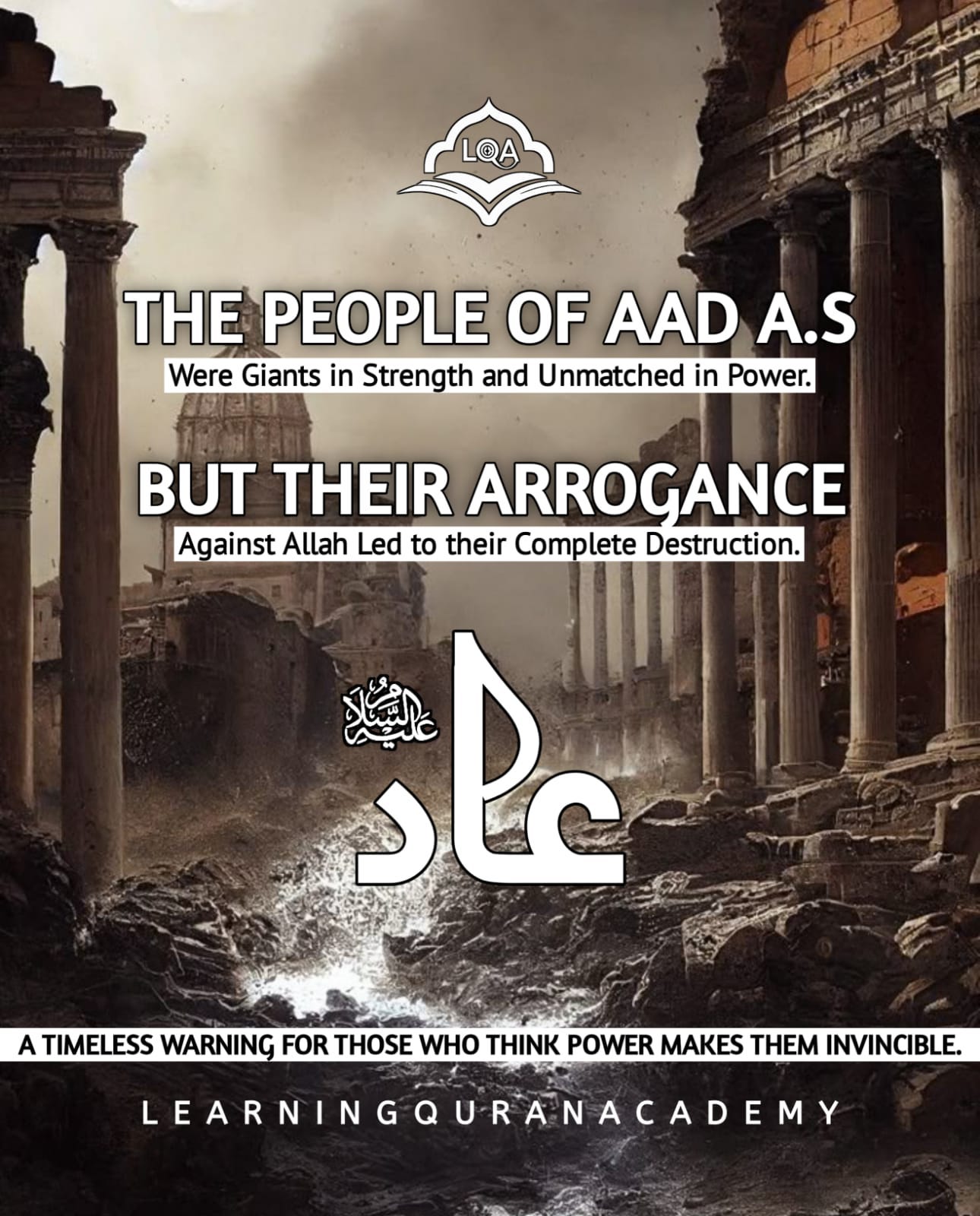
Over 2,000 years before the common era, after the catastrophic flood of Prophet Nuh (Noah, peace be upon him), a new civilization emerged in the Arabian Peninsula — People of ‘Ad in the Quran which was one of the most powerful and physically impressive civilizations to ever exist.
They were one of the strongest tribes in the Quran, full of wealth and beauty. Their body stature was tall and radiant, they lived in vast lands along with having a developed a luxurious lifestyle. Allah said about them:
“The like of which was never created in the lands.”
(Surah al-Fajr, 89:8)
In another verse:
“And remember when He made you successors after the people of Noah and increased you in stature.”
(Surah al-A’raf, 7:69)
Let us reflect and imagine the average height of ‘Ad people which classical Qur’anic commentators such as Ibn ‘Abbas and Maqatil Ibn Sulayman has suggested to be around 18 feet.
Their story does not exist in any other religious or ancient historical texts apart from the Qur’an which makes it the most authentic source of their history.
Nonetheless, there are some speculative findings related to the Qur’anic narrative which remain truths within themselves.
📚 Reference: Qasas al-Qur’an p. 83.
Where Are The People of ‘Ad Mentioned in The Qur’an? Full List of Surahs
The People of ‘Ad in the Quran are referenced in a total of nine different chapters (Surahs). These references capture quite a dramatic story of their rise, self-inflated pride and subsequent demise. Below is a list of the Surahs where their story is told:
Surah al-A’raf (7th chapter)
Surah Hud (11th chapter)
Surah al-Mu’minun (23rd chapter)
Surah ash-Shu‘ara (26th chapter)
Surah Fussilat, as known as Surah as-Sajdah (41st chapter)
Surah al-Ahqaf (46th chapter)
Surah adh-Dhariyat (51st chapter)
Surah al-Qamar (54th chapter)
Surah al-Haqqah (69th chapter)
Each mention highlights different morals about arrogance, willful blindness to the truth, disregard for divine consequences, as well as divine punishment. Hud (peace be upon him) was sent as their warner and they chose to ignore his message which led to their downfall.
Lineage of the People of ‘Ad in Islamic History
In the Quran, the People of ‘Ad are connected to a man named ʿĀd, who was a son of Shem (Sām) who is recognized as a son of Prophet Nuh (Noah) عليه السلام. According to historians, ʿĀd is considered to be the fourth generation after Nuh, and his genealogy is frequently referenced as:
ʿĀd ibn ʿAws ibn Iram ibn Sām ibn Nūḥ (عليه السلام).
This powerful Arab tribe became known by his name — the People of ‘Ad, and they lived in extraordinary palaces built on towering columns in a region called Iram which the Qur’an mentions as:
“Iram — who had lofty pillars”
(Surah al-Fajr, 89:7)
The city of Iram, which was once considered mythical, was claimed to be located by some archaeologists in 1984 using satellite images taken by NASA’s Space Shuttle Challenger. Research suggests this place is located in today’s Oman, near the Empty Quarter (Rub’ al Khali).
📚 Reference: Qasas al-Qur’an, p. 84.
The Land of Warning: Where the People of ‘Ad Once Lived
People of ‘Ad are mentioned in the Quran and lived in the region that is now one of the most desolate deserts in the world, known as ‘Al-Ahqaf’ which translates to the hinterland “lands afar”.
This area is currently located between the Arabian Sea and the Red Sea. Also, it encompasses parts of Oman, Hadhramaut (Yemen), Bahrain, and Western Yemen.
The region is now referred to as the Empty Quarter (Rub’ al-Khali) where ‘Al Ahqaf’ extends to over 650,000 kilometers and is one of the largest deserts in the world.
It contains white blinding sand dunes that rise like mountains and devour anything that is dropped to it in a matter of seconds.
The region was once a fertile and green land housing the ʿĀd tribe, who were incredibly arrogant. They are known to deny their prophet due to their immense material wealth.
The region now stands barren with no vegetation, but serves as a warning sign to those who chose to follow the same path.
“And remember the brother of ‘Ad, when he warned his people in Al-Ahqaf…”
(Qur’an — Surah al-Ahqaf, 46:21)
Shaddad’s Earthly Paradise
The People of ‘Ad are described in the quran as a powerful civilization with unmatched architectural capabilities. The quran refers to them as “Iram — of the lofty pillars” in surah Al-Fajr (89:7–8). They are further quoted:
“Iram — who had lofty pillars, the like of which was never created in the lands.”
Some scholars mentioned, for instance, Iram might have been a regal designation or perhaps the name of their patriarch, Iram bin Sam.
Other commentators, such as those from Tafsir al-Bayan (Vol. 8, p. 466), suggested that it stemmed from the architectural identity of the ‘Ad nation, which was their peculiar and obsessive pillar-based construction style; a theme largely unknown before them.
Along with these rulers was Shaddad ibn ‘Ad, a legendary king believed to have built a heavily fortified city made of gold and marble, which was found in underground ruins more recently.
This city earned the name Shaddad’s Jannat al-Ard (Earthly Paradise). It was a place that stood for human hubris and the divine repudiation of it. Though physically dominant and extravagant in their structures, the arrogance of the people ultimately led to their doom.
Quranic Story of Shaddad and the Paradise That Was Destroyed
The story of the ancient nation called the People of ‘Ad, as mentioned in the Qur’an, is one of the most astonishing accounts in the quran.
This culture was known for their great strength and their architecture. One of their leaders, Shaddad ibn ‘Ad, is known to have built a so called “paradise” on earth known as Iram. This was an attempt to rival the true paradise that is promised in the afterlife.
The classical scholars, including those cited in Ma’ariful Qur’an (Vol. 8, p. 741), suggested that Shaddad built a city with gold and silver along with precious stones and towering columns — with the Qur’an title “Dhāt al-ʿImād” which means the “possessors of lofty pillars.”
The intention behind this was to build a worldly utopia for people to enjoy and distract them from the Hereafter.
After working hard for three hundred years, Shaddad was ready to enter the city with his elite.
They never got the chance as divine punishment struck. The entire civilization perished and their grandiose city was erased entirely. No matter how majestic and striking an empire seems, it will always be subject to the supreme power of God.
Besides being historical, this story serves as a divine warning against pride, materialistic mentality, and disregarding the concept of life after death.
People of ‘Ad were ruled by Shaddad, who is said to have lived for more than 900 years. Once he completed the extravagant paradise he was building, Shaddad invited his people to witness what he believed to be a rival to the eternal Garden of Hereafter — the city of Iram.
As Shaddad approached the golden gates of his man-made “Jannah” in grand procession, he was struck by divine wrath. Iram’s Iyan had transformed into golden gates deep within the desert, and before Shaddad could take his first step the entirety of his kingdom was cast into the depths of desert sand, imprisoned for eternity.
The authenticity of this legend may differ among Islamic scholars, but it has been cited in well-known texts such as:
📘 Ma’ariful Qur’an, Vol. 8, p. 741
📘 Bayan al-Qur’an, Vol. 8, p. 466
No matter the case, this event serves as a warning to humanity in the Qur’an. For the illusion of supremacy has only one outcome, and that is defeat.
The People of ‘Ad: First Nation to Embrace Idol Worship After The Nuh (AS) Flood
Famed for unrivaled courage and physical prowess, the People of ‘Ad were the first to embrace idol worship after the flood of Nuh (AS).
As written by Imam Jalaluddin al Suyuti in his Tafsir al Durr al Manthur, this tribe also worshipped idols as Samud and Habar, while Ibn Kathir mentions another idol named Samad. Other sources list names like Sadaa, Samood, and Wahra.
As noted by historians, the deities worshipped by ‘Ad closely resembled those of the people of Nuh: Wadd, Suwa’, Yaghuth, Ya’uq, and Nasr, all made from stone.
When the ‘Ad drowned in moral corruption and shirk (polytheism) they were called to return to monotheism and upright living by Allah sending a pure and righteous prophet from among themselves.
The Message of Prophet Hūd (AS) to the People of ‘Ād
Hood (AS) was the prophet sent to guide the People of ‘Ād which was an influential tribe among the Arabs. They were considered to be descendants of pure Arabs.
As reported in a hadith from SAHIH IBN Hibban, Prophet Muhammad SAW said, “Four Prophets were Arab: Hūd, Ṣāliḥ, Shuʿayb, and your Prophet, O Abū Dharr.”
Hood (AS) belonged to the khilud tribe which was known to be noble and well-respected. A part of his monologue included, “Oh my people, worship Allah alone. You have no deity besides Him.” Quran 7:65.\
The chiefs of ‘Ād showed extreme arrogance, mocking and accusing Hood (AS) to be hallucinating.
They put forth a face of being reasonable no resolution was being extended to their problems, while holding on dearly to the idols that their ancestors were prone to worshipping. “You have brought no clear proof. We will not leave our gods for what you say. If you are truthful, bring upon us what you threaten us with.” Quran 7:70
Prophet Hūd’s timeless message like every other messengers, asked for absolute followedorder to tawhid (monotheism), moral virtue, and submission to divine orders.
Prophet Hūd (AS) preached to his people for more than fifty years without a stop, reminding them of Allah’s blessings while warning them of the consequences that came to past nations such as the people of Nūḥ (Noah) (AS). Nevertheless, his efforts were in vain as the People of ‘Ād remained defiant, consumed in their arrogance and pride. Their unmatched strength was a mockery to the possibility of a divine punishment.
Allah says in the Qur’an:
“As for ‘Ād, they acted arrogantly in the land without right and said, ‘Who is mightier than us in strength?’”
(Qur’an Sūrah Fussilat, 41:15)
The ‘Ād civilization extended from Oman to Yemen, consisting of 13 powerful tribes. Their land was prosperous, abundant in gardens with nourishing rivers, waterfalls, and fields rich with crops. They were exceedingly tall and impressively built, further augmenting their delusion of superiority.
Instead of being grateful, these people were lead into disobedience. Their downfall was initiated the moment they placed their trust in worldly might rather than the Creator.
The Supplication of Hūd (AS) and How Divine Punishment Started
Prophet Hūd (AS) faced years of disbelief from the People of ‘Ād, who labeled him as cursed, insane, or bewitched, insisting that their stone idols had put a curse on him.
They mocked him calling him a sorcerer for his attempts at warning them. However, the moment he decided to reach out to Almighty Allah was when they showed ignorance along with arrogance, and he stated:
“My Lord, indeed they have denied me, so judge between us, and grant me victory.”
— Surah al-Mu’minūn, 23:39–40
Allah granted a reply:
“They will soon come to regret their denial.”
It was at this moment punishment began. The angel of the clouds received orders to not let it rain, the one controlling springs was asked to cut off their rivers, waterfalls, and wells, and as a result, the greenery started to vanish.
The lush green land converted to wasteland where crops, fruits, and livestock no longer thrived. This consequentially led the People of ‘Ada into a three year long famine.
Observing the Prophet Hūd’s (AS) people in despair, he continued to encourage them toward repentance:
“My folks! Seek forgiveness from your Lord and come back to Him. Insha’Allah, He will send to you abundant rain. He will also double your strength. But don’t turn away as sinners.”
— Surah Hūd, 11:52
In their arrogance, they responded:
“O Hūd, you haven’t brought us any clear proof and we will not abandon our gods just because you say so. You are afflicted with madness by one of our gods.”
— Surah Hūd, 11:53–54
Their mockery, disbelief and pride sealed their fate.
The Chiefs of ʿĀd Visit The Sacred Land Seeking Rain
These tribes were pagans, but even during the times of Allah (SWT), these pagan tribes recognized the supreme authority of a divine force which governed the Heavens and Earth.
It was common practice among idol worshipers to travel to Baytullāh (The Sacred House) in Makkah to plead during times of calamities, showcasing the existence of a singular power despite their aspirations to the contrary.
Fearing an end to their thirst, seventy chieftains of ʿĀd set off to Makkah in search of solace. During this period, Mu’awiyah ibn Bakr, ruler of the ‘Amalīq tribe, was in control of that area. Welcoming his mother’s tribe, he showered them with warm hospitality.
The group stayed in Makkah for a month without losing hope, praying day and night for much-needed rainfall. Helping perform prayers was Qayl ibn ‘Anbar, who simultaneously served as their chief prayer leader.
In response to their prayers, Allah sent three clouds, one white, one red, and one black. A voice from the heavens proclaimed, “Choose one of these clouds.”
As Qayl looked at the clouds, he noticed the black one was the most appealing. Without much consideration, Qayl decided to go with,” This one seems full of rain and promise.” However, the answer he received was, “You have chosen your destruction.”
With no divine mercy but pure vengeance, the black cloud filled with wrath was driven towards the lands of ʿĀd. When the people noticed the clouds gathering in the distance, they could not contain their happiness.
To mark the celebration, people took out flutes and drums and assumed the drought was over.
Without any clue to the actual intentions, the clouds were there to provide annihilation instead of much-desired water.

The Black Cloud of Doom: Unforgivable Divine Anger
Over the valleys of ʿĀd, a dark cloud was forming. It loomed over like a king about to indulge in his deepest desires. The people were certain that long awaited rain was about to fall any second now, and they danced their hearts out. But in reality, it was just mockery of their foolishness and insensitivity.
**The Qur’an states:
“When they saw it as a cloud advancing toward their valleys, they said: ‘This is a cloud bringing us rain!’ No — it is what you were impatient for: a wind with a painful punishment.”**
(Surah al-Aḥqāf, 24)
The sky turned fierce. The gentle breeze was replaced by a relentless storm, which now contained what the people ridiculed only moments ago. Allah says:
“It destroyed everything by the command of its Lord. So they became such that nothing could be seen except their empty homes.”
(Surah al-Aḥqāf, 25)
Every single trace of pride was wiped clean, and any egotistical attitude they held onto was decimated along with uprooted trees, flattened palaces, and extinguished lives.
The nation of ʿĀd was once steeped in arrogance and blinded by their pride, only to become this ancient tale, defeated and forgotten, and captured in dust in their own domain.
“Thus do We recompense the wicked.” (Qur’an)
The Fall of ‘Ād: Winds of Wrath and the Shelter of Hūd (علیه السلام)
The tribe of ʿĀd perished under a form of punishment that no civilization could endure. As described in the Qur’an:
“Allah sent upon them an extremely violent wind for a period of seven consecutive nights and eight days without any pause, so that you might witness the hollowed palm tree-like bodies of the people.”
(Surah al-Ḥāqqah, 6–7)
It was not a tempest of mere nature; this was an unparalleled furious divine storm — unmatched in elixir of gale wrath that could pierce the mightiest barriers and strongest bodies. Life was extinguished, homes dismantled, and their pride was reduced to nothing.
He later explained:
“Allah opened only as much of that wind as a ring’s space upon them — and it annihilated them.”
(Narrated by Ibn ‘Umar, in al-Bidāyah wa al-Nihāyah)
But not all were obliterated. Prophet Hūd (علیه السلام) and the faithful companions who stood by him were sheltered in a place known as Hāzirah. It is a valley which is divinely shielded where winds cannot reach.
Even decades later, the Prophet ﷺ would recall this moment. When ʿĀishah (رضي الله عنها) asked him about his expression gaze upon the clouds, he said:
“O ʿĀishah! What guarantee is there this cloud does not bring torment? The people of ʿĀd also saw clouds and thought it was rain — but it was destruction.”
(Qasas Ibn Kathīr, pp. 134–135)
This serves as a reminder that punishment from the heavens may swiftly and silently descend, disguised as a blessing, however, it contains unbearable wrath for those who disobey.
Heavenly Signs: The Lesson Derived from the ʿĀd People
The Qur’an describes the fate of previous civilizations not as a distant tale but as gives timeless reminders. The story of the ʿĀd people, once favored with abundant wealth, strength, and striking magnificence, remains sobering as majestic Divine graces sparks unchecked human arrogance.
Receiving worldly comforts without limits came with denial of their Prophet Hūd (علیه السلام) who brought forth a message of truth. Defiance and pride drove rampant until fierce winds, set forth by Allah, obliterated their civilization, erasing their legacy from the earth.
“Thus We destroyed them for their sins. And We drowned the people of Pharaoh. And they were all wrongdoers.”
(Surah al-Anfāl, 54)
This story does not simply reside in history; it serves as a caution for us today — and reminds us that authority, development, and wealth do not protect anyone from harm.
As individuals, and as an ummah, if we choose to disregard the Lord’s prescriptions, ridicule the message of our beloved Prophet ﷺ, or drift into negligence, we put ourselves in peril.
Thus, we should be evaluating our personal and communal actions in these troubling times and ask ourselves: Are we without realizing it or with realizing it, defying Allah and His Messenger ﷺ?
메타데이터
- post_id
- d2c4b43a0e93
- slug
- the-people-of-ad-in-the-quranthe-people-of-ad-in-the-quranwho-were-the-lost-people-of-ad-in-the-d2c4b43a0e93
- url
- https://medium.com/@learningquranacademy/the-people-of-ad-in-the-quranthe-people-of-ad-in-the-quranwho-were-the-lost-people-of-ad-in-the-d2c4b43a0e93
- canonical_url
- https://medium.com/@learningquranacademy/the-people-of-ad-in-the-quranthe-people-of-ad-in-the-quranwho-were-the-lost-people-of-ad-in-the-d2c4b43a0e93
- author_url
- https://medium.com/@learningquranacademy
- status
- ok
- fetched_at
- 2026-06-11 12:34:08