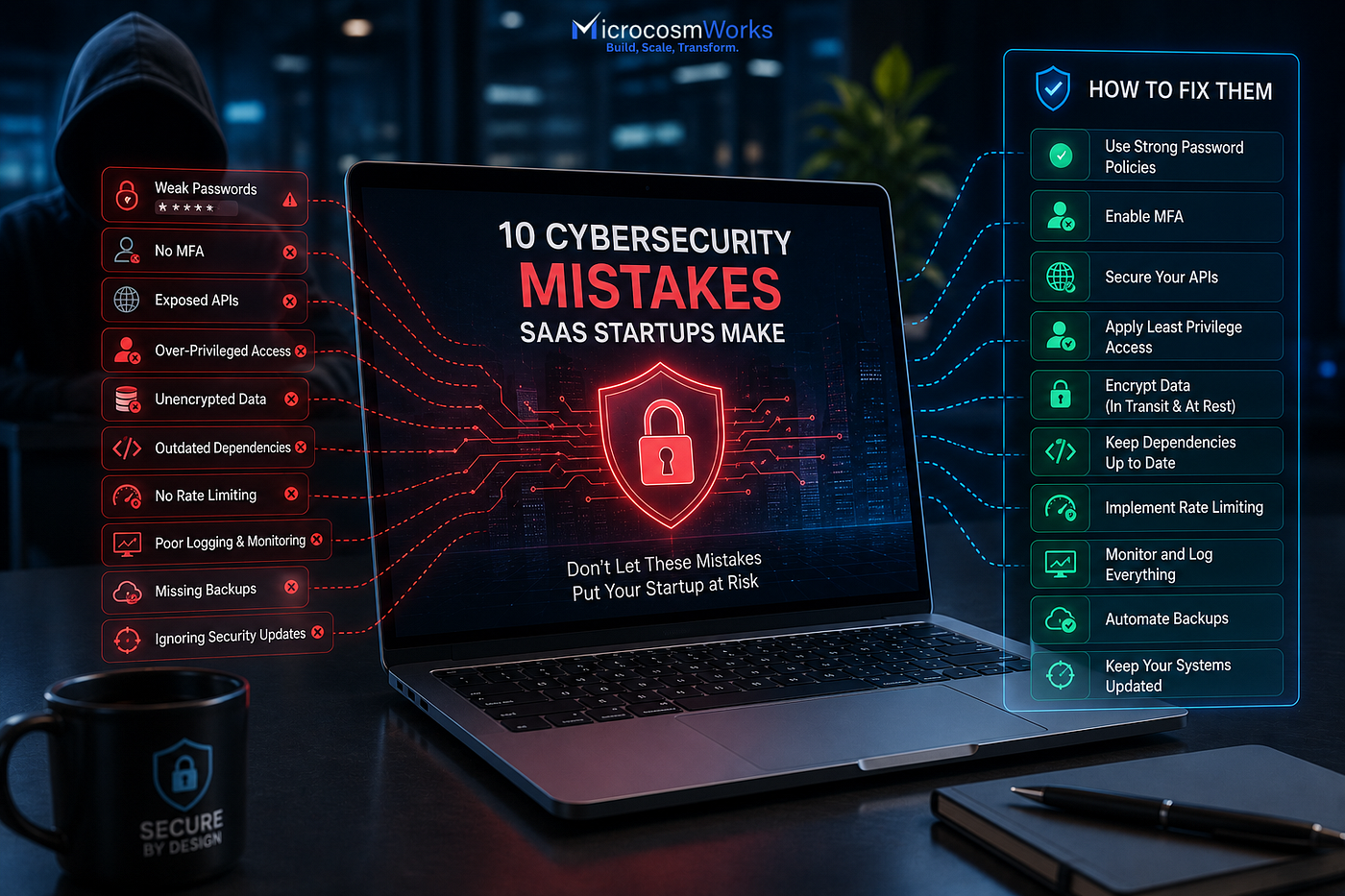
10 Cybersecurity Mistakes SaaS Startups Make (and How to Fix Them)
Most SaaS startups don’t get hacked because someone outsmarted them. They get hacked because nobody was paying attention.
10 Cybersecurity Mistakes SaaS Startups Make (and How to Fix Them)
Most SaaS startups don’t get hacked because someone outsmarted them. They get hacked because nobody was paying attention.
Speed is the religion of early-stage startups. Ship fast, iterate faster, worry about security later. It’s an understandable instinct — and one that costs the industry billions every year.
The uncomfortable truth is that most SaaS security failures aren’t sophisticated. They’re embarrassingly preventable. Here are the ten mistakes that come up again and again, and exactly what to do about each one.
1. Treating Security as a “Later” Problem
Founders push security down the roadmap until a client’s security review, a compliance requirement, or an actual breach forces the conversation. By then, retrofitting security is 3–5x more expensive than building it in from the start.
The Fix: Make security a sprint-zero requirement, not a backlog item. Define your threat model before you write line one of production code.
2. Hardcoding Credentials and Secrets
API keys, database passwords, and tokens committed directly to source code. It happens constantly — and attackers actively scan public GitHub repositories for exactly this. One slip and your production database is someone else’s playground.
The Fix: Use environment variables and secret managers (AWS Secrets Manager, HashiCorp Vault). Run a secrets scanner like Trufflehog in your CI pipeline before every merge.
3. Skipping Multi-Factor Authentication
Not just for your users — for your own team’s access to production systems, admin panels, cloud consoles, and CI/CD pipelines. A stolen password without MFA is a full compromise waiting to happen.
The Fix: Enforce MFA on every account that touches production. No exceptions, no workarounds for “convenience.”
4. Overpermissioned Roles and Access
Giving every developer admin access because it’s convenient. Every service account with full database permissions because it’s easier than scoping them correctly. This is how a single compromised account becomes a total data breach.
The Fix: Implement least-privilege access across the board. Every human and every service gets the minimum permissions required to do their job — nothing more.
5. No Data Encryption at Rest or in Transit
Storing user data unencrypted in your database, or transmitting it over unencrypted channels. In a regulated industry, this isn’t just a vulnerability — it’s a compliance violation that can shut you down.
The Fix: TLS everywhere in transit, AES-256 at rest. This is non-negotiable and costs almost nothing to implement correctly from day one.
6. Missing Input Validation and Injection Vulnerabilities
SQL injection, XSS, and command injection are decades-old attacks — and they still work because developers under time pressure skip validation. The OWASP Top 10 hasn’t changed dramatically because these problems keep recurring.
The Fix: Validate and sanitize every input. Parameterize all database queries. Run SAST tools in your pipeline to catch these automatically on every commit.
7. No Logging, Monitoring, or Alerting
On average, 197 days pass before a breach is discovered. Most startups wouldn’t know they’d been compromised until a customer tells them — or a journalist does. Flying blind in production is not a startup problem, it’s a choice.
The Fix: Implement centralized logging from day one. Set alerts for anomalous login patterns, unusual data access volumes, and error rate spikes. Tools like Datadog, Sentry, and CloudWatch make this accessible even for small teams with no dedicated security staff.
8. Ignoring Dependency Vulnerabilities
Your application is only as secure as its weakest library. Open-source dependencies with known CVEs are one of the most common attack vectors in modern software — and most teams only check their dependencies when something breaks, not when it’s been silently compromised.
The Fix: Automate dependency scanning with Dependabot, Snyk, or OWASP Dependency-Check. Set a hard policy: critical vulnerabilities get patched within 72 hours, no exceptions.
9. No Incident Response Plan
When a breach happens — and statistically, it will — the worst time to figure out your response is in the middle of the incident. Panicked decision-making, unclear ownership, and no communication template turn a bad situation catastrophic.
The Fix: Write a one-page incident response playbook before you need it. Define who owns what, what gets communicated to customers and when, and what your legal notification obligations are under GDPR or other applicable regulations.
10. Deferring Compliance Until Enterprise Deals Demand It
SOC 2, ISO 27001, HIPAA, GDPR. Startups defer these until a Fortune 500 prospect puts compliance in the sales blocker column. At that point the work takes 6–12 months — and costs a deal that was otherwise won.
The Fix: Start building toward SOC 2 Type I from your first year. The controls overlap heavily with simply being secure — it’s not as painful as it sounds if you haven’t already built a mountain of technical debt to untangle first.
The Pattern Underneath All Ten Mistakes
Every single mistake above has the same root cause: security was treated as someone else’s job, or a future problem, rather than a foundational engineering discipline baked into how the product is built.
The SaaS startups that avoid these pitfalls aren’t the ones with the biggest budgets — they’re the ones that made security a first-class concern from the beginning, integrated it into their development workflow, and got expert guidance before they needed it urgently.
If you’re building a SaaS product and you’re not sure where your current security posture stands, a structured cybersecurity consulting engagement is the fastest way to find out — and to get a clear roadmap for fixing what matters most before a breach or a failed enterprise audit forces the conversation.
For teams in active SaaS application development, the best time to address these issues is before launch — when fixing them is a sprint, not a six-month remediation project competing with your product roadmap for engineering hours.
Security isn’t a feature you add when you’re ready. It’s the foundation everything else sits on. Build it right the first time — your future enterprise customers, and your users, are counting on it.
MicrocosmWorks helps SaaS startups and enterprises build secure, scalable products from day one. 40+ clients, 100% job success rate, based in New Delhi with clients across the US, UK, UAE, and Australia.
메타데이터
- post_id
- d2e1c9fa62f2
- slug
- 10-cybersecurity-mistakes-saas-startups-make-and-how-to-fix-them-d2e1c9fa62f2
- url
- https://medium.com/@ujjwal.tripathi_30844/10-cybersecurity-mistakes-saas-startups-make-and-how-to-fix-them-d2e1c9fa62f2
- canonical_url
- https://medium.com/@ujjwal.tripathi_30844/10-cybersecurity-mistakes-saas-startups-make-and-how-to-fix-them-d2e1c9fa62f2
- author_url
- https://medium.com/@ujjwal.tripathi_30844
- status
- ok
- fetched_at
- 2026-07-19 09:14:29