Uchronia: Reimagining History’s “What Ifs”
It’s about taking a historical moment and giving it a twist.
Uchronia: Reimagining History’s “What Ifs”
It’s about taking a historical moment and giving it a twist.
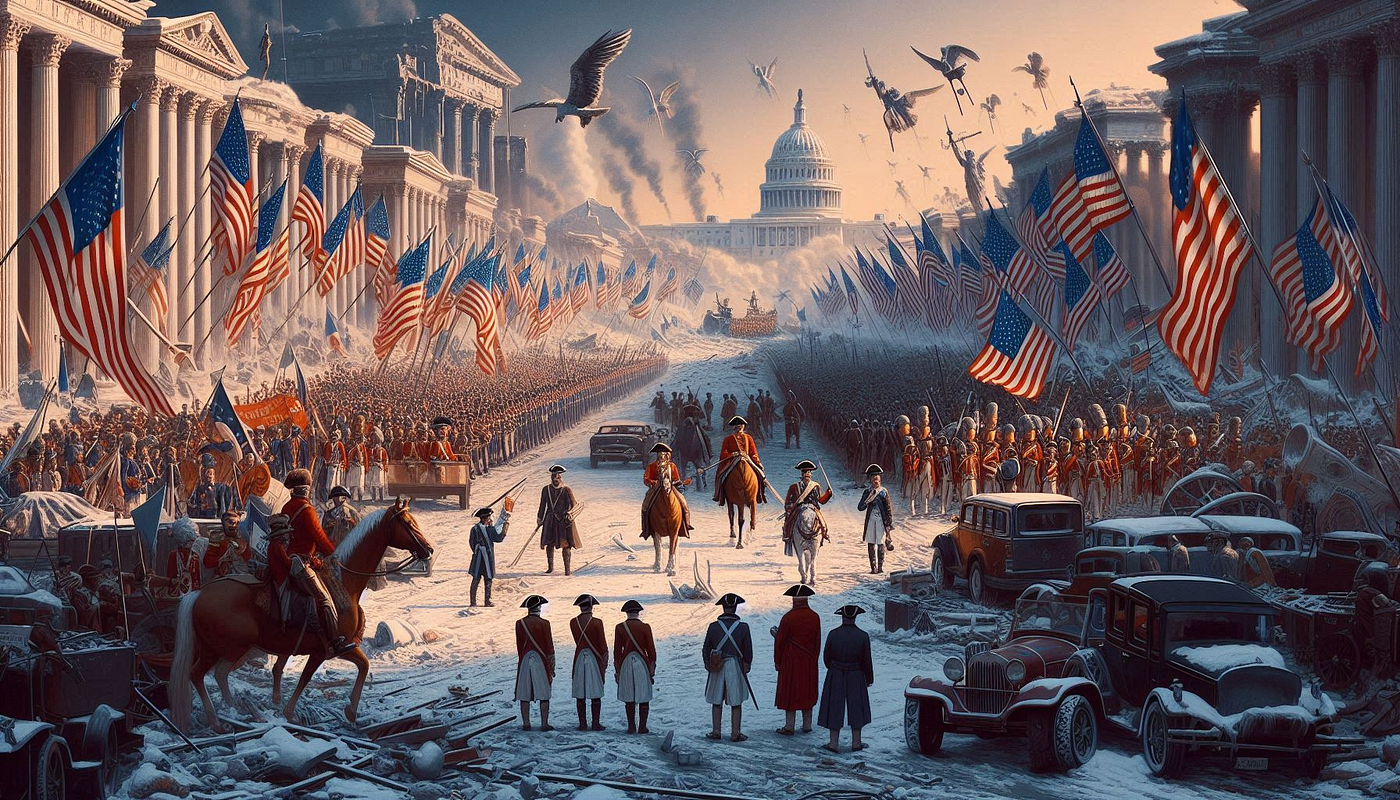
images created using Microsoft Designer
“What if” major historical events had turned out differently?
Uchronia reshapes history with alternate versions of our past.
At its core, is about creating fictional timelines. It’s taking a historical moment and giving it a twist.
What if the American Revolution failed? What if the Roman Empire never fell? These are the kinds of questions uchronia tackles.
The term “uchronia” comes from the Greek words “ou” (meaning “not”) and “chronos” (meaning “time”). It’s a play on “utopia,” which means “no place.” So, uchronia is essentially a “no time” or an alternate time that never existed.
Writers of uchronia pick pivotal moments in history and imagine different outcomes. Changes ripple through time, affecting everything from politics to culture.
Philip K. Dick’s “The Man in the High Castle” imagines a world where the Axis powers won World War II. The United States is divided between Nazi Germany and Imperial Japan. It’s a chilling look at what might have been.
Robert Harris’s “Fatherland” also deals with a Nazi victory in World War II, but focuses on a murder mystery set in 1964 Berlin. Harris paints a picture of how Europe changes under long-term Nazi rule.

Uchronia isn’t just about big, world-changing events. Some writers focus on smaller, more personal “what ifs.”
In Stephen King’s “11/22/63” the main character tries to prevent the assassination of John F. Kennedy. It’s about the personal decisions of the protagonist as about changing history.
Uchronia can be a tool for social commentary. By changing historical events, authors highlight issues in our real world. They show us how fragile reality is, and how easily things could have been different.
Take Harry Turtledove’s “Southern Victory” series, where the Confederate States won the American Civil War. Turtledove examines themes of racism, imperialism, and political extremism.

Uchronia can mix real historical figures with fictional events. In Kim Stanley Robinson’s “The Years of Rice and Salt,” most of Europe’s population is wiped out by the Black Death. World history is dominated by Asian and African cultures. Robinson imagines how figures like Tamerlane or the Ming Dynasty shape a different world.
The TV show “The Man in the High Castle” brought uchronia to a wide audience. Video games like “Wolfenstein: The New Order” let players fight within an alternate history where the Nazis won.
One challenge of writing uchronia is making the alternate history believable. Authors need to research history thoroughly. They must understand cause and effect. A small change in the past could have unexpected consequences.
In Ward Moore’s “Bring the Jubilee,” the Confederacy’s victory leads to a technologically stunted America. The book looks at how this affects scientific progress.

Uchronia can explore cultural “what ifs.” Kingsley Amis’s “The Alteration” imagines a world where the Reformation never happened. The Catholic Church still dominates Europe in the 20th century. This lets Amis show how religion shapes society.
Some uchronia stories don’t just change one event. They create new timelines. S.M. Stirling’s “Draka” series imagines a world where events in ancient Greece went differently. The result is a dark alternate history spanning centuries.
Sometimes it’s the small things that make a difference. In Terry Pratchett’s “Night Watch,” a time-traveling policeman makes tiny changes to his own past. These small alterations end up having major effects on his present.
An interesting subgenre of uchronia is “secret history.” These stories suggest that history is the result of hidden events. Tim Powers’ “The Anubis Gates” proposes that historical events were caused by time travelers and magic users working behind the scenes.

Uchronia is a way to use historical figures in new contexts. In Michael Chabon’s “The Yiddish Policemen’s Union,” a Jewish settlement in Alaska becomes permanent after World War II. Chabon uses this setting to show Jewish identity in a new light.
Some stories focus on technology. What if certain inventions came earlier or later? Eric Flint’s “1632” series sends a modern American town back to 17th century Germany to see how modern technology changes the course of the Thirty Years’ War.
Some stories look at how our present might be different if the past changed. Ken Follett’s “Winter of the World” is about how the Cold War might have played out if the Nazis developed the A-bomb first.
Uchronia has inspired films. Quentin Tarantino’s “Inglourious Basterds” imagines a group of Jewish-American soldiers assassinating Hitler, altering the course of World War II. The movie blends historical facts with fictional elements.
Television series like “The Man in the High Castle” and “For All Mankind” gained popularity. “For All Mankind” presents an alternate timeline where the Soviet Union lands on the moon first. This series shows how small changes in historical events have far-reaching consequences.

Comic books and graphic novels are fertile ground for uchronic storytelling. Alan Moore’s “Watchmen” is set in an alternate 1985 where superheroes exist and influence world events. The presence of these powerful beings changed the outcome of the Vietnam War and the presidency of Richard Nixon.
The TV series “The Plot Against America” imagines an alternate 1940s America where Charles Lindbergh, an isolationist and alleged Nazi sympathizer, becomes president. This premise examines themes of antisemitism, authoritarianism, and the fragility of democracy.
Board games like “Axis & Allies” allow players to reimagine the strategies and outcomes of World War II, while role-playing games set in alternate historical settings encourage players to explore “what if” scenarios in an interactive format.

The popularity of uchronia in various media has led to the creation of online communities dedicated to discussing and creating alternate history scenarios. The rise of streaming platforms has made uchronic content more accessible than ever.
As technology advances and new forms of media emerge, it’s likely that uchronia will continue to evolve, finding new ways to explore the tantalizing question of “what if?”
Uchronia, alternate history, historical fiction, speculative fiction, “what if” scenarios, reimagining history, counterfactual history, historical divergence, parallel timelines, alternative past, historical speculation, Uchronia in popular culture, alternate history media, speculative storytelling, interactive uchronia, uchronic gaming, alternate timeline communities, uchronia and social commentary

메타데이터
- post_id
- d2f944768ec1
- slug
- uchronia-reimagining-historys-what-ifs-d2f944768ec1
- url
- https://medium.com/speculative-encounters/uchronia-reimagining-historys-what-ifs-d2f944768ec1
- canonical_url
- https://medium.com/speculative-encounters/uchronia-reimagining-historys-what-ifs-d2f944768ec1
- author_url
- https://medium.com/@clnichols
- status
- ok
- fetched_at
- 2026-08-01 19:53:43