The authenticity obsession in UGC is making your ads worse.
The debate is: “Will AI kill influencer marketing?” One camp says yes — AI UGC is so convincing that real creators will become irrelevant…

The authenticity obsession in UGC is making your ads worse.
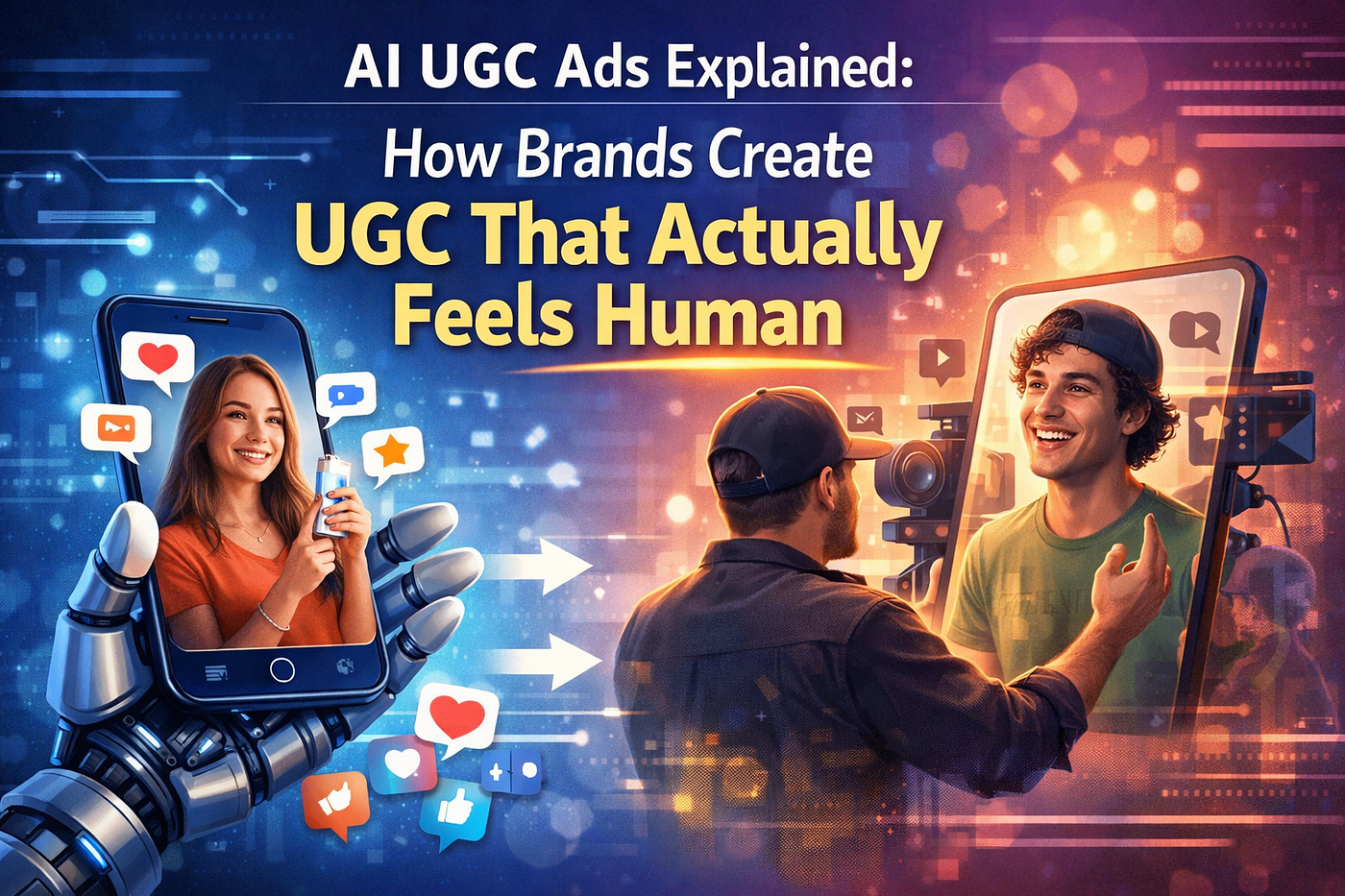
The debate is: “Will AI kill influencer marketing?” One camp says yes — AI UGC is so convincing that real creators will become irrelevant within a year. The other camp says no — audiences can always spot the fake, and authentic human connection can never be replicated.
Both camps are missing the point entirely.
The real question isn’t whether AI UGC is real enough. It’s whether it makes the audience feel something.
The Problem With Most AI UGC
Most AI UGC fails for one reason: it’s trying to trick the audience.
Brands spend thousands engineering hyper-realistic AI avatars, obsessing over whether the skin texture is convincing enough, whether the eye movement is natural enough, whether the background looks real enough.
And while they’re busy trying to fool the viewer, they forget to give the viewer a reason to care.
Here’s the truth: audiences already know that characters in ads are constructed. They knew it when it was a paid actor in a 1990s infomercial. They know it now when it’s an AI avatar in a TikTok. It doesn’t matter. What matters is whether the story makes them see themselves.

What Actually Works — And Why
When I was working on the Buldak XL campaign, we had a real constraint: no live filming was possible. No real people, no location shoots, no traditional UGC production.
So instead of trying to fake realism, we did something different. We built characters that carried the emotional truth of the product experience — the moment of discovery, the first reaction, the absurdity of eating something this aggressively spicy and loving it anyway. Humor. Exaggeration. Recognition.
Not “here is a real person using this product.” But “here is a feeling you know — and this product owns it.”
The key insight: UGC’s real job has never been to prove that real people use the product. Its job is to build a vivid, specific mental image of what the product looks like inside someone’s actual life. The “U” in UGC — User — isn’t about authenticity of production. It’s about authenticity of experience.
The Hybrid Model — Why AI and Real Work Together
AI UGC and human UGC aren’t competitors. They’re different tools for different moments in the same story.
Real creators bring irreplaceable social proof — the messy, unscripted, imperfect energy that signals genuine experience. Audiences trust it because it costs the creator something real: their reputation, their time, their credibility.
AI brings something different: precision, scale, and narrative control. You can engineer the exact emotional beat you need. You can tell the story that would be impossible to film. You can iterate without a production schedule.
The strongest campaigns I’ve seen — and built — use both. Real creators for trust. AI for story architecture. Neither trying to be the other.

The One Rule That Makes AI UGC Work
Stop trying to make the audience believe the character is real.
Start trying to make the audience feel what the character feels.
Laugh with them. Cringe with them. Recognize themselves in them. The moment the audience is emotionally engaged, the question of “is this AI or real?” becomes completely irrelevant — the same way no one watching a great film stops to ask whether the actor really lived through the events.
Emotion is not a trick. It’s the oldest and most honest form of storytelling there is.
The B2B Exception Nobody Talks About
Everyone assumes UGC — AI or otherwise — is a B2C game. It isn’t.
B2B buyers are still humans. They still respond to story. They still make emotional decisions and justify them with logic afterward. The difference is the emotional register: less aspiration, more recognition. Less “I want to be like this person” and more “this person has the same problem I have.”
For B2B, AI UGC works when it dramatizes the problem — not the product. When it makes the decision-maker laugh, nod, or feel seen. When it turns a dry value proposition into a moment someone wants to share with their team.
That’s not a limitation of the format. That’s the format working exactly as it should.
메타데이터
- post_id
- d2f9c57bbb00
- slug
- ai-ugc-isnt-dead-you-re-just-making-it-wrong-d2f9c57bbb00
- url
- https://medium.com/@mani_dastgerdi/ai-ugc-isnt-dead-you-re-just-making-it-wrong-d2f9c57bbb00
- canonical_url
- https://medium.com/@mani_dastgerdi/ai-ugc-isnt-dead-you-re-just-making-it-wrong-d2f9c57bbb00
- author_url
- https://medium.com/@mani_dastgerdi
- status
- ok
- fetched_at
- 2026-06-09 15:37:30