Inside Nintendo's Needy Mii Apartment
A friend-shaped face wakes up inside a tiny apartment and asks for food. A shirt. Advice about a crush. Help with a mosquito. On June 18…
Inside Nintendo's Needy Mii Apartment
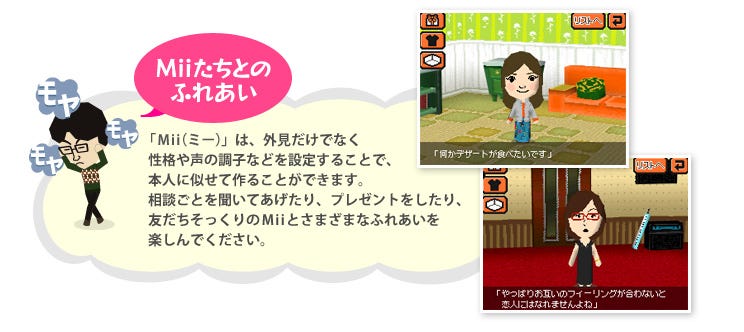
Nintendo’s official Tomodachi Collection page presents Mii interaction as the heart of the DS game: ordinary faces, tiny rooms, and social errands. Credit: Nintendo.
A friend-shaped face wakes up inside a tiny apartment and asks for food. A shirt. Advice about a crush. Help with a mosquito. On June 18, 2009, Nintendo released Tomodachi Collection for the Nintendo DS in Japan, and the Mii stopped being a cheerful menu portrait long enough to become a demanding little person.
The game was never a Western launch. For many players outside Japan, its outline arrived later through Tomodachi Life, the stranger and louder Nintendo 3DS successor. But the DS original is the quieter fossil, a cartridge-sized apartment block where Nintendo tested a new idea: what if the avatars people made for bowling and tennis began living near each other when the console was closed?
Little Tenants
By 2009, Miis were already familiar faces. The Wii had turned them into the household mask of Wii Sports, the bulb-headed version of your uncle with sharp eyebrows, your friend with impossible hair, your own face simplified until it looked like it had been assembled from refrigerator magnets. The Mii Channel made the act of building a person feel like a toy in itself.
Tomodachi Collection took that toy and gave it routines. Nintendo’s official site described a small island where time flowed like the real world and where player-made Miis lived freely, with no fixed goal waiting at the end. You registered yourself, family, friends, teachers, and whoever else belonged in your private sitcom. The game could import Miis from the Wii’s Mii Channel or exchange them through DS wireless communication, which gave the apartment house the faint thrill of contraband classmates moving into your pocket.
That is the important bit. Tomodachi Collection was not an online world. It did not need a server lobby or a friend list to feel social. It borrowed the emotional logic of the social web, the sense that little identity objects could circulate between people, then staged the drama locally on a handheld screen.

Nintendo’s relationship page shows the game’s central promise: the Miis keep forming bonds, quarrels, and tiny dramas. Credit: Nintendo.
No Finish Line
The official Japanese pages are wonderfully plain about the premise. Miis eat, sleep, worry, ask questions, meet one another, fight, fall in love, break up, and marry. The player gives them food and clothes, solves small problems, and watches the relationship map change. The game has no fixed ending, only the daily maintenance of a building full of copies.
That sounds cute until you remember what a Mii is. It is a face you made in a few minutes, close enough to a person to be funny and wrong enough to become funnier. Put enough of them together and every event becomes slightly cursed. Your teacher wants a hat. Your best friend wants to confess to your cousin. Your own tiny avatar sings karaoke with a stranger’s head bobbing next to it.

A small official gameplay still from Nintendo’s relationship section, the kind of quiet apartment scene the whole game was built around. Credit: Nintendo.
MobyGames compares the game loosely to The Sims and Animal Crossing, which helps an English-language reader find the shelf. Still, Tomodachi Collection has its own peculiar texture. It is less about building a house or perfecting a town than about checking on a stack of little people who seem to keep becoming themselves while you are away.
The Portrait Learns
Nintendo understood that the Mii was more than a profile picture. In an Iwata Asks interview, Satoru Iwata described Tomodachi Collection as a June 2009 DS game where users registered Mii characters for themselves and friends, then connected its director, Ryutaro Takahashi, to later 3DS software work because Miis were central to that system.
That makes the DS game feel like a hinge. Before it, Miis were the friendly paperwork of Nintendo’s new motion-control living room. After it, they became residents, guests, plaza walkers, StreetPass strangers, and comedy actors in systems that wanted identity to feel soft instead of clinical. The apartment block was a test chamber for a gentler kind of avatar persistence.
The weirdest surviving notes belong to preservation rather than marketing. The Cutting Room Floor documents unused animations, graphics, models, music, text, and anti-piracy behavior in the cartridge, including checks that could crash the game after naming the island and erase existing save data if the checks failed. Treat that as enthusiast reverse-engineering, not Nintendo’s sales pitch. It is still a perfect back-room detail: even the cheerful apartment had machinery underneath it, watching for a bad copy.
Still Checking In
Tomodachi Collection sold the fantasy that your social life could be miniaturized without becoming cold. The DS was already a private object, something held close enough that the stylus taps felt like tiny errands. Feeding a Mii a meal or hearing one complain from a little room had the strange intimacy of checking a message from someone who could never actually send one.
That is why the game sits so neatly in the Almanac. It is not dead internet in the literal sense. It is dead internet weather, a handheld forecast of the years when avatars, profiles, friends, and notifications would become small domestic obligations. Nintendo’s version was softer and weirder. It asked what would happen if the profile picture needed soup.
Somewhere in that first apartment block, a copy of somebody’s friend is still waiting with a speech bubble over its head.
Previously in the Almanac: Unplugged: How a Background Server Shut Down Millions of Nintendo Games
Sources
- トモダチコレクション official Nintendo DS site
- トモダチコレクション official site: what kind of game is it?
- トモダチコレクション official site: Mii creation and transfer
- トモダチコレクション official site: human relationships
- Tomodachi Collection (2009), MobyGames
- Iwata Asks: A Real Tomodachi Collection
- Tomodachi Collection, The Cutting Room Floor
Get the next forgotten web story by email
메타데이터
- post_id
- d315230db698
- slug
- inside-nintendos-needy-mii-apartment-d315230db698
- url
- https://medium.com/@dia_91230/inside-nintendos-needy-mii-apartment-d315230db698
- canonical_url
- https://medium.com/@dia_91230/inside-nintendos-needy-mii-apartment-d315230db698
- author_url
- https://medium.com/@dia_91230
- status
- ok
- fetched_at
- 2026-06-20 20:29:01