A strange animal: a park without any parks
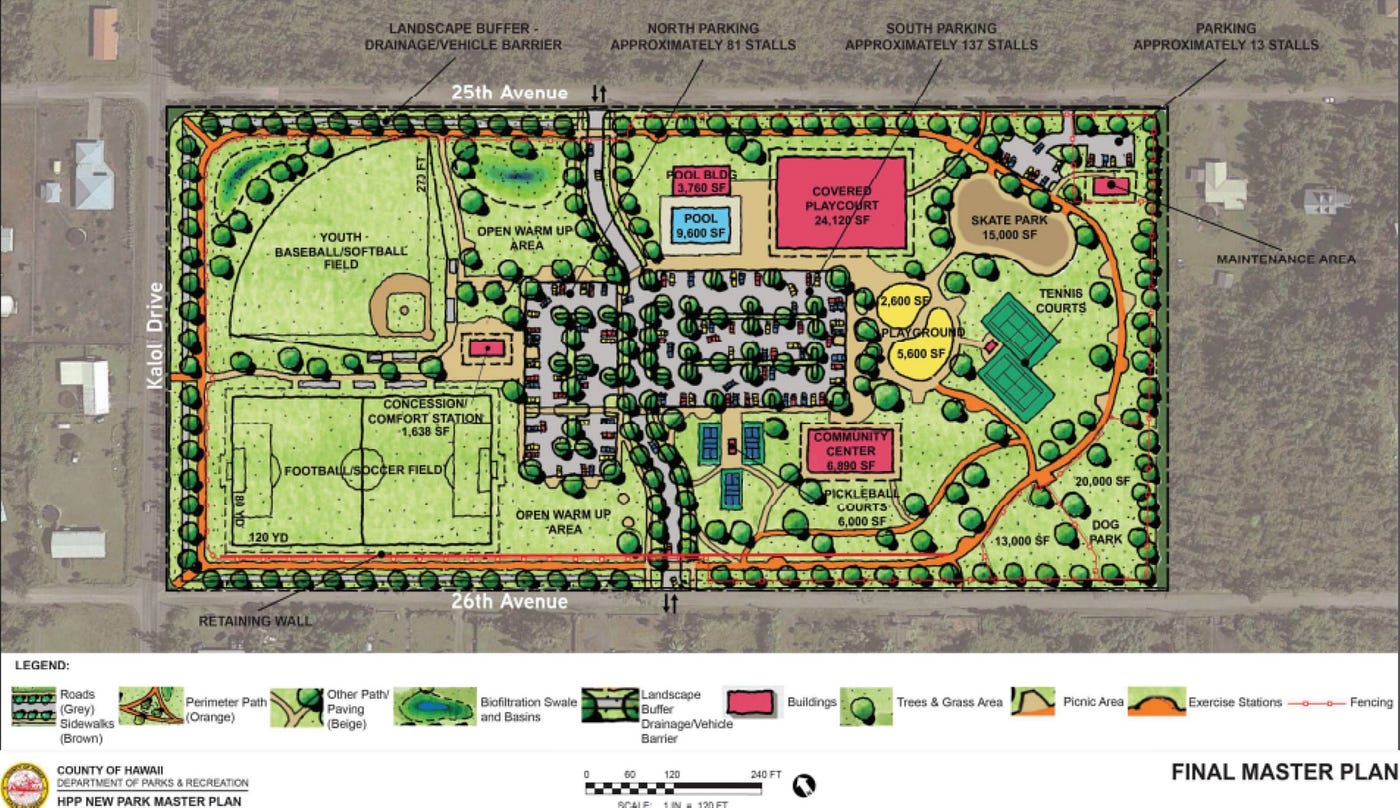
County design for the planned park in HPP on Kaloli and 26th
A strange animal: a park without any parks
After nearly three decades, our long-promised park in HPP is finally moving. Now let’s finish the job — and also consider creating a small beach park to access to the ocean we live beside.
Where, exactly, is the park in Hawaiian Paradise Park?
It’s a fair question. HPP is one of the biggest residential subdivisions in the United States — roughly 8,850 one-acre and half-acre lots spread across about 15 square miles, home to an estimated 15,000 or so people and growing faster than Puna, the Big Island, or the state as a whole.
And yet a community as big as ours, larger than most incorporated towns in Hawaii, has no actual parks other than a tiny keiki playground at the community center. No public swimming pool. No basketball courts. No pickleball courts. No tennis courts. No dog parks. And no safe way to get in the ocean even though it’s right on the ocean (our coastline is all cliffs).
That’s not for lack of planning. The plans exist. In several cases the land is already set aside and County-owned. The developers set aside a number of 20-acre lots for parks. What’s been missing is the sustained commitment and funding to turn those plans into grass, pavement, and restrooms.
So let me tell you where we actually stand — because for the first time in a long time, there’s some real good news.
The 20-acre park on Kaloli is finally moving, sort of…
The centerpiece of HPP’s park story is a 20-acre, County-owned parcel bordered by Kaloli Drive, 25th Avenue, and 26th Avenue. It’s been designated for a community park for nearly three decades.
Here’s the short version of a long history. The park was first written into the HPP Community Master Plan in 1997 and adopted by the County (Resolution 184–97). It called for a community park that could include a ball field, swimming pool, tennis and basketball courts, picnic areas, and tot lots. In 2015 the plan was updated and the park reaffirmed (Resolution 284–15). In 2016, the County surveyed the community, and more than 400 residents answered with one clear voice: parks and recreation were our number-one priority. The whole wish list was there — trails, a pool, a gym, sports fields, a community hall, a dog park, a skate park, playgrounds. This was never a plan handed down to us. It’s what HPP residents have asked for.
Then came the part that always seems to take forever in Puna: the environmental review. The County held a community meeting on it back in October 2024, which I attended. And as of this spring, the County’s own project list reports that the Environmental Assessment is complete, and they’re now selecting a consultant to design Phase I of the park. I want to give my councilmember Ashley Kierkiwicz some credit for getting us this far — it’s not been easy. But we still have a long way to go.
Design is not the same as a finished park, and Puna projects have a habit of going quiet right at this stage. Funding is not secured to actually build the park. But after 28 years, the environmental clearance is done and we’re moving from planning into design. That is real motion. It’s also exactly the moment when steady pressure and secured funding matter most, so that “Phase I design” actually becomes “Phase I construction” and not another decade of drift.
A mix of state and county funding may be what is required to get this park actually built.
The realistic way to get there is to phase it: build a good, usable first phase now — fields, courts, a playground, paths, restrooms, and parking — and expand from there as capital is secured, rather than waiting on one fully funded mega-project that never quite arrives. A park you can use in a few years beats a perfect park that’s still just a pretty drawing in 2040.
We were promised more than one park
The Kaloli park is the biggest and the furthest along, but it was never meant to be the only one. The master plan also set aside other park lands across HPP — two undeveloped county shoreline parcels along our makai edge, a small parcel near Kaloli and 26th, and a larger site near the HPPOA Community Center (which would need careful cultural review, since HPP holds documented Hawaiian sites, including shoreline petroglyphs and burials).
Most of these exist only on paper. But here’s why that matters: the hardest, most expensive part of any park project is usually acquiring the land — and for several of these, that step is already done. We don’t have to start from zero. We have to follow through.
What about ocean access?
This is the part that, to me, is both the most exciting and the most overdue.
HPP sits on the ocean — miles of it — and yet there’s nowhere in the entire subdivision where a family can safely walk down to the water, let a kid splash around, and walk back up. The master plan is blunt about why: our shoreline is rocky cliff, six to 25 feet high, with no sand beaches and no safe water-entry anywhere within HPP’s boundaries. A coastal community has been kept at arm’s length from its own coast.
So here’s one idea. Beach Road runs along our makai edge, and there’s a natural break in it. What about a modest public beach park built there, on land the community already owns, with three simple things: a low, well-engineered breakwall to knock down the swell and shelter a small pocket of calmer water where a usable little beach can form; permanent restrooms, not portable toilets; and a small paved parking area with safe access from the road.
This isn’t a marina or a resort. It’s the kind of small, neighborhood-scale spot you walk to on a Saturday. And before anyone says you can’t build safe ocean access on this rugged windward coast — we already have proof you can. The Laupahoehoe Point boat ramp, built back in 1988 by the Army Corps of Engineers and the County, sits on a comparably tough shoreline and has served that community for nearly forty years.
A Beach Road beach park has to be designed for this coast’s real wave energy from day one, with proper engineering and honest cost estimates, chosen with community input. Done right, it lasts a generation. Done cheap, it becomes another cautionary tale.
Why this is a State House issue
It would be easy to file all of this under “county business” and move on. That would be a mistake.
The County owns the land and runs the parks department. But the capital that turns a finished Environmental Assessment into an actual park very often comes from — or is sped up by — the state: CIP funds, Grants-in-Aid in the state budget, state matching funds, and federal dollars that flow through state agencies. Coastal access in particular pulls in state regulators and state engineering. None of it happens on autopilot. It happens when a legislator carries the project into the budget and refuses to let it fall off.
This connects to the bigger argument I’ve been making about HPP: our tax contributions to the state and county have roughly tripled over fifteen years while investment inside our community has stayed essentially flat. Parks are the most visible, most family-centered form that missing investment takes. When 15,000 people have no courts, no pool, and no safe path to the water, that isn’t a quirk of geography. It’s the result of HPP being overlooked by both Honolulu and Hilo.

How we can do better
So here’s what I’ll push for, in plain terms:
— Finish what’s started — get the Kaloli park from a completed EA to funded design and construction, on a published schedule, without another multi-year stall.
— Activate the reserved land we already own, even with basic parking, signage, and a path.
— Commission a real feasibility and engineering study for a breakwall-protected beach park at the break in Beach Road, in partnership with HPPOA, the County, and DLNR.
— Insist that any coastal structure be engineered and funded to last.
— And support an annual report showing capital investment by community, so our parks gap can never again compound quietly for a decade.
The park in Hawaiian Paradise Park has been promised since 1997. The land is set aside. The community has said, over and over, that this is what it wants. The job now is to name these projects, fund them, build them right, and see them finished.
That’s the work I intend to do. And I’d genuinely like to hear from you — which of these matters most to your family, and what I’m missing from where you live in the Park. Drop me a note. This is your coast and your community, and these should be your parks.
[Claude helped to write this blog]
메타데이터
- post_id
- d31abcaf949a
- slug
- a-strange-animal-a-park-without-any-parks-d31abcaf949a
- url
- https://medium.com/@tamhunt/a-strange-animal-a-park-without-any-parks-d31abcaf949a
- canonical_url
- https://medium.com/@tamhunt/a-strange-animal-a-park-without-any-parks-d31abcaf949a
- author_url
- https://medium.com/@tamhunt
- status
- ok
- fetched_at
- 2026-06-27 18:20:27