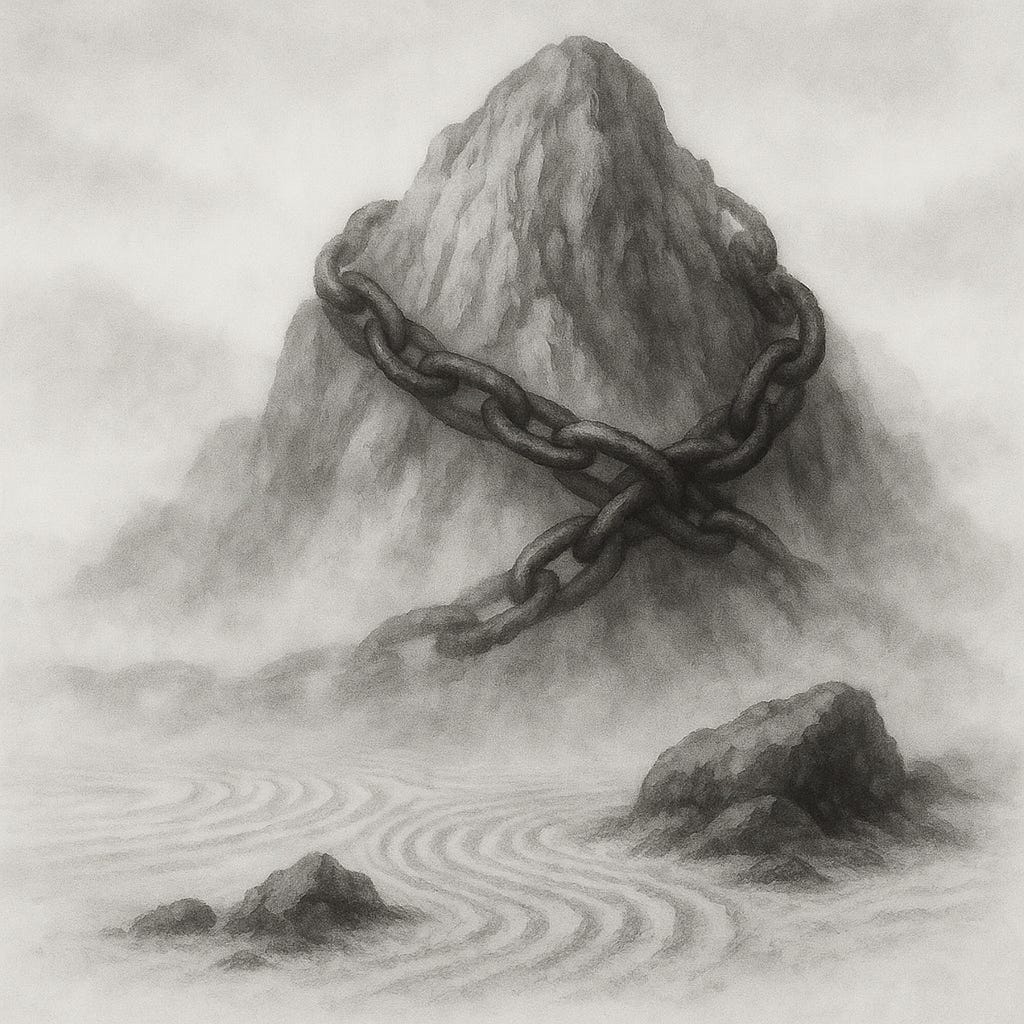
Fluke
Chance, Chaos, and Why Everything We Do Matters
Fluke
Chance, Chaos, and Why Everything We Do Matters

उम्र जल्वों में बसर हो ये ज़रूरी तो नहीं
हर शब-ए-ग़म की सहर हो ये ज़रूरी तो नहीं ……….ख़ामोश ग़ाज़ीपुरी
It is not necessary that life be spent only amidst splendors and brightness, Just as it is not necessary that every dark night of sorrow must have a dawn.
The above Urdu Couplet is what I was thinking when reading the book Fluke by Brian Klaas. Humans have a psychological need for narrative. When something bad happens, we cope by saying “everything happens for a reason” or “it’s all part of a bigger plan.” We look for a “dawn” (सहर) to justify the "night of sorrow" (शब-ए-ग़म).
By saying a dawn isn't guaranteed, the poet is suggesting that suffering does not inherently possess a hidden lesson, a reward, or a cosmic purpose. Sometimes a dark night is just a dark night. The universe isn't orchestrating a poetic conclusion for every event; events simply occur.
1. The Most Consequential Sightseeing Trip in Human History
If you could rewind your life to the very beginning and then press play, would everything turn out the same? That is the question Brian Klaas opens with, and it is the question the entire book is designed to answer. His answer is no. Emphatically, demonstrably, historically no.
Story: Kyoto, a tourist visit
On October 30, 1926, Mr. and Mrs. H. L. Stimson stepped off a steam train in Kyoto, Japan, and checked into room 56 at the Miyako Hotel. They strolled through the former imperial capital, soaking up the autumn colours, the crimson Japanese maples and the golden ginkgo trees. They visited the pristine gardens and the historic temples. Six days later they packed up, paid their bill, and left. Nineteen years later, in May 1945, thirteen men gathered at the top-secret Manhattan Project site in New Mexico and formed the Target Committee. Their task: decide which Japanese city should be the first to experience the atomic bomb. They chose Kyoto. It ticked every box: wartime factories, an educated population at a prestigious university, devastating symbolic significance as a former imperial capital. Kyoto was to be obliterated. Three backup targets were also agreed: Hiroshima, Yokohama, and Kokura. By this time, the tourist who had checked into room 56 had become Henry L. Stimson, America’s Secretary of War. When he learned that Kyoto was on the target list, he was furious. He told the head of the Manhattan Project: I don’t want Kyoto bombed. He told the commander of US armed forces: there is one city they must not bomb without my permission and that was Kyoto. He went to President Truman twice. Kyoto kept reappearing on the list. Finally, Truman relented. Kyoto was removed. Nagasaki was added as a late replacement. The first bomb fell on Hiroshima. The second bomb was intended for Kokura, but cloud cover made it impossible to see the target. The pilot circled. The clouds did not clear. With fuel running low, the crew flew to their secondary target, Nagasaki. That city too was obscured by clouds. At the last possible minute, the clouds parted. The bomb fell at 11:02 am on August 9, 1945, killing roughly 80,000 people. Kokura was spared by weather. Nagasaki was destroyed because of it. Two hundred thousand lives teetered between life and death because of a tourist couple and a cloud.
Klaas uses this story to introduce his central concept: Kokura’s luck. The Japanese phrase for when someone unknowingly escapes from disaster. Most of the pivots in our lives are invisible to us. We never see the near misses. We see the world that happened and conclude it was the only world that could have happened. Klaas wants to dismantle that conclusion, carefully and permanently.
2. The Soccer Ball That Crossed 80 Miles and Saved a Life
Klaas is suspicious of abstraction without grounding, so every large argument comes attached to a story that makes the point viscerally rather than intellectually. The soccer ball story is the one that stayed with me longest.
Story: Ivan and the ball that drifted 80 miles
In the summer of 2022, a tourist named Ivan from North Macedonia was swept out to sea off the coast of Greece. His friends alerted the coast guard. Searches came up empty. Ivan was declared lost at sea, presumed dead. Eighteen hours later, he was found alive. Just before he slipped below the waves to drown, Ivan had spotted a small soccer ball floating on the surface. He swam to it with his last ounce of strength. He clung to it through the night and was rescued. When Ivan’s story made the Greek news, a mother of two boys recognised the ball. Her sons had been playing with that exact ball ten days earlier when one of them accidentally kicked it into the sea. The ball had drifted for eighty miles across open water before converging with a drowning man at precisely the right moment. The boys had shrugged and bought a new one. They had no idea that their accidental kick had saved a stranger’s life.
The real story of our lives, Klaas argues, is often written in the margins. Small details matter. Even the apparently insignificant choices of people we will never meet can seal our own fate. The boys did not decide to save Ivan. They were not even thinking of Ivan when they kicked the ball. There was no intention, no plan, no purpose. And yet.
My note: Ivan’s survival was authored by two boys who kicked a ball without thinking, by currents that carried it the right way, by eighty miles of open water that happened to bring it to the right spot. We are not the sole authors of our lives. We are characters in a story with thousands of co-authors, most of whom we will never know. Everything is connected. I am not religious person but after these kind of story, I start question myself a little bit.
3. The Pant Leg That Saved Democracy
Klaas has a background as a political scientist, and it shows in the stories he chooses. He is drawn to moments where history’s hinge swings on something absurdly small. The Zambia story is his most personal.
Story: The pant leg and the coup that failed by a thread
Klaas travelled to Zambia to study why a coup d’etat attempt had failed. He was a social scientist, trained to look for structural explanations: political stability, lack of popular support, institutional resilience. He interviewed soldiers who had participated in the kidnapping attempt that was supposed to launch the coup. The plan was simple: capture the army commander, force him at gunpoint to announce the coup on the radio, and hope the rest of the military fell into line. As the soldiers burst into the commander’s house, he leaped from his bed and ran out the back door, beginning to climb the wall of his compound. A soldier reached up and grabbed the general’s pant leg between his fingers. The commander pulled himself up. The soldier tried to pull him down. In a slow-motion moment, the fabric slipped through the soldier’s fingertips. The commander clambered over the wall and escaped. The coup collapsed. Democracy in Zambia survived, quite literally, by a thread. If the soldier had been a millisecond quicker, his grip a tiny bit stronger, the regime would likely have collapsed.
Klaas says this experience was the seed of the whole book. He had gone to Zambia expecting to find structural, explainable causes. What he found instead was a pant leg. The story did not fit the models he had been taught. It did not fit any model. And that gap between what the models predicted and what the world actually produced was what he could not stop thinking about.
My note: Does everything happen for a reason or does stuff just happen? What if the plan worked and coup was successful. This is pure luck.
4. The Asteroid, the Eye, and the World That Almost Was Not
The book zooms out from human history to something larger: the contingency of life itself. The existence of any human being, and of the human species as a whole, rests on a chain of accidents so long and so improbable that understanding it changes how you feel about being alive.
Story: The asteroid that hit the wrong rock and made us all diggers
Sixty-six million years ago, an asteroid nine miles wide struck Earth with the force of 10 billion Hiroshima bombs. It crashed into gypsum-rich rock beneath the shallow sea of the Yucatan Peninsula. When the asteroid hit the gypsum, the explosion unleashed vast clouds of poisonous sulphur into the atmosphere. The surface of the planet surged by 500 degrees Fahrenheit, cooking the dinosaurs. The survivors mostly fit into two groups: those who could burrow underground and those that lived in the seas. When we look at any animal alive today, including the one in the mirror, we are seeing the offspring of those asteroid survivors, an arbitrary branch of life largely descended from resourceful diggers. Now consider the detail that Harvard astrophysicist Lisa Randall has proposed: the asteroid may have come from oscillations in the sun’s orbit as it passes through dark matter, small gravitational disturbances flinging it from the distant Oort cloud toward our planet. If the asteroid had hit a moment earlier or later, it would have struck deep ocean instead of shallow seas, releasing far less toxic gas, killing far fewer species. If it had been delayed by just one minute, dinosaurs might have survived. Humans might never have existed. And all of it might hinge on a small vibration in an unfathomably distant reach of deep space. That is contingency.
My note: Interesting. And agree on the asteroid. The deepest implication of the asteroid story is not that we were lucky. It is that there is no meaningful distinction between the world that happened and the infinite worlds that did not. We inhabit one arbitrary branch. The fact that it feels like the only possible world is a feature of our perspective, not a feature of reality.
5. The Archduke, the Stalled Car, and the Wrong Turn That Started a World War
The most dramatic illustration of what Klaas calls self-organised criticality, the way that complex systems build toward catastrophe and then tip, involves Archduke Franz Ferdinand, a hunting accident in the snow, and one of the most consequential wrong turns in the history of navigation.
Story: How World War One almost did not happen
In November 1913, Archduke Franz Ferdinand visited the Duke of Portland at an estate in Nottinghamshire. Deep snow covered the grounds. The duke and the archduke went out to hunt pheasants. During the shoot, the servant tasked with loading the guns tripped and fell in the snow. As he tumbled, both barrels of the gun discharged. The shots narrowly missed the archduke. If the angle of the barrel had moved by even one degree, the archduke would likely have been killed in England, eight months before his assassination in Sarajevo. The sandpile of European alliances had been building for years: France and Russia aligned, Germany joined with the Austro-Hungarian Empire, Britain with France and Russia, Germany fearing encirclement and arming furiously. By 1914 the sandpile was towering. But would the next contingent event trigger a minor avalanche or a major one? In Sarajevo, Franz Ferdinand’s motorcade came under attack. A bomb bounced off the car. He survived. He and his wife then decided to visit the hospital to pay respects to the wounded. No assassin could have prepared for this unplanned trip. As the motorcade moved through the streets, the driver took a wrong turn. He reversed the car and stalled it. The car sputtered to a stop six feet away from Gavrilo Princip, another would-be assassin. Princip pointed his gun and fired two shots. The archduke and his wife both died. Their deaths unleashed the cascade that became World War One. The Duke of Portland, who had witnessed the archduke narrowly escape death by a hunting accident nine months earlier, wrote in his memoirs: I have often wondered whether the Great War might not have been averted, or at least postponed, had the archduke met his death then, and not at Sarajevo.
My note: Interesting story. And the World War One story illustrates the difference between what Klaas calls risk and uncertainty beautifully. Risk is when you do not know what will happen but you know the odds: a six-sided die, a fair coin. Uncertainty is when you do not know what will happen and you have no way of knowing the odds because the underlying mechanism is also unknown and constantly changing. The IMF constantly fails to predict the onset of recessions because it is treating uncontrollable uncertainty as though it is resolvable risk. Europe in 1914 was not a risk problem. It was an uncertainty problem. No probability model could have told you that a wrong turn by a driver on one street in Sarajevo would tip the whole sandpile. This uncertainty and risk distinction is one of the most important things in this book.
6. Three Lost Cigars and the Course of American History
History, Klaas argues, is not made by inevitable forces expressing themselves through convenient individuals. It is made by individuals at specific moments, in specific places, whose presence or absence was itself the product of accidents. The lost cigars story is his evidence.
Story: Three cigars, a soldier in the shade, and the Emancipation Proclamation
On September 13, 1862, Corporal Barton W. Mitchell of the Union Army was taking a break from marching. He settled into the shade of a tree. As he stretched out, something caught his eye hidden in the weeds: a sheet of paper wrapped around three cigars. The heading read: Confidential. Hd Qrs Army of Northern Va. Sept 9th, 1862. Special Orders 191. Barton had accidentally discovered the complete marching orders for the Confederate Army. The document was brought to a division commander, General Alpheus S. Williams. Outside his tent, the document was handed first to his adjutant general, Colonel Samuel Pittman. Unrolling the paper, Pittman read it, grasped its significance, then paused when he saw the signature at the bottom. Immediately, he knew the orders were genuine. The orders were signed by R. H. Chilton. Before the war, Pittman had been a bank teller in Detroit. Chilton had been the paymaster for the US Army. Chilton had had to sign checks for payments. Pittman had seen Chilton’s signature thousands of times. When he saw the signed paper unrolled from the cigars, he instantly knew it was authentic. Armed with the intelligence, the Union Army marched to meet the Confederate troops. The bloodiest day in American history, the Battle of Antietam, ensued four days later. The Union suffered severe casualties but had been prepared for the assault. Antietam forced the Confederates to retreat, reversing the momentum of the war. Five days after the battle, President Lincoln issued the Emancipation Proclamation. It is a strange but plausible possibility that modern history pivoted on three lost cigars, a soldier resting in just the right patch of shade, and enemy orders arriving by happenstance into the hands of the only man in the Union Army who could have been sure they were genuine.
My note: It is an illustration of a principle Klaas introduces elsewhere: that the messenger matters as much as the message. Pittman could authenticate the orders because of who he had been before the war. His previous life, as a bank teller in Detroit, was what made him uniquely valuable in that moment. The right person, the right place, the right history intersecting with a contingent event. Every detail in the chain had to be exactly as it was. The historian in all of us wants to write this out and find the structural explanation. But sometimes the right place to look, as Corporal Mitchell discovered, is in the weeds.
7. Darwin’s Nose and the Near Miss That Almost Killed a Theory
One of the most illuminating sections of the book concerns the history of science, specifically the question of whether great discoveries are inevitable or contingent on the specific individuals who made them. The Darwin story is a masterpiece of accumulated accident.
Story: Darwin’s nose, a suicidal captain, and the shape of science
The HMS Beagle’s first voyage was captained by a man named Pringle Stokes. In 1828, while the ship was anchored at the southern tip of South America, Stokes fell into a deep depression. The dreary weather was so bleak, he wrote in his diary, that the soul of man dies in him. He locked himself in his cabin, shot himself, and died several days later. Had Stokes stayed alive, Charles Darwin would never have set foot on the Beagle. The captaincy passed to Robert FitzRoy, an aristocratic officer who was aware of the lonely isolation of command. Hoping to avoid the fate of Stokes, FitzRoy searched for an onboard companion for the next voyage. His first choice, a clergyman, refused because he did not want to neglect his religious duties. His second choice, a professor, refused because he did not want to upset his wife. The professor recommended a former student as a suitable contender: Charles Darwin. When FitzRoy set eyes on Darwin, he was alarmed. FitzRoy believed in physiognomy, the notion that physical traits reflect character. He doubted whether anyone with Darwin’s nose could possess sufficient energy and determination for the voyage. Darwin was nearly rejected because of the shape of his nose. FitzRoy eventually relented. Darwin returned from the voyage in 1836 with ideas that could revolutionise biology. He stuck his drafts in a drawer for two decades, delaying publication for reasons ranging from personal illness to fear of religious backlash. Then in 1858 he received a letter from Alfred Russel Wallace describing a remarkably similar idea. Fearing that Wallace would get the credit, Darwin rushed his manuscript to a publisher. The reviewer, a clergyman named Whitwell Elwin, tried to dissuade publication, suggesting Darwin would be better off writing a book about pigeons instead. A suicidal captain, a reluctant clergyman, an aristocrat suspicious of noses, a delayed drawer, a rival naturalist, and a clergyman reviewer who preferred pigeons: the theory of natural selection made it into the world despite all of them.
Klaas uses this to make the point that even scientific ideas, which we imagine to be the most objective and inevitable products of human inquiry, are shot through with contingency. The German meteorologist Alfred Wegener proposed continental drift in 1912. For nearly fifty years it was dismissed because he was a meteorologist and balloonist, not a geologist, and because he was German at a time when Europe was at war with Germany. The right idea, but the wrong messenger, in the wrong country, at the wrong moment.
My note: Interesting view. Darwin matters because if his nose had been slightly different, if the first captain had not killed himself, if the clergyman reviewer had prevailed, On the Origin of Species might never have been published when it was. Klaas’s point is that the timing, the packaging, the framing, the person attached to the idea: all of these contingent factors shape how and when and whether an idea reshapes the world.
8. Phytoplankton, Donald Trump, and the Election Decided by Ancient Geology
One of the most spectacular stories in the book stretches from the Cretaceous period to a US presidential election.
Story: Dinosaur-era plankton and a Georgia election
During the Cretaceous period, when velociraptors roamed the earth, an enormous inland sea covered what is now America’s Great Plains and most of the Deep South. In that shallow sea, trillions of microscopic plantlike organisms called phytoplankton thrived. When they died, they sank to the sea bottom and, over vast stretches of time, turned into a nutrient-rich chalk layer. Eventually the sea receded, revealing a crescent-shaped strip of extraordinarily fertile dark soil. Millions of years later, this became the Black Belt of the American South, named for its rich dark earth, the best cotton-growing land in the United States. European colonists and their enslaved African labour concentrated on this crescent. The location of slave plantations on the eve of the Civil War corresponds almost perfectly to the crescent-shaped coastline of that ancient inland sea. In the 2020 US presidential election, Donald Trump’s defeat depended in part on a narrow loss in the state of Georgia. Control of the US Senate hinged on Democratic victories there too. The margins for those victories came overwhelmingly from African American voters, many of them descendants of formerly enslaved people who had been forced to live and work on the fertile crescent of phytoplankton-rich soil. Donald Trump’s defeat and the entirety of Joe Biden’s political agenda after his victory were partly caused by the historically contingent demographic impact of microscopic plankton in an ancient sea.
My note: Very very interesting story. And this is what I find most powerful in the book. It is not just that flukes matter. It is that the causal chains run so deep and so far back that any meaningful account of why something happened today has to include events from millions of years ago that had nothing to do with human intention.
9. Risk and Uncertainty: The Most Important Distinction in the Book
Klaas makes a distinction that he borrows from the economist Frank Knight, and it is one of the most practically useful ideas in the book. The difference between risk and uncertainty.
Risk is when a future outcome is unknown but the precise odds of something happening are known and stable. Tossing a six-sided die is a matter of risk. We do not know which number will land face up, but we know each has a one-in-six chance. Risk can be tamed. You can build probability models around it. Insurance companies live here.
Uncertainty is when a future outcome is unknown and the underlying mechanism producing that outcome is also unknown and may be constantly changing. We are completely in the dark. The IMF constantly fails to predict the onset of recessions because it is treating uncontrollable uncertainty as though it is resolvable risk. It is not, so the forecast fails. Most of the things that matter most in human life live in the uncertainty category, not the risk category. Economics, politics, relationships, health: these are not six-sided dice with knowable distributions. They are complex, chaotic, intertwined systems where small changes can cascade unpredictably.
As the economist and former governor of the Bank of England Mervyn King put it: We have all grown up with the idea that if you are intelligent, you think about uncertainty in terms of probabilities. I think this is a serious mistake and it detracts from good decision-making. Too many people rise to the top following the strategy of always certain, but often wrong.
10. We Control Nothing but Influence Everything
The final movement of the book is where Klaas turns from analysis to something approaching wisdom. Having spent most of the book demonstrating that the world is far more chaotic, intertwined, and contingent than we like to believe, he addresses the obvious question: so what do we do with that?
His answer is neither hopeless nor falsely comforting. We may control nothing, but we influence everything. That phrase sounds paradoxical but it is not. In an intertwined world, every action sends ripples outward in ways we cannot track or predict. The boys who kicked the ball into the sea did not control whether it would save someone’s life. But they influenced the outcome. The Stimsons did not control what the Target Committee would decide two decades later. But their holiday influenced the world.
The implication is more potent than any self-help book can imagine. Many of our ripple effects will be hidden from us. We will never know the Stimson-equivalent moments in our own lives, the invisible pivots, the consequences we caused that we will never see. But the truth of this fresh worldview is that everyone and everything a person does in a lifetime matters. Not in a cosmic-plan, everything-happens-for-a-reason sense. In a causal, physical, empirical sense.
Story: Henri Poincare, black coffee, and ideas that arrive when you stop chasing them
The French mathematician Henri Poincare, one of the greatest thinkers of the last two centuries, described a striking experience. For fifteen days he had toiled with a mathematical problem, sitting at his desk, scratching out possible solutions with his quill, to no avail. The harder he worked, the more frustrated he became. Then one evening, contrary to his custom, he drank black coffee and could not sleep. Once he stopped trying to tame the problem with concerted action, something happened. Ideas arose in crowds, he wrote. I felt them collide until pairs interlocked. By the next morning, the solutions flowed out of him. I had only to write out the results. Galileo’s discovery that a pendulum could measure time, which paved the way for later clocks, was said to have emerged in a quiet moment of watching a chandelier swing from a cathedral ceiling. Einstein said that many of his most important insights emerged while playing the violin. The Wright brothers imagined their flying machine during a relaxing picnic watching buzzards. By chasing control, we trap ourselves. By letting go just a little, we may liberate not only ourselves but our best ideas.
Klaas closes with the monarch butterfly, whose three-thousand-mile migration is too long for any individual to complete. Instead, it is an interconnected journey across generations, each butterfly part of an endless relay, each life started where the parents stopped. They may cause hurricanes or, more likely, provide a profound moment of beauty to a child who pauses to gaze at them flitting across a meadow. We are like those butterflies. We are each hitched to one another, which yields a profound gift: that everything we do matters and it creates the ripple effect
My note: Fully agree. It can be comforting to accept what we truly are: a cosmic fluke, networked atoms infused with consciousness, drifting on a sea of uncertainty. We do not have to control everything. It is okay. I find this genuinely liberating. The modern malaise Klaas describes, the obsession with productivity, efficiency, control, the idea that every moment must be optimised toward some deliverable outcome, is itself a product of the wrong worldview. It is built on the illusion that we can tame uncertainty, that we are the sole authors of our stories, that if we just make the right choices everything will be all right. Accepting the intertwined, contingent nature of the world does not mean giving up. It means taking a different kind of responsibility. We may control nothing. But we influence everything.
Final Thoughts
Fluke is the kind of book that changes what you notice. After reading it, a chance encounter on a train feels different. A missed bus feels different. The news feels different. The borders between causes and effects dissolve. You start to see the soccer balls drifting across open water, the pant legs slipping through fingers, the clouds over Kokura, everywhere.
Klaas’s argument rests on six interlocking ideas. Everything is connected, so small changes can have enormous consequences. The distinction between convergence and contingency determines whether a detail matters or gets washed out. Complex systems can build toward catastrophic tipping points. The difference between risk and uncertainty is often ignored. Individual people, in specific moments, genuinely alter history. And accepting all of this, rather than retreating into the comforting myth of control, is the beginning of a more honest and richer way of living.
The phrase he keeps returning to is the one that stays longest: we control nothing, but we influence everything. It is not a slogan. It is a description of how the world actually works. The Stimsons influenced the survival of Kyoto by checking into a hotel room and looking at maple trees. The boys influenced Ivan’s survival by kicking a ball into the sea. Corporal Mitchell influenced the Emancipation Proclamation by resting in just the right patch of shade. We are all, always, doing something similar. We just cannot see it.
Perhaps the honest and freeing response to all of this is not anxiety but wonder. We are each the living manifestation of 13.7 billion years of flukes. Everything had to be exactly as it was for us to exist, in this precise moment, in this exact world. That is not a reason for complacency. It is a reason for humility, curiosity, and the willingness to do something, anything, without knowing exactly where it leads.
메타데이터
- post_id
- d33f7c9260f4
- slug
- fluke-d33f7c9260f4
- url
- https://medium.com/@chiranjivipawar/fluke-d33f7c9260f4
- canonical_url
- https://medium.com/@chiranjivipawar/fluke-d33f7c9260f4
- author_url
- https://medium.com/@chiranjivipawar
- status
- ok
- fetched_at
- 2026-06-27 07:40:21