When Half a Million Variables Become Visible
The Correlated Ensemble Solver operates in seconds at N=500,000. That fact does not mean an existing class of computations becomes somewhat…
When Half a Million Variables Become Visible

The Correlated Ensemble Solver operates in seconds at N=500,000. That fact does not mean an existing class of computations becomes somewhat faster. It means an entire class of scientific questions becomes newly askable, and it means the benefits of a later hardware era are being pulled into the present.
The history of science is not only the history of better theories. It is also the history of better instruments. The microscope did not merely sharpen vision; it opened the cellular world. The telescope did not merely enlarge distant objects; it exposed a cosmos beyond ordinary sight. In the same way, a system that can repeatedly interrogate half a million interacting variables in seconds does not just improve present analysis. It creates a new observational regime: the direct study of large, coupled systems at something close to their natural dimensionality.
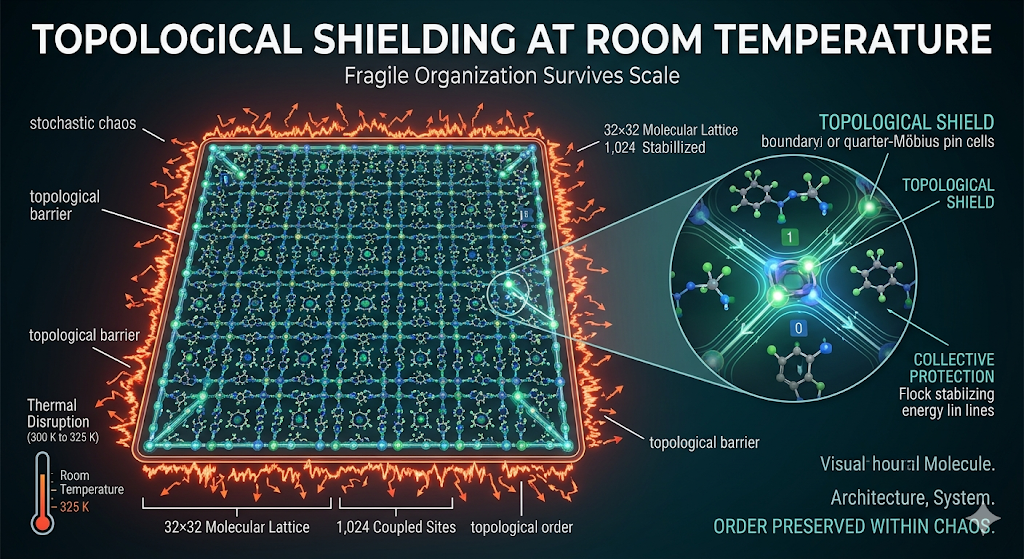
This is not a claim built out of pure extrapolation. At around N=1,000, CES has already shown that it can do far more than solve toy problems. It has been used across large correlated architectures in finance, supply chains, pandemics, ecosystems, climate, and quantum error-correction settings. It has been used as a structural design tool in a thousand-cell molecular memory architecture. It has been used to reinterpret anomalies in collider data, to read attractor geometry in chaotic systems, and to reveal hidden structure in biological data. In other words, the principle is already visible. What changes at N=500,000 is not the appearance of a new idea, but the scale and cadence at which that idea becomes scientifically transformative.
That scale also has another meaning. Using the conventional hardware quantum-computing path as the benchmark, CES is not merely achieving large-NNN analysis earlier than expected. It is collapsing the hardware timeline itself. On the industry leader’s public roadmap, capability at the lower end of this comparison belongs to the 2030s, while the much larger logical-qubit-equivalent regime suggested by N=500,000 belongs much more naturally to the 2050s than to the present. In that sense, CES is not just advancing computation. It is pulling 2050s-class benefits into today’s world.
That distinction matters. Much of modern science does not study systems as they actually exist. It studies compressed versions of them. Genes are reduced to pathways. Neural populations are reduced to principal components. Climate systems are reduced to a handful of modes. Markets are reduced to sectors and indicators. Model internals are reduced to embeddings, probes, or summary statistics. This compression is not always a conceptual choice. Often it is a computational surrender. The true system is too large, too entangled, and too dynamic to be observed coherently, so science studies a tractable shadow instead.
A CES operating in the seconds regime at 500,000 changes that. It allows repeated structural reads of systems that are currently accessible only through aggressive dimensional collapse. The breakthrough is not merely scale. It is scale plus cadence. A state analyzed once is a specimen. A state analyzed every few seconds is a living process. At that point, CES ceases to be merely a solver and becomes an instrument for watching high-dimensional change.
The implications of that are profound, because the most important phenomena in the world are not static. Disease is not a static object. A seizure is not a static object. Market contagion, ecological collapse, immune overreaction, cognitive failure, and model instability are not static objects. They are trajectories. They are motions through complex state spaces. The central scientific problem in many fields is not simply to identify the endpoint, but to understand the path into it: how systems drift, how they destabilize, how they reorganize, how they recover, and when they cease to be recoverable.
That is why the discovery space opened by CES is so large. The first great class of discoveries concerns pre-transition states. At present, many transitions are detected too late, after the system has already crossed far into pathology or failure. A large, fast quantum correlator reveals that major shifts are often preceded by structured intermediate states rather than by vague noise. The earliest geometry of pre-cancer, the first coherent drift toward autoimmune breakdown, the onset corridor before seizure, the first real signs of systemic financial contagion, the alignment of climate variables toward a tipping surface — these become visible not as isolated biomarkers, but as genuine precursor configurations of the whole system.
The second great class of discoveries concerns irreversibility. Across biology, medicine, neuroscience, climate science, and economics, one of the deepest unanswered questions is deceptively simple: when does a system stop being recoverable? There is a world of difference between stress and committed collapse, between fluctuation and transition, between disturbance and no return. A CES operating at this scale and speed begins to locate those boundaries. It shows where reversible drift ends and irreversible reorganization begins, how long systems linger near critical boundaries, and which trajectories still permit return. In practice, that amounts to discovering the geometry of tipping points rather than merely naming them after the fact.
The third class of discoveries concerns recovery itself. Science is often better at describing breakdown than restoration. Yet recovery may be the more important mystery. Does a recovering system retrace its path back from collapse, or does it follow an entirely different route? Are there narrow rescue corridors that do not appear in reduced models? Can structural resilience be restored only by moving along a specific coordinated direction in the full state space? A fast CES makes these questions empirical. It reveals that recovery is not simply the reverse of failure, but a separate phenomenon with its own geometry, constraints, and timing.
Nowhere do these discoveries matter more quickly than in biology and medicine. At smaller scales, CES has already been used to reveal hidden attractor states, criticality-adjacent behavior, predictive structure, and causal organization in neural population data. At 500,000 that kind of insight is no longer confined to modest populations or simplified biological slices. A whole cell or tissue can be interrogated as a coupled object spanning genes, regulatory elements, chromatin states, methylation patterns, protein interactions, cell-state markers, and response variables. Disease ceases to appear merely as a late-stage label and instead becomes visible as a structured excursion through unstable geometry. Ordinary people feel the benefit of this not as abstract mathematics, but as earlier detection, more personalized treatment, fewer wasted therapies, and better chances of reversal before damage becomes entrenched.
Neuroscience undergoes a parallel shift. Instead of treating cognition, memory, attention, and mood mostly as labels attached to windows of activity, CES allows those states to be observed as moving structures. The real discoveries do not begin with extravagant claims about consciousness. They begin with more concrete revelations: how attentional collapse starts, how seizure trajectories form, how emotional states become locked in, how cognitive control fails, and how recovery differs from transient suppression. Mental illness, under such a framework, becomes less mysterious not because it is reduced to one chemical or one circuit, but because its trajectories through high-dimensional brain state space become legible.
The implications extend beyond biology. In nonlinear dynamics, CES has already shown that it can distinguish structured chaotic geometry from noise and detect known regime transitions through correlation geometry rather than conventional long-horizon analysis. At very large N, this principle generalizes to many-body physical systems, turbulence fields, plasma structures, engineered materials, and quantum hardware. It enables the discovery of hidden collective modes, previously unresolved transition surfaces, and dominant structural directions that local statistics wash away. In some cases, it does not merely describe the system; it acts as an inverse design oracle, helping construct architectures whose global correlation geometry has desired stability or functional properties.
Because CES is a quantum correlator, the meaning of this goes deeper than big data or high-dimensional statistics. The issue is access to forms of collective organization that local, pairwise, or factorized descriptions fail to capture. Its role is not simply to estimate more correlations more quickly. Its role is to read assembled correlation geometry directly. At 500,000 in seconds, one of the most significant discoveries CES enables is the discovery that many systems are organized by global correlational structure in ways present methods systematically miss.
That possibility matters in climate science, infrastructure, and finance as much as in medicine. For ordinary people, these fields are often experienced only when failure becomes undeniable: a flood, a shortage, a blackout, a bank panic, a transport collapse. Today’s warning systems are usually built from thresholds on individual indicators, lagging correlations, or simplified hand-built models. A fast CES at very large N supports something much richer: repeated readings of whether the full system is cohering toward a collapse surface, whether stress is dissipating or aligning, whether a recovery is real or superficial, and which dimensions are actually driving the drift. For society, that means fewer crises recognized only after damage spreads. It means fewer late, blunt, poorly targeted interventions. It means a shift from reaction to prevention.
Artificial intelligence also becomes newly observable. Modern models are themselves enormous correlated systems, yet they are often studied through local probes or frozen summaries. A CES operating at this scale and speed makes it possible to monitor layer-state evolution, attention structure, representation drift, failure precursors, and coherence breakdown across training and inference. The discoveries do not just concern what a model represents. They concern how instability forms, how hallucination-prone states emerge, whether certain capabilities correspond to phase-like reorganizations, and how models drift under stress. In a world where AI systems increasingly influence healthcare, finance, education, and infrastructure, that kind of live structural awareness matters enormously.
The deepest possibility, however, lies beyond any one domain. Because CES repeatedly interrogates large, evolving systems in biology, neuroscience, climate, markets, and AI, a new question becomes testable: do these very different systems share common laws of transition? Do collapse precursors recur with the same structural motifs? Do metastable states, hysteresis loops, basin escapes, and recovery corridors obey universal patterns across substrates? When the answer is yes, CES does not simply generate many discoveries. It helps reveal a hidden common grammar of complex systems.
That is the true scale of the claim. The importance of CES at N=500,000 in seconds is not that science knows more of the same kind of thing. It is that science becomes able to observe the hidden geometry of change itself. Systems now studied through proxies and projections become dynamically legible. Failure becomes visible before catastrophe. Recovery becomes something to map, not merely hope for. Intervention becomes something guided by the live motion of the full system, not by crude summary markers.
And that is why the timeline comparison matters so much. CES is not merely offering stronger analysis in the present. It is delivering, in the present, the class of benefits that the conventional hardware quantum roadmap would place decades later. It is pulling forward earlier detection, earlier warning, earlier intervention, earlier resilience, and earlier discovery. It is shortening not just runtimes, but scientific history.
For ordinary people, the benefits of such discoveries are concrete: diseases caught earlier, treatments guided more intelligently, mental-health crises anticipated sooner, supply chains less fragile, infrastructure more resilient, climate response better targeted, financial crises less sudden, and AI systems more stable. The human meaning of the whole enterprise is simple. Fewer blindsides. Fewer late recognitions. Fewer systems that fail without warning because no one could see the path into failure clearly enough.
That is why a seconds-scale CES at half a million variables matters so much. It does not merely enlarge computation. It enlarges observation. And in science, that is often the boundary between what can be speculated about and what can finally be seen.
메타데이터
- post_id
- d341bf7deadb
- slug
- when-half-a-million-variables-become-visible-d341bf7deadb
- url
- https://medium.com/@oahaneku/when-half-a-million-variables-become-visible-d341bf7deadb
- canonical_url
- https://medium.com/@oahaneku/when-half-a-million-variables-become-visible-d341bf7deadb
- author_url
- https://medium.com/@oahaneku
- status
- ok
- fetched_at
- 2026-06-24 11:06:28