virtua📚 Geneve Protocol: A Guide to Flexible Network Virtualization (RFC 8926)
🎯 What is Geneve?
Geneve Protocol: A Guide to Flexible Network Virtualization (RFC 8926)

🎯 What is Geneve?
Geneve (Generic Network Virtualization Encapsulation) is an IETF Standards Track protocol (RFC 8926) designed to create virtual overlay networks over existing Layer 3 IP infrastructure. It functions as a flexible tunneling protocol, acting as a successor and unifier to earlier efforts like VXLAN and NVGRE, primarily for use in large-scale data centers and cloud environments.
Core Purpose
Geneve addresses the need for network virtualization by allowing multiple, isolated virtual networks (known as tenants or segments) to share a common physical network infrastructure. It does this by encapsulating the original data packet inside a new outer IP/UDP packet, which is then routed across the physical network.
📦 Geneve Packet Format
Geneve packets are constructed in layers by a Virtual Tunnel Endpoint (VTEP), typically running on a hypervisor or specialized switch.
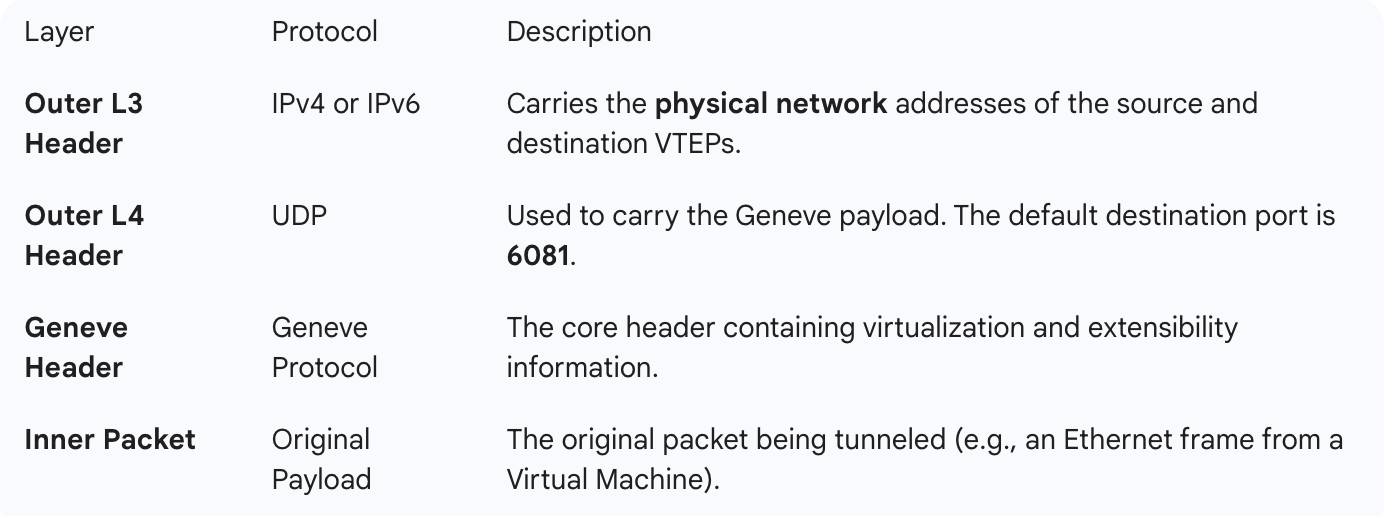
The Geneve Header
The Geneve header is the key to the protocol’s flexibility.
- VNI (Virtual Network Identifier) (24 bits): Identifies the specific virtual network segment. This supports up to 16 million unique virtual networks.
- Protocol Type (16 bits): Defines the type of the encapsulated inner packet (e.g., $0\text{x}6558$ for Ethernet, $0\text{x}0800$ for IPv4, etc.). This makes Geneve protocol-agnostic.
- Opt Len (Options Length) (6 bits): Specifies the length of the variable-length Options field in 4-byte units.
- Variable-Length Options (The Extensibility Field): This is the most crucial difference from other protocols. It allows for the inclusion of arbitrary Type-Length-Value (TLV) metadata.
🆚 Geneve vs. VXLAN: Why Geneve Exists
Both protocols provide network virtualization, but Geneve is more flexible and extensible than VXLAN. While they both utilize UDP encapsulation and a 24-bit Virtual Network Identifier (VNI), their headers have significant differences.
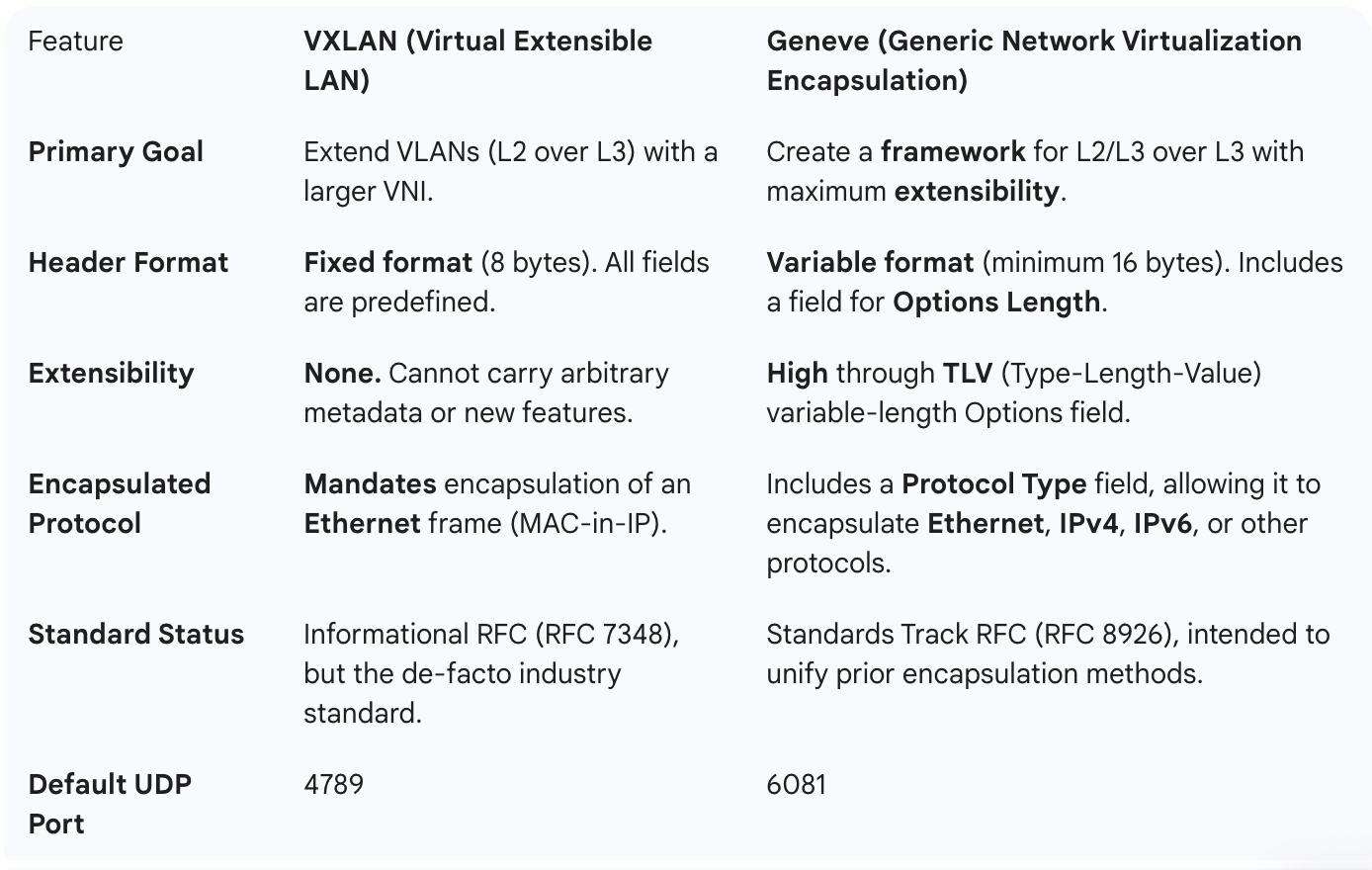
The Power of Metadata (TLVs)
Geneve’s extensibility field allows network functions to add crucial operational and policy information to the tunnel header. This metadata can be used by the destination VTEP or intermediary devices to influence traffic handling. Examples include:
- Service Chaining: Injecting instructions to steer the packet through a specific set of network functions (e.g., Firewall $\rightarrow$ Load Balancer).
- Group Based Policy (GBP): Embedding security group IDs for micro-segmentation policies.
- In-band Telemetry: Adding path and performance data at each hop for monitoring and troubleshooting.
💡 How Geneve Works: The Data Flow
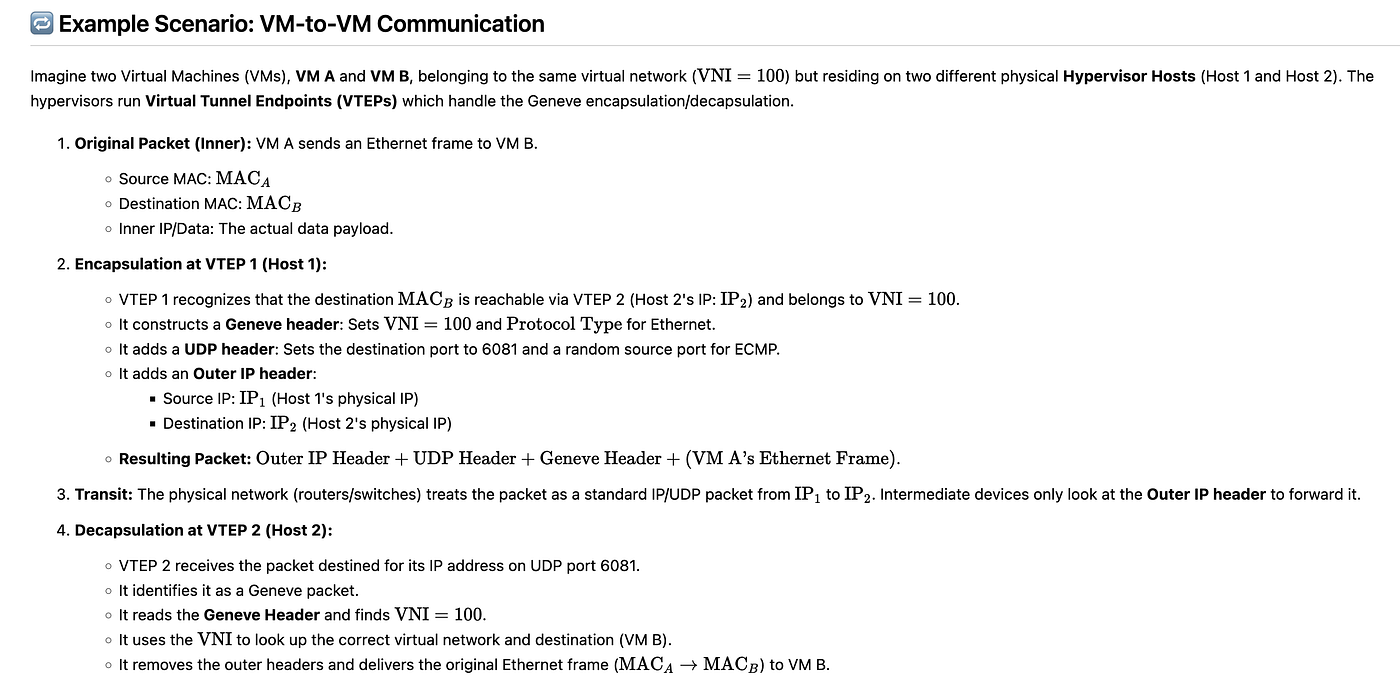
The process of encapsulation and decapsulation allows two virtual machines on different physical hosts to communicate as if they were on the same network segment:
- Encapsulation (Source VTEP):
- A VM sends an inner packet (e.g., Ethernet frame).
- The source VTEP looks up the destination VTEP’s physical IP address.
- It creates the Geneve Header, setting the VNI and optionally adding TLVs (metadata/policies).
- It adds the UDP and Outer IP headers.
2. Transit (Physical Network):
- Routers only examine the Outer IP Header and forward the packet across the underlay network to the destination VTEP.
3. Decapsulation (Destination VTEP):
- The destination VTEP receives the packet on UDP port 6081.
- It verifies the VNI and processes any optional TLVs.
- It strips all outer headers (IP, UDP, Geneve) and delivers the original inner packet to the destination VM.
🔁 Example Scenario: VM-to-VM Communication
Geneve is a key enabler for advanced features in modern software-defined networking (SDN) and cloud platforms, providing the flexibility needed to evolve network virtualization without requiring a continuous stream of new, fixed-format protocols.
Geneve #vxlan #virtualization #hypervisor #DevOps #SystemAdministration #sdntechforum
🙏 Thank you 🙏 for being a part of the SDNTechForum community! 💖🤖💖
Before you go, don’t forget to leave some claps 👏👏👏 (≥50 would be amazing 😉) and follow me ️🙏.
For further reading, explore my in-depth analysis on Medium and YouTube.
메타데이터
- post_id
- d367371fa840
- slug
- virtua-geneve-protocol-a-guide-to-flexible-network-virtualization-rfc-8926-d367371fa840
- url
- https://medium.com/@sdntechdemo/virtua-geneve-protocol-a-guide-to-flexible-network-virtualization-rfc-8926-d367371fa840
- canonical_url
- https://medium.com/@sdntechdemo/virtua-geneve-protocol-a-guide-to-flexible-network-virtualization-rfc-8926-d367371fa840
- author_url
- https://medium.com/@sdntechdemo
- status
- ok
- fetched_at
- 2026-07-14 03:07:18