Ars Goetia Seals: Who Gave Demons a Signature?
https://youtu.be/U7OYqN5WyX0
Ars Goetia Seals: Who Gave Demons a Signature?
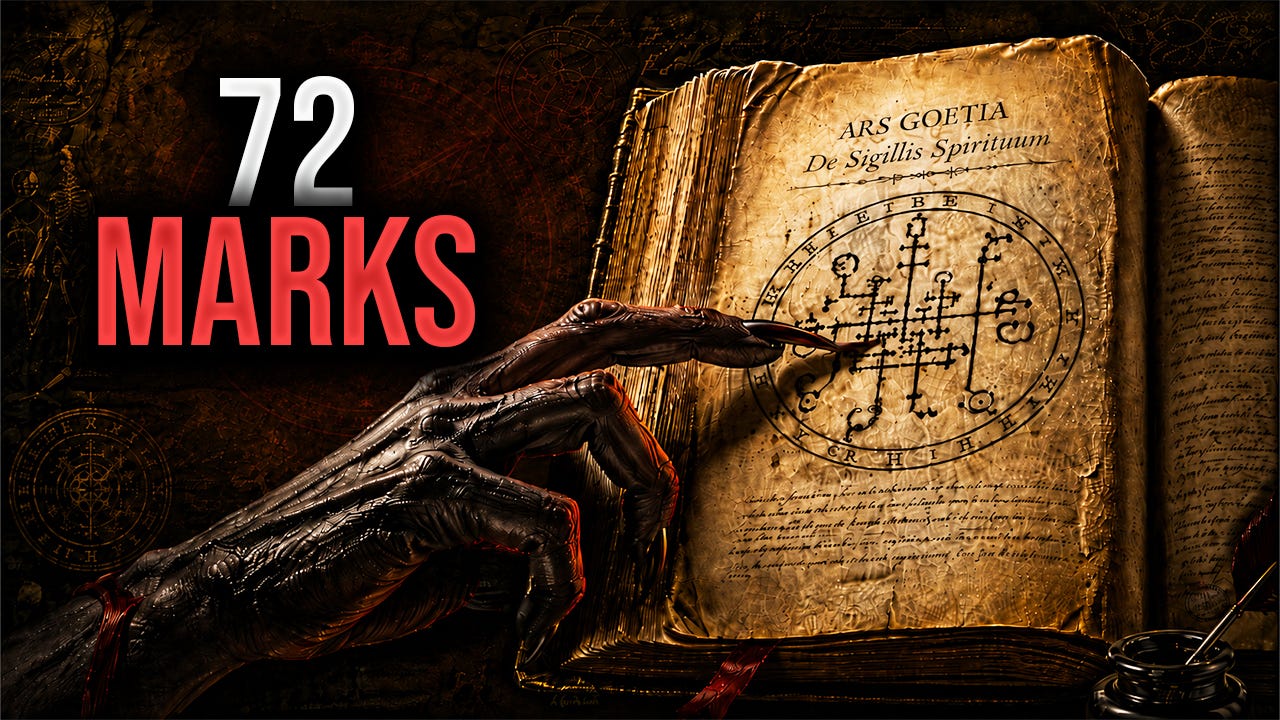
Seventy-two demons. Seventy-two names. Seventy-two geometric marks. But the origin of the seals remains unexplained.
Primary keyword: Ars Goetia seals
Related keywords: Ars Goetia, Lesser Key of Solomon, Goetia demons, demonic seals, Solomonic magic, Pseudomonarchia Daemonum, Aleister Crowley, Sloane MS 2731
At first glance, the Ars Goetia seals look like signatures. A circle. A few compressed lines. A curve bending back on itself. A name written around the edge, as if the mark inside belongs to something that can be identified, fixed, and called.
But these were not decorative symbols. In the magical system that preserved them, they were functional objects: tools meant to make contact with spirits believed to exist beyond the visible world.
The strange part is not only that the Ars Goetia contains seventy-two demons, each with its own rank and seal. The stranger part is that the seals appear late. The demon list circulated before them. Then, sometime between 1577 and 1687, seventy-two unique geometric marks entered the tradition with no named author and no surviving explanation.
Someone gave demons a signature. Nobody knows who.
What Are the Ars Goetia Seals?
The Ars Goetia is the first book of a seventeenth-century grimoire known as the Lesser Key of Solomon. It presents a catalog of seventy-two spirits, each with a name, rank, description, and seal.
Each seal acts as the spirit’s permanent visual mark.
In modern terms, it is tempting to call them “symbols.” But that word is too weak for how the system presents them. To the people who used this grimoire, a seal was not a casual emblem or a decorative reference. It was a working sign.
The seal identified the spirit. It compressed the spirit’s name and presence into a visible form. It could be drawn, worn, displayed, and held as proof that the conjurer knew what they were addressing.
The Missing Origin of the Demon Seals
The grimoire has no known author. No name appears in the surviving manuscripts that explains who created the full system of seals.
The earliest complete manuscript containing all seventy-two seals is held at the British Library in London and catalogued as Sloane MS 2731, dated to approximately 1687. It was compiled from earlier versions of the material, some going back to at least the fifteenth century.
Before that complete seal system appears, the demon list already existed.
In 1577, the German physician Johann Weyer published the Pseudomonarchia Daemonum, or False Monarchy of Demons. It included sixty-nine spirits with names, ranks, and descriptions. Weyer presented it as a critique of demonology, a catalog intended to expose the absurdity of organized demon belief.
But Weyer included no seals.
His demons existed only in language.
Then came the gap: roughly one hundred and ten years. By the time the Sloane manuscript appears, the list has become seventy-two demons, and every spirit has a unique geometric mark attached to it.
No record explains who added them. No manuscript tells us where they came from. They simply enter the tradition as though they had always belonged there.
The 1904 Version That Shaped Everything
The version most people recognize today comes from the 1904 publication by Aleister Crowley, based on a translation by Samuel Liddell MacGregor Mathers.
Mathers redrew the seals. He enclosed them in double circles and added the demon names around the outer rings in Roman letters. That edition became the standard reference point for later reproductions.
But this matters: the 1904 edition was not the raw original.
It was a later transmission. It made the seals look fixed, finished, and authoritative in a way the manuscript tradition itself did not always support. In different manuscript copies, the same demon’s seal could vary: lines shifted, curves reversed, small details altered.
The authority of the familiar Ars Goetia seals was constructed through copying, redrawing, and standardization.
The World That Produced Solomonic Magic
To understand why the Ars Goetia exists, we need the intellectual world that produced it.
In sixteenth- and seventeenth-century Europe, the boundary between natural philosophy and occult practice was not fixed in the way it is usually imagined today. Scholars could study astronomy and astrology. Physicians might consult celestial charts. Invisible forces were not automatically dismissed as superstition.
In that world, Solomonic magic had a powerful position.
King Solomon, known in biblical tradition for wisdom and for the Temple in Jerusalem, developed a second reputation across later legend: he became the master of spirits.
The Testament of Solomon, a Greek text from somewhere between the first and fifth centuries CE, described how the archangel Michael gave Solomon a ring engraved with a divine seal. With that ring, Solomon summoned demons, questioned them, and bound them to labor on the Temple.
The important detail is the ring.
It was not prayer alone that controlled the spirits. It was a mark. A specific shape that functioned as proof of authority.
Why the Seal Mattered
Medieval magicians inherited this logic directly. If Solomon controlled spirits through a seal, then later practitioners could imagine that the right marks and the right procedures might do the same.
The grimoire did not present itself as rebellion against divine order. In its own logic, Solomonic magic used sacred authority to manage something dangerous.
The founding myth intensified the system.
Solomon was said to have sealed all seventy-two spirits inside a brass vessel inscribed with divine names and cast it into a lake near Babylon. Centuries later, Babylonians found the vessel, broke the seal because they believed it contained treasure, and released the spirits back into the world.
The implication was simple and powerful:
- The spirits had been contained once.
- The seals existed.
- Therefore, containment could happen again.
A Court of Demons, Not Chaos
Open the Ars Goetia and the first thing you find is not a seal. It is a list.
Seventy-two names. Each numbered. Each assigned a rank.
Kings. Dukes. Princes. Marquises. Earls. Presidents. One knight.
This is not the language of pure theological terror. It is the language of administration and court hierarchy. Hell, in this document, is not treated as chaos. It is made legible.
Each rank corresponds to one of the seven classical planets:
- Kings are associated with the Sun.
- Marquises are associated with the Moon.
- Dukes are associated with Venus.
- Earls are associated with Mars.
The spirits have titles, domains, legions, and positions. The invisible world is organized like a political structure.
That is one reason the Ars Goetia remains so visually and conceptually striking. It does not merely describe demons. It files them.
Paimon, Bael, Astaroth, and the Logic of Rank
The text’s examples show how specific and strange the catalog becomes.
Paimon, one of the nine Kings, commands two hundred legions and arrives preceded by musicians. Bael, the first spirit in the catalog, appears with three heads: a toad, a man, and a cat. He commands sixty-six legions and is said to teach invisibility.
Astaroth, a Duke, is described as a corrupted angel of great beauty. If asked directly, he will explain the circumstances of his own fall from heaven.
These are not generic monsters. They are named figures with attributes, ranks, powers, and bureaucratic placement.
The Ars Goetia turns fear into a catalog.
What the Demon Seals Look Like
The seals themselves vary in form.
Each one sits inside a double ring in the familiar printed tradition. The spirit’s name appears outside, while the inner mark is made of lines, curves, small circles, intersections, hooks, and compressed shapes.
Some look sparse and clean. Others are dense and layered, almost like a notation system from a grammar no one has fully decoded.
Placed side by side, the seventy-two seals do not share one obvious visual system. Some resemble letter-forms. Some resemble planetary marks. Some end in crosses. Others trail into open curves.
They look like marks gathered from different sources across different periods and pressed into one catalog.
That may be close to the truth.
Pull Quote
“To draw a demon’s seal was to give fear a face and claim authority over it.”
A Seal Was Not Just for Summoning
One of the most important details in the Ars Goetia’s own ritual logic is that the seal is not simply a summoning device.
It is also a containment device.
The conjurer stands inside a protective circle inscribed with divine names. The spirit is compelled to appear in a triangle outside that circle, bounded by the names of three archangels. The seal is worn around the conjurer’s neck.
That image says everything about the system.
The human operator stands protected inside divine authority. The spirit appears outside the circle, constrained by sacred names. The demon’s seal is held, worn, and displayed by someone else.
The spirit’s identity has been compressed into a shape.
The Kabbalistic Mirror of Seventy-Two
The number seventy-two also connects to an older symbolic structure.
In Kabbalistic tradition, the seventy-two-fold name of God is derived from three verses in Exodus, each containing exactly seventy-two Hebrew letters. Arranged in a specific pattern, these letters produce seventy-two divine names, each governing an angel.
Within that symbolic world, the Ars Goetia’s seventy-two demons become a dark mirror of the seventy-two divine names.
Each demon has a corresponding controlling angel. The demon has its seal. The angel has the name that binds it.
This gives the system a deeper symmetry. The demon is not merely called. It is identified, paired, contained, and placed within a larger hierarchy of visible and invisible authority.
The Manuscript Problem
Return to the historical gap one more time.
In 1577, Weyer had sixty-nine demons and no seals. By around 1687, Sloane MS 2731 had seventy-two demons and a complete visual system.
That leaves more than a century in which the transformation happened.
No named author survives. No origin note explains the seals. No clear record tells us whether they came from one artist, multiple manuscripts, earlier talismanic traditions, planetary magic, letter systems, or a combination of sources.
And the seals vary between manuscript copies.
This means the versions people recognize today are not purely ancient, fixed forms passed down unchanged. They are the result of transmission. Copying. Redrawing. Adjustment. Standardization.
The 1904 edition made them look final.
But beneath that final appearance is a messier history.
An Administrative System for the Invisible
What the Ars Goetia built was an administrative system for the invisible world.
It gave demons:
- Names
- Numbers
- Ranks
- Domains
- Legions
- Descriptions
- Seals
This is what makes the system so compelling. It takes something formless and terrifying and turns it into a structure. It makes fear legible.
A signature says: I know what you are. I can fix you to a surface. I hold something of yours.
That is what the Ars Goetia seals do symbolically, regardless of whether one believes in the spirits themselves. They turn invisible danger into a diagram.
The grimoire does not prove that the system works. It only shows the marks and leaves the rest to the reader.
Conclusion: The Mystery of the Ars Goetia Seals
The Ars Goetia seals remain powerful because they sit between history, ritual, design, and mystery.
They are not simply occult art. They are not merely demon logos. They are the visual remains of a system that tried to map, rank, and control what its users believed existed beyond ordinary sight.
The mystery is not just what the seals mean. The mystery is how they entered the tradition at all.
A demon list existed without them. Then, more than a century later, the seals were there: seventy-two names, seventy-two ranks, seventy-two marks. No author. No explanation. No origin.
Someone gave demons a signature.
And that signature became the part everyone remembers.
For more essays on occult history, forgotten manuscripts, symbolic systems, and the strange ways people tried to map the unseen, follow Noctatlas and keep reading.
메타데이터
- post_id
- d378f918a511
- slug
- ars-goetia-seals-who-gave-demons-a-signature-d378f918a511
- url
- https://medium.com/@Noctatlas/ars-goetia-seals-who-gave-demons-a-signature-d378f918a511
- canonical_url
- https://medium.com/@Noctatlas/ars-goetia-seals-who-gave-demons-a-signature-d378f918a511
- author_url
- https://medium.com/@Noctatlas
- status
- ok
- fetched_at
- 2026-06-28 10:39:35