Multilingual eCommerce Websites: How to Sell Internationally
A practical guide to turning your online store into a global one — the SoftWin way
Multilingual eCommerce Websites: How to Sell Internationally
A practical guide to turning your online store into a global one — the SoftWin way
You’ve built a solid online store. Traffic from Germany, Poland, and Brazil is climbing. But the cart abandonment rate from those countries is brutal, and conversion is a fraction of what you see domestically.
The problem usually isn’t your product, your price, or even your shipping policy. It’s that visitors land on a store that doesn’t speak their language — literally. According to CSA Research, 76% of consumers prefer to buy products with information in their native language, and 40% will never buy from a site available only in a foreign language. That’s not a rounding error. That’s most of your addressable international market walking away before they ever reach checkout.
The answer is a properly built multilingual eCommerce website — not a browser plugin that machine-translates your homepage, but a store engineered from the ground up to sell in multiple languages, currencies, and cultural contexts. This article breaks down what that actually means, why it matters commercially, and how to do it without the common (expensive) mistakes.
What a Multilingual eCommerce Website Actually Is — and How It Works
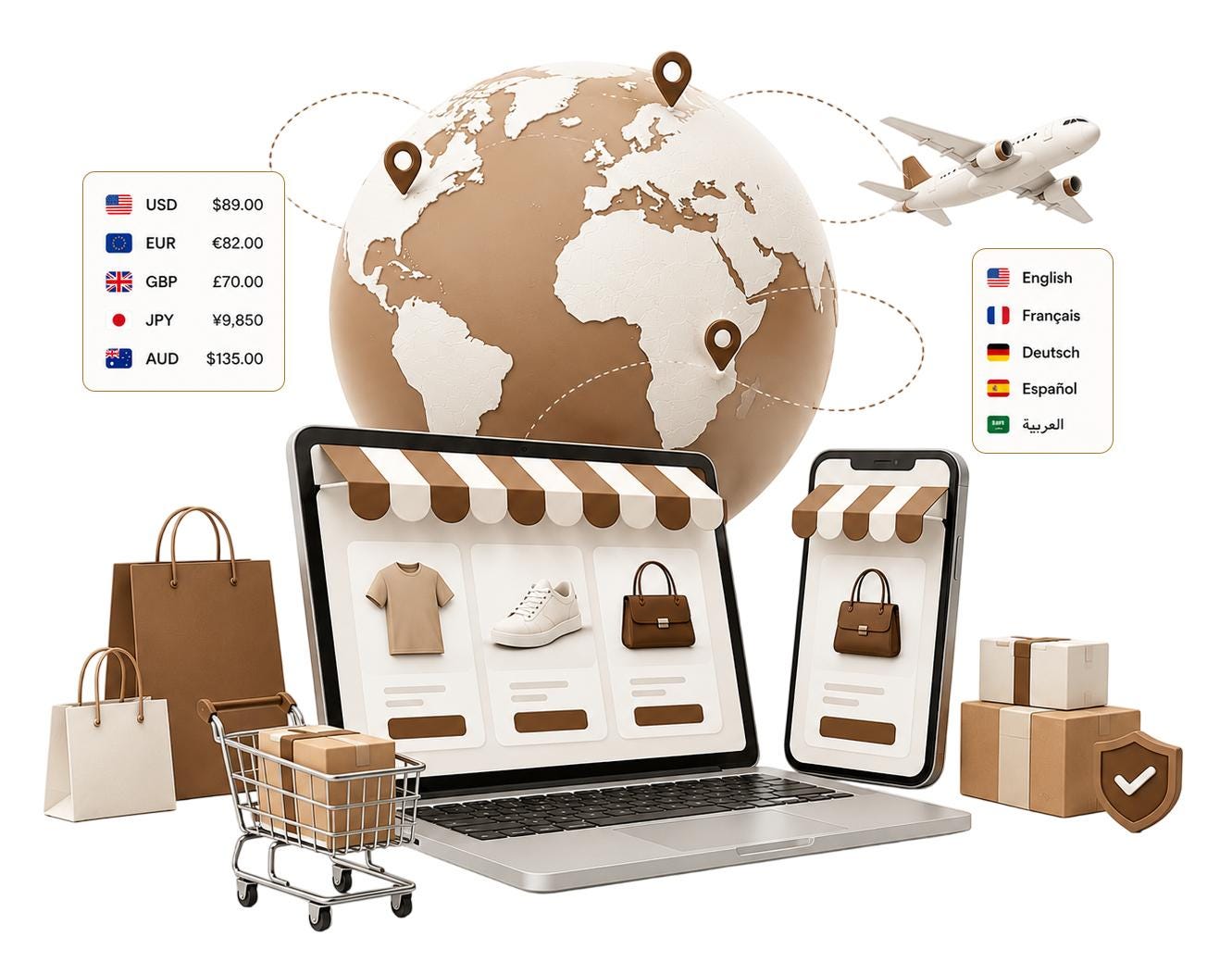
A multilingual eCommerce website is more than a language switcher in the header. At a technical level, it typically involves:
- Content localization: product descriptions, category pages, checkout flows, emails, and legal pages translated and adapted for each target locale — not just word-for-word, but culturally and contextually.
- URL and SEO structure: dedicated URLs per language/region (subdirectories like
/de/, subdomains likede.store.com, or ccTLDs likestore.de), each with correcthreflangtags so search engines index and rank the right version for the right audience. - Currency, tax, and payment logic: dynamic pricing, VAT/duty calculation, and local payment methods (iDEAL in the Netherlands, Boleto in Brazil, Alipay in China, etc.).
- Content management architecture: a headless or multilingual-first CMS/eCommerce platform that lets marketing teams manage translated content without duplicating the entire catalog by hand.
- Locale-aware UX details: date formats, measurement units, address formats, right-to-left layouts for Arabic or Hebrew, and culturally appropriate imagery.
Under the hood, most modern implementations rely on internationalization (i18n) frameworks at the codebase level, paired with a translation management system (TMS) that syncs content between developers, translators, and marketers — so a product update in English doesn’t silently break five other language versions.
Why This Matters for Business, Not Just for Marketing
International expansion is one of the highest-leverage growth levers an eCommerce business has, but only if the storefront is actually usable by the people you’re trying to reach.
The numbers back this up. Cross-border eCommerce reached an estimated $1.21 trillion in 2025 and is projected to hit $1.84 trillion by 2030. Meanwhile, English still dominates roughly 49% of the web despite native English speakers making up only about 5% of the world’s population — a massive, largely untapped opportunity for brands willing to localize properly.
The commercial upside is measurable, too. Businesses that invest in real localization report outcomes like a 120% increase in traffic and a 20% jump in conversion after localizing for a single new market, or a full doubling of international sales after a proper multilingual launch. In a DeepL-backed industry study, 96% of companies that localized their digital experiences reported positive ROI, and 75% said localized content meaningfully increased customer engagement.
For a CFO or founder, the framing is simple: every language you don’t support is a market segment you’re actively rejecting, even if you’re technically “shipping there.”
Core Features and Steps to Building a Multilingual Store
- Start with market research, not translation. Identify which markets actually convert — by traffic, search volume, and competitor presence — before deciding which languages to prioritize.
- Choose the right URL/SEO architecture. Subdirectories (
yourstore.com/fr/) are usually the best balance of SEO authority and maintainability for mid-sized businesses; ccTLDs suit large enterprises with dedicated regional teams. - Implement
hreflangand localized metadata correctly. Every page needs the right hreflang tags, translated title tags, meta descriptions, and structured data — machine-translated boilerplate hurts rankings more than it helps. - Localize, don’t just translate. Product names, promotions, humor, and imagery need cultural adaptation. A tagline that works in the US can fall flat — or offend — in another market.
- Automate currency and payment localization. Real-time exchange rates, local tax display, and region-preferred payment gateways reduce checkout friction significantly.
- Build a scalable translation workflow. Use a TMS integrated with your CMS/eCommerce platform so new products and content sync into translation queues automatically instead of manual copy-paste cycles.
- Test with native speakers, not just QA engineers. Automated checks catch broken tags; only native reviewers catch tone, idiom, and cultural mismatches.
- Monitor per-locale analytics. Conversion rate, bounce rate, and average order value should be tracked separately per language/region — aggregate numbers hide where the store is actually underperforming.
SoftWin’s Practical Take
At SoftWin, we’ve seen the same pattern across nearly every international expansion project: teams underestimate the engineering effort and overestimate what pure machine translation can deliver on its own.
Our approach when we build or refactor multilingual storefronts is to treat localization as a product architecture decision from day one — not a plugin bolted on after launch. That means designing the data model so product content, pricing rules, and inventory are locale-aware at the database level, wiring up a translation management pipeline that keeps developers and translators in sync, and building the SEO layer (hreflang, sitemaps, structured data) correctly the first time, because retrofitting it later is far more expensive than doing it right from the start.
We also push clients to pilot one or two markets fully rather than launching ten languages half-heartedly. A well-localized store in three markets consistently outperforms a mediocre one in ten.
Common Mistakes to Avoid
- Relying solely on machine translation for customer-facing content. It’s a great first draft, a poor final product — especially for legal text, checkout flows, and marketing copy.
- Ignoring
hreflangand duplicate content SEO issues. Poorly configured multilingual SEO can cause search engines to index the wrong language version for a given region, tanking organic traffic. - Forgetting checkout and payment localization. A beautifully translated homepage that funnels everyone to a USD-only checkout with no local payment methods will still lose the sale.
- Treating all markets the same. Currency, tax compliance (VAT, GST, customs duties), and consumer protection laws vary significantly by country — legal review per market is not optional.
- Not maintaining translations over time. Product catalogs change constantly; without a sync workflow, translated pages quietly go stale and inconsistent with the source language.
FAQ
Q: Is machine translation enough for a multilingual eCommerce site? A: For internal use or first drafts, yes. For customer-facing content — especially product pages, legal text, and checkout — professional review or human translation is strongly recommended to protect conversion and trust.
Q: Should I use subdirectories, subdomains, or ccTLDs for different languages? A: Subdirectories (/de/, /fr/) are generally best for SEO and maintainability unless you're a large enterprise with region-specific infrastructure, teams, and budgets that justify ccTLDs.
Q: How many languages should we launch with? A: Start with one to three markets backed by real demand data (search volume, existing traffic, competitor presence), execute them properly, then expand — rather than launching broadly and thinly.
Q: Does multilingual SEO actually improve rankings, or just user experience? A: Both. Correctly implemented hreflang tags, localized keywords, and region-specific content help search engines serve the right page to the right audience, which directly improves organic visibility in each market.
Q: How long does it typically take to launch a properly localized store in a new market? A: It varies by platform and scope, but a well-scoped single-market localization (translation, SEO, payments, legal review) typically takes several weeks to a few months — rushing it is where most of the common mistakes above creep in.
Conclusion
A multilingual eCommerce website isn’t a nice-to-have feature — it’s infrastructure for growth. The businesses winning in cross-border commerce aren’t the ones with the most languages; they’re the ones that localized a handful of markets properly, backed by solid architecture, real translation workflows, and SEO that was built in from the start.
If you’re planning international expansion and want a technical partner who treats localization as engineering, not just translation, **SoftWin builds and scales multilingual eCommerce platforms for growing brands.** Get in touch with our team to talk through your roadmap.
메타데이터
- post_id
- d381900700c8
- slug
- multilingual-ecommerce-websites-how-to-sell-internationally-d381900700c8
- url
- https://medium.com/@softwin/multilingual-ecommerce-websites-how-to-sell-internationally-d381900700c8
- canonical_url
- https://medium.com/@softwin/multilingual-ecommerce-websites-how-to-sell-internationally-d381900700c8
- author_url
- https://medium.com/@softwin
- status
- ok
- fetched_at
- 2026-08-17 00:03:24