SynthID: Google DeepMind’s Invisible Watermark for AI-Generated Content
SynthID: Google DeepMind’s Invisible Watermark for AI-Generated Content
In today’s digital world, AI is transforming how we create images, sounds, and even text. From stunning photorealistic scenes to convincing audio clips, generative AI models are opening up incredible new possibilities. But with this creative power comes a challenge:
how can we tell if something we see or hear was created by AI, especially when it looks and sounds so real?
This is where SynthID steps in, offering a powerful solution for distinguishing AI-generated content.
AI Generated Image representing Google’s Answer To Spot AI Contents
What is SynthID?
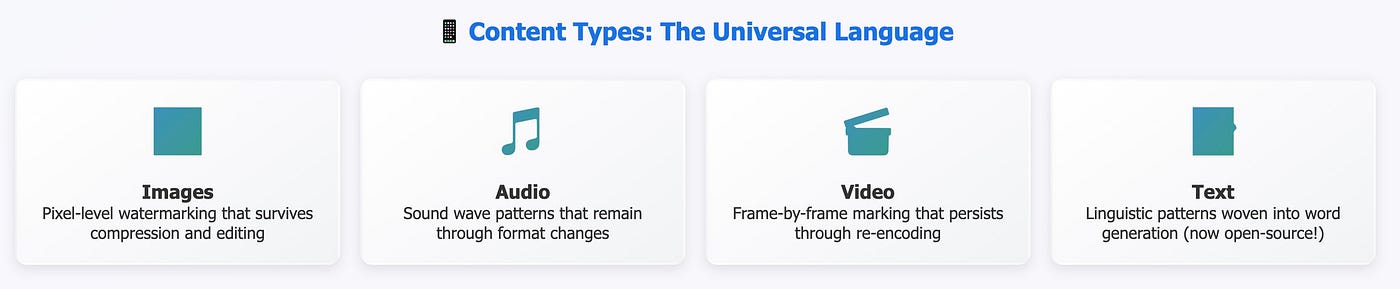
SynthID is a state-of-the-art technology developed by Google DeepMind that provides a way to both watermark and identify content created by AI systems. Its core mission is to help build AI responsibly to benefit humanity, particularly by combating misinformation and ensuring transparency in digital media. Initially launched for AI-generated images, SynthID has now expanded its capabilities to include AI-generated text, audio, and video content.
How Does SynthID Work?
Imagine an invisible signature embedded directly into a piece of digital content. That’s essentially what SynthID does. It works through a clever, two-part process:
- Invisible Watermarking: When content is generated by Google’s AI tools, SynthID can embed a digital watermark directly into its pixels (for images), or its underlying data (for audio, video, or text). This watermark is completely imperceptible to the human eye or ear, meaning it doesn’t affect the quality or appearance of the content itself.
- Smart Detection: SynthID uses a sophisticated system of two deep learning models — one for watermarking and one for identifying — that have been trained together. This combined approach ensures that the watermark remains detectable even after various modifications, such as adding filters, changing colours, adjusting brightness, or saving with different compression types (like JPEGs). This makes it much more robust than traditional watermarks, which can often be easily cropped out or removed with basic editing techniques.
The SynthID Detector acts as a verification portal where you can upload an image, audio track, video, or piece of text created using Google’s AI tools. The portal then scans the media for a SynthID watermark. If detected, it provides confidence levels and can even highlight specific portions of the content most likely to be watermarked. Importantly, because the watermark is embedded directly into the content’s data, it remains detectable even if associated metadata (information about the file) is lost or removed.

Image from Author — SyntID Process Flow
Expanding the Ecosystem
SynthID isn’t just for Google’s own AI models. Google DeepMind is committed to expanding its reach to create a broader ecosystem of verifiable content. They have open-sourced SynthID text watermarking to allow developers to integrate this technology into their own models. Furthermore, they have partnered with companies like NVIDIA to watermark videos generated by NVIDIA’s AI microservices, meaning more content across the web can have SynthID embedded. They’ve also teamed up with GetReal Security, a leading content verification platform, to enhance detection capabilities.
A Real-World Example: Verifying Online News
Let me walk you through a scenario that illustrates SynthID’s practical value:
The Setup: Emma, a journalist, receives a breaking news photo via encrypted messaging. The image shows a political figure in what appears to be a secret meeting. The source claims it’s a genuine photograph taken yesterday.
Traditional Verification Challenges:
- Reverse image searches turn up nothing
- Metadata could be easily spoofed
- Visual inconsistencies are nearly impossible to spot with modern AI
- Expert forensic analysis would take days
The SynthID Process:
- Emma uploads the image to the SynthID Detector portal
- Within seconds, the scanner analyzes the image’s mathematical structure
- Results appear: “High confidence SynthID watermark detected — 85% probability of AI generation”
- The portal highlights specific areas: the political figure’s face and hands show strongest watermark signatures
- The background elements show lower confidence, suggesting they might be from a real photograph
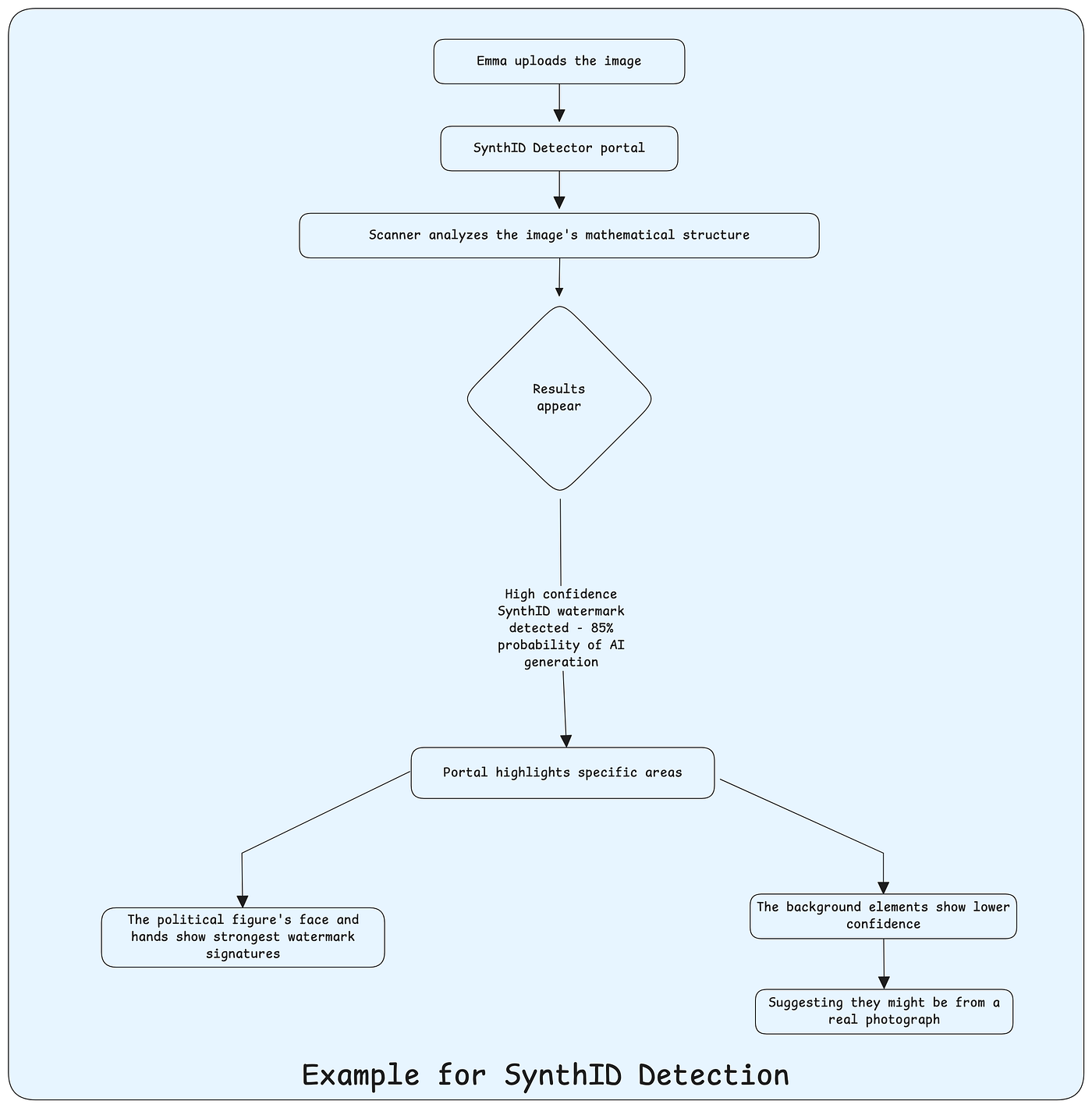
Image from Author — SynthID Example Flow
The Revelation: The analysis suggests this is a composite image — a real photograph where AI has been used to insert or modify the political figure. This information fundamentally changes how Emma approaches the story verification process.
Building The Watermarking Ecosystem
What makes SynthID particularly interesting is Google’s approach to ecosystem development. Rather than keeping this technology proprietary, they’re actively working to create industry-wide adoption.
Furthermore, Google has forged partnerships to broaden its impact:
They have partnered with NVIDIA to watermark videos generated by NVIDIA’s Cosmos preview NIM microservice. This collaboration means that more content across the web, beyond just Google’s own creations, can have SynthID embedded within it.
Google has also teamed up with GetReal Security, described as the world’s leading content verification platform, to enhance detection capabilities.
Currently, over 10 billion pieces of content have already been watermarked with SynthID.

Image from Author — SynthID Watermarked Content
Current Limitations And Future Challenges
SynthID isn’t foolproof. Sophisticated adversaries could potentially develop methods to remove watermarks, though this would require significant technical expertise. Additionally, only content from participating AI systems gets watermarked — there’s no retroactive application to existing content.
Currently, SynthID only works with Google’s AI models and select partners. A vast amount of AI-generated content remains unwatermarked, creating blind spots in the detection ecosystem.
This technology operates in an inherently adversarial environment. As detection methods improve, so do techniques for evading detection. It’s an ongoing technological arms race with no clear endpoint.
While SynthID focuses on content authenticity, watermarking technologies could theoretically be used for surveillance or tracking purposes, raising important questions about the balance between transparency and privacy.
The future of content authenticity likely depends on widespread adoption of technologies like SynthID, combined with regulatory frameworks that encourage responsible AI development. We’re essentially witnessing the birth of a new form of digital infrastructure — one that could become as fundamental to our online experience as HTTPS encryption is today. By providing transparency and a reliable method for identification, SynthID contributes to a safer digital environment, helping to prevent the intentional or unintentional spread of misinformation and fostering greater trust in the content we consume every day.
Sources :
[embed]

This story is published on Generative AI. Connect with us on LinkedIn.
Subscribe to our newsletter and YouTube channel to stay updated with the latest news and updates on generative AI. Let’s shape the future of AI together!

메타데이터
- post_id
- d392d3c8ad38
- slug
- synthid-google-deepminds-invisible-watermark-for-ai-generated-content-d392d3c8ad38
- url
- https://generativeai.pub/synthid-google-deepminds-invisible-watermark-for-ai-generated-content-d392d3c8ad38
- canonical_url
- https://generativeai.pub/synthid-google-deepminds-invisible-watermark-for-ai-generated-content-d392d3c8ad38
- author_url
- https://medium.com/@sandyonmars
- status
- ok
- fetched_at
- 2026-07-10 00:23:36