Chapter 42 and the Birth of Two: Relativity, Complementarity, and the Naturalistic Vision of…
The Problem of Reading Chapter 42 Supernaturally
Chapter 42 and the Birth of Two: Relativity, Complementarity, and the Naturalistic Vision of Classical Taoism

The Problem of Reading Chapter 42 Supernaturally
One of the most mysterious passages in the Tao Te Ching is Chapter 42:
“The Dao gives birth to One. One gives birth to Two. Two gives birth to Three. Three gives birth to the ten thousand things.”
Many interpreters, especially those influenced by Western metaphysics or theology, assume this passage must describe a supernatural cosmology. The “One” is often treated as a transcendent metaphysical substance, a divine entity, or a creator-like principle standing outside nature.
But this interpretation may fundamentally misunderstand the spirit of Classical Taoism.
The Tao Te Ching repeatedly moves away from anthropomorphic religion, supernatural intervention, and substantialist metaphysics. Rather than describing a creator-God outside the universe, Laozi appears to describe an organic, relational process by which distinctions emerge within reality itself. Chapter 42, therefore, need not invoke the supernatural at all. It can instead be understood as a description of differentiation, polarity, and relational emergence.
The Relational Logic of “One”
The key to understanding Chapter 42 lies in another famous statement from Chapter 2:
“Being and non-being arise together.”
Being (\leftrightarrow ) Non-being
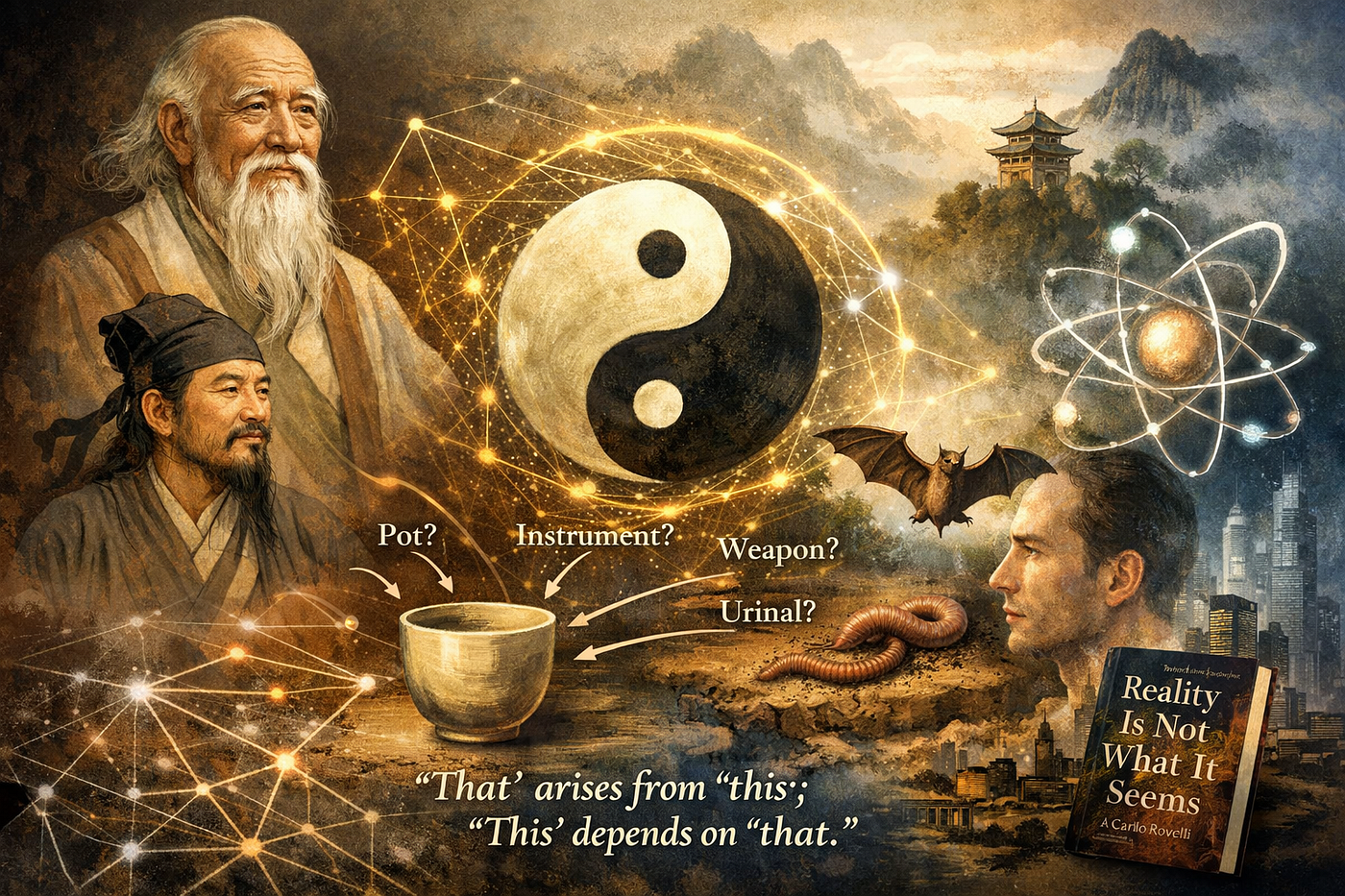
This is a statement about complementarity and relativity. We cannot understand “being” without “non-being,” “high” without “low,” or “long” without “short.” Opposites do not exist independently. They arise together and define one another.
Likewise, the concept of “One” cannot arise in complete isolation. To recognize “one,” there must already be the possibility of “not-one.” In modern symbolic language, one might say that the notion of one implicitly presupposes zero, absence, or emptiness.
1 (\leftrightarrow ) 0
Thus, “One gives birth to Two” does not require supernatural creation. The moment distinction appears, polarity appears. Identity generates contrast. Unity generates multiplicity. Yin and Yang emerge together as complementary distinctions within a relational field.
This interpretation fits naturally with the broader Yin-Yang framework of Classical Chinese thought. Yin and Yang are not independent substances fighting each other. They are mutually defining aspects of a single dynamic process.
\text{Yin} \leftrightarrow \text{Yang}
Reality, therefore, is fundamentally relational rather than substantial.
Classical Taoism as an Anti-Substantialist Philosophy
This relational framework has a profound philosophical implication: Classical Taoism is intrinsically anti-substantialist.
In substantialist metaphysics, reality is thought to consist of independently existing entities possessing fixed essence. Western philosophy, especially after Plato and later Christian theology, often sought ultimate substances, fixed forms, or a foundational being underlying reality.
Classical Taoism moves in a very different direction.
In the Tao Te Ching, things do not possess isolated self-existence. Their identities arise relationally through contrast, interaction, and complementarity. “Long” exists only relative to “short.” “Being” exists only relative to “non-being.” Yin exists only in relation to Yang.
This means that reality is not composed of self-contained substances but of mutually conditioning relationships and processes.
The Dao itself is not a “thing.” Laozi repeatedly undermines attempts to reify it into an object or metaphysical entity. The Dao cannot be grasped, fixed, named adequately, or turned into a substantial being standing apart from the world.
This anti-substantialist tendency strongly resembles later Buddhist notions of dependent origination and emptiness, where phenomena lack independent self-existence and arise only through conditions and relationships.
Why Chapter 42 Rejects Creation Ex Nihilo
This framework also differs sharply from the Christian doctrine of creation ex nihilo — creation out of nothing.
In classical Christian theology, God exists as a transcendent being outside the universe and creates the cosmos through divine will. The creator stands apart from creation in an ontological divide between God and world.
Classical Taoism dissolves precisely this kind of dualism.
The Dao is not external to nature. It is not a supernatural craftsman manufacturing the universe from outside reality. Nor does Chapter 42 describe a moment of absolute creation from nothingness.
Instead, reality unfolds through spontaneous differentiation and relational emergence.
The movement from “One” to “Two” is not the creation of a second substance by a supernatural agent. It is the arising of polarity through distinction itself. Yin and Yang co-arise as complementary aspects within a single dynamic process.
\text{Unity} \rightarrow \text{Polarity} \rightarrow \text{Multiplicity}
The Dao therefore resembles an immanent generative process rather than a transcendent creator.
This is why Laozi consistently uses organic metaphors rather than the language of divine manufacture. The Dao is compared to water flowing, valleys receiving, plants growing, and cycles returning. The imagery is ecological and developmental, not supernatural or interventionist.
The I Ching and the Logic of Complementarity
This relational logic permeates ancient Chinese philosophy. The I Ching itself is built upon a binary system of broken and unbroken lines — an astonishingly sophisticated model of polarity and transformation.
A hexagram consists of six Yin or Yang lines, producing sixty-four possible combinations:
2⁶ = 64
The significance of this system is not merely mathematical. The I Ching reflects the insight that reality emerges through relational distinctions and dynamic transformation. A broken line has meaning only in relation to an unbroken line. Yin exists only in relation to Yang.
This is why the I Ching fascinated the German mathematician Gottfried Wilhelm Leibniz, who recognized its similarity to binary arithmetic. But the philosophical significance is even deeper than the mathematical resemblance. The ancient Chinese were already developing a relational worldview rooted in complementarity long before modern systems theory or computer science.
The Five Elements as Dynamic Processes
The same relational logic appears in the theory of the Five Elements (Wuxing). These are often misunderstood in the West as primitive “elements” analogous to Greek earth, air, fire, and water. But the Chinese concept is fundamentally different.
The word 行 (xing) means movements, phases, or processes rather than static substances. The Five Elements therefore represent dynamic modes of transformation within a living system.
Wood gives rise to Fire. Fire gives rise to Earth. Earth gives rise to Metal. Metal gives rise to Water. Water gives rise to Wood. Yet the system also contains balancing relationships: Water restrains Fire, Fire restrains Metal, Metal restrains Wood, and so forth.
\text{Generation} \leftrightarrow \text{Constraint}
The system functions through reciprocal generation and reciprocal limitation. This is not dualistic conflict but dynamic equilibrium.
In many ways, this resembles the Buddhist principle of This-That Conditionality:
“When this exists, that exists. With the arising of this, that arises.”
Reality is not composed of isolated things possessing fixed essence. Instead, phenomena arise through mutual conditioning and interdependence.
Classical Taoism and the Move Away from Supernaturalism
This helps explain why Classical Taoism differs profoundly from many supernatural or theistic worldviews.
The Dao is not a cosmic emperor governing the world from above. It is not a supernatural lawgiver intervening in history. Nor is it a transcendent craftsman creating the universe from outside reality.
Rather, the Dao is the spontaneous and self-organizing process through which distinctions arise, interact, transform, and return.
This naturalistic orientation can be seen throughout the Tao Te Ching. Laozi constantly uses images drawn from nature itself: water flowing downhill, valleys receiving rivers, infants growing spontaneously, seasons cycling, and uncarved wood remaining natural before artificial shaping.
The emphasis is not on divine command but on understanding the patterns of nature and living in accordance with them.
In this sense, Classical Taoism represents part of a broader Axial Age movement away from mythological and shamanistic thinking toward naturalistic and philosophical reflection. Like early Buddhism and parts of Confucianism, it attempted to explain reality in terms of processes, relationships, and observable patterns rather than supernatural intervention.
The Convergence with Modern Systems Thinking
Ironically, modern science has increasingly moved toward a worldview that resembles many of these ancient Taoist intuitions.
Ecology teaches that organisms cannot be understood apart from ecosystems. Systems theory recognizes that wholes emerge from interaction rather than isolated parts. Quantum mechanics undermines the old notion of independently existing particles and instead emphasizes relational behavior, complementarity, and interdependence.
This does not mean Laozi anticipated modern physics in a literal sense. But it does suggest that Classical Taoism already possessed a profoundly relational mode of thought that modern science is only now rediscovering in new forms.
Greek philosophy often moved from geometry and abstraction toward metaphysics and fixed essences. Chinese philosophy, by contrast, arose more from observing rivers, weather, seasons, ecosystems, agriculture, and living systems. As a result, it became more organic, contextual, and process-oriented.
The East and the West, after diverging for centuries, may now be converging again through systems thinking, ecology, and relational science.
Conclusion: The Dao as Relational Process
Chapter 42 therefore need not be interpreted as supernatural cosmology. The “birth of Two from One” can be understood naturally through the logic of complementarity and relational differentiation.
The moment distinction appears, polarity appears. Yin and Yang co-arise. Multiplicity emerges from relational contrast.
The Dao is not a supernatural being standing outside the world. It is the ceaseless process through which reality unfolds, differentiates, balances itself, and returns to equilibrium.
Far from being primitive mysticism, Classical Taoism may represent one of humanity’s earliest and most sophisticated explorations of relational reality.
메타데이터
- post_id
- d39e48b9960d
- slug
- chapter-42-and-the-birth-of-two-relativity-complementarity-and-the-naturalistic-vision-of-d39e48b9960d
- url
- https://medium.com/@kleong54/chapter-42-and-the-birth-of-two-relativity-complementarity-and-the-naturalistic-vision-of-d39e48b9960d
- canonical_url
- https://medium.com/@kleong54/chapter-42-and-the-birth-of-two-relativity-complementarity-and-the-naturalistic-vision-of-d39e48b9960d
- author_url
- https://medium.com/@kleong54
- status
- ok
- fetched_at
- 2026-08-03 06:38:07