The Primacy of REM Sleep: A Deep Dive into Sleep Scheduling and Phases
The Paramount Importance of REM Sleep
The Primacy of REM Sleep: A Deep Dive into Sleep Scheduling and Phases
The Paramount Importance of REM Sleep
REM sleep, known for its rapid eye movement and vivid dreaming, is not just another stage of the sleep cycle — it’s the sleep stage. The brain prioritizes REM sleep due to its critical role in emotional processing and memory consolidation.
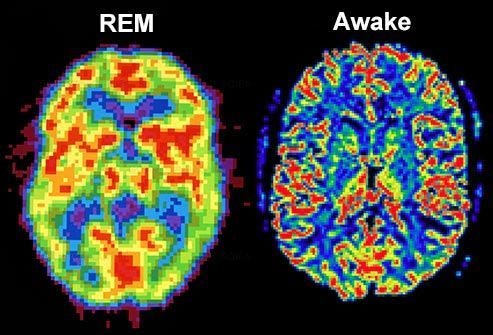
During REM sleep the brain is more active than during wakefulness (image from
The Brain’s Role: Thalamus and Hypothalamus
The thalamus and hypothalamus, two key structures in the brain, play crucial roles in REM sleep. The thalamus acts as a relay station, coordinating the high-frequency brain waves necessary for REM sleep. Meanwhile, the hypothalamus is responsible for scheduling sleep and wake cycles, setting the stage for the thalamus’s actions.
The Hypothalamus and REM Scheduling
The hypothalamus is constantly scheduling REM sleep for specific times. When you’re extremely sleep-deprived, the hypothalamus may schedule REM sleep as soon as you fall asleep, leading to Sleep Onset REM (SOREM). This immediate entry into REM sleep, however, often leaves you feeling unrefreshed.
The Two Phases of REM Sleep: Tonic and Phasic
REM sleep itself is divided into two phases: the tonic phase and the phasic phase. The tonic phase serves as a precursor to the phasic phase, which is characterized by vivid dreams.

Diagram showing tonic and phasic REM in mice
A study by Meng et al. (2021) tracked eye movements during sleep in mice, providing a visual representation of phasic REM (phREM) in mice. This research underscores the distinct characteristics of the phasic phase, showing how the brain gets to its most active phase only during phasic REM sleep.
The Brain’s Scheduling of REM Sleep
The brain doesn’t just initiate REM sleep on a whim. It schedules it, requiring preparation time. For instance, in a REM peak nap, the brain prepares for REM sleep in advance, allowing for the possibility of SOREM.
The Impact of Reduced Sleep Schedules
When you adopt a reduced sleep schedule, such as the Everyman 3 (E3) polyphasic sleep schedule, the brain faces a challenge in scheduling REM sleep. It needs to know when to initiate the preparatory phase for REM sleep, whether it’s an hour in advance or at a specific time during the day.

Showing how REM distributes on a reduced sleep schedule like E3 (image from an article on sleep reduction)
Final Thoughts
The brain goes through significant preparation to initiate REM sleep. This is why, unless the hypothalamus schedules it, you don’t enter REM sleep immediately upon falling asleep. Understanding these complexities underscores the importance of REM sleep and the potential consequences of disrupting our natural sleep patterns.
메타데이터
- post_id
- d3b3ef45943a
- slug
- the-primacy-of-rem-sleep-a-deep-dive-into-sleep-scheduling-and-phases-d3b3ef45943a
- url
- https://medium.com/@denis.barzanov2002/the-primacy-of-rem-sleep-a-deep-dive-into-sleep-scheduling-and-phases-d3b3ef45943a
- canonical_url
- https://medium.com/@denis.barzanov2002/the-primacy-of-rem-sleep-a-deep-dive-into-sleep-scheduling-and-phases-d3b3ef45943a
- author_url
- https://medium.com/@denis.barzanov2002
- status
- ok
- fetched_at
- 2026-08-03 16:18:42